

 LinkedIn

A buyer asks an assistant which project management tool fits a 15-person design agency on $300 a month. The answer cites Sprintwise’s benchmark study, briefly acknowledges its research, then recommends Boardline.
Sprintwise gets the footnote. Boardline gets the pick.
Both companies and the answer are illustrative. The pattern is familiar from tracked answers: one brand’s research gets used, another brand’s product gets recommended. A citation measures source use, not buyer preference. A report that treats those as the same thing can turn green while a competitor takes the recommendation.
Semrush’s ghost-citation study puts numbers around the distinction: across 3,981 domain appearances on 115 prompts in four engines, 61.7% were source links with no brand name anywhere in the answer text. The source contributed information. The business never entered the conversation.
I read these answers in three layers: citation, mention, recommendation. Each answers a different question. I’ll work the Sprintwise and Boardline example through all three, then use a fresh buyer question to show how the distinction changes the next job—not just the report.
A citation tells you where the information came from
Start with the layer most reports already count. A citation presents a page as a source for part of an answer. It is a provenance claim, not an endorsement of the business behind the page.
Citation counts measure how often your pages appear as sources. They do not measure how often buyers hear your name.
Retrieve the answer, not just the citation count
When a tracked prompt turns up a citation for your domain, don’t file it under wins. Pull the answer and the URLs the engine actually displayed. In one 46-answer audit across five engines, 121 distinct domains were cited and only 23 were ever named in the answer text. The other 98 stayed in the sources.
In Claude, with groas connected, my request is short:
For tracked prompt P, show me the full answer text and every source URL the engine displayed. Mark which URLs are ours, and quote the passage each citation supports.
Keep the supported passage beside the source URL. That pairing tells you what role the citation appears to play. The link alone doesn’t.
Read what the citation supports
In the Sprintwise example, the cited material is benchmark data about agency team sizes and tooling budgets. Useful, reusable, and not an argument for choosing Sprintwise’s product.
That is what informational pages often do: supply evidence for an answer that goes on to choose something else. Microsoft makes a similar distinction in its AI performance reporting, cautioning that citation counts “do not indicate ranking, authority, placement or the role a page played within an individual response.”
If your statistic supports the comparison and the closing sentence picks someone else, you supplied evidence—not the winning product. Count the citation. Don’t quietly promote it into a recommendation.
A mention tells you which businesses appeared
A mention means the brand name appears in the answer’s prose. In the ghost-citation study, 25.1% of domain appearances were mentions without a citation and 13.2% were both. Mentions are a separate signal, not a rounding error.
But a brand name can do several jobs:
- Passing reference: Sprintwise also publishes relevant benchmarks.
- Comparison candidate: Boardline, Sprintwise and Asana all cover that workflow.
- Recommendation: For a 15-person agency at $300 a month, Boardline is the fit.
The sentence—not the name count—tells you which one you got.
Before counting, strip citation chips and source-link titles. A name that appears only inside a chip is a source label. Treating it as prose turns a citation into a false-positive mention. The same 46-answer audit found 9% of brands appearing in ChatGPT answers solely as source-link titles.
My next request to Claude is deliberately narrow:
Show the exact sentence containing our brand and classify its role: passing reference, comparison candidate, or recommendation. Mark ambiguous cases separately.
If a sentence doesn’t clearly select the brand for a buyer’s situation, I don’t round it up into the recommendation column.
Back to Sprintwise. Its name appears twice: once inside a citation chip, once in the passing reference to its benchmarks. Boardline appears once, in the pick.
Count names indiscriminately and the report reads Sprintwise 2, Boardline 1. Read the sentences and Sprintwise was sourced and acknowledged; Boardline was chosen.
Same answer. Opposite conclusion. Build the report from sentences, not tallies.
A recommendation tells you who fits this buyer’s request
A recommendation presents a brand as suitable for the buyer’s stated situation. Unlike a neutral shortlist entry, it makes a fit judgment.
That judgment belongs to a particular question, not to the brand in isolation. Change the buyer’s constraints and you change what the answer is evaluating.
Keep the budget and use case attached to the pick
Ask which CRM fits a small business and HubSpot CRM takes the first pick in 44–65% of answers across models; ask about an enterprise rollout and Salesforce Sales Cloud takes 59–65%. Budget, headcount and use case are not noise around the question. They are the question.
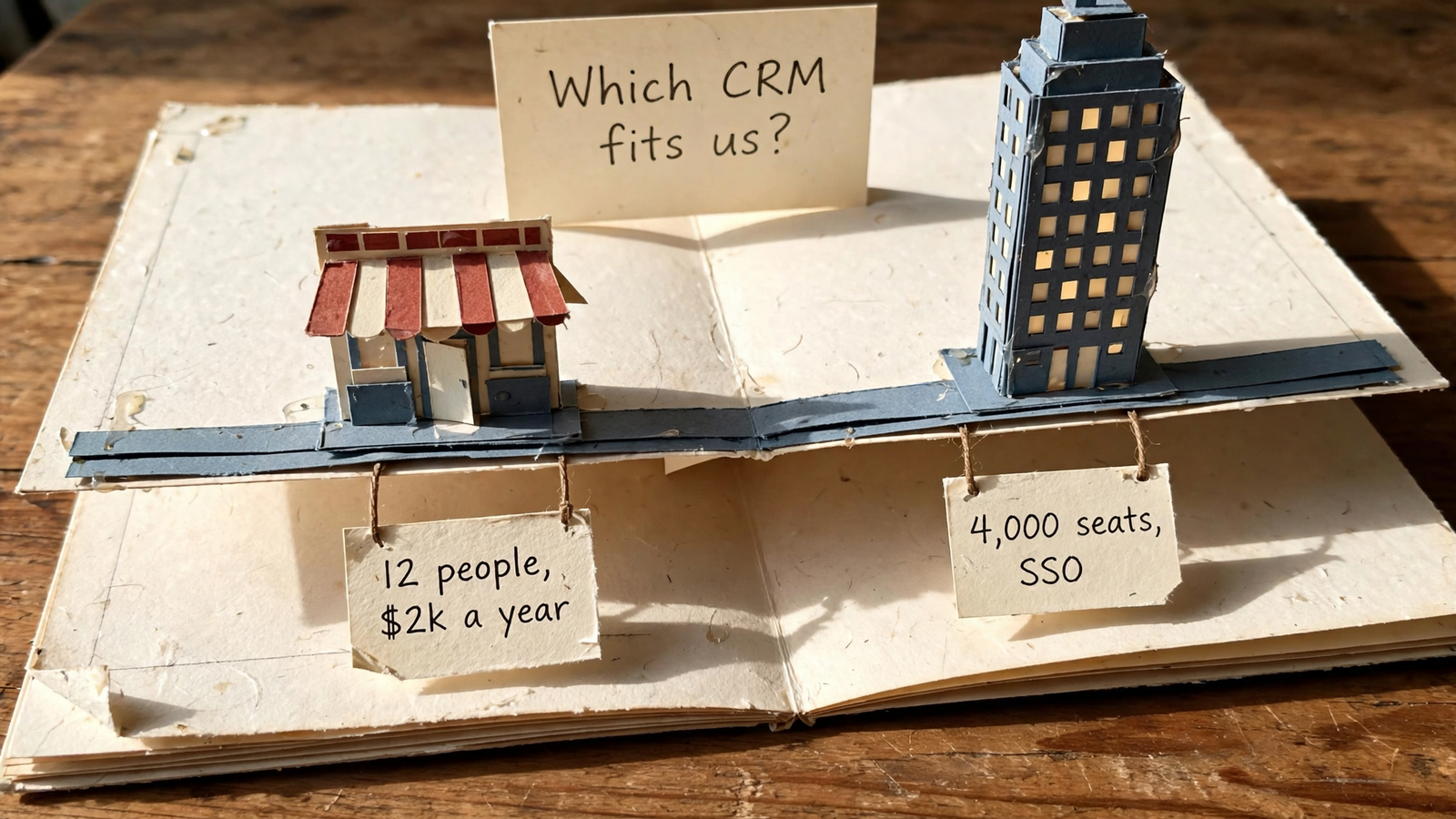
The GPT AI Index measured a related effect: only 5 of 14 models held the same first pick across paraphrased, budget-constrained and scale-constrained versions of the question.
The counting rule I use, borrowed from Genmark’s three-layer framing, requires a selection-type prompt and a brand presented as suitable for the stated need:
- A neutral vendor list does not count.
- A counterexample does not count.
- Simply echoing a brand the user supplied does not count.
- A conditional recommendation keeps its condition attached.
For Sprintwise, the useful question is not “Were we recommended?” It is “Were we recommended for a 15-person agency with $300 a month?”
Record the condition with the recommendation. This is the layer closest to the buyer’s choice, not a proven measure of pipeline.
Compare the same question across assistants
Even with the constraints held steady, engines can disagree. Vercite’s study of 18,151 answers found two engines naming the same brand first for the same prompt only 28% of the time. When both recommended something, they shared at least one brand 59% of the time.
That is why I compare the same buyer question across two tracked assistants before proposing a change. I want the sentences, the stated criteria and the picks side by side—not two blended visibility scores.
A disagreement is a reason to inspect the evidence before acting. When Claude and ChatGPT disagree about the same account, that disagreement becomes an approval gate, not an invitation to ship two contradictory fixes.
Why the three columns move independently
Once the layers are separate, an apparently strange result becomes ordinary: an informational page can earn citations without establishing product fit.
A team at SE Ranking built a brand from scratch to test AI visibility. Tracked citations climbed from 17,023 in April to 42,435 in August, including a stretch when the team had stopped publishing. GA4 recorded 100 users total; server logs showed one AI-referred visit.
Their listicles were cited in 4,399 non-branded answers but named the brand in only 14.2% of them. One in-depth guide was cited much less often yet named the brand in 69.2% of the answers where it appeared. More source use did not automatically mean more brand recognition.
The reverse can happen, too: a business can be recommended without receiving a direct website citation. Orbie’s visibility framework separates retrieval, citation, recommendation and demand, explicitly treating them as stages rather than a proven funnel. Recommendations can come from model memory rather than a newly cited product page.
For diagnosis, I separate three problems that can all hide behind “we don’t show up in AI”:
- The answer does not use our pages as sources.
- It uses our content without meaningfully introducing our brand.
- It names our brand but prefers a competitor for the stated need.
Those are different failures. Giving all three the same content brief is how a team stays busy without knowing what it is fixing.
Give Claude the job the evidence supports
Once the columns are filled in, the next move depends on what is missing. “Publish more content” is not a diagnosis.
Give Claude the answer and its evidence before asking for a change. The output I want is one identifiable gap, not a content calendar.
No citation: compare the sources the answer did use
If the answer carries no source of yours, first ask whether retrieval reached your pages at all. Don’t assume a writing problem before checking that.
Then give Claude the answer, its cited URLs and your relevant page:
Compare the cited pages with ours. What claim does each source support? Which passage supplies the evidence? Do we document the same information, and where?
In a version of our example where Sprintwise’s study is absent, the relevant source might supply team-size and budget figures. If Sprintwise has those figures broken out by segment, that is material to inspect. If it has only a narrative report, rewriting the introduction does not supply the missing evidence.
Find the source gap before commissioning more prose.
Cited but barely named: identify what the answer borrowed
Our original Sprintwise answer belongs here. The assistant uses the research and gives the brand a passing acknowledgment, but the research passage says nothing about product fit.
Ask Claude to separate the borrowed information from the product claims:
What does our cited passage establish? Does the answer connect that information to our product, or use it only as general evidence?
Useful research and persuasive product evidence are different jobs. A benchmark can succeed at the first without doing the second. Don’t rewrite a useful study merely because a dashboard failed to distinguish them.
Named but not chosen: inspect the selection criteria
When your name appears but the pick goes elsewhere, start with the criteria the answer actually states.
Our illustrative close says for a 15-person agency at $300 a month. Ask Claude to extract those criteria, then check them against documented offer facts: team-size fit, price floor, integrations, onboarding time or contract length, where relevant to the answer.
Where your pages say nothing about a criterion the assistant evaluated, you have a documentation gap to investigate—not proof that positioning is the problem. That is often the useful starting point for understanding why a cited site still loses the recommendation.
State the supported fact if it is missing. Don’t invent a fit the product does not have. Clearer documentation gives the answer evidence to evaluate; it does not guarantee the pick.
Propose one change, then require approval
Once the gap is clear, the proposed change can be small: state a pricing floor, document an integration, or break out a benchmark segment. Hand Claude the evidence and ask for one change with its reason attached.
Then approve it before anything ships.
Answers move between runs. The same 46-answer audit found 16 answers changed on at least one metric between two runs two days apart. Shipping five edits at once makes an already noisy comparison harder to read.
Keep the change narrow and the reason visible. That is also how I want marketing infrastructure to behave: in groas, the autopilot is off until you switch it on, every change is logged with its reason, and any change can be undone in one step.
Approve the change, rerun the question, then read the columns again. One improved answer is an observation, not a victory parade.
Keep three columns, not one victory number
The report I want is boring on purpose: one row per tracked prompt, with separate citation, mention and recommendation columns. Every entry gets the excerpt or sentence that earned it. Mentions keep their role; recommendations keep their buyer conditions.
No blended victory number. A merged score hides exactly the failure this piece is about: frequent source use beside a competitor’s recommendation.
Keep the reporting context alongside the columns:
- Engine and model setting.
- Question set, including buyer constraints.
- Run count and dates.
- The supporting answer text and URLs.
Be honest about sample size. A 40% recommendation rate from five runs is two answers. If one column must lead the report, which score deserves the lead depends on what you sell and how buyers decide. The recommendation column shows the fit judgment; it still does not prove a sale.
Here is the request I would keep handy:
For tracked prompt [your prompt], in [engine], today:
1. Return the full answer text and every source URL. Mark which URLs are ours.
2. List every sentence containing our brand. Classify each appearance:
   citation-chip label, passing reference, comparison candidate, or recommendation.
3. For any recommendation, quote the sentence and the buyer constraints
   stated in the prompt. Preserve any conditions attached to the pick.
4. Repeat in [second engine]. Flag where the two answers disagree.
5. Propose one page change, cite the evidence for it, and wait for my approval.
Run one more buyer question through the model
A buyer asks for field service software for a 12-truck HVAC company that needs QuickBooks sync and wants to stay under $200 a month. Your dispatch-scheduling guide gets cited for a statistic about route density. Your brand appears among four vendors in a neutral rundown. The answer then picks a competitor whose pricing page names QuickBooks.
Fill the columns:
- Citation: yes. Your statistic supplies evidence.
- Mention: yes. Your brand is a comparison candidate.
- Recommendation: no. The final pick goes elsewhere.
Now suppose your pages document neither the integration nor the relevant price. The citation column is not the immediate problem. The answer is making a choice under two constraints, and your pages leave both unanswered.
That does not prove why the competitor won. It does identify a concrete next job: check the product facts, state both on one page if supported, approve the change, then ask the same question again. Watch the recommendation column without pretending the other two were empty.
Copy the request above, swap in your tracked prompt, and let the three columns name the next job. I have watched teams spend a quarter chasing citation volume when the only empty column was the one where the assistant actually picked a product.


