

 LinkedIn
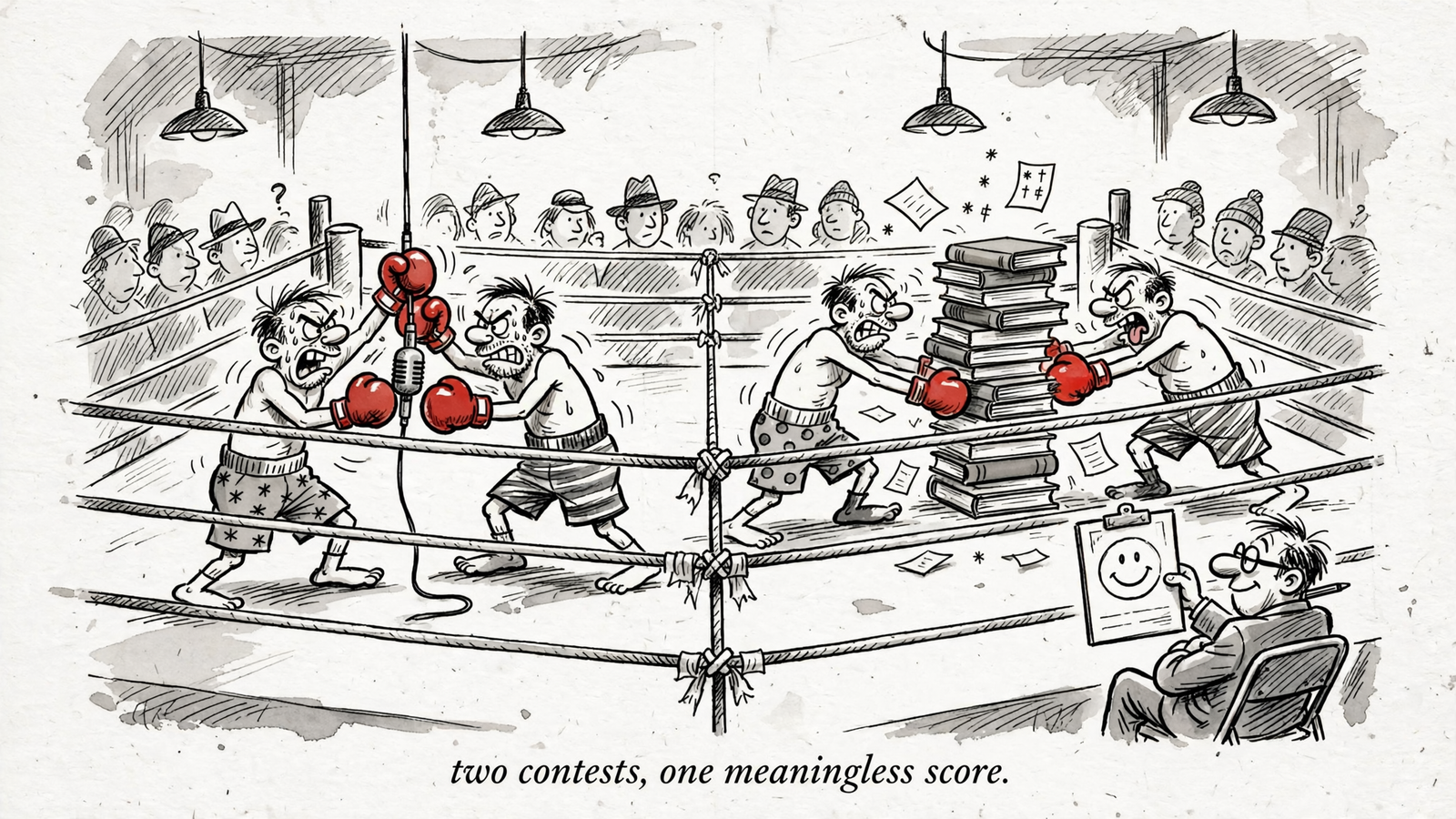
For businesses comparing themselves with competitors in Claude answers, mention-based share of voice and citation share measure different wins: getting named and supplying the evidence. If your dashboard rolls them into one visibility score, it hides which contest you are losing.
I use mention share to judge brand inclusion and citation share to find source opportunities. Neither gets to impersonate a universal visibility score. Here is the head-to-head across four decisions that actually affect the work: what enters the denominator, which commercial question each metric answers, whether the result survives an audit, and what to fix when a rival leads.
Before round one: fix the cohort and the counting rules
I used to tell clients share of voice was share of voice. I was wrong. In AI answers, the comparison needs a fixed cohort before either number means much.
For this audit, I start with:
- 25 to 30 buyer prompts I would actually pay to appear for.
- Four to five tracked brands, including my own, and four to five tracked domains.
- The same prompt wording, country, and login state on each collection run.
- A record of the prompt text, engine, and collection time.
Ahrefs distinguishes basic mention share from its volume-weighted Brand Radar measure. Weighting can turn the same underlying mentions into a different headline percentage. Before comparing two scores, I want to know whether they count the same thing.
I also keep ChatGPT, Perplexity, Gemini, and Google AI Overviews separate from Claude before combining anything. Each engine retrieves and cites differently. One blended number is convenient for a slide, less convenient for deciding what to fix.

For this comparison, I count each tracked brand at most once per answer and each tracked domain at most once per answer. One answer can still contain several tracked brands and several tracked domains. These are working definitions, not industry standards.
Here is the tale of the tape:
| Decision axis | Mention-based share of voice | Citation share |
|---|---|---|
| Denominator | All tracked-brand appearances | All tracked-domain appearances |
| Commercial question | Does the answer include my brand? | Does my domain supply the evidence? |
| Audit requirement | Answer text, brand counts, and recommendation context | Cited URLs, domain counts, and citation context |
| Work after a loss | Improve how the offer is described and supported | Improve the passage or placement supplying the answer |
If a dashboard cannot show its denominator, I do not have a usable metric. I have a mood.
Round 1: the denominator decides what a lead means
Say I run 30 prompts. My brand appears in 12 answers, while competitors account for another 18 brand appearances. Under the counting rule above, my mention share is:
12 ÷ 30 tracked-brand appearances = 40% mention share.
My presence rate is also 40% in this example: 12 of 30 answers. That numerical match is a coincidence, not a reason to treat the measures as interchangeable. One denominator counts brand appearances; the other counts answers.
Citare describes mention share using a brand’s mentions divided by all tracked brand mentions, and Geosoftwarerankings uses that mention-based approach for share of voice. The important word is tracked. Add another competitor that appears in the answers and my share falls without my brand disappearing from a single answer.
Citation share changes the counting unit from names in the prose to domains in the source list. It also exposes a naming problem. Geosoftwarerankings and Momentence describe citation measures based on the proportion of prompts where a domain appears. Promptwatch distinguishes response-level citation rate from citation-level share.
For this audit, I keep those measures separate:
- Citation rate: my domain appears in 6 of 30 answers, or 20%.
- Citation share: those answers contain 90 tracked-domain appearances, and my domain accounts for 6, or 6.7%.
Same collection. Different questions. The first tells me how often I supply a source; the second tells me how much of the tracked source pool I occupy.
Neither denominator wins this round. Report raw answer counts and presence rates beside both shares. Otherwise, a moving competitor list can look like a moving business.
Round 2: mentions win inclusion; citations win source analysis
Mention share tells me whether buyers encounter my brand in the answer. That makes it the better lead metric when the commercial question is, “Am I getting onto the shortlist?”
But an incidental mention is not a recommendation. I read the sentence around the name before celebrating the percentage. “Consider this provider” and “this provider is not a fit” both contain a brand mention. Only one is the shortlist appearance I want.
Claude makes the distinction between mentions and sources concrete: it can recommend a brand without linking to its site, or cite a page while recommending someone else. The name in the answer and the source behind it do not have to belong to the same business.
That is why I keep separate columns for mention presence, recommendation context, and cited domain. A single visibility score compresses away the part I need to act on.
For a business trying to generate calls, demos, or booked jobs, mention share wins this round. Then I check whether those mentions actually present the business as a choice.

Citation share answers a different question: whose evidence does the answer use? That matters when I want to identify source opportunities, not merely count brand appearances.
A citation still is not an endorsement. Microsoft’s Citation Share is described as a share of citations for a grounding query, not a traffic-share measure. Being the footnote does not tell me whether the buyer visits, or whether the surrounding paragraph argues for my business.
The paid-search parallel is familiar: high impression share with the wrong ad copy can still lose the click. Visibility is a starting point, not the finished commercial result.
For source analysis, citation share wins. Open the cited passage before deciding that a citation is a win worth repeating.
Round 3: neither metric wins without an inspectable audit
Neither share survives scrutiny unless I can see the answers behind it. With Claude plugged into groas, this is the audit request I use:
Show the underlying answers, cited URLs, prompt text, engine, and collection time for this cohort. Count each tracked brand once per answer and each tracked domain once per answer. Show the raw counts and denominators, and flag any missing evidence.
The point is not to get Claude to announce a more confident percentage. It is to make the counting inspectable. If the underlying evidence is unavailable, I want a flag, not a plausible-looking total.
I also distinguish an answer with no citations from an answer whose citation evidence is missing. The first belongs in the presence-rate calculation as an answer where my domain was not cited. The second is an evidence problem. Quietly treating them as the same thing corrupts the audit.
Missing answer text prevents a reliable mention count. Missing collection details prevent a clean comparison between runs. I flag those gaps before trusting either share.

Once the evidence is visible, the next job is to stop moving the goalposts:
- Add competitors that appear in the answers, and mention share can fall while my own presence stays flat.
- Add informational prompts that cite Wikipedia and Reddit, and the source mix changes even though the commercial prompts do not.
- Add an answer with 12 tracked source domains, and citation share can dilute while citation rate holds steady.
I learned the same lesson in paid search: change the match-type mix and CPA can move without the underlying business moving. Here, a revised prompt mix can manufacture a trend.
Freeze the cohort for 30 days. If I change it, I label the change rather than pretending the next percentage is directly comparable. This round is a draw: both metrics need the same discipline, and neither deserves trust without it.
Round 4: a mention loss and a citation loss need different repairs
A mention deficit sends me to the answer prose. I pull the answers where the brand is absent and read how Claude frames the offer, which competitors it includes, and what attribute appears to decide the list: price band, location, integration, or review count.
If rivals own “best for agencies under $5k a month” and the offer never states a starting price, that missing sentence is a concrete place to start. I do not need a vague project called AI-powered brand authority. I need to know whether the page explains the thing the prompt asks buyers to compare.
A citation deficit sends me to the paragraph AI search skips and the pages behind the links. I open the three domains Claude cites most for the cohort, find the passage that answers the exact question, and compare it with mine line by line.
The gap is often unglamorous:
- No definition near the top.
- No numbers in a table.
- No steps under a clear heading.
- No passage that directly answers the prompt.
I draft the page change inside Claude with groas, require my own approval before publication, and keep the logged reason with the change. If the next collection run shows no lift, I can review the change and undo it in one step rather than reconstructing what happened.
A mention loss changes how I describe and support the offer. A citation loss changes the passage supplying the evidence. Neither is a reason to rewrite the entire website on instinct.

Here is the triage I run, in order, because order controls cost:
- Check presence before share. If the brand appears in 4 of 30 buyer answers, inclusion comes before a campaign to collect more source links.
- Check recommendation context. Are the mentions shortlist picks, incidental references, or cautionary footnotes? A rising mention count can conceal the wrong kind of attention.
- Check source concentration. If two third-party listicles supply half the citations, I examine those placements instead of assuming another page on my own domain is the first fix.
- Choose one repair and keep the cohort fixed. The next collection should help judge the work, not combine a page rewrite with a new prompt set and a different competitor list.
For a pipeline business, I would put citation chasing behind inclusion work when mention presence sits under 15% on buyer prompts. That is my triage rule, not a universal benchmark. The point is to avoid building better footnotes while leaving the shortlist problem untouched.
Mention share wins the first move for that reader. Citation share wins the diagnosis when inclusion is already healthy and the missing piece is the source.
Verdict: mention share wins for pipeline businesses
My winner for businesses trying to generate calls, demos, or booked jobs is mention-based share of voice. It directly addresses whether the brand enters the buyer’s consideration set. Citation share does not answer that question, however impressive the percentage looks.
Say the business spends $20k a month and appears in 4 of 30 buyer answers while a rival appears in 18. That 13% presence rate puts inclusion at the front of the queue. I would work on the offer description, the proof points around the brand, and the prompts where it goes missing before chasing a larger share of footnotes.
Publishers, listicle sites, and affiliate operations should pick the loser on purpose. If the immediate objective is to have pages used as sources, lead with citation share and use mentions as the supporting measure. Still, a source citation is not a traffic report. The metric needs to match the outcome being investigated, not stand in for every outcome at once.
That is a decision, not a tie: mentions lead for pipeline businesses; citations lead for source-led publishing.
I reject any dashboard that cannot expose the prompt list, tracked brands and domains, answer texts, cited URLs, and collection time. Without those, its score is a sales chart.
Run the audit request in Claude with groas plugged in. Freeze the 25-to-30-prompt cohort for 30 days and track both shares beside raw counts. When mention presence climbs and recommendation context stays positive, keep working in that direction. When only citation share moves, check whether the cited passage supports the business or a rival. groas promises neither rankings nor citations, only logged work that can be undone.
Judge inclusion by mentions, judge source opportunities by citations, and pay only for deficits tied to the commercial outcome being pursued.


