
YouTube Ads Won’t Get Fewer: Six Calls to Check by 2027
October 1, 2026
•
11
min read



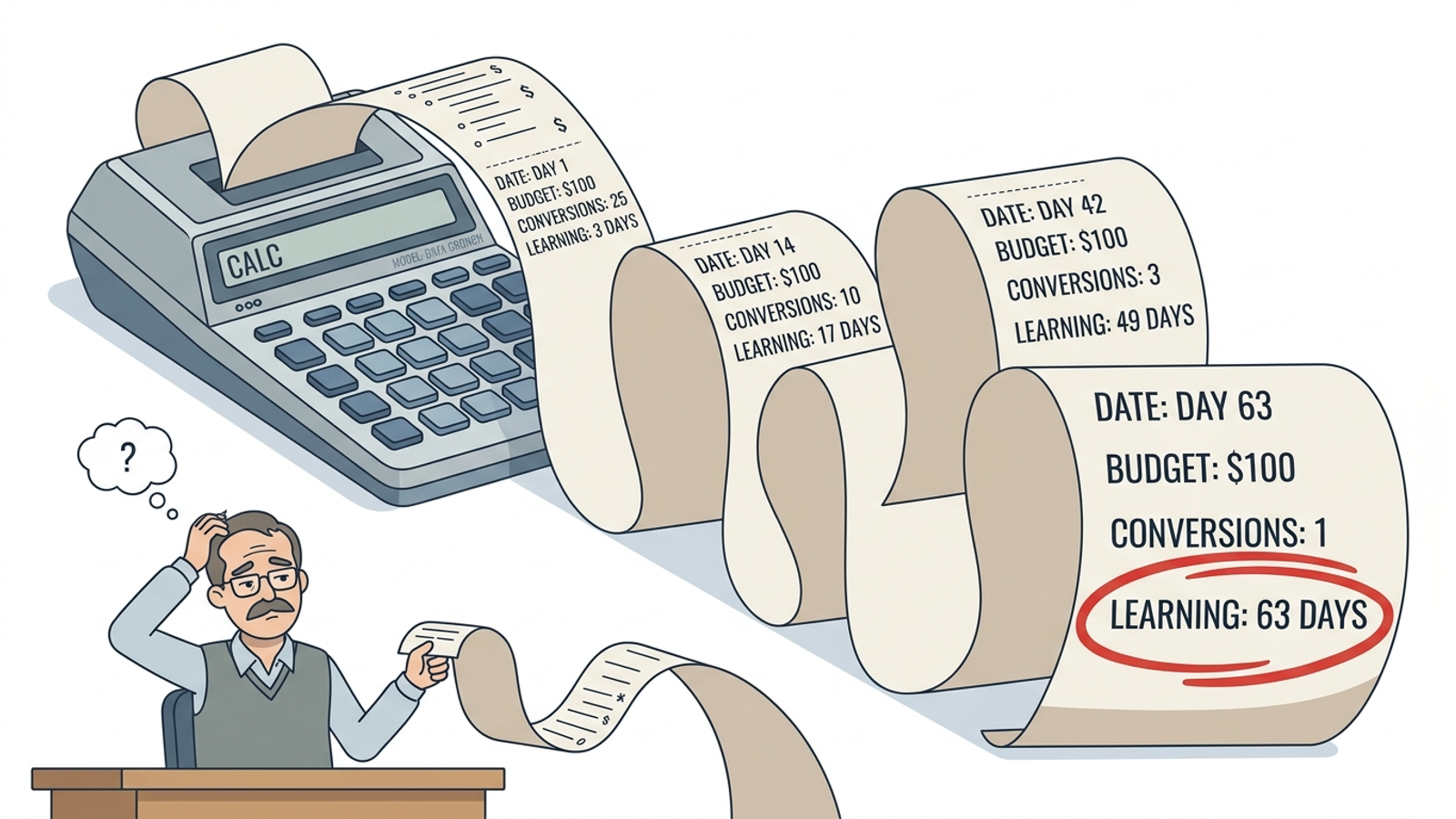
At $40 a day and a $50 CPA, you buy about 0.8 conversions a day. Against Google’s roughly 50-conversion calibration benchmark, that is about 63 days of volume, not a week.
I used to tell clients to wait seven days and then judge the campaign. I was wrong. Google says Smart Bidding learning time depends on conversion volume, conversion cycle length and bid strategy type. Divide the benchmark by what a small budget actually buys, and the useful planning horizon can stretch into months. That changes what the first two to four weeks are for.
The one-to-two-week line in many guides has a history. A look back at a January 2018 Google whitepaper notes that learning was slow at 30 conversions and that Target ROAS needed 50 or more. The shorter timeline stuck because it is comforting. It is less useful when an account produces fewer than one conversion a day.
Google’s current help page describes learning in terms of conversion count, conversion cycle length and bid strategy type, and says calibration can take one to two conversion cycles. The later update describes up to around 50 conversion events or three conversion cycles after a change. An account with substantial history may calibrate faster. Fifty is a planning benchmark, not a promise that the Learning label will disappear on conversion 50.
There is another pair of figures worth keeping separate. Guidance recommends evaluating Target CPA over periods with at least 30 conversions and Target ROAS over at least 50. Those are floors for reading performance, not a stopwatch for the learning status. They make the same practical point: a handful of conversions cannot support a confident verdict on a bidding strategy.
Here is the estimate: daily budget divided by CPA gives expected conversions per day. Divide the roughly 50-conversion benchmark by that daily rate. The budget determines how many opportunities you can buy; CPA determines their price. A small-account breakdown shows the same volume problem another way: 10 leads a month can mean roughly five months to reach 50, while 25 a month means roughly two.
| Daily budget | Assumed CPA | Expected conversions per day | Approximate days to 50 |
|---|---|---|---|
| $30 | $35 | 0.86 | 58 |
| $40 | $50 | 0.8 | 63 |
| $100 | $50 | 2.0 | 25 |
| $100 | $150 | 0.67 | 75 |
| $300 | $50 | 6.0 | 8 |
| $300 | $150 | 2.0 | 25 |
| $1,000 | $50 | 20.0 | 3 |
These are calculations from illustrative budgets and CPAs, not observed learning durations. They assume the CPA and conversion rate hold steady, and they do not account for conversions arriving after the click. Use the table to set expectations, not to schedule an announcement that the algorithm is trained.
At $40 a day and a $50 CPA, the expected rate is 0.8 conversions a day. That puts 50 conversions about 63 days away on paper. If the click-to-booked-call cycle takes 14 days, some of the outcomes from recent clicks will not even be visible when you pull a day-14 report. Google explicitly includes conversion cycle length in its learning-time guidance. Day 14 is too early to call that small campaign a winner or a failure.
Manual CPC does not have a Smart Bidding learning period, which may be why some of us who learned on manual bids underestimate how volume-bound automated strategies are. Accounts below about 30 conversions in 30 days can struggle with Smart Bidding; this example expects about 24. The status label might still clear sooner than the table suggests. Bidding continues to learn after the label clears, so I would not confuse the warning light going off with proof that performance has settled.
Google lists several reasons a bid strategy may enter Learning:
That is not a rule that every edit deletes every conversion the account has ever recorded. It is a warning that changes can force the bidder to recalibrate while new results arrive. Switching conversion actions can restart learning, while similar campaigns merged under account-level pooling may need little relearning. What you change matters.
This is why the familiar weekly routine gets expensive. Nudge the budget on Monday because spend looks slow. Tighten tCPA on Wednesday because CPA looks high. Add keywords on Friday because coverage looks thin. Each decision has a rationale; together they make it hard to tell whether the original strategy worked or whether you spent the month watching it adapt to your edits. One practitioner breakdown warns that weekly target tweaks can keep an account from settling. At low volume, stability is a bidding input, not a personality trait.
Consider an illustrative account spending $100 a day for $50 leads. That buys an expected two conversions a day, or about 25 days to collect 50. Raise the budget substantially on day 8, lower the target CPA on day 16 and split out fresh keywords on day 23. You have not necessarily thrown away the first 46 conversions. But you have changed the conditions three times before reaching the benchmark, so a clean read on the original setup is gone. The calendar says week four. Your evidence now describes several different campaigns wearing the same name.
Structure is the first lever because structure determines how much data a strategy can use together. Consolidating similar campaigns or using a shared portfolio strategy can help thin campaigns learn from more volume. Suppose four separate campaigns each produce 0.5 conversions a day. At that rate, each would take about 100 days to reach 50 on its own. If those campaigns genuinely serve the same intent and can be consolidated into one campaign producing two a day, the simple volume estimate falls to 25 days. Same total conversion rate. A less fragmented history.
That arithmetic is not permission to merge unrelated customers or offers. It tells you where to look first: if separate campaigns chase the same customer and use the same conversion action, ask what the separation buys you. If the answer is only a tidier dashboard, the bidder may be paying for your tidiness.
Account-level pooling may mean similar campaigns need little relearning when merged, while a conversion-action switch can restart it. That distinction argues against combining every cleanup job into one afternoon. Consolidating similar search campaigns is one decision. Changing what counts as success is another. Make each deliberately, then leave enough time to see what it did.
The second lever is the action you bid toward. One approach is to use a higher-volume micro-conversion close to the final conversion, then work backward from conversion rate and value when setting a target. A booked call that happens twice a week offers few examples. A qualifying upstream action that happens three times a day offers about 21 a week, putting the 50-event estimate at roughly 17 days for that action. It does not make booked calls arrive faster by magic.
Say a final sale closes from 20% of form fills and is worth $1,000. On those assumptions, a form fill has $200 in expected value. If your acceptable cost per sale is $50, that implies roughly $10 per fill before you revisit the economics. I have not seen Google publish that reverse-engineering formula; it is the arithmetic of the example, not a platform rule. More importantly, if the upstream action does not predict the sale, you train the bidder to buy junk faster. Borrow volume from upstream only if upstream predicts downstream.
A tight tCPA or tROAS target can restrict the bidder before it has many examples of what your price buys. At 0.8 conversions a day, that restriction may slow spending and the collection of new examples. Maximize Conversions without a target gives the strategy room to seek conversions within the budget. The tradeoff is plain: less price control while you gather volume.
I would not set a universal rule that every account estimated to need 25 days must avoid targets. The table cannot tell you how useful the account’s existing history is, or how long its conversions take to arrive. It can tell you when a target deserves skepticism. The practical rule is do not demand precision from a strategy that has barely seen the outcome you want it to buy. Build a stable baseline before tightening the price.
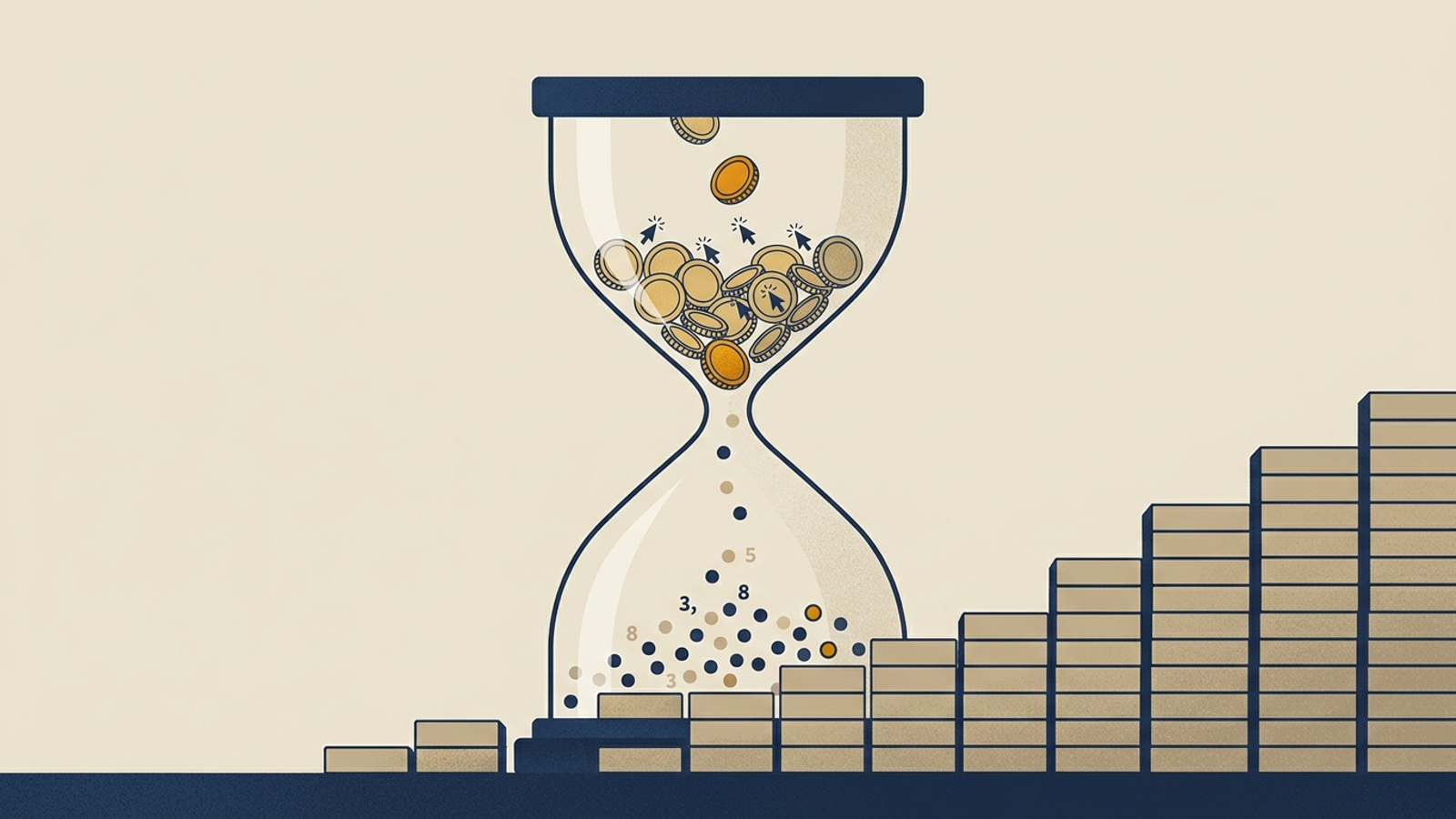
Tests have the same volume constraint. A native 50/50 experiment splits conversion volume between arms and can prolong Smart Bidding learning. At two conversions a day across the original campaign, each arm might receive one a day. The simple 50-event estimate becomes 50 days per arm instead of 25 days for one campaign. A sequential test avoids that split but can mislead when conversions arrive well after the click.
The testing guide illustrates that lag with a SaaS example: a 60-day sales cycle made a tCPA test look unsuccessful in the interface before closed revenue arrived 40% higher. It recommends allowing 7 to 14 days plus the conversion-lag window before judging a new strategy. That is a minimum observation plan, not evidence that a low-volume split has gathered enough conversions. Do not halve a thin signal and expect a faster answer.
The first two to four weeks should follow the volume math, not a standard launch calendar. Use the table to decide what you can reasonably learn, then protect that read from unnecessary edits:
None of those ranges guarantees when a Learning label clears or how a campaign performs. They answer the question a seven-day rule dodges: how many examples can this account actually produce?
The decision the numbers support is simple. Set your review schedule by conversion volume and lag, not by the number of Mondays since launch. Avoid edits that make an already thin read harder to interpret; for a closer look, see what can restart learning and how to protect the budget while it runs. I learned this after judging too many small accounts at day 14. The bidder was still short on examples. No wonder the report looked stupid.
Against Google's roughly 50-conversion calibration benchmark, learning time depends on how many conversions your budget buys per day. At $40 a day with a $50 CPA, that is about 0.8 conversions daily, putting 50 conversions around 63 days away. The planning horizon can stretch into months at low volume.
No. Fifty conversions is a planning benchmark, not a promise that the Learning label will clear on conversion 50. Google says calibration can take one to two conversion cycles, and later guidance describes up to around 50 conversion events or three conversion cycles after a change. Bidding also continues to learn after the label clears.
Divide your daily budget by your CPA to get expected conversions per day, then divide the roughly 50-conversion benchmark by that daily rate. For example, $100 a day at a $50 CPA buys two conversions daily, or about 25 days to reach 50. These are calculations from illustrative figures, not observed learning durations.
Often not. If the account produces about 0.8 conversions a day and the click-to-booked-call cycle takes 14 days, some outcomes from recent clicks will not be visible in a day-14 report. Google explicitly includes conversion cycle length in its learning-time guidance, so day 14 is too early to call that small campaign a winner or a failure.
Certain changes can put a bid strategy back into Learning, including a new or reactivated strategy, settings changes, or composition changes such as adding or removing campaigns, ad groups or keywords. Switching conversion actions can restart learning, while similar campaigns merged under account-level pooling may need little relearning. Edits do not erase past conversions, but frequent changes make results hard to interpret.
Yes. Consolidating similar campaigns or using a shared portfolio strategy lets thin campaigns learn from more volume. Four campaigns each producing 0.5 conversions a day would take about 100 days each to reach 50, but one combined campaign at two a day reaches it in about 25 days. Only merge campaigns that genuinely serve the same intent and use the same conversion action.
One approach is to use a higher-volume micro-conversion close to the final conversion and work backward from conversion rate and value when setting a target. For example, a sale closing from 20% of form fills at $1,000 gives each fill $200 in expected value. Do this only if the upstream action actually predicts the sale, otherwise you train the bidder to buy junk faster.
A tight target can restrict the bidder before it has many examples of what your price buys, which may slow spending and the collection of new examples. Maximize Conversions without a target gives the strategy room to seek conversions within the budget, with the tradeoff of less price control. Build a stable baseline before tightening the price.