


If you are the owner who asked ChatGPT about your industry and got your competitor’s name back, leave your card in your wallet. That answer feels like a verdict, but one frightening screenshot is a terrible purchasing brief.
I spent years watching good clients make the same move in Google Ads: one bad week, one scary screenshot, then a rushed signature on whatever promised the fastest fix. Before you spend a dollar on AI visibility, find out which buyer prompts you lose, why the answers cite who they cite, and whether AI bots can read your site at all.
This is the 30 days I would run if it were my business and my money. No subscription required.
Dear owner: the answer felt personal
You typed something like the question your customers ask. Best water heater installer in Austin. Who builds custom closets in Denver. Maybe just what you do, plus your city. The answer came back confident and polite, with three names that were not yours. So you tried different wording, hoping it was a glitch. It named them again.
I know why you want to act now. Someone looking for your service might see that answer before they ever see your site. But you do not yet know whether you have a site-access problem, a missing-answer problem, a third-party mention problem, or merely a result that changes on the next run. Let the purchase wait while you find out which problem is yours.
I used to tell clients to sleep on any change that felt urgent. I was wrong about plenty of tactics over the years: match type structures I swore by, exact match discipline I defended too long. I was not wrong about this one. The decisions you make in the hour after a scare are the ones you can pay for longest.
I have seen this panic buy before
Say you spend $20k a month on Google Ads. One week, CPA jumps 40%. Someone sends you a screenshot of wasted spend on Monday morning. By Friday, you have signed for a bid tool, a new agency, a landing page rebuild, sometimes all three. The spend was real. The fear was real. You just bought the fixes too fast to know which one matched the problem.
The tool was rarely a scam. It was pointed at the wrong gap. I audited accounts where a client paid for click fraud software when broad match was eating the budget, or bought new creative when tracking was double-counting leads. Panic buys an answer before you have mapped the misses. I do not want you repeating that with AI answers.
Your competitor’s name on the screen is a reason to investigate. It is not yet a reason to sign a contract.
A Google ranking does not explain the AI answer
You might assume you lost because your competitor outranks you on Google. I assumed the same thing in 2024, when I still told clients that position one would take care of everything else. I was wrong. In one Ahrefs test of 15,000 prompts, only about 12% of ChatGPT citations were in Google’s top 10 for the same prompt, and around 80% did not rank at all. A number one page can sit invisible while a smaller competitor gets named. For a longer breakdown, read these six straight answers on AI search visibility and citations.
The engines do not even show their work the same way. ChatGPT often answers from memory plus optional Bing search and frequently gives no citation at all, while Perplexity runs live web search for nearly every question with numbered sources. Only about 11% of cited domains overlap between the two. Perplexity leans hard on Reddit in almost half its top citations, while ChatGPT leans on Wikipedia in almost half of its top 10. A mention in one engine does not tell you what you will see in the other.
That is why I would look at the source behind each lost answer rather than guess from your Google position. For your own pages to become sources in ChatGPT and Perplexity answers, AI crawlers need to reach them, those pages need quotable answers to the questions the engines seek, and your brand needs a presence on third-party sites the engines trust. Which part is missing for you? The answer on your screen cannot tell you by itself.
Start with access. ChatGPT search inclusion runs through OAI-SearchBot, and Perplexity surfacing runs through PerplexityBot. If robots.txt or a firewall blocks a bot, it cannot cite the blocked page even if that page ranks on Google. Vendor docs say a robots.txt change takes about 24 hours to apply. I have seen owners ready to pay $2,000 a month for content while an old developer rule was still telling AI bots to go away. Check the door before you commission new rooms.
Then look at the answer itself. What a deck might call entity optimization, I call writing something the machine can lift. Perplexity scores for direct 40-to-60-word answers with clear headings, lists, tables, and FAQ structure, and fresh pages can be cited within days. For recommendation prompts such as best X, almost 44% of ChatGPT citations came from best-of list articles, most updated that year. The same prompt almost never returned the same brand list twice.
So do not rewrite your homepage because one run named a rival. First see whether the answer wanted a short comparison, a current list, a third-party review, or a page your bots could reach.
You need a map before you need software
Tools that track which prompts trigger brand mentions run a fixed list of buyer prompts across ChatGPT, Perplexity, and AI Overviews. They record who gets mentioned, who gets cited, and your share of voice across the set. Prompt coverage is arithmetic: appear in 15 of 50 prompts and you hold 30%. The useful output is not the score. It is the list of buyer prompts where competitors appear and you do not. Until you have that list, a tool cannot tell you what to fix.

I would build the first map by hand because the work teaches you what a dashboard can hide. Write down 25 prompts your buyers might type, not the ones that flatter you. Best plus your trade plus your city. Cost plus your service. Your service versus a competitor. How long does X last. Run each in ChatGPT and Perplexity. Note who gets named and which pages get cited, when the answer provides citations.
Then repeat some prompts. Recommendation answers shift. The same prompt almost never returns the same brand list twice, and one study saw Reddit citations in ChatGPT swing from around 60% to around 10% in weeks. A single screenshot gives you a starting point. A month of logged answers gives you something to compare.
For each lost prompt, ask what page should have answered it. Open the cited pages. You may find a Reddit thread, a best-of list, a directory, or your competitor’s pricing FAQ rather than a competitor homepage. That tells you what kind of gap to investigate. If Perplexity cites a 50-word comparison table while your site offers a 2,000-word brand story, your immediate problem is not a lack of monitoring software. You have not given it the answer that prompt calls for.
You will find plenty of advice to publish authoritative content, add schema, build backlinks, and pursue G2 listings. That advice is not all wrong. The order is wrong for someone who has not examined a single lost prompt. Check the prompts and their cited pages first. Check bot access. Then decide whether you need clearer answers on your own site or a plan for third-party mentions.
Ignore shortcuts sold as the whole fix. In an Ahrefs matched test of 1,885 pages that added JSON-LD against 4,000 controls, the lift was about 2.4% in AI Mode and 2.2% in ChatGPT, indistinguishable from zero. In the same research batch, 97% of llms.txt files got zero bot requests in a month. Schema still matters for rich results, and an llms.txt file harms nothing. Neither is a substitute for finding out why you lost the prompts you care about. If a vendor leads with either as the fix, keep your card in your wallet.
Make one honest note beside each miss: access blocked, useful answer missing, third-party source cited, or not enough evidence yet. You can discuss a purchase once you know which notes keep recurring.
Your first 30 days before you sign anything
Keep this list open for a month. Work in order: you need the original answers before you can diagnose a miss, and you need that baseline before you can tell whether anything moved. You can do this first pass without buying a tool.
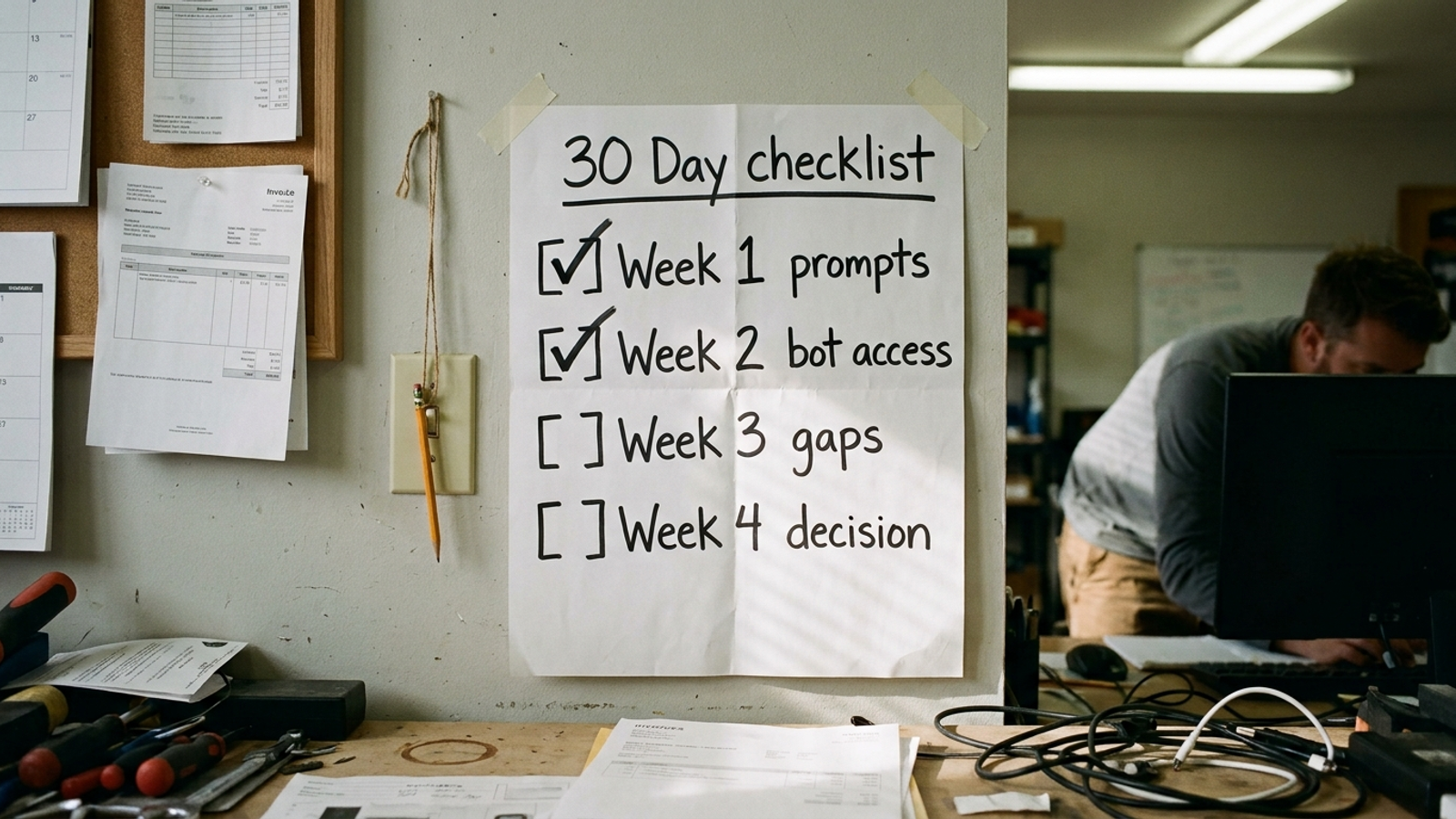
Week 1: log the buyer prompts you lose
- Write 25 prompts your buyers might type, not your brand terms. Include best plus trade plus city, cost, versus, and how long or how much questions.
- Run each prompt in ChatGPT and Perplexity; log whether you were mentioned, who else was, and which pages were cited, if any.
- Choose 10 to 20 prompts to rerun monthly and keep the log. Do not treat one screenshot as a stable result.
- Count coverage: mentions divided by total prompts. Keep that number as your baseline.
Week 2: check whether bots can read your pages
- Check robots.txt and confirm OAI-SearchBot and PerplexityBot are allowed on your key pages. An old disallow can block access while Google still ranks you.
- Load your top five service pages with scripts off and read them as plain text. Check whether prices, service areas, and FAQs still appear.
- After any robots.txt change, allow 24 hours, then rerun one lost prompt before changing something else.
Week 3: match each miss to its source
- For each lost prompt, open two or three pages the answer cited and note the format: table, short answer, list, or review page.
- Write a missing answer in 40 to 60 words under a plain heading on the page that should address it. Do not start with a new blog section by default.
- List the third-party pages cited instead of yours: Reddit threads, best-of lists, and directories.
Week 4: decide what you can fix yourself
- Sort the gaps into three piles: bot access, answers on your pages, and third-party mentions.
- If most losses sit in the third pile, decide whether you have time for the outreach and publishing cadence those pages demand.
- Before signing, ask a vendor which 10 prompts they will work on, which pages they will change, and how they report citations versus mentions. If you get a score instead of answers, walk away.
- Rerun your original 25 prompts on day 30 and compare them with day one. Skip this and you can pay for a year of motion with nothing to show but a prettier report.
You do not owe the first vendor in your inbox an answer this week. Give yourself the month, keep the log, and make them answer your questions before you answer theirs.
Signed, someone who has paid for the wrong fix before.