

 LinkedIn

At $100 of contribution per customer, a $1,499 monthly management fee needs 15 extra customers to cover its cost. Not 15 customers total: 15 you would not have won without the change in management.
That distinction is the hiring decision. A profitable ad account does not automatically make its management worth paying for. The manager must improve the outcome enough to cover its incremental cost, not take credit for every sale that passes through the account.
I’m using groas’s published $1,499 monthly fee to calculate that hurdle against DIY and an incumbent provider. The fee is the published input. The customer economics, budgets and performance scenarios below are illustrative calculations, not results or promises.
What the $1,499 fee has to earn back
The starting rule is straightforward: incremental revenue multiplied by contribution margin must cover the management fee plus any incremental advertising spend. An agency engagement guide describes the same economic test, with ad spend paid separately to Meta.
For the opening calculation, I assume ad spend stays unchanged and DIY carries no cash management cost. That leaves the full fee to recover through additional customer contribution.
Here is the arithmetic using the published $1,499 fee. The contribution values are hypothetical inputs; the customer counts are calculated thresholds, rounded up to whole customers.
| Contribution per extra customer | Extra customers to cover the fee | Calculation |
|---|---|---|
| $50 | 30 | 1,499 ÷ 50 = 29.98 |
| $100 | 15 | 1,499 ÷ 100 = 14.99 |
| $250 | 6 | 1,499 ÷ 250 = 5.996 |
| $500 | 3 | 1,499 ÷ 500 = 2.998 |
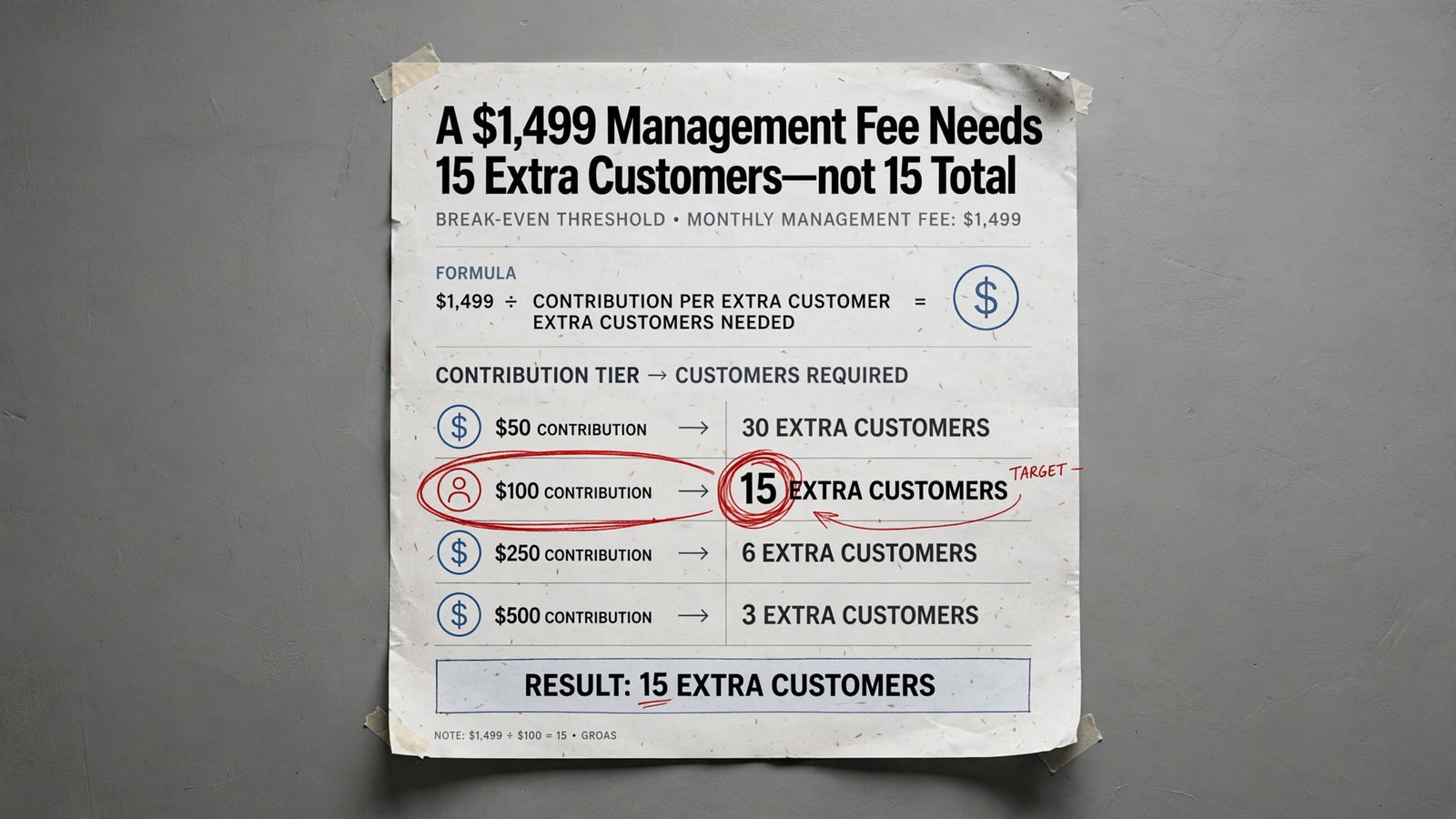
The formula is:
Extra customers required = incremental monthly cost ÷ contribution per extra customer, rounded up.
That is the same break-even logic used in this worked example of a fee divided by contribution per order. The result is a cost hurdle, not a forecast.
Read your row, not somebody else’s. A low-ticket ecommerce store keeping the first row’s contribution after product, shipping, refunds and payment fees faces a very different decision from a service business keeping the last row’s contribution after labor and parts.
A flat fee makes the management-cost hurdle predictable: it does not rise just because the advertising budget rises. That does not make extra advertising free. Any additional spend still needs to earn its way back.
Use the table to judge the required improvement, not the total revenue already flowing through the account.
Get contribution right before trusting the answer
I used to tell clients to use gross margin straight from their P&L. I was wrong. For this decision, I need contribution per extra customer: selling price minus the variable costs that appear when that customer appears. That follows the standard contribution definition.
Start with the sale, then subtract the costs attached to fulfilling it:
- Product or fulfillment labor.
- Shipping and payment fees.
- Refunds and returns.
- Any variable sales cost.
Leave out fixed rent, sunk tools and a salary you pay anyway. Do not subtract the management fee here either. The fee is the hurdle; contribution is what clears it.
For lead generation, move the calculation back a step. In an illustrative scenario, suppose you close one in five qualified leads and keep $500 from each closed job after fulfillment. That produces $100 of expected contribution per qualified lead. Against the published $1,499 fee, the threshold becomes 15 extra qualified leads, assuming that close rate holds and ad spend stays unchanged.
The word qualified matters. Filling the CRM is not the same as funding the fee. If the additional leads close at a different rate, the contribution calculation changes with them.
There is another easy trap: counting extra ad spend twice. If winning the additional customers requires more advertising than the baseline, account for that cost in one place:
- Subtract it from the additional contribution; or
- Add it to the cost hurdle.
Not both. And not neither, which makes the spreadsheet considerably more cheerful than the bank account.
Write down contribution after variable costs before deciding whether the customer threshold looks achievable.
Compare the cost difference, not the replacement’s sticker price
The full fee is the right hurdle only when the alternative costs nothing in cash and nothing else disappears after the switch.
Against an incumbent provider, I care about the difference in total relevant costs. Against DIY, I subtract expenses I genuinely stop paying. A tool that remains on the credit card is not a saving, however enthusiastically the sales deck describes consolidation.
These are hypothetical baselines compared with the same published $1,499 monthly fee:
| Current arrangement | Cost genuinely removed | Monthly cost difference |
|---|---|---|
| DIY with no paid support removed | $0 | $1,499 more |
| DIY, cancelling a reporting tool | $400 | $1,099 more |
| DIY, replacing a freelancer | $600 | $899 more |
| Incumbent provider | $2,000 | $501 less |
| Incumbent provider | $800 | $699 more |
If groas replaces the more expensive incumbent in that table, it starts ahead on management cost. Holding performance would preserve the saving. There is no reason to demand that it recover its entire sticker price again through additional customers.
Conversely, replacing the cheaper incumbent means the new arrangement must earn back the difference, not the full fee. Comparing every option against zero quietly changes the question halfway through the analysis.

Owner time needs a separate line. In another illustrative calculation, six hours a month valued at $150 an hour represents $900 of released time. It is not automatically $900 of cash available to pay the fee. It becomes cash only if those hours turn into billable work you would otherwise turn down.
Time back can still matter. I just would not label it cash profit and then wonder why the invoice feels heavier than the spreadsheet suggested.
Write the baseline as total relevant cost today versus total relevant cost after the switch. Run the calculation on the difference.
Prove the management lift, not merely the advertising lift
Platform ROAS can make a management fee look justified. I would not believe it on its own.
Attribution assigns credit to sales associated with advertising. It does not, by itself, establish what would have happened without that advertising. That is why Meta Conversion Lift compares an exposed group with a holdout.
Overlapping attribution creates another problem. One practitioner illustrates it with Facebook claiming 500 orders and Google claiming 400 against 600 total orders. Each dashboard can look persuasive while the combined story fails basic arithmetic.
I have lived that double-count: the deck shows a healthy return, finance shows flat contribution, and the agency gets credit for customers who were coming anyway.
But there is a second distinction here, and it matters just as much. Showing that advertising caused sales is not the same as showing that a new manager improved on DIY or the incumbent. A holdout can help establish advertising incrementality; the hiring decision still needs the right management baseline.
The underlying incrementality principle compares outcomes with and without the marketing exposure. For this decision, the additional question is how much contribution the new arrangement produces beyond what the previous arrangement would have produced.
Before the engagement, I would put the measurement agreement in writing:
- Name the comparison. DIY or the incumbent provider, not an imaginary account with no sales.
- Define the outcome. Additional customers and contribution, not platform-attributed revenue alone.
- Account for changed inputs. Spend, seasonality, offer changes and conversion lag can change the answer.
- Choose the evidence. A relevant holdout or a cautious baseline, with its limitations stated upfront.
- Compare the gain with the cost difference. Include additional ad spend once.
A cautious baseline is weaker evidence than a suitable controlled comparison. It can inform a decision without proving causation. Where the data cannot separate better management from a changed offer or a seasonal bump, I would say so rather than assign the entire improvement to the provider.
Contribution margin, blended marketing efficiency and reconciliation with the P&L provide useful checks beyond platform ROAS, as this discussion of DTC measurement describes. They still do not make the counterfactual disappear.
Agree on what would count as incremental improvement before paying for it. Otherwise, the reporting meeting becomes a negotiation over definitions.
The account can look healthy while the economics fail
Here is the worked example that exposes the mistake.
Suppose monthly ad spend is $20,000 and reported revenue is $60,000. Those are hypothetical inputs, not an account result. Suppose the business keeps 30% of revenue after fulfillment, refunds and other variable costs, before advertising and management.
The standard break-even ROAS calculation is one divided by contribution margin. In this scenario, that is approximately 3.33x. The reported 3.0x return is already below break-even before the management fee enters the picture.
| Illustrative account economics | Amount |
|---|---|
| Reported revenue | $60,000 |
| Contribution before advertising, at 30% | $18,000 |
| Advertising spend | $20,000 |
| Contribution after advertising, before management | −$2,000 |
A large revenue number does not rescue that arithmetic. Neither does a green dashboard. I have kept accounts like that alive too long because the dashboard was green and the bank account was not.
Now separate the account’s overall economics from the manager’s incremental economics. Suppose DIY would have produced $55,000 of the same revenue at the same ad spend. The management improvement is $5,000, not $60,000. At the same 30% contribution rate, that adds $1,500 before the published $1,499 management fee.
One dollar remains.
That is a marginal improvement after the fee, not a healthy account overall. Both statements can be true: the manager just covers its incremental cost, and the business still needs to fix the underlying advertising economics.
The example assumes the revenue difference really comes from management, with ad spend and the other relevant inputs unchanged. If the evidence cannot support that assumption, the calculation is a scenario, not proof.
Judge the additional contribution the manager produced. Do not award it the entire account.
The decision the numbers support
The customer threshold is only half the decision. The other half is whether the required improvement is credible against the baseline.
Using the earlier fee-based calculation, 30 extra customers at $50 contribution clears the hurdle. On an illustrative base of 200 customers, that requires a 15% increase in incremental customers, after accounting for seasonality and lag. It is not interchangeable with a 15% improvement in reported ROAS.
That is a demanding hire. I would skip it unless the tracking is clean and the follow-up can handle the additional volume.
At $500 contribution, the threshold is three extra customers. That is a different economic proposition, but it is not automatically easier to prove: ordinary month-to-month movement can obscure whether management caused the difference. A small customer count is a lower hurdle, not evidence that someone cleared it.
This is why I prefer a flat fee for the calculation. It keeps the management hurdle still while the advertising moves. It does not guarantee performance, but it makes the cost side of the decision easier to inspect.
Before signing, write down:
- The baseline: what DIY or the incumbent already produces.
- The cost difference: the new fee minus costs genuinely removed, plus any additional ad spend.
- The contribution: what each extra customer leaves after variable costs.
- The evidence: how the claimed improvement will be separated from what would have happened anyway.
Then divide the incremental monthly cost by contribution per extra customer and round up. These are decision thresholds, not promises about what groas or anyone else will deliver.
If your hurdle is six customers at $250 contribution and you can name a credible route to six incremental jobs, book a consultation and make the provider price that lift. If your hurdle is 30 at $50 and you cannot, keep the fee.


