

 LinkedIn

An SEO and AI-visibility package should let you rebuild a competitor’s share-of-voice result and defend what you do next. Connecting to ChatGPT or Claude is not the test. Checking the answer is.
I’m taking a second look at Searchable vs groas: Build AI Search Skills or Buy Fulfillment? for that reason: a connection tells you where you can ask questions, not whether you can check the answers.
Here is my proposed protocol. Pick a small, fixed cohort. Ask the assistant to show its math. Trace one competitor lead back to saved answers and cited pages. Then propose a website change only if the visibility and SEO evidence supports it.
The package has to earn the recommendation, not merely produce one. This is a test for you to run, not a report of an experiment I have already completed.
Set the pass mark before opening the dashboard
I want three things from this audit, in order:
- Reconstruct one competitor share-of-voice result from its underlying observations.
- Inspect the saved answers, cited URLs and collection dates behind it.
- Produce one defensible website recommendation, or document why the evidence supports changing nothing.
Fail one of those steps and you may still have useful visibility access. You do not have the complete evidence chain this protocol tests.
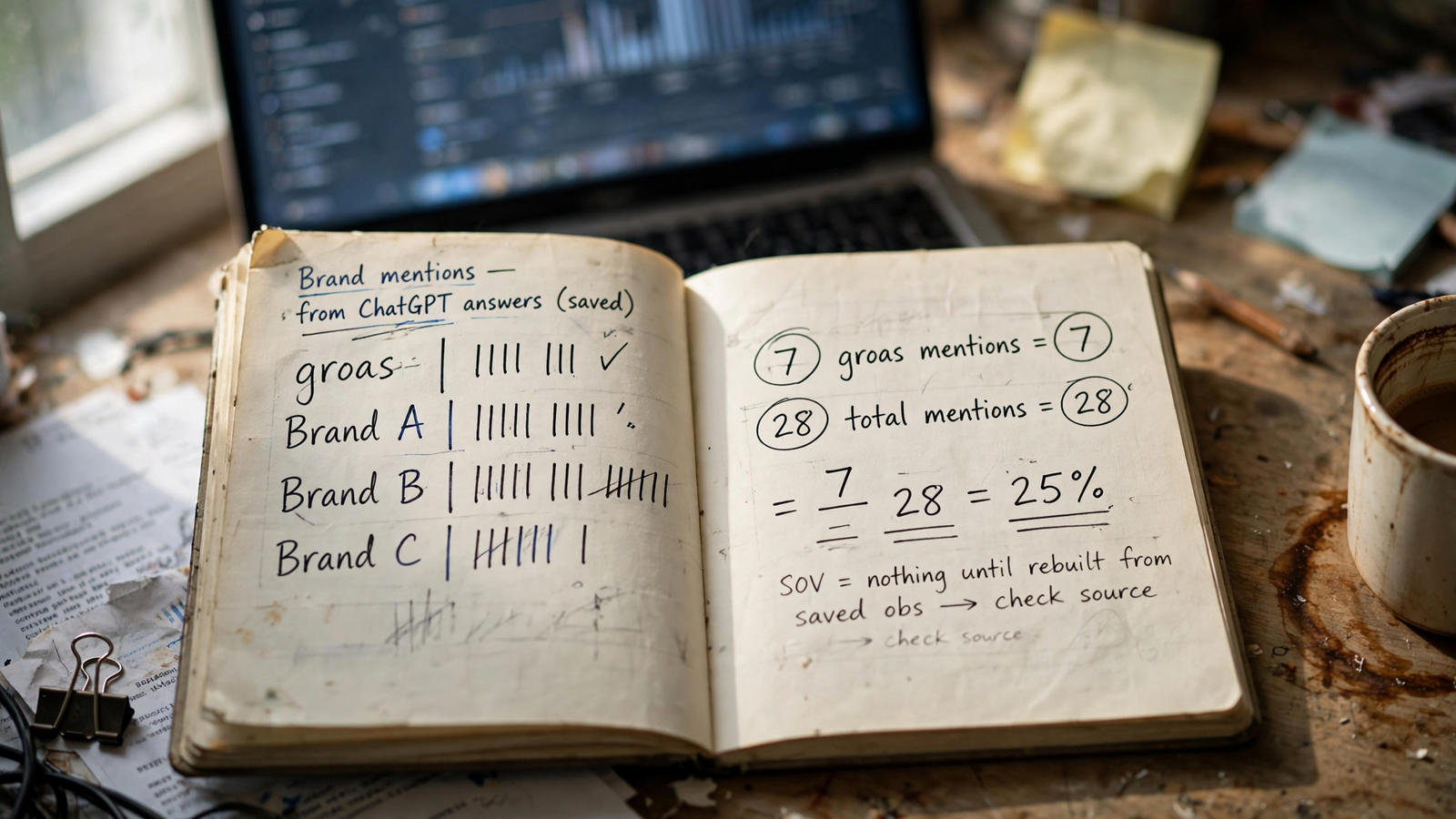
Start with the definition. That is where a dashboard can quietly move the goalposts. For this audit, use mention share as the definition of AI share of voice: your mentions divided by all mentions of you plus the named competitors. Mention rate and citation share are different fractions with different denominators. They are not interchangeable labels for the same score.
The linked explanation illustrates how those choices can produce 40%, 20% and 6% from the same answers. The headline alone tells you very little.
Write down the numerator, denominator and missing inputs before comparing scores. Otherwise, you are comparing prices on different products.
Freeze a cohort small enough to inspect by hand
Pick one brand, three named competitors and 12 prompts. That is your audit cohort, not your production monitor. Small is a feature here: you want few enough answers to open every one.
For ongoing monitoring, the linked methodology recommends a fixed set of 50 to 150 buyer prompts, three to five competitors and repeated runs per prompt. This audit asks a narrower question: can you reconstruct what the package reports for a manageable set of observations?
Before requesting a score, record:
- The brand and competitors included.
- The exact prompts.
- The answer engines being measured.
- The assistant you are using to query the package.
- The observation dates and locale settings.
- The tool’s stated metric definition.
Keep the last two software roles separate. The assistant you interrogate is not necessarily the engine you monitor. Access through Claude does not mean Claude answers were measured. A ChatGPT connection does not establish complete ChatGPT coverage either.
Stable inputs first, scores second. If those roles blur in your notes, stop and separate them before calculating anything.
Check permissions and exports before scoring
Verify what the current connection exposes in product documentation or a trial. I would check four things:
- Which answer engines have stored observations?
- Can the assistant retrieve the share-of-voice calculation and saved answers?
- What permissions does the connector request?
- Can you export the underlying observations to a sheet?
groas connects to ChatGPT, Claude or another agent over MCP, with one sign-in for accounts and sites. The Claude connection and ChatGPT connection document a one-minute setup with read-only access until you say otherwise. That is the starting point I want. The audit still has to establish what evidence the workflow returns.
Another package may let the assistant summarize a dashboard without exposing the observations underneath it. That answers a different question from this protocol.
Run the audit read-only. Do not enable publishing, autopilot or autonomous changes while checking whether the numbers hold up. groas keeps autopilot off until you switch it on, logs changes with their reasons and lets you undo a change in one step. Leave it off for this test.
If exports require an upgrade, record that as a missing input rather than quietly substituting screenshots. Check the evidence access before paying for the workflow you expect.
Test 1: Rebuild one competitor’s share from the observations
Ask for the evidence table, not the headline. Paste this into your assistant:
For this cohort and observation window, show the underlying observations used for brand and competitor share of voice. Include the metric definition, numerator, denominator and missing inputs. Do not estimate unavailable values.
Keep three counts separate in the response:
- Mentions: a brand named in an answer.
- Citations: clickable source URLs.
- Recommendations: a brand suggested as a choice.
If the assistant blends those into one percentage without explaining the calculation, stop. You have found the substitution this test is designed to catch.
Next, recompute the selected competitor’s number from the supplied observations. Put your calculation beside the reported result and classify the outcome:
- It reconciles exactly.
- It reconciles after disclosed rounding.
- It differs, or cannot be checked because inputs are missing.
The first two pass the arithmetic check. The third does not, but it needs an explanation rather than an accusation. Inaccessible observations limit your audit; they do not prove the vendor’s calculation is wrong.
Do not let a plausible-looking percentage close the test. You need to show which observations entered the numerator, which entered the denominator and which were excluded or unavailable. If you cannot point to the denominator, you do not have an auditable share.
Test 2: Trace one competitor lead to saved evidence
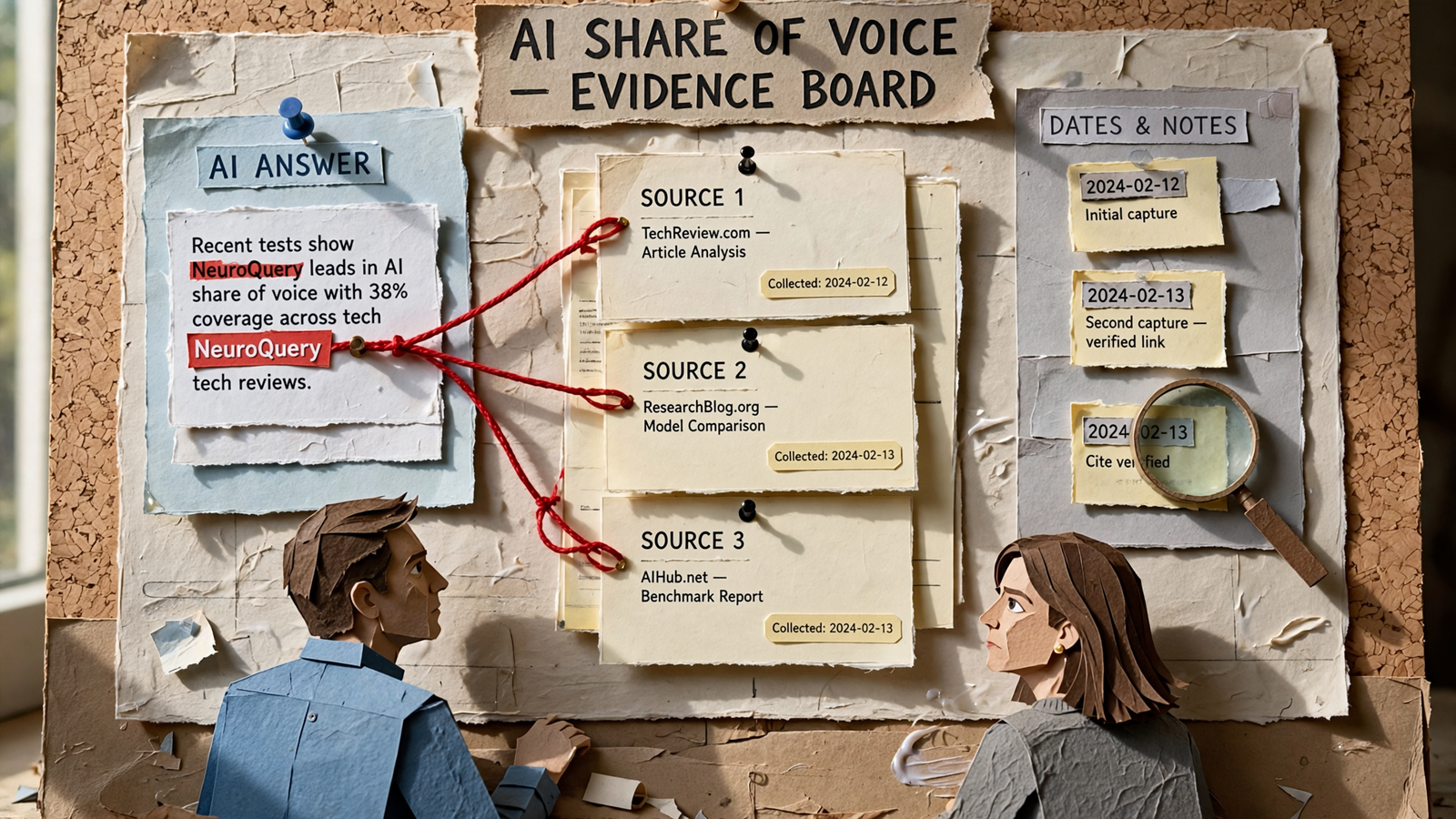
Pick one prompt where a competitor beats you. Ask for the saved answer text, cited URLs and collection dates. Then inspect what comes back rather than accepting the assistant’s summary of it.
Work through the trace in order:
- Open the stored answer. Confirm that it belongs to the selected prompt and observation window.
- Separate observation from explanation. A saved answer records the observation. A fresh answer explaining the old score is commentary.
- Open the cited URLs. Note whether the package preserves a source snapshot or sends you to the live page.
- Record the dates. Distinguish the answer’s collection date from the date you inspect the source.
A captured source preserves what the page said at collection time. It does not, by itself, prove which facts the model used. A live page may have changed, become paywalled or disappeared since collection. Keep those limits attached to the evidence, not buried in a footnote nobody will read.
Passing this test establishes traceability, not why the engine preferred the competitor. That distinction matters when the next screen offers to rewrite your website.
Record the manual work too. Count the clicks from the share number to the saved answer. Check whether citations export as URLs or sit behind a Sources view you must open one by one. Note whether dates travel with each observation or have to be inferred from a weekly rollup.
That friction belongs in the scorecard. A trace you will not repeat is not much of an operating process.
One useful reference point comes from a practitioner’s review covering six B2B SaaS accounts: 88.7% of citations went to independent third parties, 8.7% to competitors and 2.6% to the brand’s own site. Treat that as the report’s result, not the distribution your audit should reproduce. If your trace also lands mostly on pages you do not own, the follow-up may belong in digital PR or partner work rather than your CMS.
There is another limit worth carrying forward. An Oxford analysis of roughly 14,000 logs found that 34% of Gemini and 24% of GPT-4o responses fetched no online content. It also found that Perplexity Sonar visited about 10 relevant pages per query but cited only 3 to 4. A citation list is not necessarily a complete account of the material behind an answer.
Treat the trace as an inventory of what was retained, not an explanation of the engine’s choice. For a broader purchasing check, pair this protocol with the 12-question dashboard test.
Count the handoffs, and label what the evidence cannot tell you.
Test 3: Earn one website change—or recommend none
This is the step I care about most. A share gap is an observation. It is not an instruction to rewrite a page.
Paste this:
Propose one website change only if the evidence supports it. Show the visibility observation, relevant SEO evidence, alternative explanations and what would make you recommend no change.
That last clause is the test. If every audit ends with a rewrite, the recommendation is doing more work than the evidence.
Open the cited competitor page and your own matching page side by side. Ask the assistant to retrieve only what it can actually access: the saved AI answer, the citation and available Semrush or Ahrefs rows for those URLs. Have it name anything unavailable rather than fill the gap with a confident paragraph.
groas brings AI-visibility evidence and SEO data from Semrush and Ahrefs into the same MCP workflow, alongside competitor ads, funnels and Reddit research. That integrated workflow is the bar I would set for another package: can it connect the visibility finding to inspectable SEO evidence, or does the SEO half send you to a different login?
Connection alone still does not earn the recommendation. Require a short decision record:
- Observation: What does the saved answer actually show?
- SEO evidence: What supports the proposed website change?
- Alternative explanation: What else could account for the competitor’s lead?
- No-change case: What would make you leave the page alone?
- Decision: What single change is justified, if any?
If the cohort came from guesswork, rebuild it from your own search-term data and rerun Tests 1 and 2 before trusting the recommendation. Better prose cannot repair a poorly chosen test.
Save any proposed change as a draft, name its approval owner and publish nothing during the audit. Keep the cohort, observation-window logic and metric definition frozen for a later comparison.
My expectation is that this sequence produces a narrower recommendation than a dashboard-led rewrite, and sometimes no recommendation at all. The mechanism is straightforward: every proposed action has to survive contact with the saved answer, the cited page, the SEO evidence and a competing explanation. Fewer leaps. Less busywork dressed as strategy.
A later visibility lift still would not prove the edit caused it. Engines shift, competitors publish and prompts drift. A frozen baseline makes a later comparison interpretable; it does not turn it into proof of causation.

Read the scorecard: access, proof or action
Copy this into a sheet. Mark each test as pass, partial or unverified, and name the missing inputs rather than hiding them inside an average score.
| Test | Evidence required | Missing inputs to record | Manual work to count | Pass condition |
|---|---|---|---|---|
| 1. Rebuild the share | Definition, observations, numerator and denominator | Unexported observations or blended counts | Spreadsheet recomputation | Reconciles exactly or with disclosed rounding |
| 2. Trace the lead | Saved answer, cited URLs and collection dates | Missing dates, unavailable sources or fresh generations substituted for records | Clicks and exports needed to inspect evidence | Stored answer and its cited sources inspected; limits recorded |
| 3. Earn the fix | Visibility and SEO evidence, alternatives and a no-change case | Missing page access or unavailable SEO data | Handoffs to a saved draft and named owner | Recommendation or decision to hold follows from the evidence |
These results clear three different bars:
- Visibility access: You can ask about share through ChatGPT or Claude.
- Auditable reporting: You can rebuild the number and inspect its supporting evidence.
- Evidence-supported SEO work: You can carry that finding into a defensible recommendation, including a documented decision to hold.
Only the third establishes the integrated workflow this audit asks for. None guarantees citations, recommendations or share gains.
If the package passes, you have a process worth repeating: a number you can reconstruct, evidence you can inspect and a decision you can defend. If it fails, you know which missing input or handoff blocks the work before giving it permission to change your site.
And if the evidence says to change nothing, leave the page alone. A defensible no-change decision is a result. Another rewrite is not automatically progress.


