
YouTube Ads Won’t Get Fewer: Six Calls to Check by 2027
October 1, 2026
•
11
min read


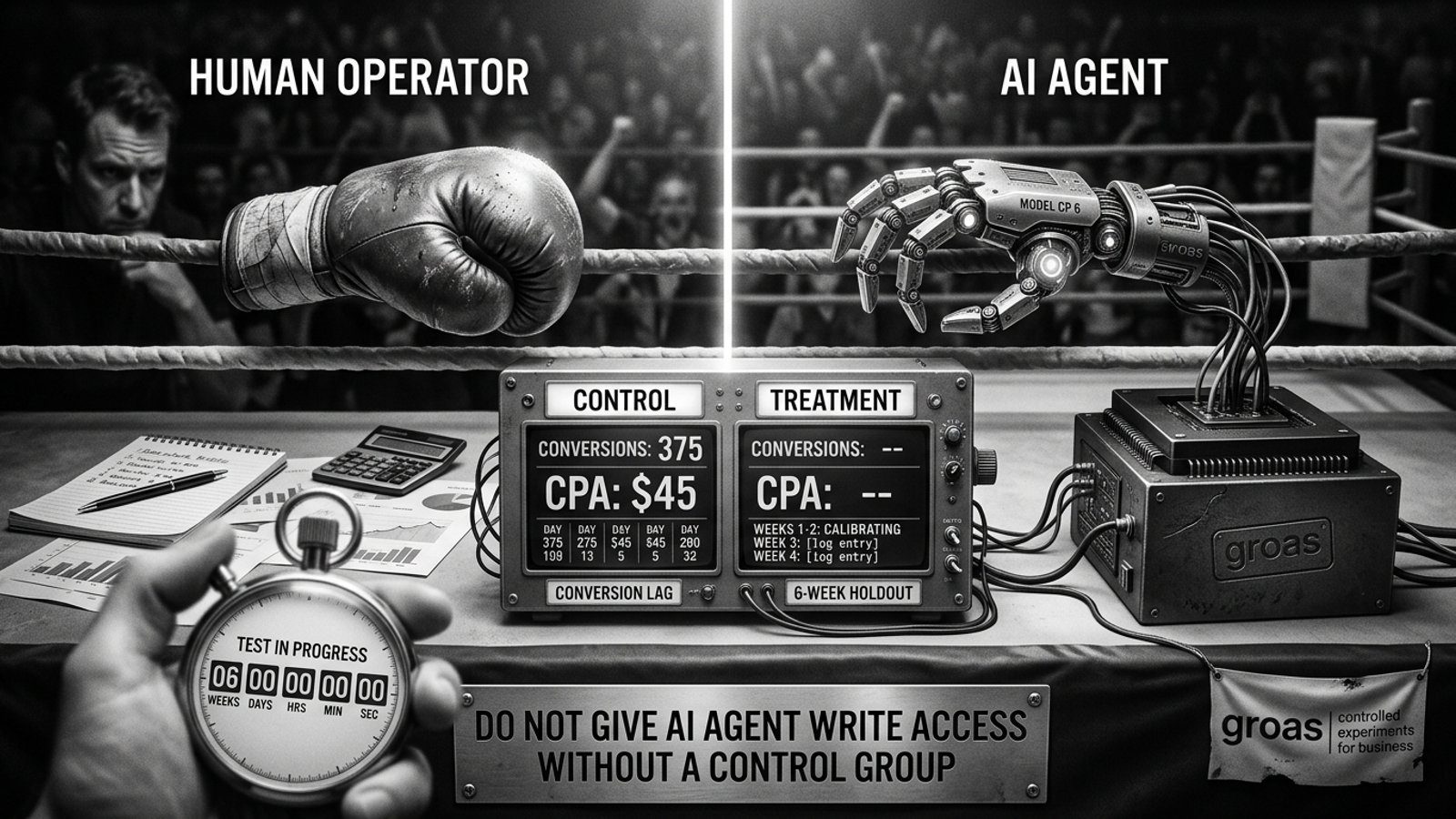
A five-star review will not tell you whether an AI agent can beat your Google Ads manager. Neither will a one-star warning. On Ryze AI’s Trustpilot page, praise for automated budget shifts sits beside complaints about erratic bids and changes that never reached the account. Neither experience is your account, your conversion tracking, or your auction.
Give an AI agent for Google Ads write access without a control group, and you are guessing. If revenue rises, the vendor takes credit. If it falls, auction competition takes the blame. I would run a concurrent holdout instead: same period, comparable traffic, one metric chosen before anyone sees a result. Reviews tell you what happened to someone else. A controlled split tells you whether the agent beats your setup.
Write the hypothesis in the test brief before you grant access: On comparable auction traffic, will autonomous management produce a lower cost per acquisition (CPA) or higher return on ad spend (ROAS) than the current operating model? Choose one as the primary metric. Do not switch to the other because the first disappoints you.
This is not a contest to see who generates fifty responsive search ad variations fastest. Nor is it a test of whether a dashboard can produce more recommendations than a person can read. The agent claims it can manage the account more effectively. Measure the economic outcome of that management.
My expectation: continuous execution can beat periodic account reviews when it catches useful bid, budget, and query changes sooner. That is a mechanism, not a result. The split has to show whether the advantage survives contact with your account.
Do not compare an agency-run May with an agent-run June. As PPC practitioner Tomas Kubilius explains in his guide to clean Google Ads experiments, a month-over-month comparison mixes the treatment with seasonality, supply-chain changes, and competitor bids. Run both operating models at the same time.
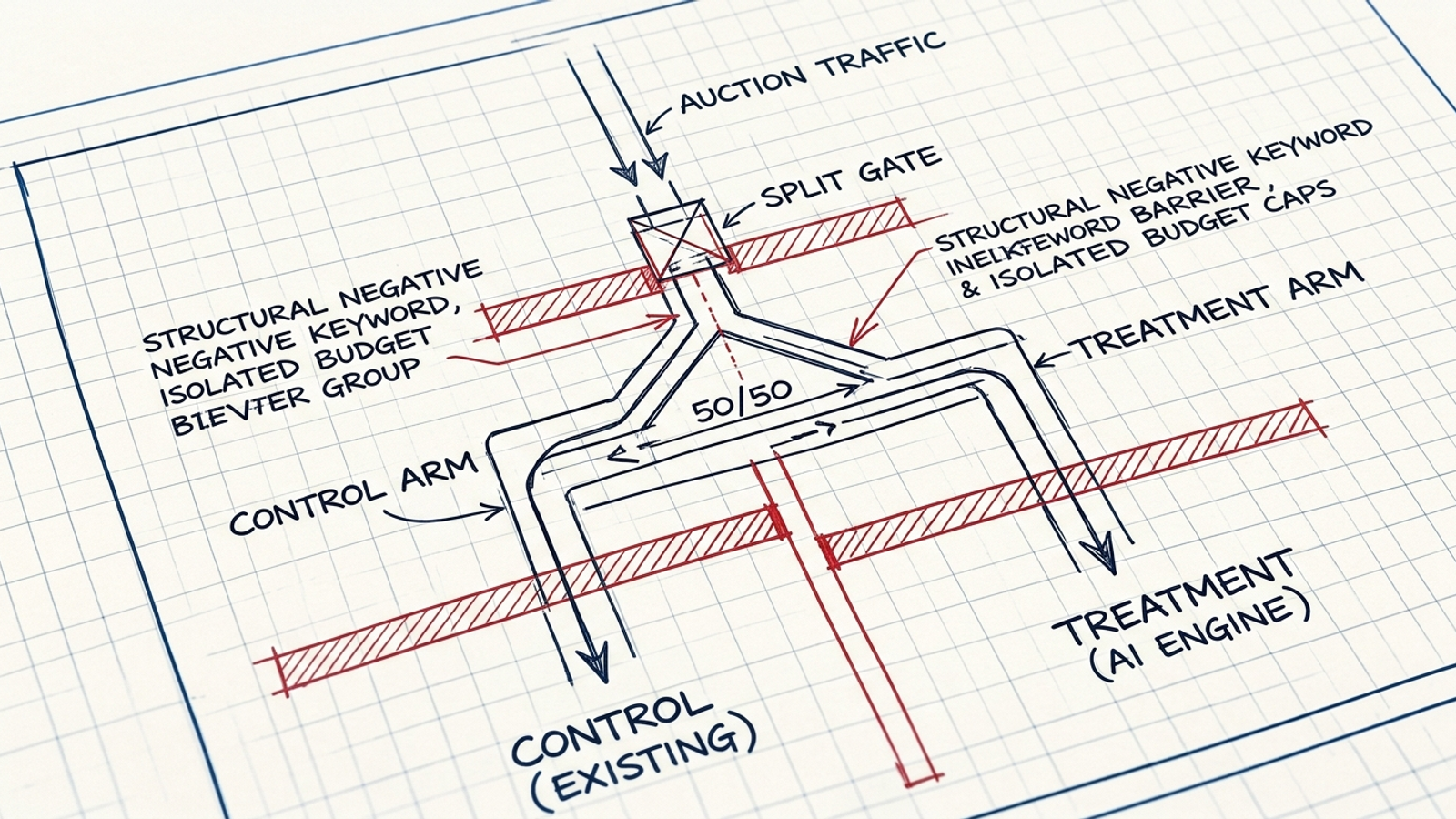
For standard Search campaigns, set up a 50/50 split in Google Ads Experiments. Assign the current operator to the control and the agent to the treatment. Both sides then face the same test period and a split of eligible traffic. That does not make every individual auction identical; it removes the much larger problem of comparing different months.
Where a suitable user-level split is not available for Shopping or Performance Max, use matched geographic markets. Pair territories using historical volume and conversion rate before assigning them to control or treatment. The draft pairing to investigate, for example, is Texas, Ohio, and North Carolina against Florida, Pennsylvania, and Georgia. Check the pairing against your history; state names alone do not make markets equivalent.
Do not give the agent high-intent core product campaigns while the incumbent gets expensive non-brand terms and call that a split. You have selected the winner before the test begins. If you cannot make the arms comparable, do not treat the result as evidence of lift.
Document who can change what before day one. The incumbent should manage the control under its normal operating rules. The agent should manage only the treatment. Neither side gets to alter the other arm’s bids, negatives, assets, or landing pages. Keep conversion definitions and any sitewide changes consistent across both arms, and record exceptions.
This matters particularly when an agent connects through an API or Model Context Protocol connector. Operators discussing business AI tools on Reddit call for explicit write boundaries, spend caps, and action logs. Put those boundaries in place before the connector goes live. A rollback for a serious problem is allowed; hiding it from the scorecard is not.
Give each arm its own hard daily budget cap. Google Ads Help documentation says campaign experiments do not support shared budgets across arms. More broadly, a shared pool makes it harder to tell whether one manager performed better or merely had different access to spend. Separate budgets and restricted write access are controls, not optional settings.
For lead generation, I would pre-register CPA on verified, non-spam conversions. For ecommerce, I would pre-register ROAS on net cart revenue after returns. Choose the measure that represents the business outcome, specify how it is calculated, and give both arms the same conversion source. Clicks, impression share, and ad relevance scores belong in the diagnostic notes, not in the victory column.
Set a practical hurdle before the first dollar is spent: for example, 15% lower CPA or 20% higher ROAS, depending on which metric you chose. A 2% gap would not persuade me to replace an operating model. The hurdle is a business decision, though, not a statistical significance test. Record how you will assess uncertainty and the minimum conversion volume needed to make a call. Otherwise, someone will discover a new definition of “success” on day 43.
A calendar deadline cannot manufacture conversions. An account with eighteen conversions after four days cannot tell you much about a small CPA difference, however confident its dashboard looks.
Konvtrack’s incrementality testing benchmarks put the scale in perspective: its estimates call for approximately 1,500 conversions per arm to detect a 10% difference, or roughly 375 per arm for a 20% difference. Those figures are planning benchmarks, not a promise that your six-week test will reach either target. If the account gets fewer than 50 conversions a month across all campaigns, expect a multi-arm test to be inconclusive.
Check expected volume before the split. If the planned evaluation window will not produce enough evidence for the difference you care about, record that limitation. You can still learn whether the connector executes changes, respects budgets, and creates work for your team. You cannot turn a thin sample into proof of CPA or ROAS lift by speaking firmly about it.
Treat the first two weeks as burn-in, not as part of the final performance score. Google Ads API experiment guidance says to disregard the first one to two weeks when evaluating automated bidding models or new features. Grow Wild Agency’s discussion of the learning phase describes roughly 50 conversions and 7 to 14 days per campaign for Smart Bidding calibration, with low-volume campaigns more prone to volatility.
That does not mean you ignore a runaway bid for fourteen days. Enforce the spend caps, inspect changes, and intervene if necessary. Log every intervention. Weeks 1–2 are excluded from the outcome comparison, not exempt from supervision. The planned scorecard covers weeks 3–6.
Every seven days, compare Google Ads Change History with the vendor’s account of what it did. If you are testing an autonomous paid ads management tool, look for changes that reached the account: bids adjusted, queries negated, assets paused or updated. A suggestion sitting in a notification feed is not an executed action.

This is the distinction I care about with groas: its specialized models execute bids, budgets, and query filtering continuously, and log actions with plain-language reasoning. In a test, that should be visible in the platform record, not merely asserted in a sales deck. Keep three columns each week:
Do not infer causation from a single weekly movement. The log is there to verify the mechanism and expose hidden labour. If an operator spends four hours a week repairing the agent’s decisions, put those hours beside the CPA or ROAS result. Automation that quietly creates a second management job is not a clean win.
Run this check every week. A tidy-looking 50/50 split is not enough if the treatment can take easier conversions or reach into the control.
If one of these leaks occurs, document when it began and what it affected. Do not quietly clean the chart and call the experiment controlled.
At the end of week 6, stop the evaluation window. After the planned maturation period, pull the same conversion cohorts and the same primary metric for both arms. Check volume, uncertainty, budget use, and the intervention log before making one of four calls:

If you are evaluating Ryze or alternatives to Ryze, inspect what you are actually buying. Does the product execute within your guardrails, or does it hand you a queue of suggestions? A self-serve connector that leaves budget troubleshooting and negative-keyword cleanup with your team has not replaced the operator. It has assigned the operator homework. I would rather test autonomous execution with a named strategist accountable for direction than mistake a busy notification feed for management.
Send any vendor or AI Google Ads agency these terms before the product deck turns into a debate about features:
A vendor willing to be measured should be able to discuss those boundaries. If an account executive insists on unrestricted brand access, offers only month-over-month summaries, or calls a control group unnecessary friction, decline the proposal. You would be funding the experiment while letting someone else write the answer.
If the agent clears the holdout, expand with hard budget guardrails and human ownership. Our runbook for putting Google Ads on autopilot safely covers that next step. If it loses, keep the current setup. If the evidence is thin, do not pretend a star rating fills the gap. Run the split, read the change log, and let the result change what you do next.
Run a concurrent holdout: put the current operator in a control arm and the agent in a treatment arm during the same period with comparable traffic. Reviews only show what happened to someone else's account, and comparing different months mixes seasonality and competitor changes into the result.
For standard Search campaigns, set up a 50/50 split in Google Ads Experiments with the current operator as control and the agent as treatment. For Shopping or Performance Max, where a user-level split may not be available, pair geographic markets using historical volume and conversion rate instead of comparing different months.
Give each arm its own hard daily budget cap and restrict write access so the agent manages only the treatment and neither side alters the other arm's bids, negatives, assets, or landing pages. Keep conversion definitions consistent across both arms and record every exception, including any rollbacks.
Choose one primary metric before spending starts: CPA on verified non-spam conversions for lead generation, or ROAS on net cart revenue after returns for ecommerce. Set a practical hurdle such as 15% lower CPA or 20% higher ROAS, and do not switch metrics if the first result disappoints.
Planning benchmarks cited in the article estimate roughly 1,500 conversions per arm to detect a 10% difference and about 375 per arm for a 20% difference. If your account gets fewer than 50 conversions per month across all campaigns, expect a multi-arm test over six weeks to be inconclusive.
Google Ads API experiment guidance says to disregard the first one to two weeks when evaluating automated bidding models, so weeks 1–2 are treated as burn-in and excluded from the performance scorecard. The evaluation window covers weeks 3–6, followed by a 14-day hold after week 6 so lagging conversions can mature.
Every seven days, compare the Google Ads Change History against the vendor's account of its actions, looking for executed changes like bid adjustments, negated queries, and paused or updated assets. A suggestion in a notification feed is not an executed action, so also log any rollbacks, repairs, or manual decisions and the operator time they took.
Three common leaks: brand query poaching, where one arm bids on your brand and claims high-intent conversions; budget or audience leakage from shared budgets or overlapping geo targeting; and conversion lag distortion, where recent weeks look expensive because conversions have not yet posted back. Isolate brand search, enforce separate budgets, and allow a 14-day post-test buffer before the final read.