

 LinkedIn

Don’t grant editing access until your new Meta agency signs a preservation agreement. Before anyone proposes a rebuild, I want three things in writing: what stays running, what justifies a pause, and who can authorize changes. A tidy account structure is not compensation for switching off the campaign paying the bills. Use this checklist during onboarding, with Ads Manager open and the incoming manager on the call. The first pass is an approval check, not a promise that every ownership or tracking problem takes five minutes to fix. If a line exposes a problem, resolve it before access changes hands.
Before access: establish ownership and protect the winners
- Confirm your business owns the account, assets, and billing. Check the owner of the ad account, Page, Instagram account, domain, and dataset, not just whether someone can see them. An asset appearing in your interface is not the same as your business owning it. Record anything held in the outgoing agency’s portfolio before approving the takeover.
- Common mistake: treating access as ownership. An ad account created in a portfolio stays there, and a pixel/dataset can be shared rather than transferred. If ownership is wrong, use the exception checks below; another invitation does not fix it.
- Keep full control of your business portfolio. Grant the agency access through Partners > Add > Give partner access, enter its Business ID, and select the agreed assets and permissions. Do not give agency staff full control of the portfolio because it makes onboarding convenient.
- Export the baseline before anyone edits anything. Save the last 28 days of spend, results, cost per result, attribution settings, and available change history. Download instant-form leads while they remain available. Keep these files somewhere your business controls, rather than relying on the outgoing agency to retrieve them after the relationship ends.
- Record IDs, owners, and partners for the portfolio, ad account, dataset, and audiences in one inventory. Add who controls the CAPI token or Gateway. The asset owner must grant the incoming agency access; the new manager cannot solve an ownership gap by accepting an invitation from the wrong party.
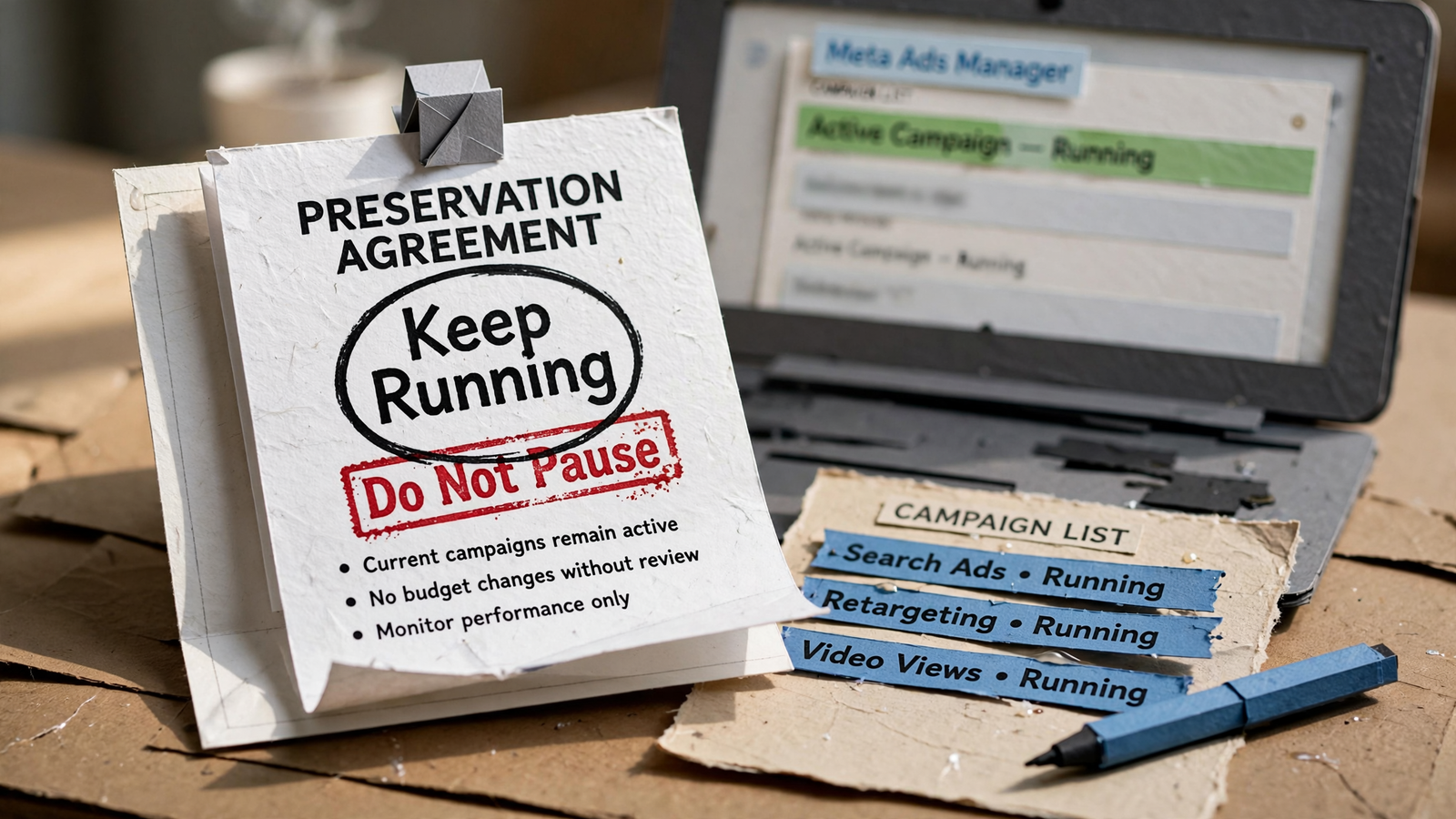
- Name the campaigns and ads that must stay running. Identify the one or two campaigns paying the bills, record their current CPA or ROAS, and exclude them from day-one edits. The preservation list must identify actual campaigns and ads, not say “protect performance” and leave the interpretation to whoever logs in first.
- Require a written reason before anyone pauses or materially changes a protected campaign. Changes to targeting, creative, or the optimization event can disrupt learning. The incoming agency should review the existing setup before changing it, not use a rebuild as its introduction.
Before approving the plan: lock the measurement and decision rules
- Put the business KPI, attribution window, and baseline beside every target. Specify whether success means qualified leads, purchases, or booked jobs. Record the last 28 days of spend and cost per result alongside the attribution setting. A target without its measurement rules gives the new agency room to change the scoreboard while claiming it improved the score.
- Common mistake: comparing ROAS reported under different windows. Attribution settings change the reported result, so label the window on both the baseline and subsequent reports. Do not approve a performance claim until the comparison uses the agreed setting.
- Require a tracking check before a structural rebuild. Confirm the dataset owner, domain verification, and that server events arrive in Events Manager Test events. Establish who controls the existing CAPI setup before removing access. Rebuilding campaigns on broken tracking buys faster bad data; it does not repair measurement.
- Check whether the token belongs to a system user in the agency’s portfolio and whether its Gateway sits in the agency’s cloud account. Where the setup depends on the outgoing agency, document the replacement work and verify events before cutting that dependency.
- Agree pause and scale rules before the first disappointing day. Base them on spend, conversion volume, and reporting delay. Write down what evidence justifies stopping a producing ad set and what budget changes need approval. “We’ll monitor it closely” is not a rule; it is a sentence that survives almost any outcome.
- Treat thresholds such as 2x target CPA with zero conversions, or a 20% budget increase over 48 hours, as proposals to agree—not universal instructions. The rule must account for the agreed KPI and reporting delay, otherwise a manager can pause before the results have caught up.
- Record why a significant edit is necessary. An ad set typically needs about 50 optimization results in a week to exit learning; that is a reason to avoid unnecessary disruption, not permission to ignore poor performance indefinitely.
- Name one accountable change owner and define approval boundaries. Write one name beside the handover, then separate changes the agency can make alone from changes requiring your sign-off. Budget adjustments within a cap and creative tests belong on one side; pausing a protected winner, changing the optimization event, and touching billing belong on the other.
- Keep asset ownership separate from day-to-day management authority. The agency can manage campaigns without owning your business assets. Write the cutover date beside the responsible person’s name so neither agency can treat responsibility as something the other one probably handles.
Before publishing: make tests earn their place
- Separate proposed tests from the campaigns funding the business. Put new creative, audiences, or optimization-event tests in a separate test campaign with its own agreed budget cap. State what the test changes and what stays untouched. The existing winner remains the baseline, not spare machinery for the incoming manager to dismantle.
- Common mistake: duplicating a winner for a test, then editing the original anyway. That removes the comparison the duplication was supposed to preserve. Require the plan to identify both the test and the protected original before anyone clicks Publish.
- Set review dates and require a change log with reasons. Put day 7 and day 30 in the calendar. For each change, record what changed, who changed it, why, and the expected effect on CPA or ROAS. Review the reasoning as well as the result; a screenshot cannot explain a decision.
- Use Meta’s change history and per-object activity history, but copy important decisions into your own sheet. Before hiring, ask for last month’s change log. Read whether the reasons make sense, not just whether the report contains an attractive ROAS number.
The go/no-go box: no blank lines, no editing access
- Ownership: My business owns the required assets and controls billing; the agency receives partner access, not ownership.
- Baseline: The last 28 days of performance, attribution settings, leads, and available change history are saved somewhere my business controls.
- Preservation: Protected campaigns and ads are named, with written conditions for changing or pausing them.
- Tracking: The dataset owner, CAPI dependencies, and Test events check are documented, including any work required before old access is removed.
- Accountability: One change owner, approval limits, review dates, and a rollback trigger are written down—not left in a meeting recording.
Apply the same standard to groas
- Make preservation a condition, not a courtesy. The ownership principle in what hiring a Meta ads agency should not mean handing over applies here: management access is not a reason to surrender the account, assets, or billing.
- Run the same 12 checks before granting access on groas. Put the KPI, attribution window, baseline, pause rules, and rollback authority in writing before work starts. A preservation-first approach is the alternative to an agency asking for trust while leaving the operating rules blank.
Schedule the cutover before two agencies start editing
- Set one cut-off date with one name attached. The outgoing agency stops editing when the incoming agency takes responsibility. Do not leave overlapping authority open-ended because someone has another creative idea to try.
- Use a short, explicit overlap: the incoming manager first receives read access and supplies the preservation list; editing access follows only after approval. The draft plan can use a 48-hour overlap, but access should not advance simply because the calendar says day two.
- Have the business owner grant the incoming partner access to the agreed assets and remove the outgoing partner in Business Settings > Partners. The incoming agency cannot grant itself ownership or permissions it does not have.
- Check Partners, not just People. Confirm that individual logins from the outgoing agency no longer retain access to the ad account or dataset. Removing a familiar name is not the same as completing the access check.
- Confirm which agency owns every pending test at the cut-off. Two managers editing the same ad sets can pause each other’s work and leave neither responsible for the result. One active decision owner is the point of the handover.

If the ownership check fails, stop the clean-handover fiction
- Resolve agency-owned assets before approving the media plan. If the ad account was created inside the old agency’s portfolio, do not promise yourself a normal transfer. Record which assets can remain available through sharing and which require a business-owned replacement.
- Create the business portfolio in your business’s name and keep control of any replacement dataset. Where a new CAPI token is required, establish it under your business’s system user and verify server events in Test events.
- Do not cut the old tracking dependency before its replacement is verified. Write the transition steps, the responsible owner, and the conditions for moving spend into the preservation agreement. A new dataset is not a reason to pretend the measurement history has followed it.
- Keep the producing campaign running while the ownership problem is resolved wherever the existing arrangement allows it. A provider insisting on a day-one rebuild still needs to explain how sales continuity survives that decision. “Cleaner structure” does not answer the question.
Keep evidence your business can retrieve without asking permission
- Save the handover pack outside the agency’s control: the 28-day performance export, instant-form lead CSV, available change-history export, preservation agreement, and inventory of asset IDs, owners, and tracking dependencies. Give the folder an owner, just as you give the account a change owner.
- Download time-sensitive records now. Historical reporting and lead downloads have different availability limits; do not assume that because an old campaign remains visible, every record needed for the handover will remain downloadable too.
- Keep the signed baseline beside the change log. At the day-7 and day-30 reviews, compare the agreed KPI under the agreed attribution setting, then inspect the decisions behind any change in results. Do not let a new reporting layout replace the original agreement.
- Read each approval line aloud on the onboarding call and get a yes in writing. An agency willing to document winners, pause rules, and authority gives itself a baseline to beat. Pushback on those basics tells you what the next review meeting will sound like.
The final requirement: someone must own the rollback
- Agree who can stop or reverse a change—the item most often skipped. Name the person, the response time, and the trigger before granting editing access. The trigger might be a tracking break, spend beyond an agreed CPA threshold, or a 30% week-over-week rise in cost per qualified lead. Choose the applicable rule rather than copying all three without thought.
- Specify what happens next: who stops the test, who restores the prior setup where possible, and who records the reason. A named reviewer without authority to act is another ticket queue, not a rollback plan.
- The cost of leaving this blank is continued spend while everyone waits for someone else. Say the account spends $20k a month: the rollback name still costs one sentence to write. Leave it unwritten, and a paused winner can spend days disrupted while reporting catches up and both agencies explain. Get the name and trigger in writing before anyone touches the account. Start with preservation, not a rebuild.


