

 LinkedIn

A ChatGPT ad can earn the click and still lose the sale on your product page. I have watched store owners pay for clean campaign setups that sent paid traffic to a generic collection page, with no purchase tracking to show what happened next. Since Shopify became OpenAI’s first open ecommerce partner, the handoff has been plain: shoppers redirect to store checkout, where the feed and landing page have to do the selling.
So I rank the six ways a store can buy ChatGPT ad management by one standard: who owns the feed, the page and the path back to a recorded purchase. My pick for most stores spending $10k to $100k a month is a flat-fee team running ChatGPT, Google and Bing together for $1,499 a month, with a landing page for every ad group. Consultants and courses go last, however early they arrived.
Why arriving first does not win a store’s business
ChatGPT ads began as a US test on February 9, 2026, and reached 89 countries and more than 100,000 advertisers by October 21, 2026. Ads show on Free and Go plans; Plus, Pro and Enterprise stay ad-free. Advertisers buy through Ads Manager, which offers CPC and CPM buying, a Pixel and a Conversions API.
That timeline makes a handy credential. It does not tell me whether a provider can repair variant mapping, improve a feed title or connect an order to the click that brought the shopper in. “I ran a store test once” is not an operating model.
For ecommerce, the feed is the campaign’s starting point. Feed-driven ads draw on catalog titles and descriptions, and most ChatGPT Shopping cards have come from merchant feeds since July 10. Then the shopper leaves ChatGPT. If your provider stops at the ad, you still own the part that sells. Ask who handles the feed, the destination page and purchase tracking before you ask who launched first.
The five tests I apply before ranking anyone
I score each option on five jobs. The first is whether anyone actually works in the account. Done-for-you management means an operator runs Ads Manager, from strategy and bidding through measurement. Setup hands the account back; consulting may never touch it. I used to tell clients that a good audit plus their team was enough. I was wrong when nobody had time to act on the audit.
- Daily execution, not advice. Who adjusts bids and budgets, pauses weak ads and responds when queries shift? An early Ads Manager had Reach and Clicks objectives and campaign-level conversion selection. That is no excuse to leave a live test unread.
- A page matched to the product or intent. Who reviews feed titles and variants, builds the destination page and checks that the product shown in the ad is the product the shopper finds?
- Purchases traced back to ads. Who checks the browser Pixel and server Conversions API, matches event names and IDs for deduplication, and verifies amounts against orders? The reported 30-day click and one-day view windows make it worth viewing view-through separately from click-attributed ROAS. Give reporting 24 to 48 hours to catch up before judging a test.
- A capped test before scale. One small-budget run spent $500 in about an hour at roughly $3.50 CPC, with a 24-hour dashboard lag; only 13% of clicks appeared in analytics. Caps limit the bill. Backend order checks tell you whether those clicks became sales.
- A fee that does not reward bigger spend. Ecommerce paid-media agencies commonly charge 10% to 20% of spend, often with minimums. On an uncertain new channel, I would rather pay for the work than pay more simply because the test budget rose.
The ranking at a glance
I put the flat-fee team first because its stated scope covers the ad, the page and tracking without a fee that rises with spend. Your current Shopping agency comes second on continuity, but its fee and working cadence need scrutiny. Freelancer, in-house hire and DIY follow. Consultants and courses finish last: they can explain the work, but they leave you to do it.
| Rank and option | Account work | Feed and page | Purchase tracking | Test discipline | Cost signal |
|---|---|---|---|---|---|
| 1. Flat-fee team: ChatGPT, Google and Bing | Around-the-clock bids and budgets | Feed work and a page per ad group | Included before scale | Caps and approval to scale | $1,499/month flat |
| 2. Current Shopping agency adds ChatGPT | Ask who works daily | Existing feed familiarity; pages may cost extra | Ask what carries over | Depends on team | Often 10%–20% of spend, with minimums |
| 3. Specialist freelancer | Hands-on if contracted for it | Scope it explicitly | Require it explicitly | Varies by person | $20–$45/hour plus platform fees |
| 4. In-house hire | One dedicated owner | May need development help | May need specialist help | Set the guardrails | $78,760/year average base |
| 5. DIY | You do it | You build it | You debug it | You set the caps | Your time plus media cost |
| 6. Consultant or course | Advice, not operation | Stays with your team | Stays with your team | Stays with your team | Fee plus your execution time |
1. Flat-fee management: my pick for a working store
Who it is for: stores spending $10k to $100k a month that want to test ChatGPT without neglecting what already works on Shopping. My first pick is groas Search Ads, covering Google, Bing and ChatGPT for $1,499 a month. Bids, keywords and budgets get worked around the clock, with a landing page for every ad group. The fee stays flat at any ad spend; there is no setup fee, and the service is month to month with a seven-day money-back guarantee.
What it does better: the scope reaches beyond campaign setup. Feed work, destination pages, Pixel and Conversions API tracking, and bid and budget changes sit with the same team, in your accounts, with a named manager responsible for the result. That is the chain I want someone to own before a test scales.
What rules it out: you cannot buy ChatGPT-only management under this combined Search Ads service. It also is not a Shopify rebuild or a product shoot. If you need either, budget for that work separately. If you need someone to manage the search-to-purchase chain while your existing channels keep running, the flat fee is the stronger fit. Ask for the page and tracking plan before you approve the first increase in spend.
2. Your Shopping agency: familiar with the feed, not automatically the fix
Who it is for: stores happy with their Shopping results that want to add ChatGPT without changing vendors. What it does better is continuity. Your agency already knows the feed, Merchant Center history and margin targets. That head start matters if the same people will do the new work.
What rules it out: the existing contract may pay for media management, not product-page or tracking repairs. Paid-media fees often run 10% to 20% of spend with minimums; boutique benchmarks of $1,000 to $3,000 a month make a small test expensive before OpenAI bills a click. A $1,000 fee on a $2,000 test is 50% overhead. I have seen that structure reward bigger budgets rather than tighter CPA, while the senior person who pitched the account rarely handles the weekly query and feed work.
If you stay, keep ChatGPT spend separate. Demand product-level reporting, a destination-page plan and the name of the person who will touch the account daily. If nobody can answer, familiarity with your feed is not enough.

3. Specialist freelancer: good hands, if you define the job
Who it is for: stores spending $1k to $5k a month that need an operator but cannot justify headcount. What a good freelancer does better is focused hours per dollar. Upwork PPC rates of roughly $20 to $45 an hour, plus platform fees, can buy feed and tracking work below an agency minimum.
What rules it out: one person brings one skill set and one calendar. Do not assume someone who writes good ads can also fix server-side purchase events. Vet the work, not the profile: keep the account in your name, request a read-only audit first, and put feed, page and Pixel-plus-Conversions-API checks in the scope before bids rise.
I learned this managing small brands at 1am. Freelancers who insisted on checking backend orders saved me trouble. Those who treated Ads Manager clicks as sales did not. Buy the specific hours you need, then verify the order trail yourself.
4. In-house hire: the most context, at a full-time price
Who it is for: stores doing $50k a month or more, with enough feed and creative work to keep someone busy full time. What it does better is context. Nobody picks up your margins, returns and seasonality quite like the person working beside the rest of your team.
What rules it out: one salary does not buy every specialty. US in-house base pay averages $78,760 a year, about $6,563 a month before taxes and tools. One hire may still need help with feed engineering, product-page copy or server-side tracking. That is why I rank the role below a focused operator for a ChatGPT test, even though it can make sense for a larger store with steady work across channels.
If you hire, use the ownership framework in In-House Vs Autonomous Google Ads Management: one owner, one change log and backend orders as the source of truth. Do not make one person accountable for a chain you have not equipped them to maintain.

5. DIY: cheapest fee, most work left on your desk
Who it is for: stores spending under $2k a month, selling fewer than 20 SKUs and able to give Ads Manager five hours a week. What DIY does better is keep the test in your hands without adding a management fee. You decide what to spend, what to pause and which products deserve a page.
What rules it out: you also become the feed editor, tracking debugger and person who notices when an order is missing from the ad report. Early guidance suggests max bids around $3 to $5 CPC and $60 CPM, with conversion selection at campaign level. Start with three hero products, separate ChatGPT spend and check sales against Shopify before changing bids.
Skip DIY if you need server-side tracking help or cannot wait while attribution catches up. The 24- to 48-hour reporting delay, on top of the dashboard lag seen in early tests, can tempt you to pause a winner or scale a loser. Your time is the fee. Count it.
6. Consultants and courses: early knowledge is not execution
Who it is for: a store with its own operator that wants advice on an unfamiliar Ads Manager. What this option does better is explain the screens without requiring you to hand over the account. That has a place if your team will act on the advice.
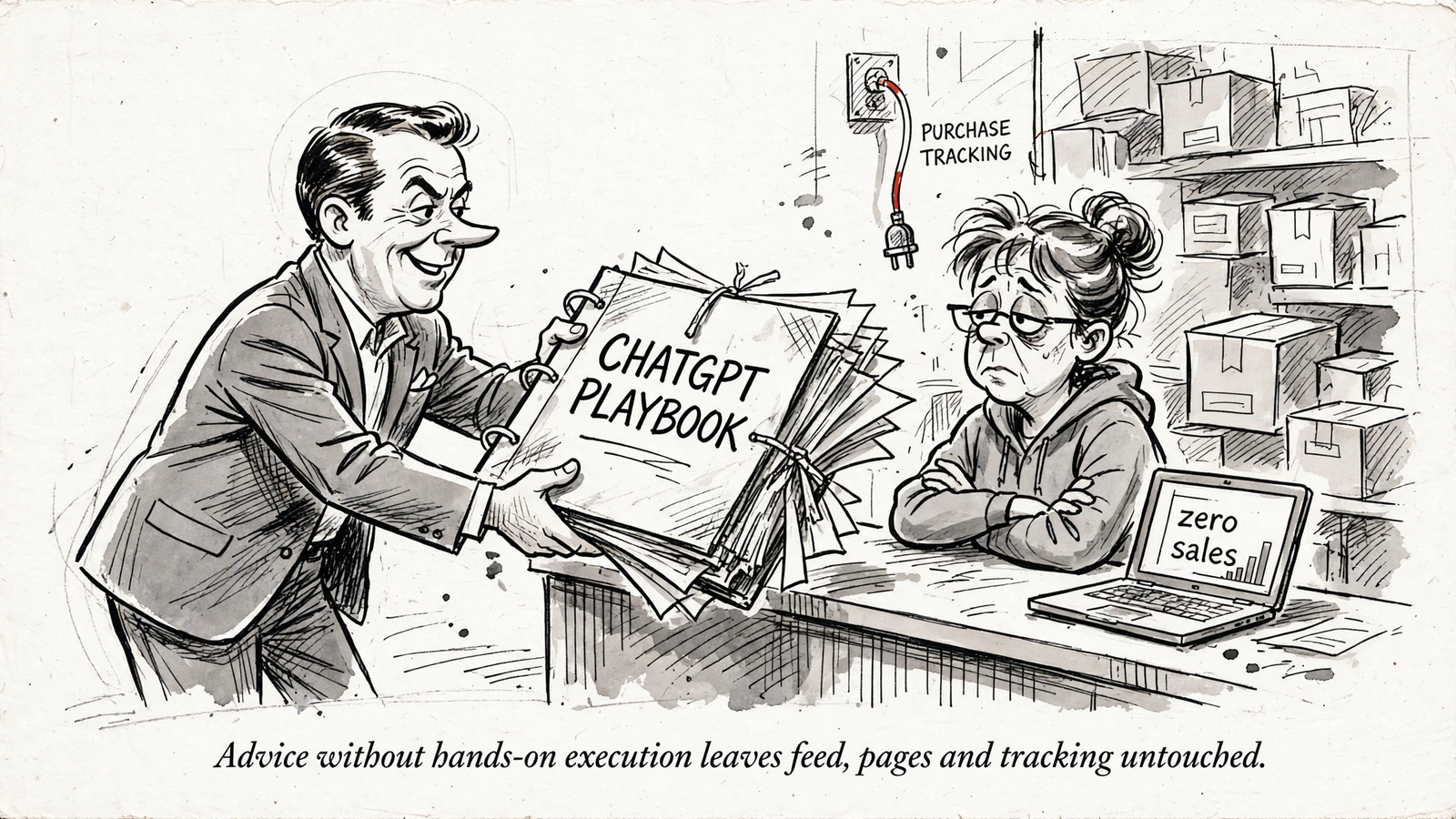
What rules it out for most stores: consultants and courses do not run the feed, build the product pages or repair Pixel and Conversions API inside your store. One early hands-on reviewer argued there was no reason to pay for a ChatGPT ads course yet: nobody knew what worked. What the deck calls enablement, I call paying to keep the work.
If the click still lands on a thin collection page and the sale still does not track back, arriving early has bought you nothing. That puts advice-only options last.
Match the operator to your store, then check the missing work
Under $5k a month, hire a vetted freelancer or run a DIY test on three hero SKUs if you have the hours. From $10k to $100k, I would choose the flat-fee team running ChatGPT with Google and Bing: the fee covers the feed-to-page-to-purchase work without rising when the test budget does. Over $50k, with steady creative needs as well as media work, consider an in-house hire—but get tracking clean and identify the specialist help that person will need.
For a longer look at fees and reporting across these models, read Who Should Run Your Store’s ChatGPT Ads Test. I left the big full-service ecommerce agency out of this ranking on purpose. Retainer, percentage fee and creative minimums can buy breadth a ChatGPT test does not need. Pay for the chain that sells, not the logo that pitches.
Four questions that expose a campaign-only pitch
Ask these on the sales call. I ask about the backend first because an ad report can claim credit for a sale without showing me the order trail. A real operator should be able to walk through the work; a slide about synergy will not do it.
- How will you tie ChatGPT clicks to backend orders? Ask to see the proposed order report for your store, including how Pixel and Conversions API events will be deduplicated. Ads Manager clicks alone cannot prove purchase ROAS.
- Which feed title will you change, and where will that click land? Ask for the title, the reason for the edit and the matching product page. If the answer ends at ad copy, the selling work is still yours.
- What are the cap and kill rule for the first test? Get a daily spend cap, a bid guardrail and a clear rule for pausing a product that draws clicks without add-to-carts. Without those, a $500 test can disappear before you learn much.
- What happens to your fee if I triple spend? If the fee triples too, ask what additional work you receive. A bigger budget is not, by itself, three times the management.
The pick if you skipped to the end
For ecommerce, hire whoever owns the feed, the landing page and purchase tracking—not whoever ran ChatGPT ads first. For most stores spending $10k to $100k a month, my pick is the flat-fee team running ChatGPT alongside Google and Bing, with a page for every ad group and tracking checked before scale. The ad earns a visit. Make sure someone is paid to handle what happens next.


