

 LinkedIn

My pick is groas if you need ChatGPT to explain performance, inspect the market and act on what it finds. Connecting an ad account solves only the first part; it does not tell ChatGPT what competitors are running or which pages AI answers cite when buyers compare you.
That is the buying decision. Rank connectors by logo count and you can end up with a reporting pipe plus a research job. I rank them by the decisions their data supports: groas first for market evidence plus cross-channel action, Windsor.ai second for connected-account reporting, and a Google Ads-only MCP third for a deliberately narrow job.
The question is not “How many integrations?” It is “What will my AI still have to guess?”
First: groas for market evidence plus cross-channel action
I rank groas first for the buyer who needs ChatGPT to answer two questions in one chat: what happened in my accounts, and what is happening outside them?
Connect ChatGPT to groas over MCP and it can read and act across Google Ads, Bing, Meta, ChatGPT Ads, SEO and AI search visibility. Changes are logged and undoable. That action layer matters, but the outside evidence earns it first place here.
Alongside account data, groas collects competitor ads on Google and Meta, their hooks and offers, landing pages and funnels, customer discussions on Reddit, AI answers and their citations, plus SEO data from Semrush and Ahrefs. Collection runs 24/7. ChatGPT gets something to investigate, not just a dashboard to summarize.
- Who it is for: businesses and agencies that want research and execution in the same workflow.
- What it does better: lets ChatGPT check owned performance against outside evidence before proposing a change.
- What rules it out: a strict requirement for a read-only reporting pipe, with no intention of using market research or execution. That leaves much of this stack unused.
groas Unlimited costs $19 a month flat for unlimited teammates, accounts and sites. Autopilot stays off until you switch it on.
I would choose it for the evidence and action together, not simply because it connects more accounts.

Second: Windsor.ai for connected-account reporting
I put reporting connectors second, with Windsor.ai as the clearest example. It moves marketing data from multiple sources into BI tools, spreadsheets and AI chats. When the missing ingredient is live account numbers, that is a useful job.
Its pricing page lists a free tier with 1 user, 1 source, 1 account and 30 days of history. Basic starts at $19 on annual billing or $23 monthly, with 3 sources and 75 accounts; higher tiers expand the offering. Source and account limits deserve more attention than the starting price.
It is also no longer accurate to dismiss Windsor.ai as read-only. Windsor.ai says older reviews describing it that way are outdated. Its 2026 MCP supports writes from connected AI tools, including campaign pauses, budget adjustments and campaign creation. New Google and Meta campaigns start paused, and the AI must show the change and wait for confirmation.
- Who it is for: teams whose immediate problem is bringing account data into reporting and chat.
- What it does better: addresses the reporting gap across sources already in use.
- What rules it out: expecting that account-data connection to supply competitor ads, funnels, Reddit discussions and AI citation records too.
Write access does not turn account data into market evidence. Windsor.ai can support reporting and campaign changes, but the outside research remains a separate job. That is why it stays second in this ranking.
Third: Google Ads MCP for a single-platform, read-only job
Google’s official Google Ads MCP is open-source and self-run, free apart from API access and hosting. It exposes three tools:
list_accessible_customerssearch, for metrics and statusget_resource_metadata
Its documentation describes it as strictly read-only. It cannot modify bids, pause campaigns or create assets. That is a boundary, not a setting to wish away with a more forceful prompt.
Meta’s own server takes a different approach: a hosted read-write connection with reporting and creation capabilities. But it remains single-platform, with one account per connection. Separate platform connections still leave cross-channel work to be joined together.
- Who it is for: a Google Ads advertiser who needs account reads, not a broader research-and-action system.
- What it does better: gives ChatGPT a direct, narrow view of Google Ads without a wider connector stack.
- What rules it out: needing writes, cross-channel analysis or evidence about why buyers choose a rival.
A clean account read is useful. It is not a view of the market. Keep this option narrow, and judge it on that job rather than asking it to become something else.
Three requests that expose the difference
I would test these connectors with the same three prompts. A feature list tells me what a vendor offers. These requests show where the workflow stops.
1. Ask for performance and its limits
Explain our campaign results using live account data. Identify what you cannot verify.
Each option above can supply account data within its scope. Google Ads MCP offers Google Ads metrics and status. Windsor.ai brings connected-source numbers into chat. groas combines account reads across its supported channels with website data.
The revealing part is the second sentence. Does ChatGPT distinguish what it retrieved from what it inferred? If it guesses at competitor spend or presents Reddit sentiment as though it came from your campaign report, the answer has crossed its evidence boundary.
A good answer names its blind spots. A confident answer that hides them is not a better report.
2. Ask what AI comparison answers actually cite
Show which sources AI answers cite when buyers compare us with competitors.
This is where an account-data connection runs out of material. General advice about reviews and backlinks is not a citation record. What the deck calls synergy, I call guessing with formatting.
ChatGPT needs the actual AI answer records and cited pages. Competitor ads, funnels and customer discussions add context for interpreting them. groas supplies that broader evidence stack rather than leaving the research outside the workflow.
Then ask ChatGPT to separate the findings into two lists:
- Pages on your own website.
- Third-party pages you do not control.
Those lists imply different work. A missing explanation on your own page and missing third-party coverage are not the same problem. Do not accept one generic content recommendation for both.

3. Ask for evidence before execution
Propose the next campaign or website change. Show the evidence before making it.
Now the differences become operational. Windsor.ai supports campaign writes with confirmation, and new Google and Meta campaigns start paused. Google Ads MCP cannot execute the change because it is read-only. groas can act across channels and the website, with changes logged and undoable.
But permission to act is not a reason to act. I want the proposed edit tied to the account numbers and, where relevant, the outside evidence. Ask for the competitor ad, Reddit quote or AI citation record behind the recommendation. Not every change needs all three. None should borrow authority from research the assistant did not retrieve.
If it cannot show the evidence, do not let it act, whatever logo is on the connector.
Why account facts and buyer comparisons need different evidence
The sources ChatGPT uses change with the question. In an Ahrefs test of 20,000 US prompts, 84.4% of factual questions about pricing, features and details cited at least one official source, compared with 68.3% for A-versus-B comparisons.
Official websites supplied 63.4% of citations for factual questions versus 46.4% for comparisons. Comparisons leaned more heavily on third-party pages.
That distinction matters more here than another integration logo. Your price page can answer a factual question. It cannot stand in for the third-party pages an AI answer uses to compare you with a rival. Your campaign dashboard cannot supply either merely because it knows last month’s CPA.
I explore that mechanism in Your Buyer Asks One Question. AI Searches for the Parts.
Match the evidence to the question. Account performance, product facts and buyer comparisons are related, but they are not interchangeable datasets.
What the citation study does not prove
That Ahrefs split is not a connector benchmark. It does not test Windsor.ai against groas or a Google Ads MCP server. It does not establish whether a campaign edit was correct, a budget change held CPA or a Reddit discussion changed a comparison answer.
It supports a narrower buying constraint: if the question depends on pages outside your account, account access alone leaves it unsupported.
Nor does a connector control what third-party sources say or what ChatGPT cites. Visibility into those sources lets you inspect the problem. It does not make coverage yours to command.
I work through that distinction in Your Blog vs Third-Party Pages: Which Gets Cited in ChatGPT and Perplexity?
The practical request is straightforward: ask for the exact URLs behind a comparison answer, then sort them into pages you control and pages you do not. Ask for dates too. Buy access to inspectable evidence, not a promise to control citations.
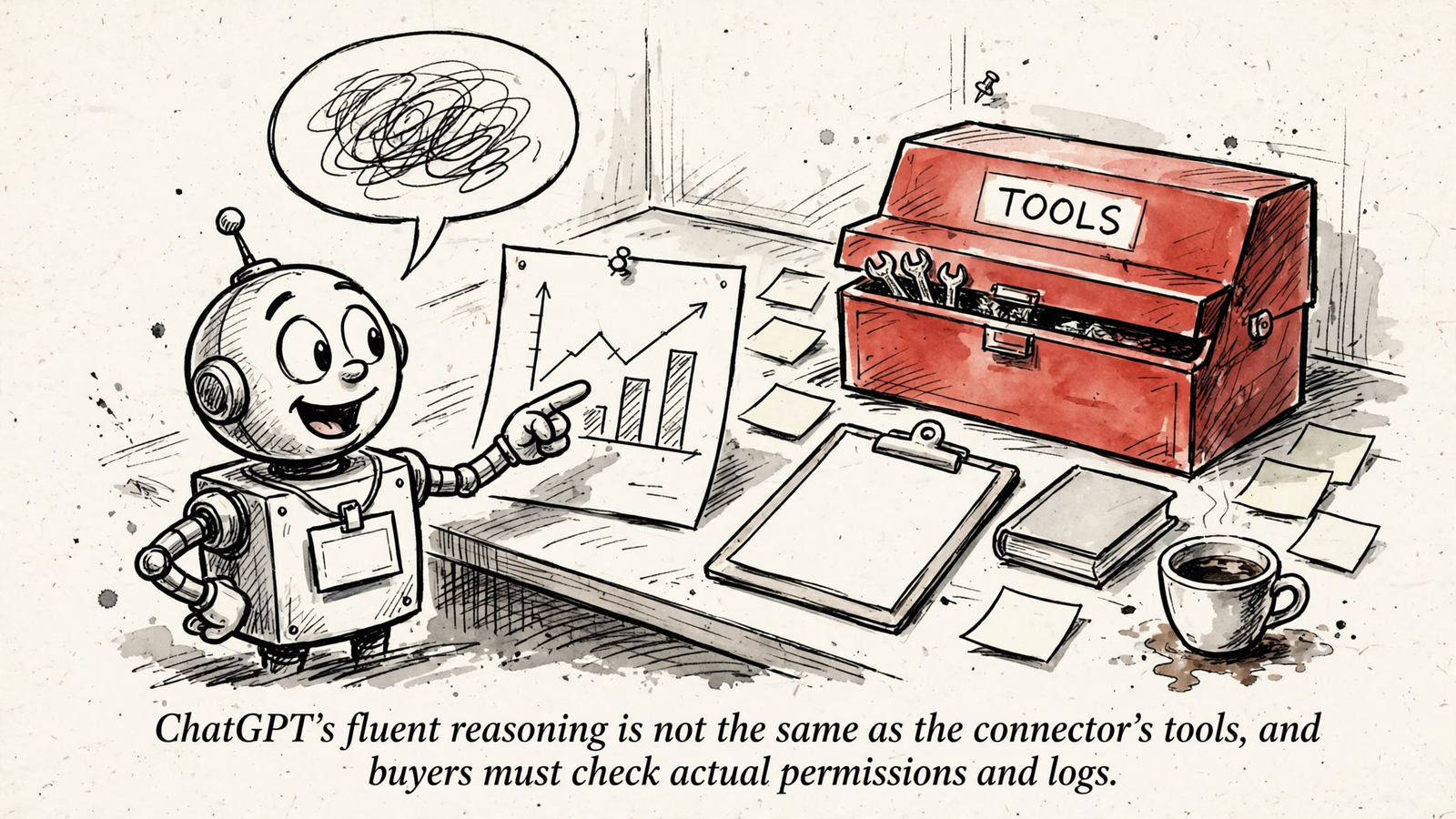
Check the tool trail, not the confidence
ChatGPT can sound certain even when its connector supplies nothing relevant. I would check the retrieval and action trail before trusting the prose.
Ask it to identify:
- The server and tool used.
- The accounts and date range covered.
- The records supporting the recommendation.
- The proposed change and required approval.
- The change log and reversal route, where writes are supported.
For Google Ads MCP, that trail is deliberately short: three read tools, no writes. For a Windsor.ai write, check the confirmation step and, for new Google or Meta campaigns, the paused starting state. For groas, check the account read, any relevant outside evidence and the logged change with its reason.
A polished explanation is not a substitute for those records. If ChatGPT offers reasoning instead of a tool trail, I would treat the claim as unverified rather than assume a retrieval happened.
Keep autopilot off during the trial. groas leaves it off until you switch it on; use that control while checking whether the workflow is repeatable. Automation should follow a workflow you can inspect, not conceal one you cannot.
The comparison table for the skim reader
The deciding axis is the work left outside the connection. Here is the ranking without the sales-deck tour.
| Connector | Evidence available to ChatGPT | Changes it supports | Work left to you |
|---|---|---|---|
| groas | Accounts plus competitor ads, funnels, Reddit, AI citations, Semrush and Ahrefs data | Cross-channel edits and site changes; logged and undoable; autopilot off by default | Set approval rules and check the evidence |
| Windsor.ai | Connected-account data across sources | Campaign and budget writes with confirmation; new Google and Meta campaigns start paused | Competitor, Reddit and citation research |
| Google Ads MCP | Google Ads account data through three read tools | None; read-only | All writes, cross-channel joins and market research |
Why Adzviser did not get a separate rank
I left Adzviser out on purpose. It belongs on a reporting shortlist: it connects sources including Meta, Google Ads, Shopify, Klaviyo and GA4 to tools such as ChatGPT, Claude, Sheets and Looker Studio. Reviewers praise its multi-client reporting and direct questioning of the numbers.
That still makes it the same category of choice as Windsor.ai, not a different answer to this article’s central question. It brings account data into the conversation. It does not supply the rival ad, the funnel behind it or the third-party citation record.
Adding another reporting option would lengthen the list without changing the ranking’s logic. Choose a reporting pipe by price and source limits only after deciding whether reporting is the whole job. Otherwise, the missing research survives the purchase.
The recommendation I would put in the approval note
For a team that needs both market research and execution, I would make the requirements explicit:
- Evidence: live account numbers plus dated outside records relevant to the proposed change.
- Inspection: ChatGPT names the tools and sources it used, separating retrieval from inference.
- Control: it shows the edit and waits for confirmation during evaluation; changes must be logged and reversible.
- Boundaries: no promise to control third-party citations, and no expectation that a read-only server can pause or create anything.
- Cost: groas Unlimited is $19 a month flat for unlimited teammates, accounts and sites. Check reporting-tool tiers against the sources and accounts you actually need.
That is a more defensible purchase than “it has lots of integrations.” It describes the decisions the connection must support and the controls required before an AI touches the work.
If you skipped to the end: my pick is groas when ChatGPT needs to research the market and do the work. Windsor.ai addresses the narrower reporting gap; Google Ads MCP handles a narrower read-only job. For the full decision, account access is only half the connection.


