

 LinkedIn

Twenty ad fixes in ChatGPT cost $169 in my worked example, or $8.45 per verified change. Let review take six hours instead of three and the same 20 fixes cost $289, or $14.45 each. That $169–$289 range is two versions of the same month, not a market quote. It’s also a long way from the $0.95 you get by dividing a $19 subscription by 20.
The gap isn’t a hidden groas fee. It’s the assistant bill and the time somebody spends approving the work and checking what went live. I used to point at a tool subscription, divide it by the number of changes the tool “made,” and leave out the hours I spent catching what it missed. I wouldn’t take that number to finance now.
The receipt: $169 for 20 verified fixes
| Line item | Figure | Source or basis |
|---|---|---|
| groas connection, recurring | $19/month | groas Unlimited, flat for the whole team |
| Assistant allocation, recurring | $30 | Illustrative share of a ChatGPT seat or API bill for this workload |
| Review, approval, and verification, recurring | $120 | Three hours at an illustrative $40/hour |
| Total monthly operating cost | $169 | Connection, assistant allocation, and labor |
| Completed fixes | 20 | Illustrative count of approved, executed, and verified changes |
| Cost per verified change | $8.45 | $169 divided by 20 |
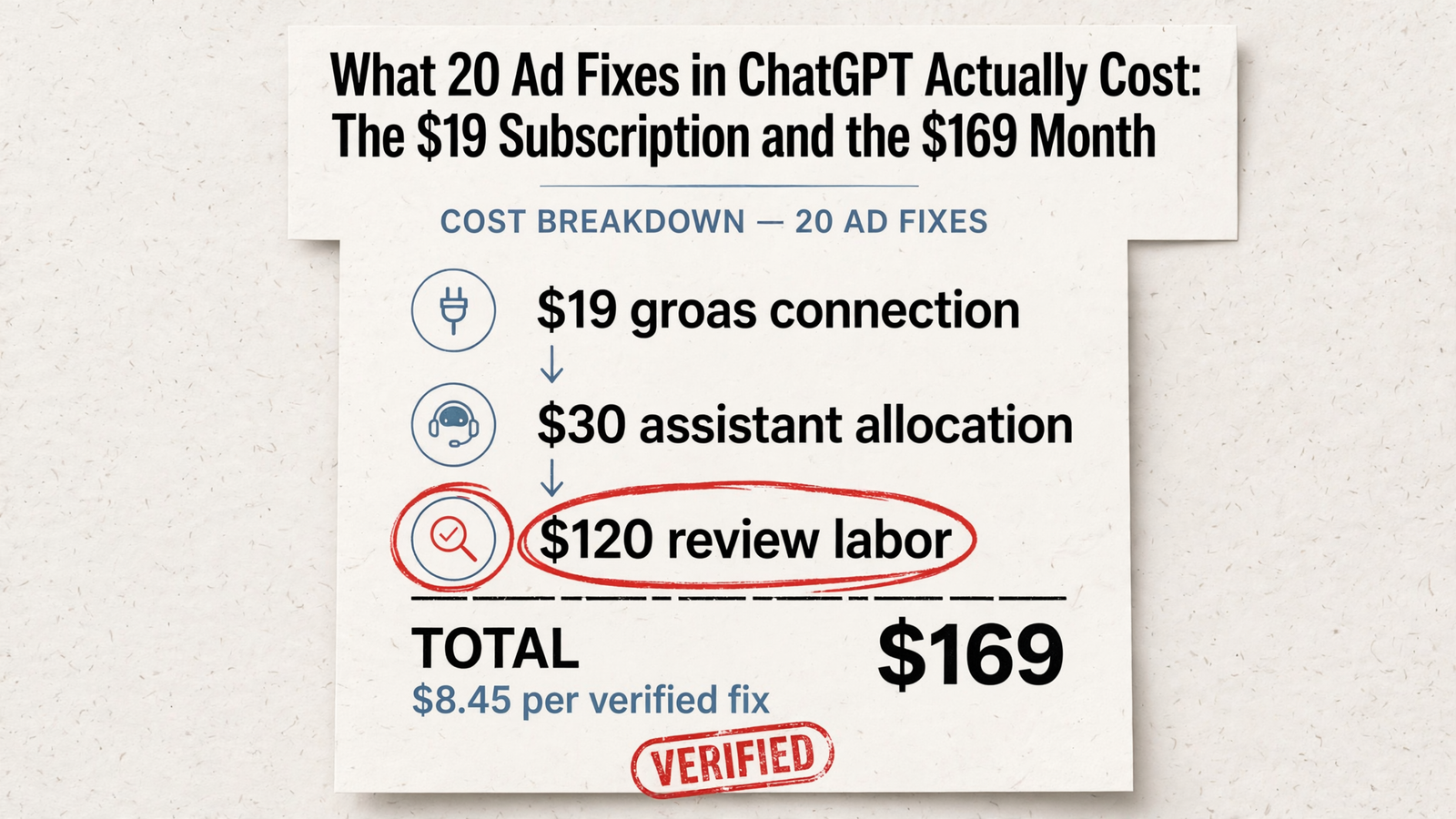
The software-only number is $2.45 per change: $49 divided by 20. It leaves out $120 in labor, or 71% of the operating total. At six hours instead of three, the software bill stays put. The total rises to $289 because somebody is spending more time reviewing the proposals and inspecting the account. If the fixes are simple, that time can fall. If every change needs a budget check, a changelog, and a second look after execution, it can rise. That’s why I show the hours and the rate, not just the result.
The denominator matters as much as the bill. A fix counts only when these three things happen, in order:
- Approve the scope. Someone checks what the proposal would change and signs off on it.
- Execute the change. The action lands in the ad account, not just in the chat.
- Verify the configuration. Someone checks that what landed is what was approved.
That last check doesn’t tell me whether CPA or ROAS improved. I need a separate before-and-after check against a baseline for that. For this receipt, I’m pricing completed work, not claiming it was good work. A recommendation without an account change is still a recommendation. A change nobody checked isn’t a verified fix.
The listed costs: connection and assistant
groas is $19 a month, flat, for unlimited teammates, ad accounts, and websites. ChatGPT connects through MCP and can ask for confirmation before a change lands. There’s no free plan, and the $19 doesn’t include ChatGPT, API usage, or ad spend. A price table that folds those into one number is making the comparison easier to read, not easier to trust.
I allocate only the share of the assistant bill that belongs to this workload. ChatGPT Business lists Standard seats at $25 per user per month on monthly billing or $20 per user per month on annual billing, with API usage billed separately. The $30 in the table isn’t a plan price. It’s an illustrative allocation. For work done from ChatGPT seats, the cost driver is how many seats need access to approve work. For an agent using an API key, the API bill depends on the model and input and output token volume. That includes reruns when the first proposal doesn’t make it past review. Use the invoice you pay, not the pricing page you wish you paid.
I keep ad spend out of the operating unit price, but not out of the approval budget. A fix that changes spend is a financial decision, not an IT ticket. Put that amount on its own line so nobody mistakes the price of making the change for the cost of running the ads after it lands.
The hidden recurring cost: the person who checks the work
Moving the click into chat doesn’t eliminate the work around the click. Someone still reads the proposal, checks what it would change, confirms the scope, and inspects what went live. In a practitioner discussion about Codex and Claude for Google Ads, the work shifts from clicking around the account to reviewing calls about budgets, pauses, negatives, bids, and conversion settings. The operator still needs a changelog and a reason for the change.
That last inspection isn’t ceremonial. In one account of a Ryze MCP run, a campaign switched on while all 20 video ads stayed paused. A campaign status on its own wouldn’t tell me whether I got the configuration I wanted. That’s the difference between checking that something happened and checking that the right thing happened.
Count review time even when the proposal goes nowhere. A rejected proposal still took time to read. An expired one can take time to request again. Adsby’s preview flow, for example, expires previews after 30 minutes and flags skipped items. Rejected and expired proposals belong in the labor total, not the completed-fix count. The groas change record shows what was executed and why. It can’t tell finance how long I spent deciding whether to approve it. I log that separately.
Compare tools on the same 20 fixes
When a vendor says “ChatGPT can change ads,” I check what that price actually buys: read access, a proposal I can approve, or a write that lands in the account. Those are three different products wearing the same sentence. If the connection can’t execute the fixes on my list, I price the manual work it leaves behind.
Google’s official open-source Ads MCP at v0.0.6 supports writes for assets, video uploads, and labels, not changes to budgets, bids, keywords, or campaign status. Its developer guide describes a two-step flow: the model proposes an action, then waits for confirmation before committing it. Even the asset writes leave assets unattached in the library. If my list includes moving a budget, changing a bid, or pausing a campaign, I still have to make those edits in Google Ads and verify them there. Leaving that time off the bill makes the connection look cheaper by leaving the work out.

Account slots aren’t a unit of work, either. Pipeboard’s pricing lists two slots on Free, three on the $29.90 Pro plan, 10 on the $99 Premium plan, and 25 on the $199 Agency plan, with extra slots at $10 each. A review of Pipeboard’s usage limits notes that even a read counts as a weekly execution. A slot tells me how many accounts I can connect. An execution count tells me something about usage. Neither tells me how many approved fixes landed and passed inspection.
For this workload, I’d take groas’s flat connection over pricing by account slot or sending the writes back to an operator. ChatGPT can act on Google Ads, Bing Ads, and Meta Ads through groas, and each change has a logged reason and a one-step undo. I’m buying execution and a record of it in the same place. I’m not buying my way out of review.
The one-off bill: setup doesn’t belong in every month
Price setup separately from recurring work. Connecting groas to ChatGPT through MCP takes about a minute and no code. That isn’t the job a self-hosted bridge asks you to do. In a practitioner thread on self-hosting Google Ads MCP, the reported work took roughly 20 hours and involved Python, Node, Google Cloud, OAuth, API keys, and preparing project context for the model. That’s a reported setup, not a quote for yours.
If I self-host, that labor goes on a one-off line. If finance wants to spread it across the months I expect to use the setup, I show that allocation separately. Otherwise I can make month one look worse than a normal month or make the purchase look cheaper by leaving setup out entirely. Neither helps someone decide what to buy.
For the bill with setup and review laid out together, see Your First Marketing MCP Bill. For the same costing exercise at a larger scale, see What 100 Ad Changes From ChatGPT Actually Cost.
Give finance a calculation it can spot-check
I wouldn’t hand finance a paragraph saying the tool is cheap. I’d hand over a calculation that ties back to invoices, time logs, and account changes. Run it on an actual month. The $30 assistant allocation, the hourly rate, and the review hours in my table are there to show the math, not to stand in for anyone else’s records.
Once groas is connected, paste this into ChatGPT with your costs and time log:
Using groas change records and the costs and time log I provide, calculate the cost per approved, executed, and verified change. Separate observed figures from assumptions. Do not count recommendations as completed work. Show the total, the cost per verified change, and the software-only figure beside it so the labor line is visible. Test sensitivity at half and double my recorded review time. List what this calculation doesn’t measure, including ad spend changes, setup time, and performance effects that need a later before-and-after check.
I want five things back:
- A denominator I can defend. Count only approved changes that landed and passed the configuration check. Name what was excluded: rejected proposals, expired previews, and recommendations nobody acted on.
- A record behind each figure. Point to the change log entry, invoice line, or time log. Label estimates as estimates.
- Three separate recurring lines. Show the connection, assistant allocation, and review labor. Put the software-only figure next to the full cost, not in place of it.
- Sensitivity to review time. Show what happens at half and double the logged hours. The subscription doesn’t move; the labor line does. Finance should see how much that changes the unit cost before approving the purchase.
- A list of what’s outside the calculation. Call out ad spend, one-off setup, and performance effects. Don’t make an operating-cost figure do the work of a return calculation.
If those records aren’t there, I don’t have a purchase case yet. I have a subscription and a chat transcript. And even with a clean audit trail, I still ask the second question: did the change improve performance against the baseline? As Supermetrics’ guide on what AI agents can change points out, completing an edit doesn’t prove it was a good recommendation. One calculation tells me what the fix cost. The other tells me whether it was worth buying.
The cheapest mistake and the most expensive one
In my example, $8.45 is a number I can take to finance because I can show where it came from. The $19 is on the invoice. The review hours are in the time log. The completed changes are in the account and the change record. If review takes longer next month, I know which line moved. To put your own first month on record, connect groas to ChatGPT and run the numbers against your invoice and time log.
The cheapest mistake is dividing $19 by 20 and calling it $0.95 a fix. It costs nothing to say. It falls apart the moment someone asks who checked the work.
The most expensive mistake is calling unfinished recommendations finished work. That’s how a campaign goes live with the wrong ads, bid, or budget, and nobody can show that what landed was what somebody approved. By then the missing verification isn’t a line you forgot to put in a spreadsheet. It’s spend you don’t get back.





