

 LinkedIn

A new logo on the invoice will not fix a Meta ads operation that leaves you chasing creative. For a small-business owner with no internal buyer or creative team, my first pick is an integrated managed service with production and testing explicitly in scope.
Traditional agency second. Freelance buyer plus separate creative third. In-house hire last. That is my ranking for this reader, not a universal league table of marketing talent.
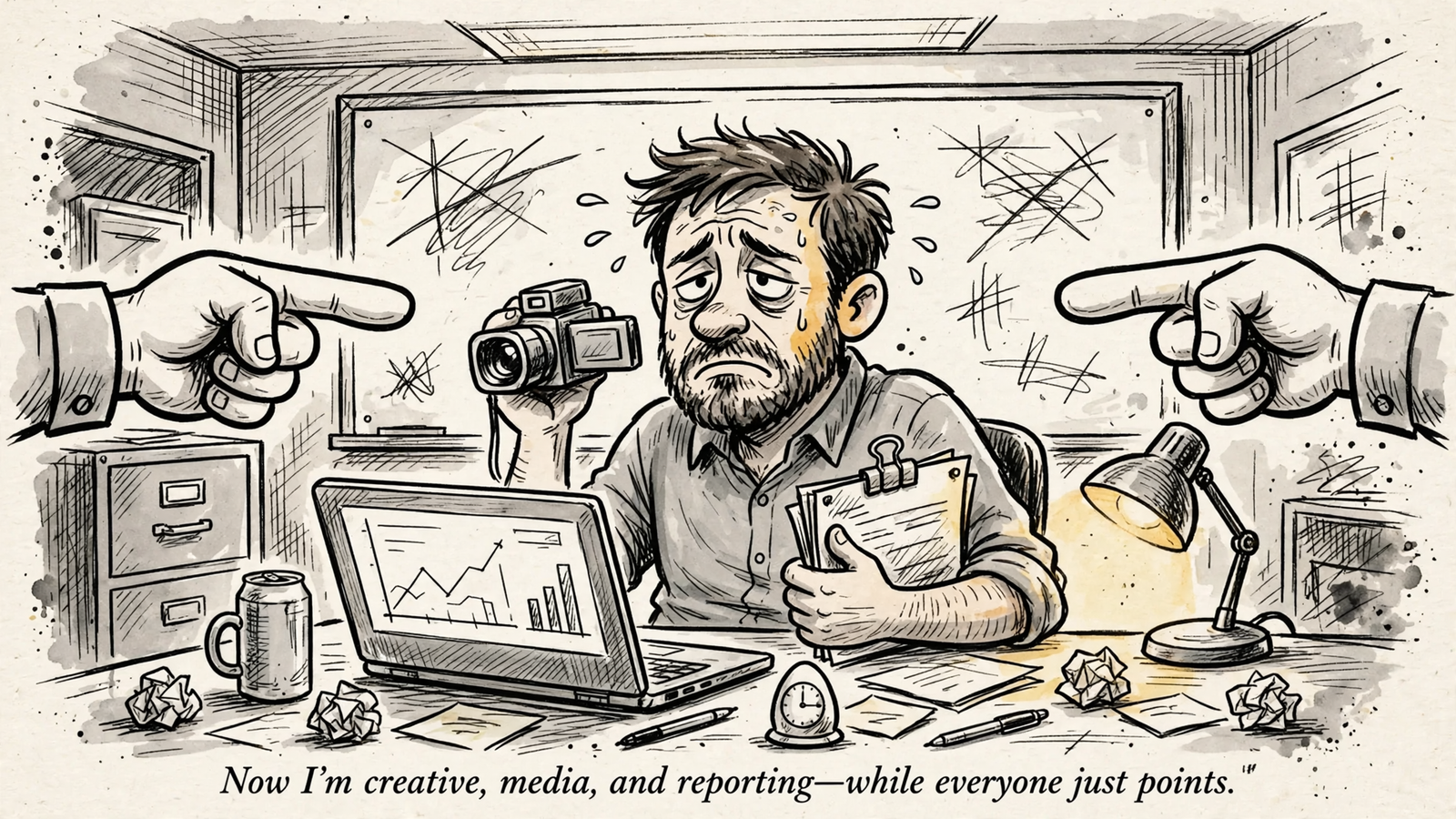
I spent years running Google Ads by hand for small brands. I respect the account work. But when one person changes targeting while another rewrites creative and nobody owns the test calendar, more account changes are not the answer. You need someone responsible for getting the next useful test live.
I call the gaps between those jobs unowned handoffs. They are what I would shop against after a bad agency experience: who owns production, who decides what gets tested next, and what you keep when you leave.
The constraint matters. I am writing for the owner with no internal buyer, no editor and no reporting analyst. You need account management, creative testing and reporting you can understand without a decoder ring. The fewest places for that work to stall wins.
1. Integrated managed service: first when you need one owner for delivery
My first choice puts media buying, creative production and testing decisions inside one agreed scope. Not one sales presentation. One scope, with someone accountable when a test stalls.
This is for the owner who wants to stop being the producer. Its advantage is straightforward: when production sits inside management, getting an ad made does not depend on you finding an editor after the buyer requests another variation. The provider owns the loop, rather than one isolated task inside it.
That distinction matters because creative volume is where Meta retainers can quietly disappoint. Basic packages include as little as one image plus one reel per month, while testing guides cite 8–15 variations per month for $5k–$10k spend and 30–80 on high-volume plans. The important distinction is that many fees cover setup and reporting, but not making ads.
Those figures are not a shopping quota. They are a reason to ask what “creative included” actually buys. Three hook edits of one script are not three new concepts, and a production allowance is not useful if nobody decides how to spend it.
Before signing, I want three answers:
- Production: What creative scope is included each month, and what costs extra?
- Testing: Who chooses the next test, and who approves it before it spends?
- Measurement: Can I see a sample report tied to cost per qualified lead rather than clicks?
What rules this option out is a mismatch between your production needs and the agreed scope. If you need 25 new UGC concepts a week, say so now. No flat fee covers infinite shoots.
I would rather buy fewer handoffs than a cheaper management fee that leaves me coordinating the actual ads. But I would buy the written scope, not the word integrated.
2. Traditional agency: second unless you need a bespoke team
A good agency earns its fee by supplying parallel hands without making you manage them. This is for the owner who can pay for that cover and needs a team that flexes around a custom brief.
Weekly creative, tracking help and set reporting can justify an agency relationship. The advantage is the ability to cover several jobs without you hiring three people. If that bespoke support is the requirement, I would move this option to first.
Expect pricing around 10–20% of spend or $500–$5,000+ per month flat, with hybrid minimum-or-percentage arrangements common. Then read the exclusions. Creative and setup charges of $300–$2,250 are often extra. That is exactly where a burned buyer can get surprised for the second time.
What rules an agency out for my reader is everything the proposal leaves unowned. A team on the pitch call is not proof of a team on the account. I want named owners for media, creative and measurement, plus an answer to how many accounts each person carries.
I would ask:
- Who writes the next creative brief?
- Who gets it produced, and what does production cost?
- Who decides whether the result earns another test?
- Who explains performance in terms of booked calls and show rate?
- What happens to the work and account access when the contract ends?
Get production charges, contract terms and handover restrictions in writing before access changes. The risk with agency-owned accounts is that you rent access to your own learning history.
An agency can cover the whole operation. The proposal has to prove that it will. If it cannot name who writes the next brief, I treat it as an offer of hours, not a team.
3. Freelance buyer plus creative: third because you become the producer
A freelancer gives you direct access to the person touching the account. That is the advantage: fewer layers between a question and an answer. This option fits the owner who can coordinate the other pieces.
Under about $5k in spend, the math can work. Typical retainers run $500–$1,500 per month, with Upwork rates around $15–$40 per hour and wider rate cards reaching $25–$150+. Five hours a week at $15–$40 per hour comes to roughly $330–$880 per month. That can look attractive next to team cover, provided you remember what you are buying.
I have hired that way myself when I needed hands, not a system. That distinction is the whole decision.
Freelance buying fees often cover setup, targeting and reporting, not ad production, landing pages or follow-up. Holiday cover is another question, not something I would assume. A capable buyer can still leave you with a second job coordinating everything around the account.
Before comparing the fee with a managed service, assign these jobs:
- Writing the creative brief.
- Hiring and paying the UGC creator or editor.
- Keeping raw files and usage rights.
- Approving the finished ads.
- Choosing the next concept when the first tests flop.
That last job is not the same as requesting more edits. As the creative-testing distinction makes clear, three edits of one opening test the opening, not the idea.
What rules this model out is simple: you wanted to stop owning the calendar. If you cannot say who gets the next ad made, read the freelance buyer vs groas breakdown on who gets the next creative test live before granting access.
Hire a freelancer when you can own production. Do not confuse a lower buying fee with the coordination work disappearing.
4. In-house hire: last when there is no team around the hire
A media buyer does not automatically supply a creative department. An in-house hire fits a business with steady spend, steady creative demand and someone equipped to manage the marketer.
The advantage is a dedicated person inside the business. For the owner in this ranking, the problem is paying full-time cost while still coordinating the gaps around that person.
A US media buyer averages $68,535 per year, or about $5,700 per month before taxes and benefits. The salary alone does not settle editing, design, landing pages or holiday cover. Putting the buyer on payroll does not make those jobs vanish.
I would consider the hire when three things are already in place:
- Enough testing work to keep the person busy.
- Budget for creators or an editor.
- A manager who can judge the work, including the creative.
Without that support, you buy a single point of failure with a salary. That is what rules it out for the owner who starts with no internal team. The hire may be good; the operating model can still be incomplete.
The full cost and creative-ownership breakdown of hiring an in-house Meta buyer versus outsourcing is worth reading before posting the job.
Do not hire your way out of a handover problem only to move the handover inside your payroll.

Compare the total bill—and the work left on your desk
Say you spend $3,000 a month on media. A $975 minimum management fee adds roughly 33% on top of that before creative extras. Small-budget guides recommend options such as $500–$1,400 monthly packages or $20–$45 hourly freelance help under about $5k spend, but the price only makes sense beside the scope.
Compare the total cost of getting tests live, not just the management line. Advertising spend stays separate, paid to Meta from your own account. Then add production costs and identify the coordination work that remains yours.
| Rank and model | Who owns creative production? | Who owns testing decisions? | Cost shape | Rule it out when… |
|---|---|---|---|---|
| 1. Integrated managed service | Provider, explicitly within scope | One accountable team | Check the complete management and production scope | Your production needs exceed that scope |
| 2. Traditional agency | Agency if included; often extra | Named media and creative owners | $500–$5,000+ monthly or 10–20% of spend, plus exclusions | Owners are unnamed or the agency owns the account |
| 3. Freelancer + creative | Separate producer; you coordinate | Agree the buyer’s authority and your role | $500–$1,500 monthly buying fee, plus creative | You wanted to stop coordinating production |
| 4. In-house hire | Still needs creative support | Internal buyer, with management | About $5,700 monthly salary, plus taxes, benefits and support | There is no creative bench or cover |
The table is not a verdict on individual talent. A good freelancer can be a better hire than a bad agency. My ranking asks a narrower question: which model leaves the least essential work unowned for this particular business?
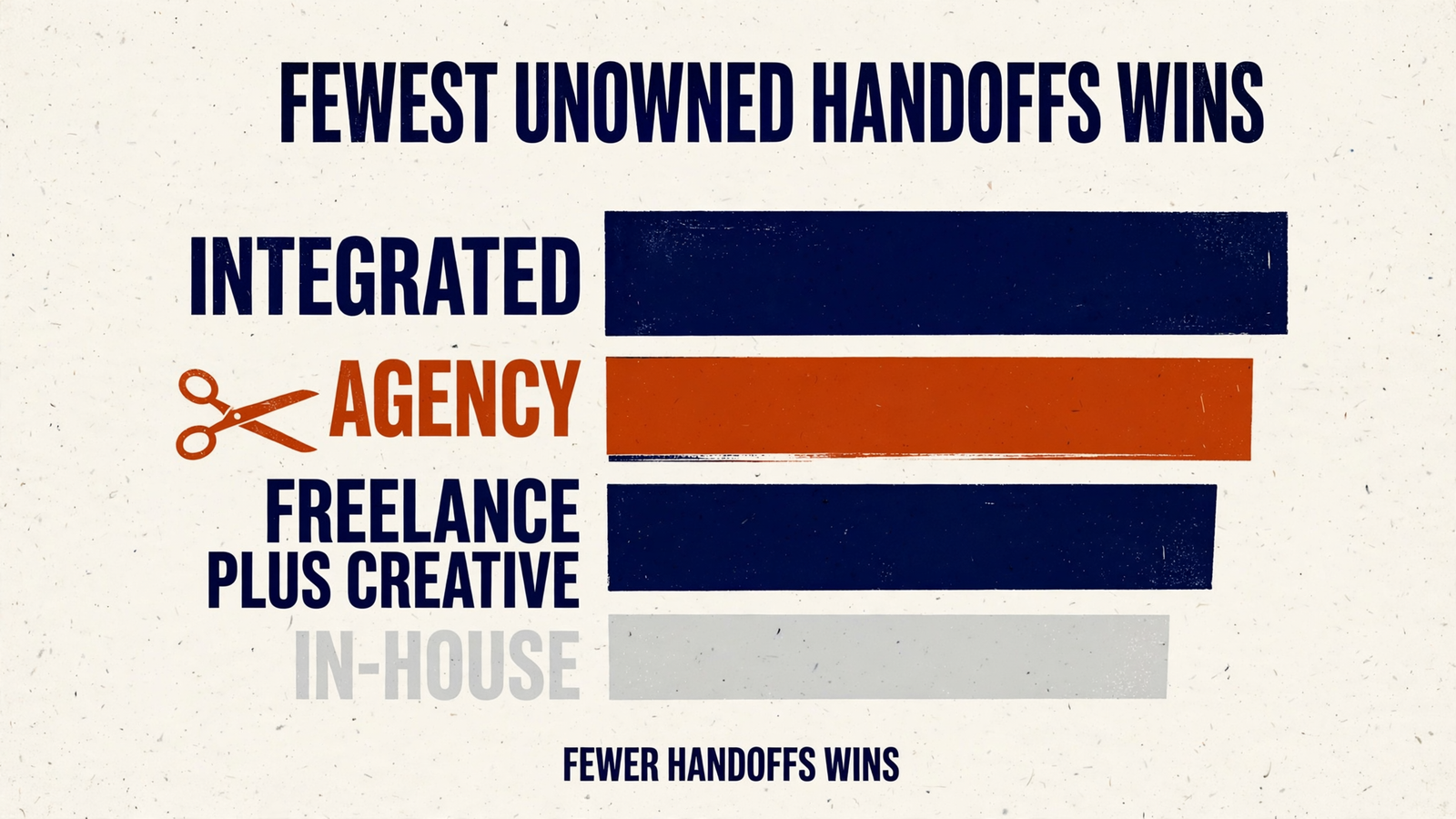
My verdict: buy the fewest unowned handoffs
I left one popular option out on purpose: the self-serve ads tool that promises to replace management. A dashboard or AI creative generator does not take responsibility for delivery. It gives you suggestions or assets while leaving production coordination, testing decisions and reporting interpretation on your desk.
For the owner in this article, that is not a fifth team model. It is the same coordination job with a subscription attached.
Before any new provider gets editing access, I would handle the unglamorous preservation work:
- Inventory what worked. Keep a record of successful ads and export the account history.
- Agree approval limits. Put in writing what the provider can change or spend without asking.
- Keep ownership in your business. Your Business portfolio should own the ad account, Pages and datasets, with the provider using partner access.
- Keep payment and control. Pay Meta directly and retain admin rights in-house.
- Write the exit before the entrance. Put ownership, data return and transition support in the contract.
The portfolio point matters because each Meta ad account can belong to only one Business portfolio and cannot be moved; an account created in an agency portfolio stays there. I would settle that before discussing the first campaign.
Then I want three pieces of evidence: a named delivery owner, a sample report tied to qualified leads and one paragraph explaining who decides the next test. If a provider cannot produce those, access is premature.
If you skipped to the end, my pick is an integrated managed service for the owner with no internal team, with creative production and testing responsibility written into the scope. Traditional agency second, freelancer plus creative third, in-house hire last. The wider Meta ads management ranking for owners with no marketing team puts those choices in context.
No delivery model guarantees performance. What you can buy is fewer places for work to stall. Buy that, then hold the provider to cost per qualified lead.
One last check for the first 30 days: look for new creative shipped, a written log of what was tested and killed, and reporting tied to qualified leads rather than reach or clicks. If week three arrives with only budget shifts and a promise that the algorithm is learning, you bought the same operating model on a different invoice.
Fire the model, not just the vendor.


