

 LinkedIn

By December 31, 2027, you will hire a ChatGPT Ads agency for what it refuses to let change without your sign-off, not for how many ad variations it produces. The agency’s most valuable deliverable will be a boundary, not another headline.
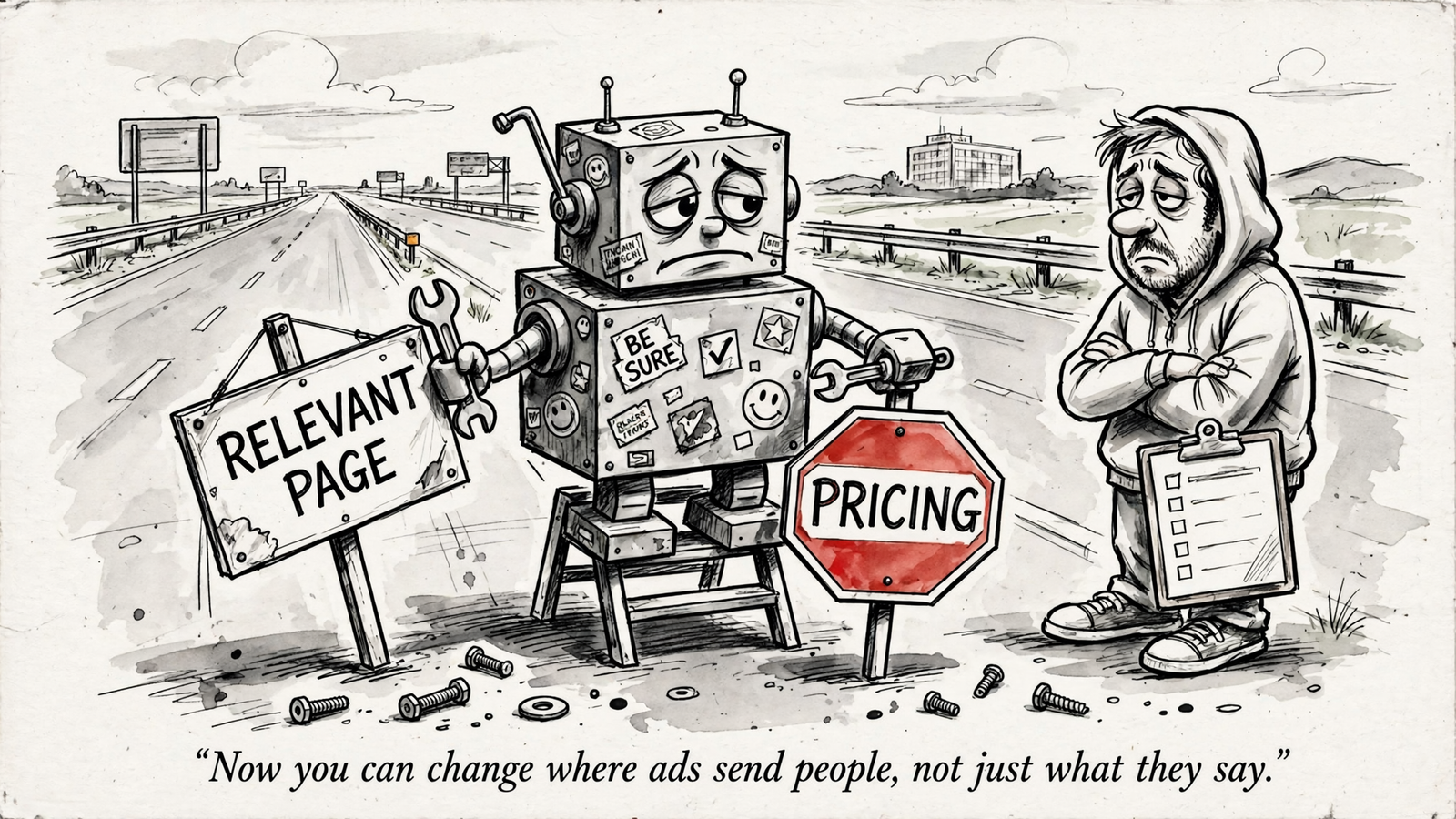
On October 30, 2026, OpenAI turned on creative enhancements by default for new and existing self-serve campaigns. The system can rewrite headlines and descriptions, translate text, resize images and send clicks to what it calls a relevant page on your site. That shifts the agency’s job from producing variations to deciding which changes your business can tolerate.
If you are shopping for hands-on management now, that distinction matters. Enhanced ads can run automatically without review, with no preview of every variation. Reporting covers impressions, clicks, spend, CTR and attributed conversions, but does not separate enhanced versions from originals. An agency can hand you 50 fresh variants without showing you which versions the platform actually served.
More copy does not solve that problem. Permission, destination checks and accountable measurement do.
A destination change is not just another creative edit
Rewriting a headline is familiar. Google and Meta have done it for years. Sending a paid click to another relevant page on your site changes something more fundamental: the offer and conversion path the visitor encounters.
That page might contain a different offer, a longer form or a compliance statement your agency never approved for paid traffic. The platform picks the page; your cost per qualified lead moves for reasons a creative report cannot explain. Once the destination can change, approving the ad is no longer enough.
A serious agency should explain the limits on day one. Existing account and campaign opt-outs are preserved, campaign settings beat the account default, and sales-managed accounts are excluded. The switch covers self-serve and BPO campaigns, with control under Manage settings in Ads Manager.
I used to tell clients to leave every automation default on and sort it out later. I was wrong. With destination changes, leaving the default on is already a decision. You have accepted the possibility of paid traffic reaching pages you have not reviewed for that purpose.
Check the setting before you approve the spend.
Prediction 1: Written boundaries become a buying criterion
By December 31, 2027, most serious ChatGPT Ads proposals will open with a one-page boundary sheet: what may change, what requires approval and which destinations are unacceptable. Not a creative deck. A permission slip.
The mechanism is straightforward, but the implementation is not. The toggle today is all-or-nothing, with no per-type switch for copy versus URL versus translation. An agency cannot honestly promise “copy allowed, destinations locked” through that toggle. If your requirements demand that separation, the agency has to acknowledge the mismatch and make an explicit opt-out decision.
A boundary sheet is a business requirement, not proof that the platform can enforce it. The valuable work is translating those requirements into the controls actually available, then telling you where automation must stay off.
Consider an illustrative case: you sell compliance-sensitive B2B software at $20k a year. The platform picks a relevant help-doc page because it answers the conversation neatly, but your demo request flow never loads. Or a translation turns “no setup fee” into wording that reads as a guarantee in German.
The click still counts. The impression still counts. Neither tells you whether the visitor encountered the offer you intended to sell.
Buyers already want more visibility into this environment. Four buyers asked for prompts that triggered ads, conversation context and proof that exposure drove a sale. Those requests point toward the same buying question: what can the agency actually control, observe and demonstrate?

I expect three signs of this shift over the next year:
- RFPs ask where paid clicks may land, not just what the ad says.
- Proposals include a sample change log rather than leading with variation counts.
- Finance challenges conversion growth that does not show up in qualified pipeline.
That last question gets awkward when no report separates enhanced versions from originals. I make the same distinction in what there is to manage in a ChatGPT Ads account: you cannot fairly assign credit for changes you cannot distinguish.
What would prove me wrong? By the deadline, serious buyers still select agencies mainly on headline and image quotas, with no demand for written boundaries. That would mean destination control never became the buying criterion I expect.
Until then, ask for the boundary sheet—and the settings decision that makes it real.
Prediction 2: Creative-volume promises lose ground to change accountability
By December 31, 2027, “we deliver 30 fresh creatives a month” will sound like a caterer bragging about plates while someone else cooks.
When the platform can generate headline, image and destination combinations, another batch of agency variations becomes a weaker claim to value. The harder job is documenting the agency’s decisions, identifying what remains unobservable and owning the response when lead quality falls.
The agencies that understand that shift will sell a weekly answer to three questions: what changed, why it changed and who owns the consequence. Where the platform does not expose an answer, the report should say so. A blank filled with confident language is still a blank.
The measurement limitations are already visible. OpenAI warns that changes over time do not on their own establish the effect of creative enhancements. A better week after switching enhancements on is not, by itself, proof that the switch caused it.
Destination tracking creates another gap. Advertisers use UTMs to connect clicks to downstream outcomes, but tracking-parameter passthrough when the destination changes is undocumented. The help page does not explain how parameters carry over when OpenAI picks another relevant page, or whether pages can be excluded.
That does not prove tracking breaks. It means the agency should test what it can observe rather than assume that a source tag establishes which page the visitor reached. Source attribution and destination verification answer different questions.
My agency-pitch test is simple: ask for last month’s change log from a real account. It should distinguish agency actions from observable platform behavior and label anything the platform does not disclose. If the agency substitutes 40 new headlines for that explanation, it has answered a different question.
The Meta parallel is familiar. Product browsing, an Advantage+ enhancement, was set to turn on in existing ads on October 28 unless advertisers opted out. Meta claimed 3% more conversions from an August 6–21 test involving about 117,700 advertisers. Default-on automation comes with a performance claim. The account manager still has to decide whether to accept it for your business.
What would prove this prediction wrong? Buyers keep rewarding creative quotas over decision records, or agencies demonstrate that their extra production reliably explains downstream gains despite platform-generated variation. Either outcome would weaken my argument that volume is losing its value as proof of work.
For now, pay for ownership of decisions, not a count of files delivered.
Prediction 3: Serious agencies isolate enhancement tests
By December 31, 2027, competent ChatGPT Ads managers will treat creative enhancements as an isolated test, not background noise while they change everything else.
The mechanism is measurement. Reporting shows impressions, clicks, spend, CTR and attributed conversions without splitting enhanced versions from originals. Change the budget and the creative in the same week as the enhancement setting, and several explanations compete for one CPA move.
If you change everything together, you learn nothing you can confidently repeat. That is the discipline I carry over from Google Ads: when conversions are scarce, wasting the test is expensive.
The test I would ask for is boring:
- Keep a baseline with enhancements off.
- Run enhancements on in a matched test group, holding other changes steady.
- Judge downstream quality alongside platform-attributed conversions.
- Record what the comparison can establish—and what it cannot.
A matched comparison is not a license to call every difference causal. It is a cleaner starting point than changing several things and crediting whichever feature appeared in the latest sales deck.
Click-session data alone is also too narrow a verdict. One measurement guide reports that only about 40% of attributable ChatGPT conversions happen in the click session, with aggregate-only reporting. It recommends layered measurement: pixel or CAPI for bidding, UTMs and CRM data for quality, plus a geo holdout for lift.
The practical point is not to collect more numbers for their own sake. It is to avoid mistaking an immediate click response for the whole commercial outcome.
Say you spend $20k a month. I would rather see 12 qualified sales calls traced to the test group than 400 platform variations and a 0.4-point CTR bump. The calls still need context and a fair comparison. But at least they are closer to what the business is buying.
Count qualified pipeline and closed revenue. Treat variation counts as a diagnostic, not a result.

What would prove this prediction wrong? By December 31, 2027, credible agencies still routinely change enhancements and other campaign variables together, yet can reliably establish which changes improve downstream quality. That would undermine my claim that isolation becomes a basic mark of competence.
Until that happens, ask what stays fixed before asking what the agency plans to test.
Better controls would change the work, not remove ownership
There is another way these predictions could lose force: OpenAI could make control much easier.
Per-type toggles for copy, URLs and translation, previews of every variation, separate reporting for enhanced versus original, and page-level exclusions would remove much of today’s uncertainty. If the job becomes a five-minute settings exercise, agencies will struggle to sell it as specialist work.
But better controls do not decide your business rules for you. Someone still has to define the permitted offer, approve destinations, interpret the results and take responsibility when qualified calls fall. Better visibility would make that work easier to judge, not automatically make creative volume valuable again.
That is the distinction I would use when vetting an agency selling ChatGPT Ads as proof it can run them. A sales deck shows variations. A manager explains decisions, limits and consequences.
Do not confuse access to the platform with ownership of the outcome.

What I would demand before granting account access
If I am right, the buying process needs to change before the agency’s pitch does. Get these four things in writing before spend starts:
- Business boundaries and a control-gap statement. Specify which offers, claims, destinations and translation markets are acceptable. Then require the agency to identify which restrictions the platform can enforce and which it cannot. A locked-page promise is worthless without a way to honor it.
- An explicit enhancement decision. Record whether enhancements are on or off at campaign level, with the reason in one sentence. Leaving the default on because nobody looked is not a strategy.
- A weekly destination and tracking review. Ask for the landing pages and parameter behavior the agency can verify, the checks it performed and any visibility gaps. If an unacceptable destination cannot be excluded, require a decision about leaving enhancements enabled—not a fictional exclusion list.
- One named owner. One senior person signs the agency’s change log and answers for the decisions affecting lead quality. A shared inbox can acknowledge activity. It cannot substitute for accountability.
These requests are deliberately short. I am not asking for a thicker report. I am asking for a record that separates what the agency decided, what the platform exposed and what nobody can yet prove.
That is the operating model I want at groas: autonomous execution with a named human owner, clear boundaries and accountability tied to outcomes rather than production theater.
If I am right, stop shopping for the agency with the thickest creative pack. Ask for the thinnest change log that still explains itself: what changed last week, why it was allowed and what the evidence says about qualified pipeline. That log is the product now. If an agency will not commit to that accountability before you pay, keep your budget until you find one that will.


