

 LinkedIn

By November 2028, I predict buyers with ambiguous brand names will reject AI visibility dashboards that cannot prove which business they counted. The renewal test will be answer-level evidence and a visible exclusion list, not another decimal place on a score.
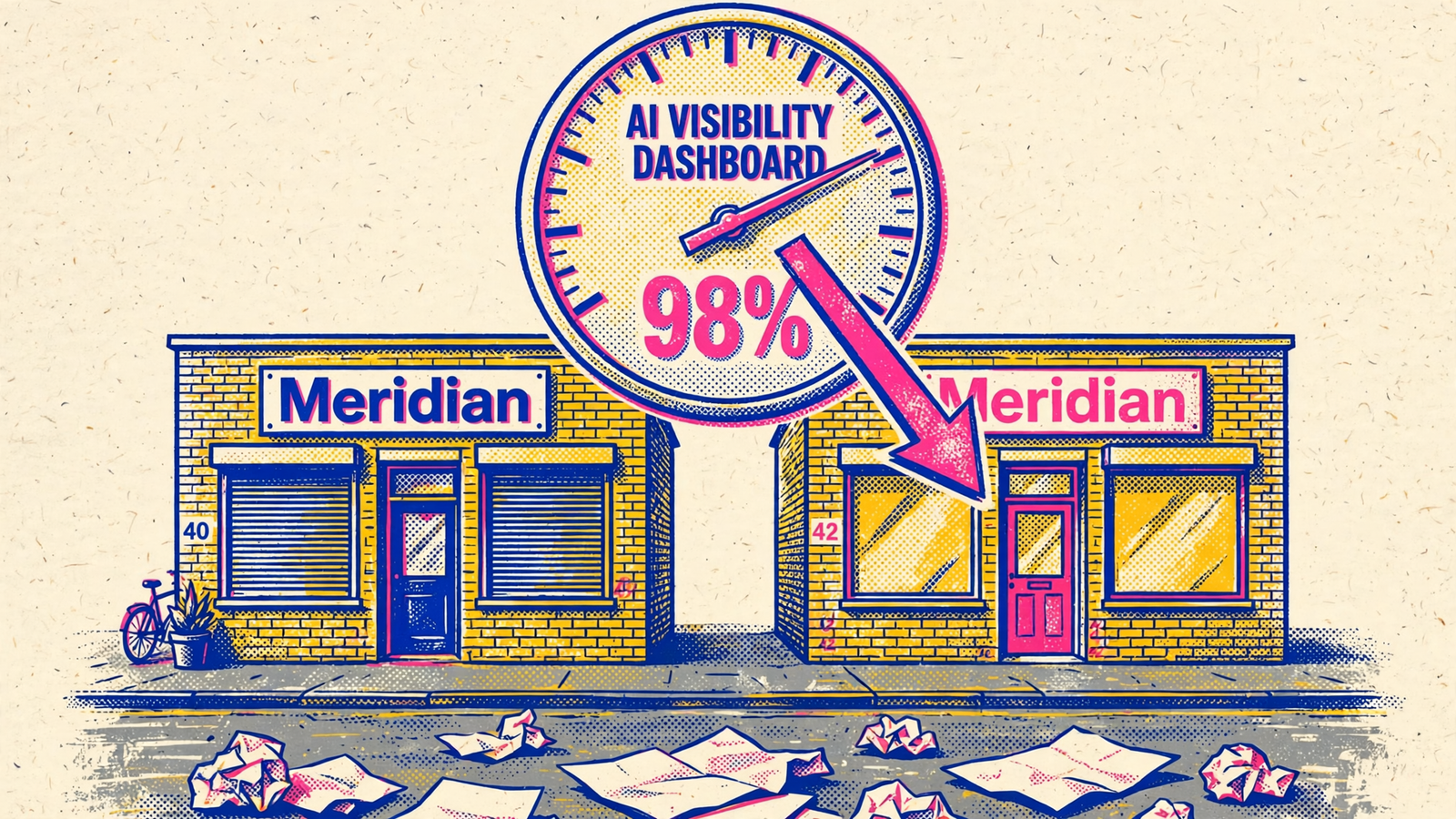
Say you run a 40-person services firm called Meridian. Solid site, real reviews, spending, say, $20k a month on search. There is another Meridian two states over, plus a Meridian software tool and about a thousand uses of the word in travel copy.
Your dashboard reports 34% visibility across ChatGPT, Claude and Perplexity. Without the saved answers underneath, that could be 10% you, 15% the other Meridian and 9% noise. A mention count can measure somebody else’s visibility. You paid for a scoreboard that counted the wrong team.
That is the problem behind my three predictions. For businesses with namesakes, ambiguous acronyms or distinct product lines, identity evidence will stop being reporting detail. It will become a buying criterion.
The failure starts with a simple shortcut: finding a name instead of identifying a business. An independent test of 12 platforms against 600 manually checked answers found 9% false positives on average. In one audit, 28 of 30 reported mentions referred to a fictional character with the same name. The tool found the string it was told to find. That is spellcheck with a chart.
I separate the problem into three failures:
- Name collision: another company, person or character with your name gets counted as you.
- Category collision: your name is also an ordinary word, or part of one. Think Craft matching aircraft and handcrafted, or Pulse matching heart-rate articles.
- Prompted recall: the test prompt includes your brand, the answer repeats it, and the dashboard records that as earned visibility.
These failures happen before the score gets calculated. A polished chart cannot repair a bad identity match.
Prediction 1: By November 2027, ambiguous-name buyers will demand identity evidence
My first prediction is that buyers will expect to inspect the answer behind a counted mention and see which business it describes. Not just the highlighted name. The business.
The mechanism is straightforward. When two businesses share a name and category, an assistant can assemble a confident answer around the wrong one. Resolution depends on co-occurring details such as location, founder or year; stable identifiers such as domain and address; and whether sources agree. It does not depend on marketing adjectives.
A tracker that checks only the name can inherit that mistake. Worse, it can count a perfectly accurate answer about the other Meridian as a win for yours.
That is why identity evidence must sit underneath the count. I want the full answer, its cited links and the details that establish which Meridian it describes. Does it identify your domain, address or founder? Does it describe your product line? Or does everything except the name belong to someone else?
The distinction between outcomes matters, too. A mention is a name in the text, a citation is a source link, and a recommendation is an endorsement for a need. Being named or cited does not automatically mean being recommended. The two pipelines behind that split are worth understanding before paying for a bigger number.
The raw material is already becoming available. groas collects AI search visibility data around the clock alongside competitor ads, funnels and Reddit research. With Claude plugged into groas, I can query the collected data in plain English. That is a starting point for inspection, not permission to assume every apparent match is correct.
My request would be specific: “Show the available evidence behind our mentions, including citations and the business each answer describes. Flag uncertain matches.” Any missing answer text or identity evidence belongs on the gap list, not behind a confident score.
What would prove this prediction wrong?
If November 2027 arrives and ambiguous-name buyers still renew on aggregate counts without inspecting the underlying answers, I lose this one.
The practical check is whether a buyer can retrieve three months of saved answers, identify the business each describes and point to the matches rejected. If buyers keep accepting a pooled percentage without that evidence, my timeline is wrong.
For now, I would make a vendor show the identity match before discussing the visibility trend.
Prediction 2: By November 2028, share-of-voice reports will need visible exclusions
Once a buyer finds the wrong Meridian in a report, the next question is obvious: how many more are in there?
That is the mechanism behind my second prediction. Inspectable answers expose classification mistakes. Buyers then need a way to correct those classifications and see how the correction changes the report. A private note saying “ignore this one” is not enough.
I would keep the prompt set, engines, geography and observation window fixed, then divide the answers into three groups:
- Confirmed matches: evidence ties the answer to your business.
- Wrong entities: the answer belongs to a namesake or another meaning of the term.
- Unresolved answers: there is not enough evidence to call it either way.
Keep all three groups visible. Exclude wrong entities from your brand’s count, but do not quietly erase them from the audit trail. Do not turn unresolved answers into confirmed wins just because the name appears.
One demo of a four-layer check with a corroboration gate reduced a headline from 66.7% to 26.7% grounded mentions. Only 4 of 15 answers survived with an anchor such as a citation or product term in the same sentence. The name count and the grounded count told very different stories.
The exclusion list is part of the measurement, not housekeeping. So is the denominator.
A precise share-of-voice percentage can hide a small, vendor-chosen prompt set. That set is not the open web, and the universe of possible buyer prompts is effectively infinite. Legacy rank tracking at least gave me a keyword list to argue over. With AI visibility, I still need to know where the sandbox ends.
Pooling engines adds another layer of concealment. One worked example uses 100 samples per engine and records 60 ChatGPT mentions, 10 Perplexity mentions, 20 Claude mentions and 30 Gemini mentions. The pooled rate is 30%. Correct arithmetic. Poor explanation of where the brand actually appears.
Then there is run-to-run variation. A January 2026 repeat test found under a 1 in 100 chance that ChatGPT returned the same brand list twice in 100 runs, and about 1 in 1,000 for the same list in the same order. A move from third to fifth on Tuesday is not enough evidence to call a loss.
There is also presentation risk. A reported September 2025 reduction in ChatGPT outbound citations changed dashboard visibility without necessarily changing brand relevance. The metric moved with the answer format, not something the buyer controlled. That is another reason to treat these numbers as directional, rather than as a direct reading of demand.
My requirement is simple: show the three groups, the denominator and the engine split. Otherwise, I am looking at a mood ring.
What would prove this prediction wrong?
If buyers with namesakes keep renewing through November 2028 without asking which answers were excluded or left unresolved, I am wrong.
The test is not whether vendors add an exclusions tab. It is whether buyers require it before signing. If aggregate name matching remains sufficient for those decisions, visible exclusions stay optional reporting detail.
I would put the correction and exclusion rules in the buying requirements now, rather than negotiate them after discovering the other Meridian.
Prediction 3: By late 2027, evidence exports will matter more than another headline score
My third prediction is that the decisive buying question becomes “show me the table,” not “what is our score?”
The mechanism follows from the first two predictions. If identity decisions need inspection and exclusions need correction, buyers need evidence they can sort, compare and challenge. A dashboard screenshot cannot do that job.
Before authorizing a page change for Meridian, I would ask for an answer table containing:
- The prompt text, engine and date.
- The full answer.
- Cited URLs, separated into yours, competitors’ and other sources.
- The business or product line the answer describes.
- The identity decision and a confidence flag.
- The reason an answer was excluded or left unresolved.
Then I would sort by engine. In an analysis of 3.7 million AI citations, 91% of cited URLs appeared in only one LLM. Coverage in one engine is not a substitute for evidence from another.
Plan limits make that distinction more important. The same comparison lists Profound Starter as ChatGPT-only, Peec as offering a choice of 3 of 6 models, and Claude and Gemini as paid extras in Otterly. A headline score does not tell me what the plan never measured. Those limits are a poor fit if the buying question spans engines outside the package.

groas gives me collected data to interrogate through my own AI, alongside competitor advertising and Reddit research. With Claude connected, I can ask questions in plain English rather than stop at a headline dashboard score. That is the useful starting point: bring the evidence into the investigation.
It is not an automatic verdict. I still need to establish which answers describe my Meridian, which describe the namesake and which remain unresolved. Export first, rewrite second. Label missing evidence before acting on the apparent trend.
I would not imply a one-click correction inside a tracker unless I had tested it. Nor would I treat a snippet as an identity decision. Features such as separate mention and citation tracking, list position and saved snippets help inspection, but the business match still needs to be established.
The measurement itself also has limits. Vendor documentation acknowledges that AI platforms provide no first-party visibility data and describes dashboard collection as a logged-out-user proxy. An export does not remove those limits. It makes the evidence available for scrutiny instead of hiding it behind a percentage.
What would prove this prediction wrong?
Hand two vendors the same ten ambiguous prompts. Can their exports show which one counted your Meridian and which counted the other one?
If that evidence never changes a purchase or renewal, or buyers keep paying for the headline while the table sits unopened, I lose this prediction. Useful data is not automatically a buying criterion. Buyers have to use it.
I expect the table to matter the first time someone asks why visibility rose 12 points while pipeline stayed flat. Before changing the website, I would check what those 12 points actually counted.
What I would require this week
If my predictions are right, an ambiguous-name business should not wait until 2028 to demand proof. The buying requirements fit on an index card:
- Saved answers first: full text, date, engine, prompt and cited URLs, with your sources distinguished from competitors’ sources.
- Identity rules in writing: evidence such as your cited domain, a product term in context, or your location and category beside the name. A bare name match is not enough.
- A fixed denominator: the same prompts, engines reported separately, country and 30-day window, with rerun noise acknowledged.
- Visible corrections and exclusions: confirmed matches, wrong entities and unresolved answers remain inspectable. The report shows what was rejected and why.
For the unresolved pile, keep the uncertainty visible instead of deleting it. The longer case for that Unknown column is worth reading before signing anything.
If a vendor cannot show all four, shortlist one that can. Use Claude through groas to inspect the available evidence, identify the gaps and ask for the table. Run the same prompts for a month before treating a headline movement as a reason to move your $20k.
That is the buying criterion behind an ai visibility dashboard search, including the prompt-shaped queries already appearing in Search Console: not another chart, but proof that the chart describes the right business.
A model update, prompt swap or namesake getting press can move the headline without moving pipeline a dollar. If the Meridian count drops next quarter, check the answers before checking the budget. When a dashboard cannot prove which brand it counted, I would not renew it. I might be paying to track somebody else.


