

 LinkedIn

By November 2027, serious Google Ads agents will refuse a blind undo. They’ll read the live setting first. If another authorized editor has changed it, they’ll stop rather than put the old value back without a fresh yes.
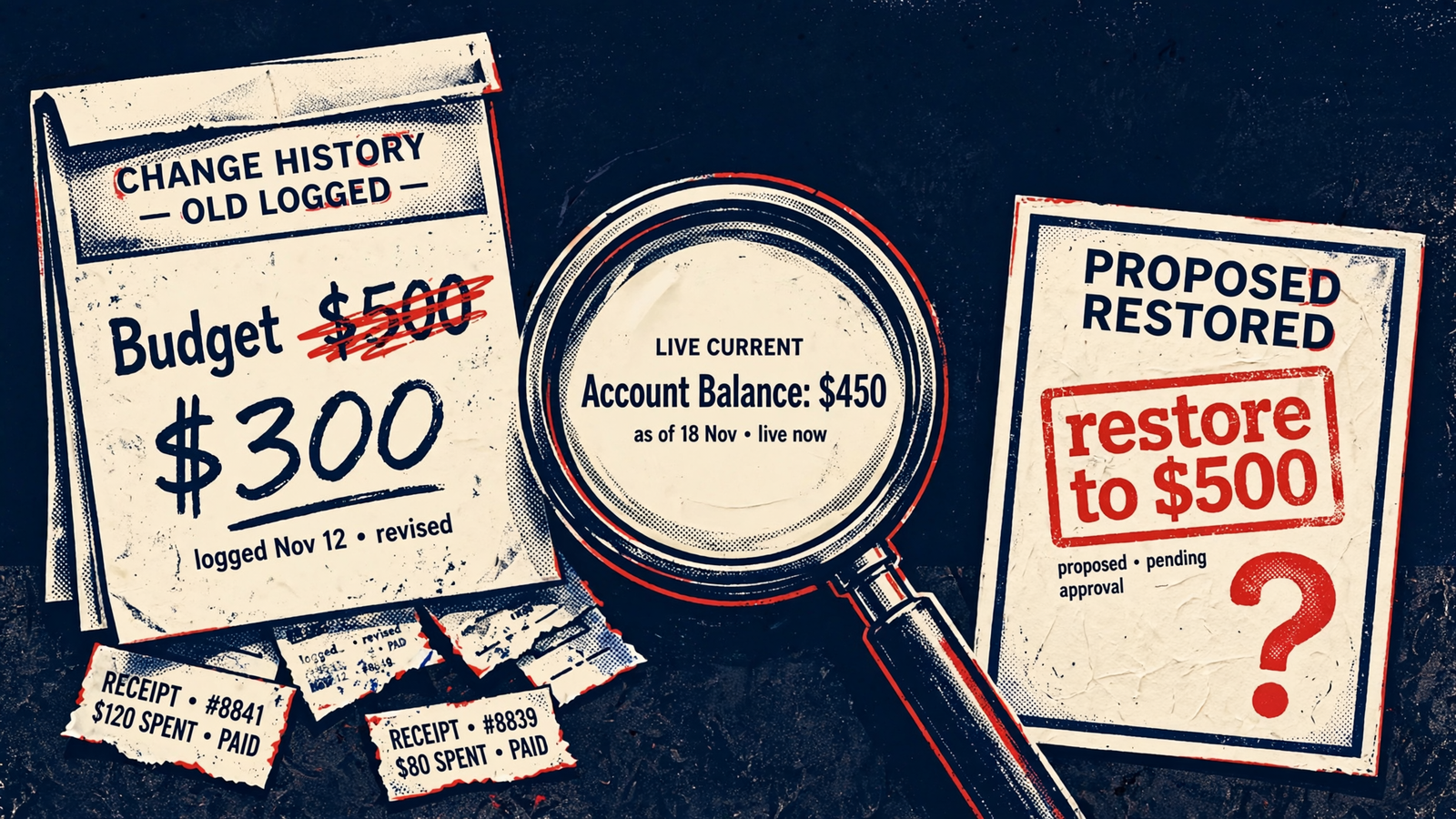
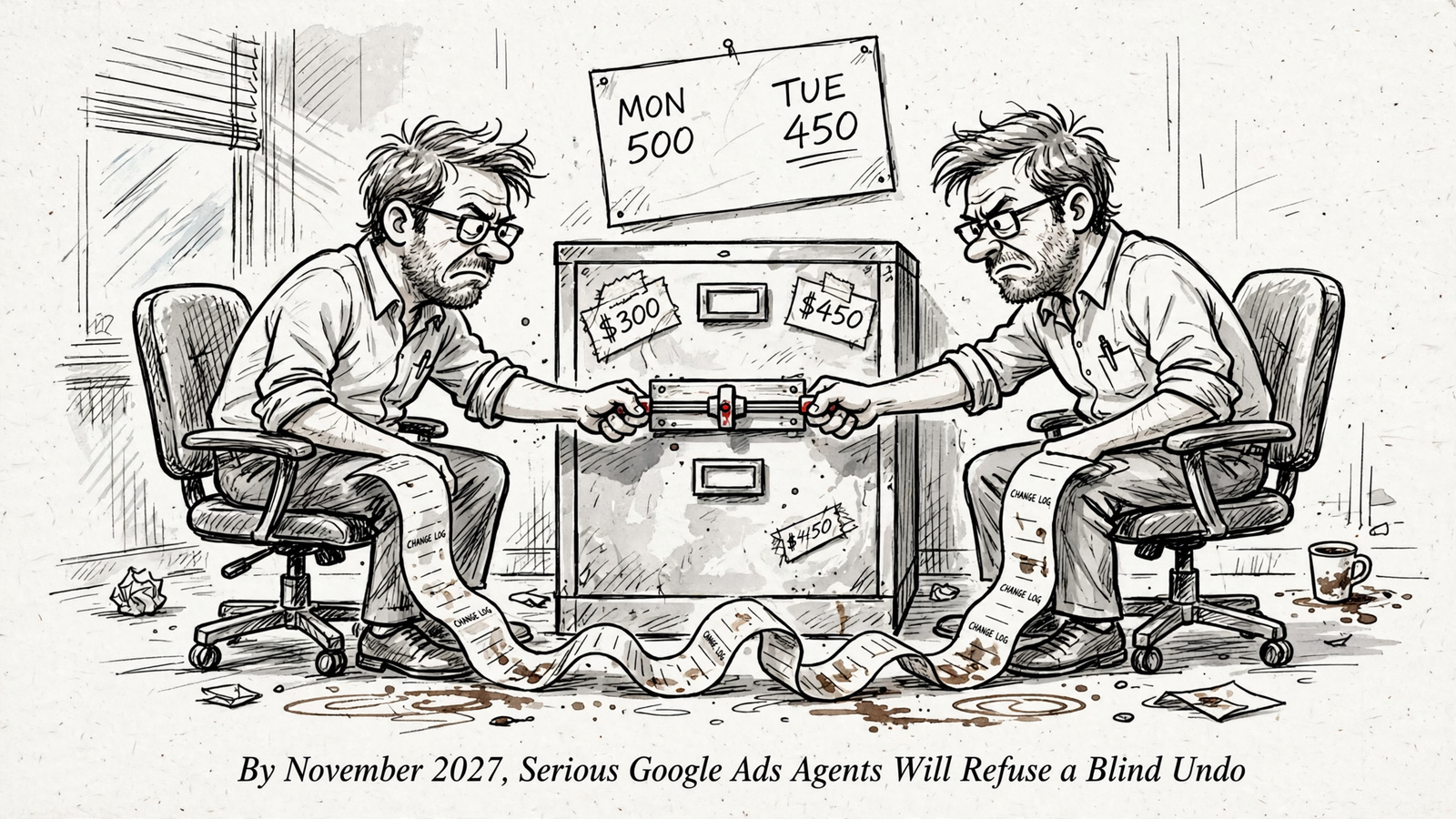
Say I’m spending $20k a month and let Claude change budgets through groas. On Monday, Claude drops a campaign’s daily budget from $500 to $300 because CPA has run 27% over target for three weeks. On Tuesday, a teammate sees delivery slow down and raises the budget to $450 for a promo push. On Wednesday, I type “undo Claude’s change.” An agent that goes straight to the log puts the budget back to $500. It just overwrote a valid decision it never checked.
The agent did exactly what undo sounds like it should do: it put back the number that was there before. But I asked it to reverse Monday’s edit, not replace Tuesday’s. If the wrong budget sits live for a while, putting the right number back won’t erase the delivery in between. Undo can fix the field. It can’t undo the spend.
An approval log can’t tell me what’s live
On November 12, Ryze documented approve, reject, and revert-approval actions from chat and MCP, along with replies to managed campaigns. That matters because approval is becoming part of the product, not just a conversation someone has before the agent writes. But reverting an approval isn’t rolling back a live account change. One changes the status of a decision. The other writes a value into Google Ads that someone else may have changed since.
I used to tell clients an undo button meant they were safe. I was wrong. Google says I can undo most changes from the last 30 days, but it also says an undo can fail if someone removed the item or already undid the change. A history entry tells me what happened. It doesn’t tell me the same reversal still makes sense.
Other vendors draw the line in different places:
- Optmyzr says I can’t undo its optimizations inside Optmyzr. It sends me to Google Ads Change History, where the Tool column distinguishes
Google Ads API - OptmyzrfromWeb client (manual). - Opteo says in its MCP docs that there’s no undo button. I can ask my AI to change the setting back or check platform history. A check applies only to that exact change for a few minutes. If I edit the change, it needs a new check. Opteo leaves it to my AI tool to decide whether to ask for approval.
- Adalysis lists four read-only MCP tools. They read reports. They don’t change, pause, or spend anything.
Those are different ways to handle permissions and history. None of the behaviors above answers my Wednesday question: does the live budget still match what Claude wrote on Monday? Until I have that answer, I treat a restore as a new write, not a free pass.
Prediction 1: Three of five vendors will document a live check before undo
By November 30, 2027, at least three products on my fixed watchlist will document that a reversal reads the live Google Ads setting and compares it with the logged change before writing anything. The five are groas, Ryze, Optmyzr, Opteo, and Adalysis. I’m looking for public docs that say the agent fetches the live value at reversal time and compares it with what the original action wrote. A generic promise that changes are safe doesn’t count. A product without MCP write support doesn’t count either.
Once approval lives in MCP, the approval log becomes the paper trail everyone points to when spend goes wrong. It can show that Monday’s move from $500 to $300 was authorized. It can’t tell me whether $300 is still live on Wednesday. The better the log gets at answering the first question, the harder it is to pretend it answers the second.
Opteo’s rule that a check counts only for that exact change, for a few minutes is the clearest hint in the current docs. The check is tied to the write, not to a standing belief that the agent knows the account. Apply that same idea to reversals and the check belongs on Wednesday, not Monday. Looking up Monday’s edit tells the agent which value it needs to compare. Looking up the live budget tells it whether that value still holds. I want both reads, not a more detailed account of the first one.
What proves me wrong: On November 30, 2027, fewer than three of the five document that live comparison. When I read the docs, I’ll look for what the tool reads before the reversal, not what it logs after.

Prediction 2: Two of five will show old, current, and proposed values
By November 30, 2027, at least two of the five will document a review that shows old, current, and proposed on every undo request. Old is the value before the logged edit. Current is what’s live now. Proposed is what the agent would write if I let it proceed.
In the budget example, that review looks like this:
| Label | Value | What it means |
|---|---|---|
| Old | $500 | The budget before Claude’s Monday edit |
| Current | $450 | The live budget after Tuesday’s promo edit |
| Proposed | $500 | The value the undo would write |
Two of those numbers are the same. That’s the point. Showing me $500 twice is useful only if I can also see the $450 I’m about to replace. And the change log still needs to show that Claude wrote $300. I spot the conflict by comparing the live $450 with the logged $300, not by comparing $450 with the original $500. Those comparisons answer different questions: did the setting move since Claude wrote it, and what would my approval do now? A confirmation that says only “Restore $500?” answers neither.
There’s already a version of this logic outside PPC. A draft undo spec for AI agents calls for a pre-check that doesn’t change anything. It gives the reversal a version tag and calls for the tool to report a conflict if the record has changed. The spec doesn’t show that an ads vendor already displays all three values. It shows how to separate the check from the write. The review is where I expect vendors to make that distinction visible.
What proves me wrong: Fewer than two of the five document all three values by November 30, 2027. In a demo, I’ll ask the vendor to point to the number its undo would overwrite.
Prediction 3: Two of five will stop rather than overwrite a conflicting edit
By November 30, 2027, at least two of the five will document what happens when the live setting doesn’t match the logged write: the agent stops or asks for fresh approval before it writes. It doesn’t quietly restore the original value and count that as a successful undo.
This is where approval earns its keep. The useful split in human-in-the-loop tool use is between reading a setting and authorizing a write with consequences. Monday’s permission covered lowering the budget from $500 to $300. On Wednesday, raising a live $450 budget to $500 is a different decision. The log can explain why I’m asking. It can’t supply the new yes.
The draft spec’s UNDO_CONFLICT pattern makes that refusal explicit. In my example, I want the agent to say: “I wrote $300 on Monday. The budget is now $450. Restoring $500 would overwrite the intervening edit. Do you want me to proceed?” If the history shows who made the edit, show me that too. I don’t need the agent to guess why Tuesday happened. I need it to leave Tuesday alone until I decide. I might still want $500. But the agent should make me approve replacing $450, not ask me to approve undo as if the word settles it.
What proves me wrong: Fewer than two of the five document a stop or a fresh approval requirement by November 30, 2027. A warning that appears after the budget has already been restored doesn’t count. In this case, the refusal is the product working.
What I ask Claude to do today
I don’t need to wait for those docs to test the workflow. In the same chat as the groas connection, I use a prompt like this:
Before reversing this groas change, read the current setting and compare it with the value the logged action wrote. Show me the old, current, and proposed values before writing anything. If the current value differs from what the action wrote, stop and ask me for fresh approval.
I keep the request narrow: one account, one campaign, one setting. I name the date and the value I think Claude set. Then I judge the answer against the Monday-to-Wednesday example. “Logged $500 to $300; live $450; proposed $500; do you approve replacing $450?” is the answer I want. “Done, set back to $500” is a fail. So is a neat summary of Monday’s edit that never tells me what’s live on Wednesday. I check the live campaign, not just the chat transcript. The prompt asks for the check. It doesn’t guarantee the check happened.

I prefer groas and Claude for this workflow because groas gives me the change log, the reason for the edit, and a one-step restore. I don’t have to start with a read-only report, an approval flag, or a trip back to Google Ads history just to find the restore. Autopilot runs within the rules I set. None of that is the conflict detection I’m forecasting. The log gives Claude something to compare against a live read. The restore is there when I need it; I hold off until the comparison is clear.
Before I give a second editor write access, I decide who can touch budgets and bids, who owns structure, and who gets to approve an overwrite. If I run two assistants against one account, disagreement is a reason to stop, not a reason to let the faster assistant win. That’s why write access alone isn’t enough to sell governance. The useful control is what happens when two authorized edits collide.
The buying verdict: ask what undo refuses to do
When I demo a Google Ads agent, I skip the happy-path undo. Show me a reversal where someone else edited the same setting yesterday. Show me old, current, and proposed together. Then show me what happens when the current value doesn’t match what the agent last wrote. I want to see it stop with the budget still at $450. A vendor that can demo the refusal has built for a shared account. A vendor that can only demo the restore has built for a demo.
Set the policy this week, before another editor gets write access. Put it on one page:
- Which humans and agents can touch budgets, bids, and structure.
- Which values the agent must show before an undo writes anything.
- Who can give a fresh yes when the live value differs from the logged write.
If the vendor can’t show you that behavior, don’t give it write access to the account that pays the bills. Check the docs for all five vendors again on November 30, 2027, and you’ll know whether I called it right.





