LinkedIn

By November 2027, the AI search trackers winning renewals will show which missing recommendation led to which approved page change. If a prompt score is still the finished deliverable at renewal, I’m wrong.
I spent the better part of a decade managing Google Ads accounts by hand. A report could be accurate down to the last row and still leave me with the only question that mattered: what do I change? AI visibility tools have the same problem. PallasAI’s rundown of buyer complaints names it plainly: the report spots the gap, then leaves the team to work out what to do about it. A score can tell me I’m missing from an answer. It can’t tell me whether to revise the page I have or write the one I don’t.
I’m betting on the prompt-to-page handoff: from a buyer’s question to the source an assistant chose to a change someone on my team can approve. That’s also how I’d judge whether a tool covers SEO and AI visibility together. Does the finding survive the trip from the report to the page, or does someone have to do the diagnosis again? I’ll use groas with Claude as a concrete example, not as proof of where the market is going. And I’m betting on what buyers will demand, not what assistants will cite. No tracker gets to make that second call.
Prediction 1: Citation gaps will come with a decision about which page to change
I used to hand clients a spreadsheet of losing keywords and call it a plan. The spreadsheet was accurate. The plan was missing. Nobody had matched each loss to the page that should answer the query. A visibility gap without a page decision is work I still have to do.
Say Claude or ChatGPT cites a competitor’s pricing page for “best payroll software.” The useful part of that finding is who got cited and which page the assistant used. The score tells me I lost. The source gives me something to compare. If the competitor’s page has a pricing table and my relevant category page doesn’t, I have a candidate for an update to a URL I already own. I don’t have proof that adding a table will earn a citation. That’s the difference between a recommendation I can review and a promise nobody can keep.
I’d put the two pages next to the observed answer. If the answer draws on a pricing comparison the cited page makes and mine doesn’t, I have something specific to review: does that comparison belong on my category page? “Improve visibility for payroll prompts” gives my team nothing to approve. “Review this pricing comparison for this URL” does.
Sometimes I won’t find a page worth updating. If the comparison the answer needs doesn’t exist on my site, I may need to create a page. If the gap is in a third-party source, rewriting my category page isn’t the same job. That’s why Aikenhouse’s distinction between tracking and source analysis matters: without the sources, the tool can tell me I’m losing but gives me little to work with on why. I’d diagnose the gaps before writing more content, not commission a new page every time a prompt turns red.
What would prove me wrong
If, in November 2027, the leading tools still sell prompt scores as the finished deliverable, with no route from a cited source to an existing URL or an explicit decision to create a page, this bet fails. I’d look at renewals and procurement checklists, not roadmaps. If buyers renew without asking which page changed because of the report, the score is still the product.
What I’d ask Claude now
groas connects Claude to my website and collects AI search answers alongside SEO data. That lets me ask for a page decision, not another score:
For these priority buyer prompts, show the cited sources and our relevant URLs. Which gaps call for an update rather than another page? Separate what you observed from what you inferred.
Prediction 2: Buyers will ask for evidence they can query in Claude and ChatGPT
A screenshot can show me share of voice. It can’t answer the question I ask next: Which answer, on which date, cited which page? That matters because generative answers vary. PallasAI makes the case for tracking a consistent set of prompts rather than reading too much into one score. And Fame.so cites an Ahrefs test of about 37,500 citations in which 59% of ChatGPT citations were gone by day two, only 4% lasted all 20 days, and about 75% of dropped citations later returned.
That last number is the one I’d keep next to the chart. If many citations disappear and then come back, I want to know whether I’m looking at a recurring gap or just the answer that happened to show up that day. I want the observations behind the recommendation, not a prettier version of the score.
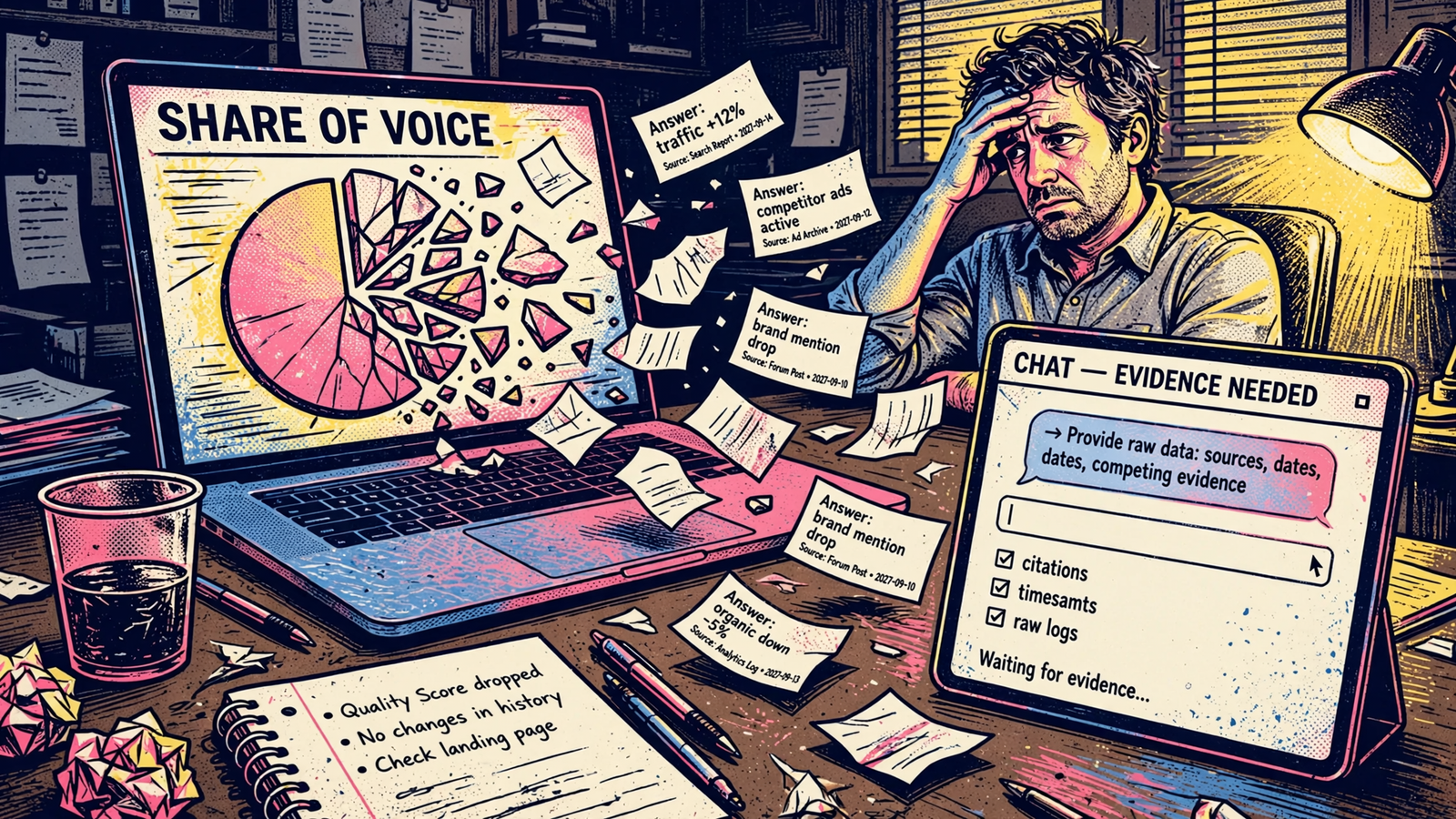
Back to payroll. Before I ask for a pricing edit, I want to see whether the competitor’s page keeps showing up for the same prompt or whether I’m acting on a single observation. Those are two different briefs. In one, I have a recurring gap worth investigating. In the other, I have an example worth keeping an eye on. I don’t want the person drafting the edit to have to guess which one I handed them.
The handoff already exists. Omnia MCP makes prompts and citations accessible from assistants including Claude and ChatGPT, so a buyer can ask which URLs each engine cited rather than stop at a dashboard summary. For this job, I’d pick groas MCP because it puts the AI search answers and SEO data next to the website I’m trying to change. I can ask Claude to compare the cited source with my existing URL while it drafts the fix, rather than carry the findings over from a separate audit.
What would prove me wrong
If dashboard summaries still win renewals in November 2027 and vendors face little pressure to hand underlying evidence to assistants, this bet fails. The cleanest weekly PDF wins. The test isn’t whether the vendor has an assistant integration. It’s whether buyers ask to inspect the evidence in the assistant they use to write the fix.
What I’d ask Claude now
Show me the observed answers and citations behind this recommendation. Name the assistant, the prompt and the observation date. Don’t generalize from one answer.
If Claude can’t give me the answer, its citations, the prompt, the assistant and the date, I don’t approve the change on that evidence.
Prediction 3: Publishing controls will matter as much as publishing speed
The moment a tracker can edit the site, a bad diagnosis can go from a bad chart to a live mistake. I used to tell clients speed was the advantage. I was wrong about which part needed to be fast. I want to spot a gap quickly. I don’t want to publish off one noisy run just because the tool lets me. Fast detection helps. Fast publishing without review is how I end up rolling back a change I never would have approved.
The failure mode is already documented. VantagePoint’s write-up on AI CMS edits describes changes that can go live without an obvious error and still hurt the site: broken robots.txt rules, missing canonicals and altered templates. I’d take its safeguards into a buying conversation and ask the vendor to show me how the workflow handles each one:
- Set the scope. Put limits on edits to robots.txt, redirects, sitemaps and templates.
- Review the diff. See exactly what will change before it goes live.
- Crawl staging first. Check the proposed changes before publishing them.
- Log the deployment. Make it possible to trace what happened if the change needs to come back out.
I’d use the same proposed edit for the whole demo. If I asked for a pricing comparison on one page, I want to see that one page in the diff. A template change is a different decision, even if the recommendation that started the job was sound. I’m approving the edit in front of me, not giving the tool permission to make whatever else it thinks might help.
With groas, autopilot stays off until I switch it on, changes are logged with their reasons, and undo takes one step. I still decide what’s in scope and review what I’m approving. An undo button is useful after a mistake. It isn’t permission to skip the diff.
What would prove me wrong
If the products winning in November 2027 compete mainly on how much they can publish unattended, and buyers renew without asking about approval scope, evidence or change history, I’ve read the market wrong. Pages shipped while nobody was watching would turn out to be a better sales pitch than pages someone checked. I wouldn’t buy on that basis now.
What I’d ask Claude now
Draft an update to this existing page. Show the supported claims and the proposed edits. Do not publish until I approve.
Then I use groas to apply only the approved change and keep the logged reason. No approval, no publish. No log, no trust.
Put the handoff in writing before your next renewal
I wouldn’t wait until November 2027 to run this test. I’d start with 20 to 30 seasonal buyer prompts that actually precede a purchase:
- Record the baseline. Save the observed answers, cited sources and dates before changing anything.
- Follow a gap through to approval. Keep the original observation with the proposed edit so I can see why that page, and not another one, is changing.
- Recheck the same prompts. Once the approved update goes live, look at the answers again and check my own site outcomes.
That first set of observations is a baseline, not a control group. If the answers move, I know they moved. I don’t get to say the edit caused it. AI systems make their own retrieval decisions, and a visibility score can’t guarantee a citation or prove revenue on its own. The test I can run before renewal is whether the tool takes me from an observation to a defensible change without making my team reconstruct the case at every step.
Before I pay, I want to know who owns the gap after the report lands. Alium’s buyer interviews describe what happens when nobody does: one Profound user found the reporting educational but light on action. I’d rather buy the workflow that names the next page change than pay for a report my team has to turn into one. That’s the ownership question I’d settle before buying another AI visibility dashboard.
Here’s what I’d put in writing before peak season:
- Prompt-to-page mapping: For each priority gap, show the cited source and name the next decision: update a specific URL, create a page, or work on a third-party source. Don’t force a match to an existing URL if there isn’t one.
- Assistant-ready evidence: Make the observed answer, citations, prompt text, assistant name and observation date queryable in Claude or ChatGPT. Don’t make my team reconstruct the evidence from a screenshot.
- Approval and a change log: Keep autopilot off by default. Set limits on which paths can change, review the diff before publishing, and make sure I can see why a change went live and undo it in one step.
- A test for next quarter: Agree on what the vendor will show besides a score. If the citation pattern doesn’t move, I still want to see what was observed, what changed, and what the team recommends doing next.
I’d keep that list with the renewal paperwork. If I’m right, the prompt-to-page handoff will be the difference between the tracker I renew and the chart I cancel. I wouldn’t buy another year of scores on a promise that publishing is coming later. I’d buy the workflow that can take one observed answer all the way to an approved change now.