LinkedIn
A clean crawler audit can sit right next to an AI answer that recommends your competitor. If you’re buying SEO and AI visibility together for the first time, that’s the difference I’d pay attention to when choosing between Ahrefs AI Discoverability and groas in Claude. Ahrefs checks whether bots can retrieve usable content. groas shows whether assistants actually mention, recommend, or cite you in tracked answers. And if those answers leave you out, that doesn’t prove a crawler couldn’t read your site.
I’ve seen the paid-search version for years: a campaign passes every structural check and still buys the wrong traffic. The checks didn’t fail. I was asking them to tell me something they couldn’t. Same deal here. I’d start with groas to see what shows up in actual answers. If I already suspect a specific block on specific URLs, I’d open Ahrefs Site Audit first.
| What I’m deciding | Ahrefs AI Discoverability | groas in Claude |
|---|---|---|
| Can a bot read the page? | Flags URL-level obstacles such as robots.txt blocks, heavy pages, inconsistent bot policies, and JavaScript dependence | An answer that leaves you out doesn’t identify a crawl obstacle |
| Do assistants mention, recommend, or cite me? | A clean audit doesn’t establish any of the three | Shows tracked prompts, observed answers, cited URLs, competitor share of voice, and observation dates |
| What do I do next? | Investigate the named obstacle, fix it, and recheck | Review audit findings alongside observed answers and propose a scoped, reversible change |
1. Technical accessibility: Ahrefs can name the obstacle
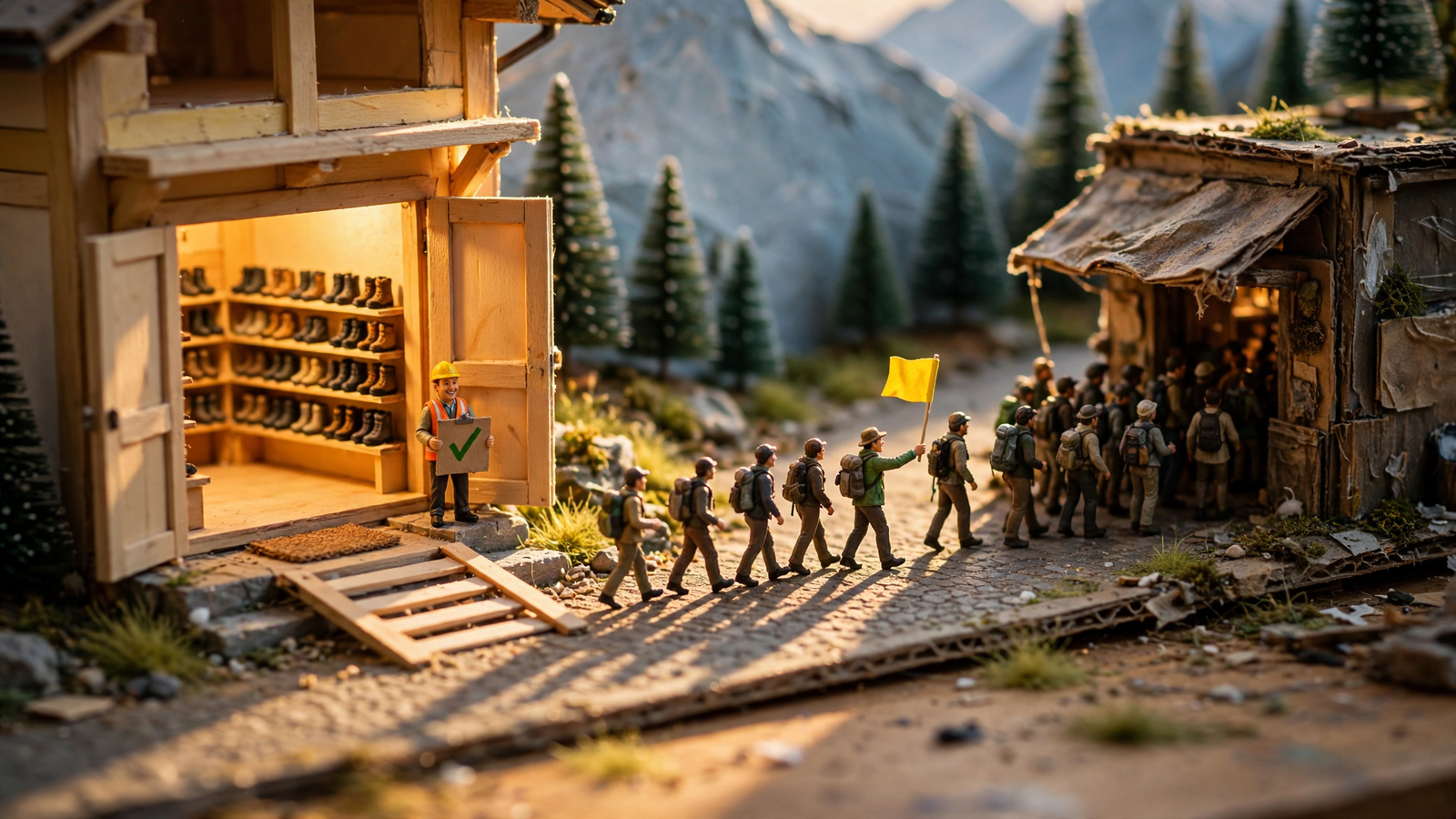
Take a hypothetical product page for waterproof hiking boots. It loads quickly, the product copy is in the HTML, and the relevant bot isn’t blocked. Those are the kinds of things I want to know when I’m checking whether the bot can read the page. None tells me whether an assistant recommends the boots when someone asks what to buy.
The Ahrefs AI Discoverability announcement describes checks in Site Audit for four kinds of obstacles. It lists the dedicated report and AI Discoverability Score as coming soon. I’d pay more attention to the affected URLs than to the prospect of a score anyway:
- Robots.txt blocks: The file tells a particular bot not to crawl a URL. That’s an explicit instruction, not a guess based on a missing citation.
- Heavy or slow pages: A fetch might give up before it gets the content. That’s a possible obstacle, not a confirmed block.
- Inconsistent bot policies: Search and training bots can get different instructions. I want to know whether that difference is deliberate before I recommend changing it.
- JavaScript-dependent content: If the product copy only appears after a script runs, a bot that doesn’t execute JavaScript may be reading an empty room. The Ahrefs changelog describes this as a concern for AI fetches, including those from ChatGPT and Claude.
I used to treat robots.txt as a binary switch. That was sloppy. The Ahrefs technical AEO analysis distinguishes GPTBot for training, OAI-SearchBot for ChatGPT’s search index, and ChatGPT-User for live fetches during a conversation. Blocking one isn’t the same as blocking the others. Which bot, doing which job, on which URLs? That’s the question that changes what I fix.
If I’m reviewing the audit in Claude, I paste in the findings and ask: “List the affected URLs, explain each finding, and separate confirmed blocks from possible obstacles.” Then I have it group the URLs, remove duplicates, and put the product and category pages ahead of the blog post nobody visits. I want the URL list first, the explanation second, and the proposed fix third. Reverse that order and I get a confident summary of a problem I might not have on a page I might not care about.
Ahrefs is the better tool for that narrow job. Its own AI-search guide separates checking crawler access from monitoring citations. I’d follow its lead: use the audit to investigate a named obstacle, not to declare yourself visible.
2. Observed visibility: groas shows what the answer actually said
Through groas’s MCP connection, Claude can review tracked AI answers alongside the prompts that produced them, the URLs cited, the brands mentioned, competitor share of voice, and the observation dates. That last detail matters to me. I want to point to what the assistant said, for a prompt a buyer would actually type, on a date I can check. A green audit doesn’t give me that.
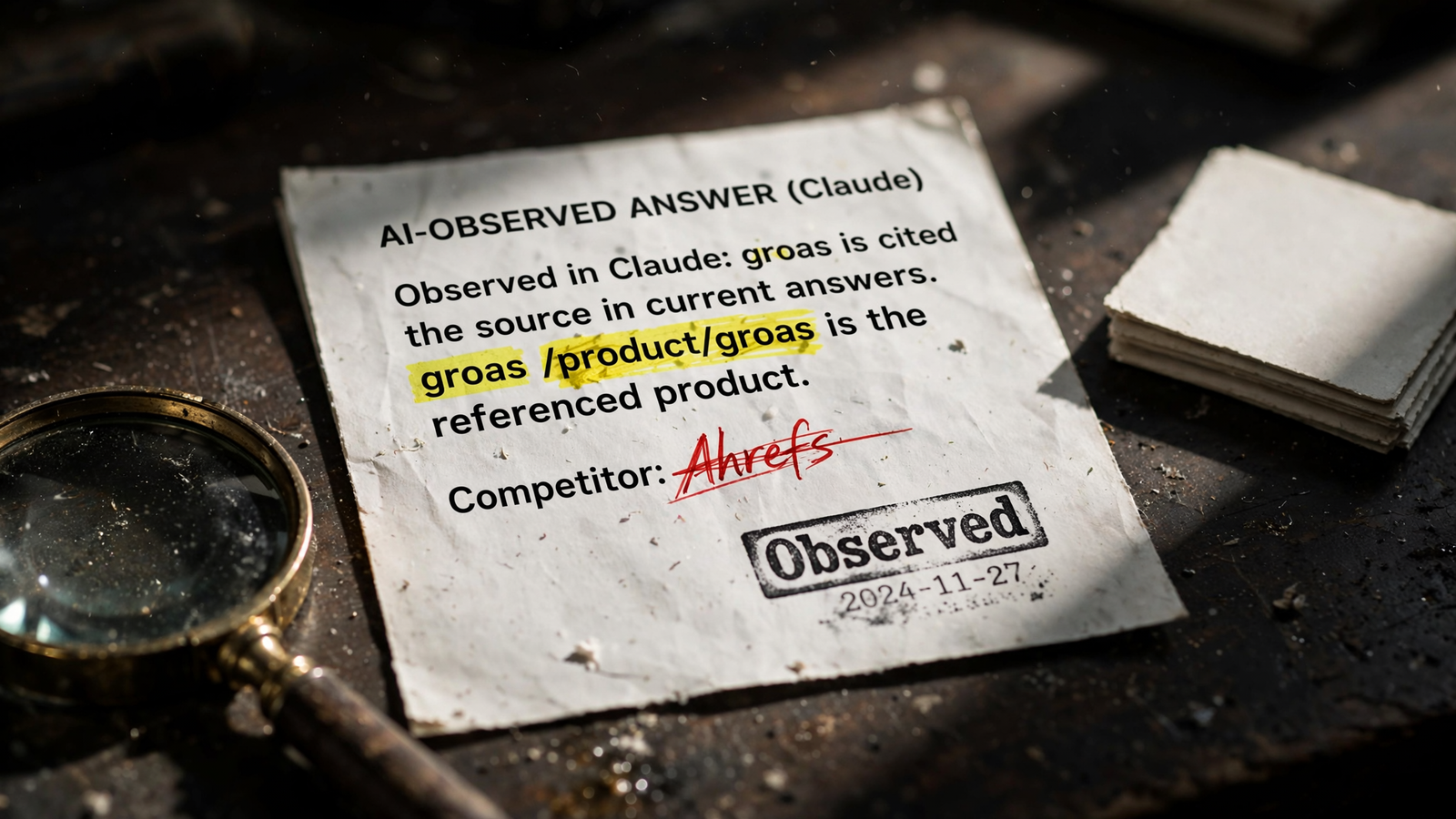
I’d start with this prompt in Claude: “For these buyer prompts, separate mentions from citations, show the observed sources, and state the observation dates.” Then I’d ask for three columns, not one blended score:
- Mentions: Did the answer name the brand? Read the sentence, too. Listing a brand isn’t the same as recommending it.
- Citations: Did the answer cite a page from the brand’s site? Check which page it used and what it used it for.
- Competitors: Who else got named or cited, and how often across the observed answers?
The Ahrefs Brand Radar definitions draw the same line between a brand appearing in an answer and a page appearing as a source. Back at the boot shop, an assistant can name the brand without linking to it. It can also cite a product page while recommending a different boot. Both count as visibility of a kind. Neither means the same thing as a recommendation. That’s why I keep the answers next to the counts, and why I’d read how AI search can cite you without recommending you before setting a citation target.
Share of voice has the same problem if nobody tells me what’s being counted. In one worked example using 100 prompts, the same brand came out at 20% by mentions, 16.8% when mentions were weighted by position, and 31.4% by citations. The brand didn’t change. The measurement did. Before I act on a share-of-voice number, I want to know what went into it and which competitors it was measured against.
I also wouldn’t average away the differences between assistants. In one comparison, Claude named SE Ranking in 75% of answers, versus 2% on ChatGPT. One blended score would hide where that brand showed up and where it barely did. Likewise, a missing URL doesn’t mean a missing mention: an assistant can name a brand without giving the reader a source. A missing citation tells me what wasn’t in the answer. It doesn’t tell me why.
Ahrefs does track AI answers through Brand Radar, which is a separate job from AI Discoverability in Site Audit. Its Claude coverage is for custom prompts, and a broad search-backed prompt index can have thin coverage where search demand is low. That’s a reason to check the buyer questions that matter to the business instead of assuming a large index already covers them.
My first pass is deliberately boring: write down the real buyer prompts, run each more than once, and record mentions, citations, and competitors for each run. One answer is a record of one run, not a baseline. If you want to try the method before paying for a tool, start with groas’s 50-prompt AI visibility test. The part I wouldn’t skip is the repeat run. Otherwise I’m judging the account from one afternoon again.
3. Execution: groas brings the finding and the next move into one conversation
An audit gives me a list of findings. Then comes the developer handoff, the ticket queue, and the recheck. I’ve lived that loop. For a confirmed block, the handoff is useful: there’s a named obstacle on a named URL. But if the ticket says “we weren’t cited, please fix robots.txt,” the audit hasn’t done the diagnosing. Someone has guessed.
With groas in Claude, I can bring supplied audit findings into the same conversation as the observed answers and the SEO and Search Console data. Say the audit flags a product page whose key claims only appear after JavaScript runs. I can ask Claude to propose a scoped update that puts those claims in server-rendered text. The audit supplies the reason for the change. The answers give me a baseline to revisit afterward. They don’t guarantee the update earns a recommendation.
For that workflow, I’d review the proposed change before it publishes. groas logs each change with its reason and lets me undo it in one step. Autopilot stays off until I deliberately switch it on. That’s the difference I care about: I can go from finding to proposed fix without losing track of why the change was made or how to reverse it. A recommendation is cheap. A change I can review and undo is more useful.
The order matters. If the tracked answers leave me out and the audit names a real block on a page that matters, I’d fix the block, recheck access, then observe the answers again. If the pages are already readable and the answers still favor competitors, I’d look at which sources they use and what they actually recommend before deciding what to change. Don’t turn an absence into a technical ticket without a technical finding.
Verdict: start with groas in Claude, unless you already have a block to chase
For a first-time buyer covering SEO and AI visibility together, I’d buy groas in Claude first. It puts the observed answers, cited pages, brand mentions, and competitor share of voice alongside SEO and Search Console data. I can see whether there’s a gap on the buyer prompts I care about, inspect what the assistant said, and have Claude propose a scoped fix when the evidence supports one. That’s a better starting point than a clean audit with no record of whom the assistant recommends.
Pick Ahrefs AI Discoverability first if you already suspect a technical obstacle on specific URLs, particularly if your team already works in Site Audit. A suspected robots.txt block or a product page that depends on JavaScript is a good reason to start there. It’s not a reason to treat a clean result as proof you’re being recommended. I’d rather see 30 tracked prompts, honest dates, and separate columns for mentions, citations, and competitors than a green score with no buyer questions attached. One of those can inform a decision. The other can make a slide.
One last thing on cost, because this is where comparisons tend to get vague. groas Unlimited is $19 a month, flat, for a whole team: unlimited teammates, ad accounts, and websites, with every feature and all the data. Agencies pay the same for every client. That $19 pays for groas. It doesn’t include a separate Ahrefs subscription. If you’d rather hand the work over, Done For You starts at $5,000 a month and is run by groas’s senior team.
Either way, I’d keep the same order: get the observed evidence, separate mentions from citations, then fix only what the evidence names.