

 LinkedIn

By November 2027, at least three competing Meta AI management products will publicly document “insufficient evidence” as a decision outcome, with a reason to leave an ad running instead of recommending a pause, a budget change, or a scale-up. Score that against product documentation, not a demo or a vendor telling you on a call that the agent “knows when to wait.”
I keep getting some version of the same question from groas customers: my Facebook ads are getting expensive, I can’t tell which ones to kill, and I want Claude to do it for me. I get the pressure. An agent that pauses something every morning looks busy. That doesn’t make it right. An expensive ad is not automatically a bad ad.
Meta’s learning-phase documentation says ad sets usually exit learning after about 50 results in the week after the last significant edit. Performance is less stable during learning, so what you see today isn’t necessarily what you’ll get later. In a Facebook Ads discussion about when to pause, one advertiser defended stopping at twice their target CPA with no sales. Fair enough when it’s your money. But one reply put the chance of getting zero sales after spending twice the true CPA at roughly 14%, even if performance hasn’t changed.
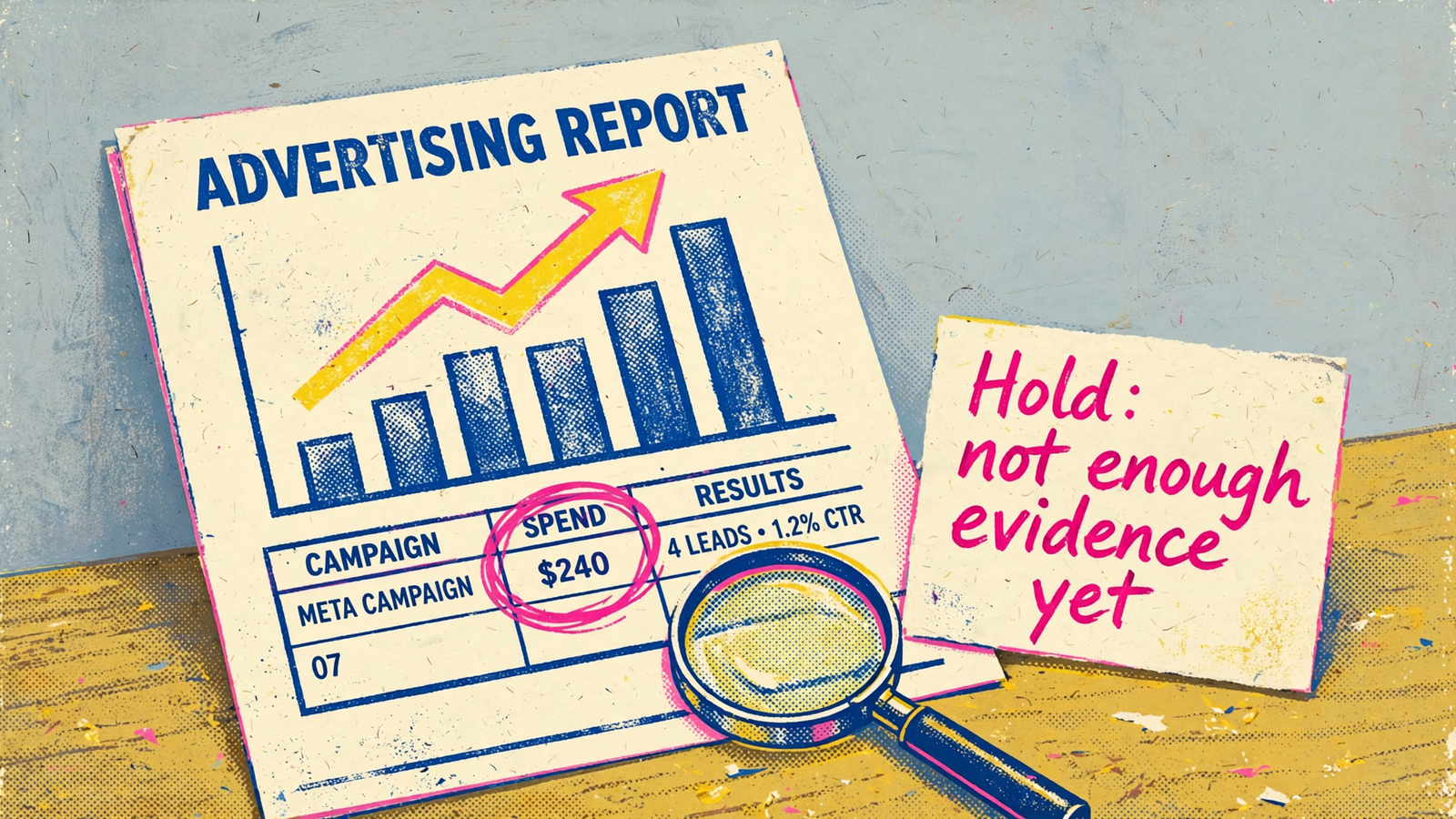
One bad day is evidence. It’s not a verdict. The next useful advance in Meta AI management is refusing a premature change and making that refusal clear enough to audit.
Prediction 1: “Insufficient evidence” becomes a visible answer
The workflow today still starts with the action. In Madgicx’s documented pause workflow, the assistant reads spend, results, and status, explains why each item matched your rule, and waits for confirmation before pausing. That’s better than silent autopilot. But it answers “Did this ad match the pause rule?” rather than “Do I have enough evidence to judge this ad?” Those are different questions, and a confirmation button doesn’t close the gap.
Meta’s own Ads MCP server, in open beta with a phased rollout, creates new campaigns as drafts or leaves them paused so nothing goes live without review and approval. That’s restraint at the point of execution. I expect competitors to put restraint into the recommendation itself: the agent says insufficient evidence and shows the spend, conversions, and reporting window behind that call.
The logic is already in practitioner guides. One framework for deciding when to kill a Facebook ad rejects a universal three-day or three-times-CPA rule and distinguishes incomplete delivery from incomplete evidence. Its Poisson reference table shows what can happen even if the underlying conversion rate holds steady: the chance of zero results is 36.8% after spending one times the true CPA, 13.5% after spending twice as much, and 5.0% after spending three times as much. Three times the CPA isn’t proof the ad is bad. It’s a different weight of evidence. A tool that can express that distinction has a feature worth selling: a documented reason not to act.
The November 2027 test
If fewer than three competing products document an explicit insufficient evidence or defer action outcome, I’m wrong. A blog post about being careful doesn’t count. Neither does a support article that tells you to set a minimum spend. I want a decision the customer can see when an ad is expensive, the data is thin, and the next move is to wait or investigate.
Ask Claude for a verdict before you ask for a change
I’d start with this prompt in groas:
Using groas, compare these ads over the same reporting window. Show spend, conversions, attribution settings, and recent changes. Sort the ads into pause, investigate, and hold. For each hold, tell me what evidence would change your recommendation. Make no changes.
If Claude gives you one ranked list of ads to kill, send it back. I want to know which ads have a case for pausing, which need a closer look at the setup, and which I simply can’t judge yet.
Prediction 2: Agents explain why they left an expensive ad running
A red CPA column tells me what an ad cost per result. It doesn’t tell me what happens if I turn the ad off. A practitioner argument about pausing high-CPA ads makes the distinction: Meta optimizes for total conversions, and a higher-CPA ad may be finding new buyers or feeding lower-CPA ads in ways Ads Manager doesn’t show. The same argument warns that pausing a top-spending ad during a dip can destabilize the account. That doesn’t prove the expensive ad is helping. It does mean I need more than the CPA column to make the case that it’s hurting.
Meta’s delivery best practices sharpen the problem. Meta advises consolidating delivery to reach about 50 optimization events per ad set, and it also advises turning off ads that aren’t delivering. Both can be right. Neither tells me where to draw the line for my account, my margin, or my attribution settings. When an agent leaves an ad running, the hold needs a reason I can audit.
Separate what the agent saw from what it suspects
When Claude recommends a hold through groas, I want two lists:
- Observed: Spend, conversions, cost per result, attribution settings, recent edits, and delivery status.
- Hypothesized: Creative fatigue, tracking lag, audience overlap, a competitor move, or a landing page change on the client side.
I used to accept the second list dressed up as the first. I was wrong to let it pass without a label. “The ad is expensive, but the window is short, there are few optimization events, and two recent edits reset learning” is a reason I can check. “The creative is fatigued,” with no frequency data, no holdout, and no comparable ad, is a story. The agent can offer that story as a hypothesis. It shouldn’t pass it off as the reading on the account.
The November 2027 test
Prediction 1 is about whether hold exists as an outcome. This one is about what the tool says when it gets there. If leading tools still report pauses, budget moves, and creative tests but their documentation doesn’t show how they explain a hold, I’m wrong. Until then, I’d ask for the missing evidence every time. An agent that explains only its pauses is asking you to trust the half of the decision it didn’t take.
Prediction 3: Pause approval and scaling approval split
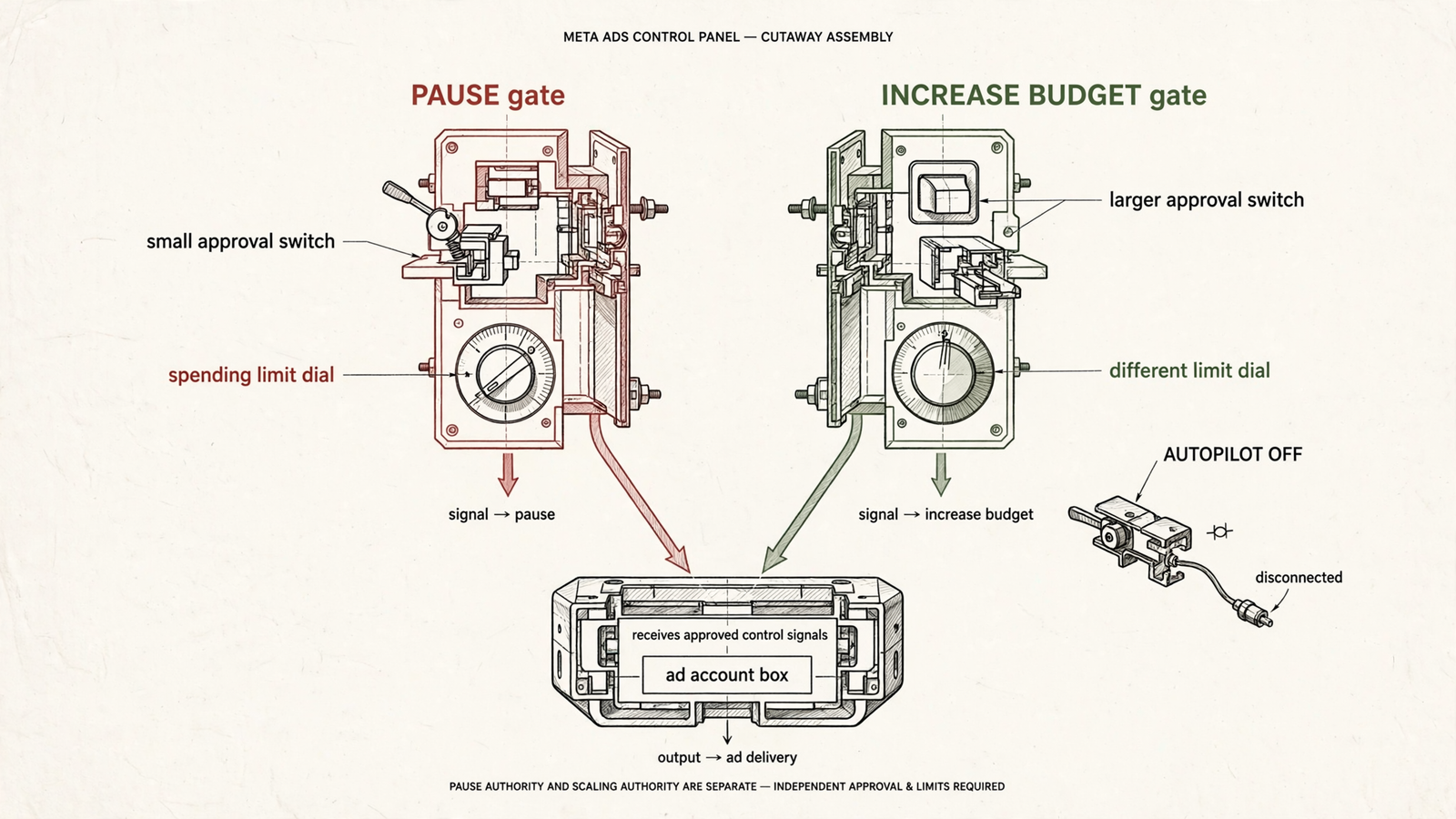
This is the one I expect advertisers to feel first, because it changes a settings screen. By November 2027, leading Meta AI management tools won’t ask just “Can the agent act?” They’ll ask “Can the agent stop spend?” and “Can the agent increase spend?” Each will have its own approval rule, budget limit, and log.
The distinction already exists in Meta’s Ads MCP tool inventory. Campaigns, ad sets, and ads are created in a paused state. ads_activate_entity starts spending; ads_update_entity makes edits. Creation, editing, and activation aren’t one gesture. Stopping spend and authorizing more of it shouldn’t be one permission. A pause stops spend, but it also cuts off delivery and the data that comes with it. A budget increase spends money faster and can reset learning. I don’t want the same rule making both calls.
Write two rules before switching on autopilot
I’d leave autopilot off until I can explain both rules. That’s where groas starts: autopilot runs only after you switch it on, and every change is logged with its reason. Here’s how I’d write the rules:
- Pause: If an ad spends twice my target CPA with zero conversions, put it up for review. That threshold gets the ad into the queue. It does not settle the verdict.
- Scale: Increasing a budget, duplicating a winner, or activating a paused ad needs separate approval. For a budget increase, I’d set a maximum percentage change per step and a window for judging the result before changing the setup again.
A Reddit thread about a first budget increase shows why I want that window written down. An advertiser doubled a budget from $100 to $200 a day, then couldn’t tell whether an ad at 0.32 ROAS on $139.32 of spend was helping the funnel or just losing money. Replies pointed to the advertiser’s 1.2 break-even ROAS and suggested holding the structure stable for five to seven days after the change. The useful point isn’t that five to seven days is a universal rule. It’s that scaling without a plan for when to judge the change turns a small ambiguity into a larger invoice.
The November 2027 test
Show me a leading Meta AI management tool that still puts pausing and scaling under the same permission in November 2027 and I’m wrong. In the meantime, I wouldn’t give an agent the second permission just because I trust it with the first.
What I’d change in groas this week
Stop asking for a list of ads to kill. Ask for a ranked queue: pause, investigate, hold. Keep the evidence and the uncertainty next to each recommendation. If an ad lands in hold because the window is short, ask how much more data the agent wants and what would move the ad out of that bucket. If it lands in investigate because delivery is incomplete or tracking looks off, ask which check would resolve it. That’s how I make do nothing a documented outcome now, without waiting for competitors to package it.

After an approved change, read the reason in the action log. In groas, changes are logged and can be undone in one step, subject to what Meta lets you restore on the entity. Undo can restore a setting. It can’t rewind auction delivery, recover spend, or bring back the learning history an edit reset. I read the log the way I’d read a colleague’s account notes: I’m looking for why they did it, not just what they clicked.
Finally, give Claude your break-even ROAS, minimum spend for considering a pause, reporting window, and attribution settings before asking for a verdict. Even Madgicx’s automation guide warns that rules can fire too often when the time range is too short or there’s no minimum spend. A significant automated edit can reset learning just like a manual one. Write the thresholds down. Otherwise, the agent has to guess where you’d draw the line, and a queue full of changes can make those guesses look like work.
Score it in November 2027
I’ll publish a scorecard: how many products document insufficient evidence, which ones explain holds, and whether pausing and scaling have separate approvals. If the category still sells activity and treats a hold as silence, I’ll say so in print. No moving the goalposts.
I don’t expect a blank scorecard. The statistical case for restraint is already in the practitioner guides. Meta’s tooling already separates creation from activation. What’s missing is a product that puts those ideas together at the moment an advertiser asks whether to touch an expensive ad.
I’d rather buy the product that says “insufficient evidence” with the numbers attached than one more tool that finds ads to pause. If you’re already asking Claude through groas which ads to kill, change the question this week. Ask for the queue, the evidence, and the uncertainty. Make do nothing a decision you can read. That’s the feature. Everything else is a demo.





