

 LinkedIn

Your CFO gives you $3,000 to buy more qualified B2B SaaS demos. Do you put it into Google Search Ads, the keyword machine already booking meetings, or ChatGPT Ads, the conversation matcher that might reach buyers before they know which vendors to search for?
Here is my answer up front. Google wins on demo volume. ChatGPT wins on shortlist timing. Test ChatGPT with money from Google’s weakest non-brand terms, never from brand or high-intent comparison search. The question is not whether cheaper clicks look good in a report. It is whether earlier exposure produces qualified pipeline that your weakest search spend did not.
The contenders: Google harvests demand; ChatGPT shapes it
Someone types best contract management software for startups into Google. You bid on that intent, inspect the search term and decide what the click was worth. I spent years in those reports at 1am, adding negatives and fixing tracking after a landing page changed without warning. It is tedious work. It also works because the buyer told you what they wanted.
ChatGPT Ads starts earlier. You write plain-language context hints describing conversations where your ad should appear, and the system matches an ad to a live chat below the answer. Buying opened to every US advertiser on May 5, 2026 with CPC bidding and no minimum; OpenAI recommends starting around a $3 to $5 max CPC. If you are used to match types, handing over that much control feels strange. It is also why the channels belong at different points in the buyer’s decision.
Axis 1: A buying query beats a research conversation for demos
Google gives you the buyer’s words. A query like contract management software pricing tells you considerably more about purchase intent than a general discussion of how to manage contracts. You can bid on it, block it or isolate it. ChatGPT matches the context of the conversation, not a keyword, and places a sponsored card below the answer. WebFX describes Google as bottom-of-funnel and ChatGPT as research-mode in its October 2026 comparison.
For demo bookings, that difference matters more than the novelty of the placement. Explicit intent books meetings; conversational context can shape the shortlist. The same comparison reports a 6.64% median CTR for Google Search against about 0.73% for ChatGPT in the US. I used to see a gap like that and dismiss the newer channel. I was wrong to stop there. If a buyer asks ChatGPT how to compare vendors, your Google ad may later catch a decision you had no part in shaping.
That does not make the research click a demo click. It gives ChatGPT a different job: get considered before the buyer starts searching for names.
Axis 2: Google lets you narrow the audience; ChatGPT asks you to describe it
Google gives you keywords, negatives, match types, geographies, first-party audiences, ad schedules and device controls. For B2B SaaS, those levers matter. You can pursue someone searching SOC 2 expense tool and stop paying for free expense tracker template. I grew up on that control panel. It is where a lot of lead quality gets made.
ChatGPT gives you context hints of up to 280 characters. It does not give you job-title, company-size or industry targeting, or a search term report to mine. You describe the conversation you want; the model decides whether the ad fits. That puts more weight on a short piece of writing and less on the exclusions an operator can make after seeing a bad click.
There is an audience limit, too. Ads reach Free and Go users, not Plus, Pro, Team, Enterprise or Edu users. If the people who sign your contracts use an employer-paid Team or Enterprise account, your ad cannot reach them there. Research from other people at the same company may still matter, but do not mistake that for title-level targeting.
Use Google to pursue defined buying intent; use ChatGPT to enter category conversations. If your demo program needs director-plus decision-makers to click and book now, ChatGPT alone is the wrong bet.
Axis 3: The qualified demo is measurable, but not equally visible
Google lets you connect the click to the outcome the CFO cares about. Record a conversion when the demo form submits, then import the qualified demo back into Google from Salesforce or HubSpot after sales screens out the students and tire-kickers. Google can then bid toward qualified outcomes rather than raw form fills. I have seen accounts look profitable on booked demos and unprofitable on qualified ones in the same week. More budget was not the fix. Cleaner conversion mapping was.
ChatGPT’s feedback is thinner. CPA bidding arrived June 5, 2026, but although reporting shows the ad and click, you cannot see the conversation that triggered it. Custom audiences need 25,000 matched users before they serve. Without the triggering chat, you cannot inspect wasted spend the way you inspect a Google search term report.
Use one definition of a qualified demo for the verdict. Track booked demos to pace the test, then use CRM qualification to compare what each channel delivered. Feed qualified outcomes into Google bidding where that import is available. Do not call ChatGPT a winner because its clicks are cheap while judging Google by pipeline. That is not a test; it is a spreadsheet trick.
Axis 4: Each click needs a different page and a different operator
A Google click often arrives sold on the category and skeptical of you. Someone searching your competitor vs you pricing wants proof quickly: a relevant headline, clear answers to the comparison, and an easy path to book. Send that buyer to a generic page and you pay for the mismatch. I learned that after a client swapped a landing page without telling me and Quality Score fell off a table. On Google, match the page to the query.
A ChatGPT click arrives curious and less committed. The buyer asked how to solve a problem, saw your card below the answer and clicked to learn more. A hard demo pitch can end that visit. A comparison, calculator or 90-second explainer can continue the conversation, with a demo invitation when the buyer is ready. Google pages should make the case; ChatGPT pages should teach, then invite. Do not test the channels with the same URL and blame the loser for a page built for the winner.

The management work differs as much as the pages. Google needs pruning: review search terms, add negatives, separate queries that convert and pause broad educational terms that spend without booking qualified demos. A tight B2B negative keyword strategy matters because new searches keep appearing. Anyone who says a B2B search account runs itself has never carried a $524 CPL target.
ChatGPT needs rewriting. With no search term report, you judge which context hints appear to draw useful research traffic, sharpen the language describing your ideal conversation, and test the card’s headline and image. It takes less keyword pruning and more judgment about what a buyer might be discussing. Google rewards daily account work; ChatGPT rewards clear context and regular revision. Running both as an unloved side project is a reliable way to learn nothing from either.
Axis 5: Cheap ChatGPT clicks do not guarantee cheap qualified demos
Conversion rate decides what a click is worth. In one same-account B2B test over 30 days, ChatGPT clicks cost $0.76 against $10.46 for Google Search, with cost per lead at $92.21 versus $157.57. The conversion rates tell the other half of the story: 0.8% for ChatGPT against 6.64% for Google. Across StubGroup’s clients, the ChatGPT medians were $2.12 CPC, 1.39% CTR and $29.61 CPM.
A $3,000 test at roughly $10.46 per Google click buys about 300 clicks; at $2.12 per ChatGPT click, it buys about 1,400. That is a reach difference, not a demo forecast. For B2B SaaS, Metadata puts click-to-lead at 1.9% and spend-weighted CPL at $524. If your sales team rejects the extra forms, the lower CPC has bought you a bigger queue to clear, not cheaper pipeline.
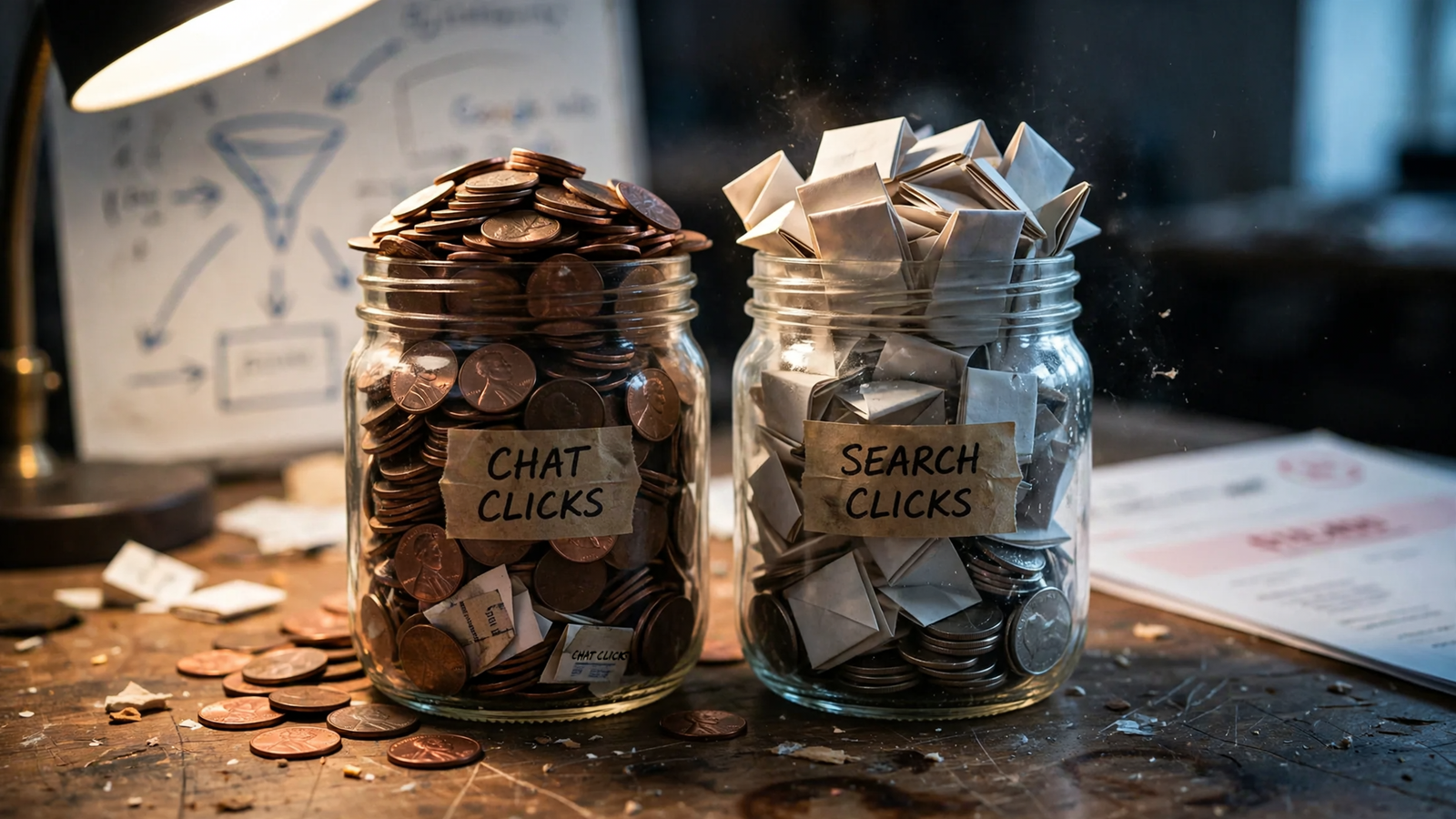
Broader revenue data points the same way. A working paper covering 102 advertiser sites found a paid ChatGPT visit earned $0.89 in revenue versus $2.45 for paid Google Search, with conversion rates of 0.37% and 1.17% respectively. At that sample’s $0.72 median search CPC, the authors calculated that a ChatGPT click would need to cost about $0.26 to match search on revenue per dollar. That calculation is not a price quote for your account. It is a warning against declaring victory from cheap clicks alone.
Judge both channels on cost per qualified demo, never CPC. ChatGPT may still earn its place by getting your name onto a shortlist that Google later closes. It should not be expected to beat high-intent Search on direct demo volume.
The scorecard: Google wins the demo brief
| Decision axis | Google Search Ads | ChatGPT Ads | Winner for demo bookings |
|---|---|---|---|
| Buyer signal | Explicit search query | Research conversation | |
| Audience control | Keywords, negatives and other controls | Short context hints; no title targeting | |
| Qualified-demo measurement | CRM import can inform bidding | Compare CRM outcomes, with less click context | |
| Page and management work | Proof-led page; regular pruning | Teach-first page; context rewrites | Different jobs |
| Demo economics | Higher CPC, stronger direct conversion | Lower CPC, weaker direct conversion | Google on volume |
That table does not make ChatGPT useless. It makes the budget choice narrower. Keep the spend that catches buyers who are ready. Test the spend that tries to reach them earlier.
Keep on Google: brand and high-intent comparisons
Do not fund ChatGPT by cutting yourbrand pricing, yourbrand vs competitor or other high-intent comparison searches. Those queries show what the buyer wants, let you control the bid and give Google qualified-demo feedback once sales has weighed in. Pulling $3,000 from that work to chase cheaper clicks is how a team trades ready buyers for curious readers, then wonders why pipeline fell.
Brand and high-intent comparison search stay on Google. No exceptions for a test budget that merely has innovation written on it.
Test on ChatGPT: the non-brand terms you already distrust
Find the broad educational tail in your Google account: terms like what is vendor onboarding software or how to track renewals that consume budget but rarely survive sales qualification. In accounts I have run, that tail was easy to spot once we stopped celebrating form fills and checked what sales actually accepted.
Then run a contained test:
- Pause enough weak non-brand spend to fund $3,000, without touching brand or high-intent comparisons.
- Write context hints around those same early questions: a buyer comparing options for a 50-person finance team, asking about implementation time or asking what breaks with spreadsheets.
- Send ChatGPT clicks to a teach-first page, not the hard-sell demo page. Run the initial test for four to six weeks, then follow the resulting leads through the sales cycle.
- Compare qualified demos in the CRM against what that weak Google spend was producing. If ChatGPT cannot beat that baseline, it does not deserve stronger budget.
This is a test of the weakest part of Search against ChatGPT’s best-fitting job. It is not permission to raid the terms that already book meetings.
Who should choose Google alone
Skip ChatGPT for now if your $3,000 is the only pipeline budget and you need meetings this month. Choose Google alone if you know the people you must reach use ad-free Team or Enterprise accounts, or if your team cannot follow up promptly and track qualification. Those are not objections to advertising in conversations. They are reasons this particular demo test would be poorly matched to your buyer or badly measured.
For long-cycle B2B teams that can wait for shortlist effects to show in pipeline, the test has a job. For a team that needs this month’s qualified meetings, Google is the winner. The loser in the demo-volume contest, ChatGPT, is still the pick for a team with weak educational search spend, a teach-first page and enough patience to see whether earlier consideration turns into pipeline.
One team should own the comparison. Google needs search-term pruning; ChatGPT needs context-hint rewrites; the CRM needs to score both against the same qualified-demo definition. That is the work an in-house team can miss when the new channel becomes a side project beside the core search account. groas runs Google, Bing and ChatGPT Search under one service for a flat $1,499 a month, with bids, budgets and landing pages worked around the clock and changes logged. One owner, one qualification standard, and no percentage-of-spend incentive to keep weak broad terms alive.
Here is the verdict to take to your CFO: Google remains the demo machine; ChatGPT gets a $3,000 audition as the shortlist machine. Keep brand and high-intent search. Move only weak educational spend, measure qualified demos through the sales cycle, and make ChatGPT earn the money it gets next. If it beats that weak Google baseline, keep testing. If it does not, put the budget back into what books meetings.


