

 LinkedIn

Cutting a Google Ads campaign from $120 a day to $80 is one decision. Keeping the budget in check after I close the chat is a job. If you’ve already connected your ad accounts to groas, that’s the choice between ChatGPT with groas and groas autopilot: approve an edit now or give a recurring job rules it can follow between conversations. I choose based on how long the instruction stays true, not how much autonomy looks good in a demo.
Closing the chat doesn’t switch on autopilot. Connecting an account doesn’t either. I enable it under rules I set, or it stays off. So the first thing I want to know isn’t whether both modes can make a budget change. It’s whether I want to be asked again before the next one.
Same connection, different permission
In chat, I approve the edit in front of me. I ask in plain English, ChatGPT reads the live account through groas and proposes a change, and I decide whether it should go through. It can pull in the market data groas collects, too, but the useful part is dead simple: I see the proposed edit before it lands. I don’t have to copy the number into Google Ads myself. The review is the work now.
On autopilot, I approve the rules up front. I define the goal, budget ceiling, allowed changes, and stop conditions, then switch it on. groas keeps checking and acting between conversations and logs each change with its reason. Reading a campaign isn’t the same as having permission to change it. Supermetrics makes that distinction explicit with separate write access per ad account. For my purposes, the next question matters more: am I approving this change or the rule that would allow it again?
Round 1: One budget edit or an ongoing spending rule?
Chat: Ask for the evidence and one proposed edit
Say I have a search campaign spending $120 a day, a $55 target CPA, and 11 days of clean conversion tracking. I ask ChatGPT to pull spend, CPA, and impression share for the last 14 days, flag the tracking gap, and propose one change. I want the current value and the proposed value on the same line. If the case for $80 a day holds up once I’ve accounted for the gap, I approve $80. If it doesn’t, I leave the budget alone.
Approval covers that edit, not tomorrow’s decision. ChatGPT can bring in the account numbers, rival ads, and what customers are saying on Reddit. I still decide whether any of it makes a budget cut the right move today. Approving $80 doesn’t mean I’ve agreed to keep cutting whenever CPA misses the target. No standing instruction comes out of that approval.
Autopilot: Write down what it may change without asking
For the same campaign, I might write an autopilot brief like this:
- Goal: Keep CPA near $55.
- Budget boundary: Don’t make a change that takes the account’s daily budget above $150.
- Allowed move: Shift up to 15% of the budget between ad groups.
- Reserved for review: Leave new campaigns paused until I review them.
The budget boundary does more work than the goal. A platform might suggest spending more to chase conversions. That’s a suggestion, not permission to raise the daily budget without review. And the ceiling isn’t a target: staying below $150 doesn’t make every move under it a good idea. That’s why I write down the move I’m allowing as well as the number I won’t go past. If I can name the moves I’m willing to let through without another conversation, autopilot has a job. If every move needs a fresh argument, I keep it in chat.
Round 2: Who knows the offer changed?
Chat: Bring the new offer into the decision
Say a home services business swaps a free estimate for a $49 diagnostic fee. Same URL, new headline. The search ads still sell the free estimate. I’d give ChatGPT the page URL and ask it to compare the current offer with the live ads and search terms before touching a bid. Otherwise, I could spend the whole review trying to fix a bid when the ad is making the wrong promise.
Chat wins when I know something the account doesn’t show. The connection brings in live account data, rival ads, funnels, and Reddit chatter. It doesn’t bring in the Slack thread where the owner killed the promo. I can supply that context before I approve anything. I’m not there just to click Approve. I’m there to say the offer changed before we spend another review debating the bid.
Autopilot: Name the changes that invalidate the brief
Autopilot doesn’t see the Slack thread either. The difference is that it keeps working under the last brief I gave it. It can read the numbers correctly and still optimize for an offer we no longer sell. So I write down what would make me stop and revisit the brief:
- A change to the offer, price, or landing page.
- A stockout or a break in conversion tracking.
- A move of more than 30% in cost per lead over three days, if that’s the tripwire I’ve chosen.
Some of those signals are in the account. Some are things I have to bring to the review. Writing down offer change doesn’t tell autopilot what happened in Slack. I still have to turn what I know about the $49 fee into a decision about the old brief. Chat borrows the judgment I bring today. Autopilot borrows the judgment I wrote down last time. If I can’t keep that brief current, I don’t leave it running.
Round 3: What counts as proof the edit landed?
Chat: Check the account, not the chat bubble
When ChatGPT says it changed a budget, I open the campaign and check the live value against the edit I approved. Then I read the groas log for the reason. Those checks answer two different questions: did the change land, and does the record explain why it was made?
An agent can lose the acknowledgment after Meta accepts a write and report a successful edit as a failure. If I trust that message and try again before looking, I’m making another decision without knowing what the first one did. The chat transcript is a claim. The account screen is the receipt. I check it before I retry, not after.
Autopilot: Check the decisions against the brief
With autopilot, I review the log in batches. Did each edit land, and was it allowed in the first place? I check whether the move stayed within the ceiling and whether the evidence supported it. A budget shift can land exactly as recorded and still be wrong under the rules. The live account tells me what changed. The brief is what lets me judge whether it should have.
I also separate undoing a change from undoing its consequences. Putting a budget back doesn’t recover money already spent. A significant Meta edit can send an ad set back into learning, and reversing it can mean another edit and another reset. That’s why I’d leave new campaigns paused until I’m ready to enable them. The log helps me see what happened. It doesn’t make the original decision free.
Round 4: Which mode actually saves review time?
Chat is cheap when I only need to ask once. If I run the same check 20 times, though, I have to look at the evidence, decide whether to approve the edit, and verify what landed every time. Say that takes five minutes a pass. Compare that with spending 45 minutes writing a brief and then two minutes a day checking exceptions. Those are planning numbers, not a stopwatch result. The comparison only holds if I don’t have to keep rewriting the brief.
That’s the hidden bill. Say my brief allows search term additions under $3 CPC, then my supplier raises prices 18%. The clicks can still come in under the limit while the ROAS math changes. In chat, I can put the new margin in the request before approving anything. On autopilot, the old rule can keep passing its own test until I revisit it. The rule isn’t broken. The assumption behind it is.
I draw the judgment line at work I can put in writing and check quickly. If I open the log and can tell why a move fit the brief, I’m reviewing a decision. If I have to reconstruct the case from scratch, I’m doing the work I meant to hand off. Count the time it takes to maintain the brief, not just the time it takes to scan the log.
The scorecard: Four rounds, two ways to run the account
I score the next job, not the whole account. The same campaign can need a one-off budget cut today and still be a good candidate for a standing spending rule later. Write access in both modes doesn’t mean both should keep permission for the same length of time.
| Decision axis | ChatGPT with groas wins when… | groas autopilot wins when… |
|---|---|---|
| Budget control | I want to approve one exact edit against today’s numbers. | I can set a ceiling and define which moves may recur. |
| Business context | The offer, page, or margins have changed, and I need to explain what that means. | The assumptions still hold, and I know what would invalidate them. |
| Verification | I want to check one approved change in the live account. | I can check a batch of logged changes against a written brief. |
| Review time | The task is infrequent or needs fresh judgment each time. | The task repeats, and checking the log takes less time than rerunning the prompt. |

Give the winner one job, not the whole account
I start in chat either way. I pick one repeatable job, like holding the line on a daily budget ceiling, and ask for the brief without authorizing a change. It’s easier to spot a hole in a rule when it’s written down than when I’m reading the log and trying to remember what I meant.
Read this campaign and propose an operating brief: goal, budget ceiling, allowed changes, changes needing my approval, and conditions that should make me revisit the brief. Do not enable autopilot or change anything.
I read the answer as a permission slip, not a strategy deck. Does it say what can move, what stays put, and what sends the decision back to me? If I can stand behind it between reviews, I use the autopilot operating contract to spell out allowed changes, evidence, and stop conditions. If it reads like a list of exceptions I have to explain in person, I leave autopilot off and stick with executing approved changes in chat. The brief has done its job even if I never switch anything on.
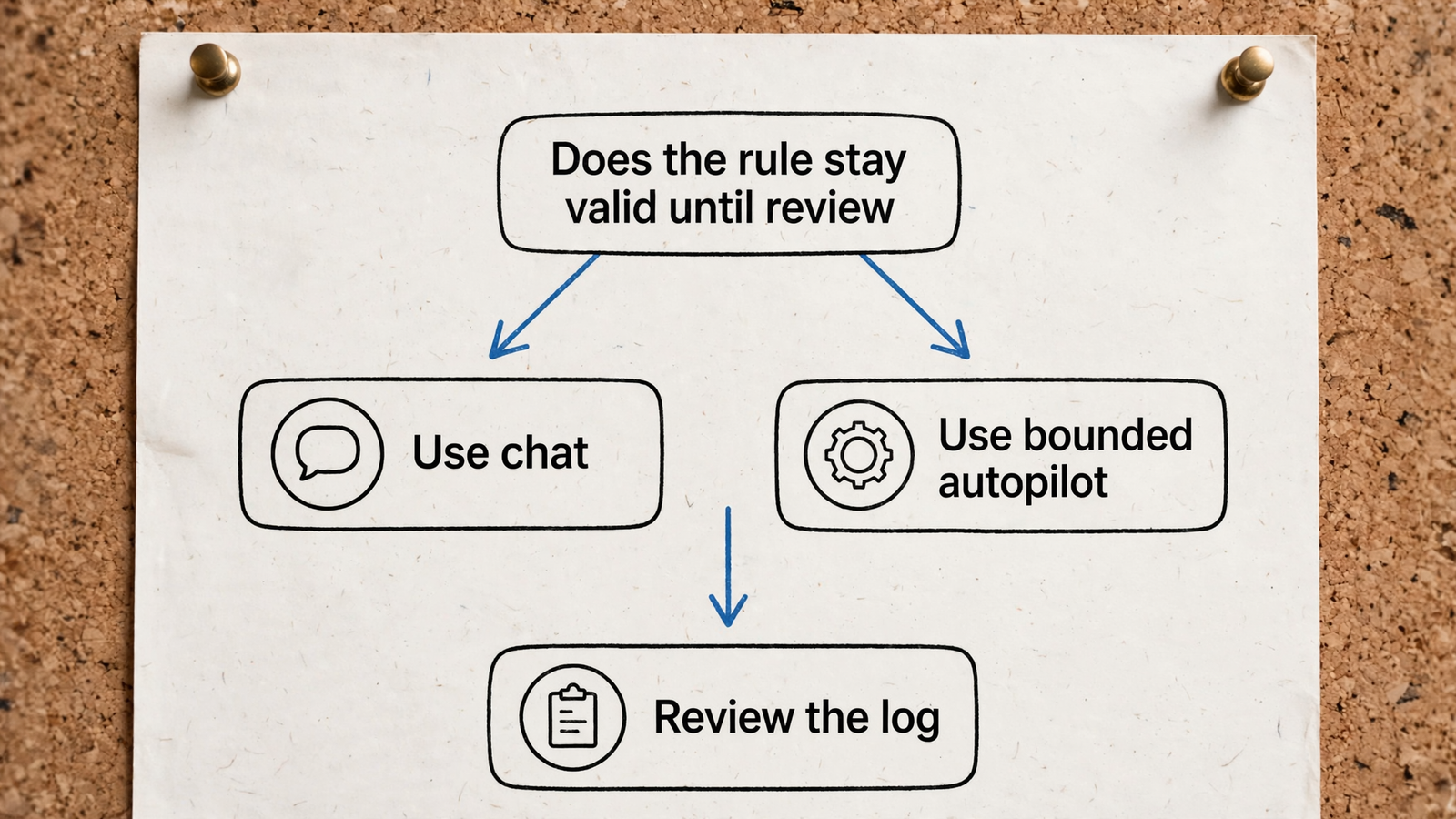
Verdict: Chat wins for most groas customers
I’d pick ChatGPT with groas for most existing customers. The connection is already there. I can approve a change in plain English, and I can bring a new price, a swapped headline, or a broken tracking tag into the conversation before the next edit. If any one of those can turn a good rule into a bad week, I want permission to end with the edit I approved.
I’d pick bounded autopilot anyway for the boring job I can write on an index card. Don’t raise the daily budget past its ceiling. Leave a new Meta campaign paused until I enable it. When the task repeats daily, the limits still make sense two weeks later, and checking the log takes less time than retyping the prompt, autopilot earns its keep. Automate the repetition. Keep the unresolved decisions in chat where you can see them.





