

 LinkedIn

Let ChatGPT make your ad changes. Leave autopilot off.
That sounds backward when every vendor is selling always-on management. But making one approved edit and running an account between chats are different jobs. A tight budget is a reason to separate them, not bundle them together.
I spent most of a decade inside Google Ads accounts for small ecommerce brands and local services, doing the handwork at 1 a.m.: search terms, negatives, budgets that drifted because someone changed a landing page without telling me. That work taught me the distinction that matters here. I can delegate a specific, inspectable task before I delegate the decision to act.
With groas plugged into ChatGPT, I can ask ChatGPT to read the live account, propose an exact edit, and carry it out after I approve it. I do not need to hand over ongoing decisions to get that benefit. Autopilot stays off until I switch it on.
An approved edit is not an unattended account
When I say let ChatGPT make changes, I mean a specific exchange:
- Read: pull live data from a connected account through groas.
- Propose: name the account, the entity, the relevant numbers, and the exact edit.
- Approve: wait for my explicit yes.
- Execute: make the approved change, then show the result.
Every change is logged with its reason. That gives me something to inspect beyond a reassuring sentence in a chat window.
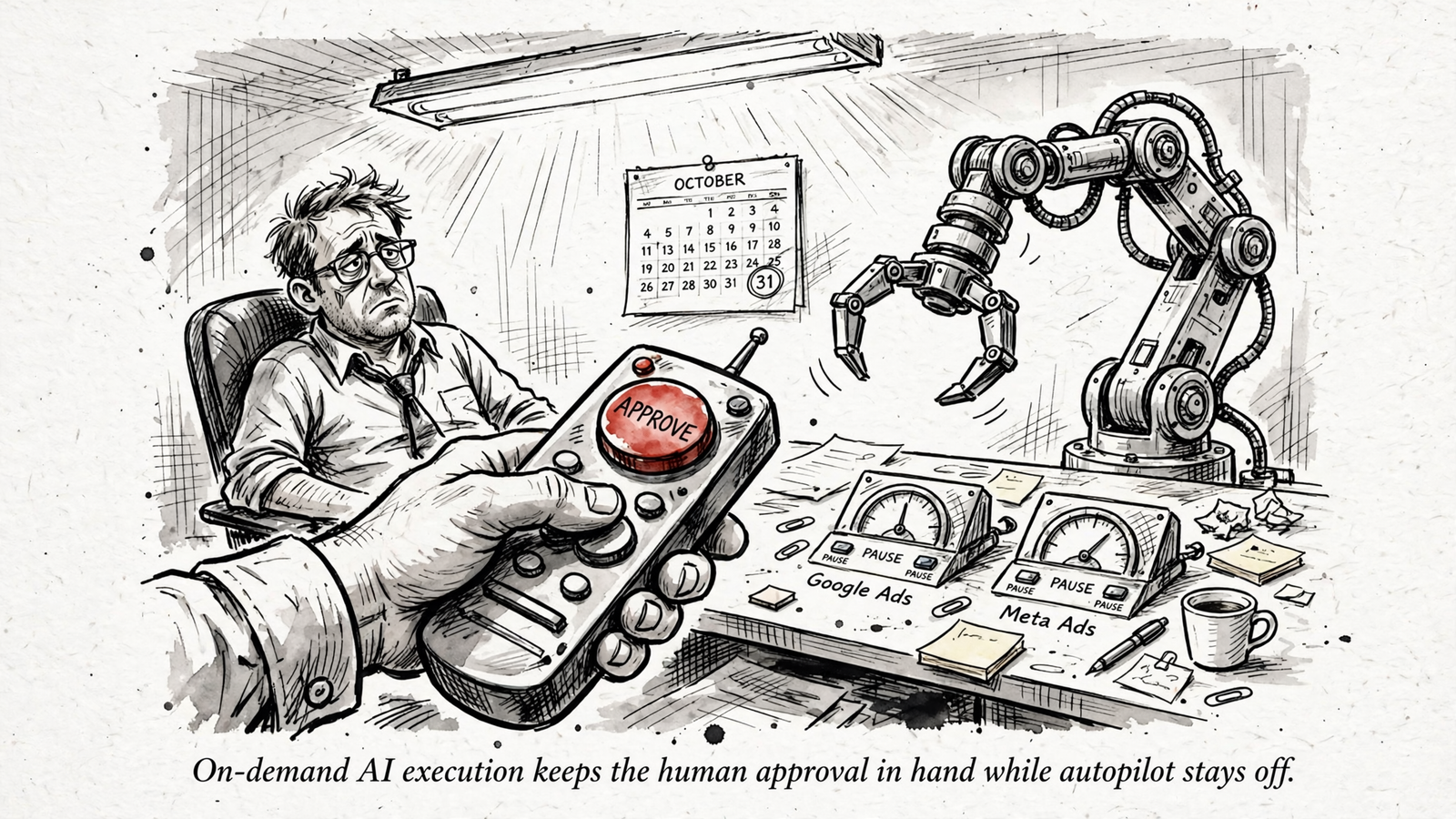
Autopilot is a different job: ongoing operation between chats, without a fresh request for each action. groas leaves autopilot off until I switch it on. Connecting an account does not activate it.
I used to tell clients that more monitoring was always better. I was wrong. Monitoring without a decision rule just creates more edits.
I want the ability to act on demand, not an obligation to keep acting.
Connect the hands, not an unattended mandate
Before connecting anything, I would settle the privacy question: what reaches ChatGPT, and can I revoke access? I authorize specific ad accounts and can disconnect them. The useful distinction is between granting account access and granting permission to operate without approval. Those are not the same decision.
If that is the holdup, read what data actually reaches ChatGPT before proceeding. Account access should be a deliberate choice, not a detail buried under enthusiasm for a demo.
The connection itself is straightforward:
- Add groas as a custom MCP server in ChatGPT using
https://mcp.groas.ai/mcp. - Sign in through the OAuth window.
- Connect the ad accounts I want to use.
- Leave autopilot off.
ChatGPT supplies the reasoning. groas supplies live account access, execution tools, and the extra market data around competitors, Reddit, and AI answers. One thinks. One touches the account. I leave the third job, deciding on its own when to touch the account, unhired.
There is a cost distinction, too. The $19 groas connection is one line on the first MCP bill, separate from whatever I pay for ChatGPT itself. I also check that my ChatGPT setup permits the actions I intend to use. A connection that can read data is not, by itself, proof that it can finish an approved edit.
The setup I want is an operator on call, not an unattended mandate. Connecting the hands does not require delegating the judgment.
Ask for one decision worth inspecting
Once groas is connected, I start with this prompt:
Read our connected ad accounts for the last complete reporting period. Identify one issue worth investigating. Show the account, entities, source metrics, reporting limitations, and proposed next step. Make no changes.
One period. One issue. No changes. That constraint is the method, not an introductory exercise before asking it to optimize everything.
Suppose I am spending $20k a month across Google and Meta. If I type “optimize everything,” ChatGPT has to infer what optimize means, which account matters most, what good looks like, and how much risk I will tolerate. I have handed it several decisions without admitting that I am handing over decisions.
A tight question forces a different sequence. First, pull the live data. Then name the entity. Show the metric and its limits. State the next step where I can inspect it.
I am buying an inspection, not an outcome. If the answer cannot name the relevant campaign or ad set, show the spend and CPA or ROAS, and explain what the reporting cannot prove, there is nothing to approve.
The point is not to make ChatGPT sound cautious. It is to make its reasoning specific enough to reject. “Performance looks weak” gives me nothing. A named entity, a reporting window, and a proposed action give me a decision.
If I cannot inspect the proposal, I ask again. I do not reward vagueness with account access and a yes.
Approve a bounded change, then check the account
Before approving anything, I ask ChatGPT to restate the edit in plain nouns:
- The account and campaign.
- The ad set, ad group, or other entity being changed.
- The current setting and proposed setting.
- The reason for the edit, in one sentence.
I ask for that restatement because approval without entities is not approval. It is a vibe.
A bounded proposal might be to pause one Meta ad set that spent $400 with zero purchases in the last 14 days. That is an example of a specific proposal, not a universal rule that $400 without a purchase always earns a pause. The reporting limits still belong in the decision.
For this starting workflow, if the proposal touches multiple entities or raises spend, I shrink it before approving it. Changes that reset learning or expand targeting stay under direct supervision. The principle is the same one behind bounded, reversible, spend-reducing automation: limit what a mistaken decision can do.
After execution, I check two places:
- The log entry, including the reason for the change.
- The account itself, showing the new state.
Then I keep the word undo in perspective. Google Ads lets me undo most types of changes from the last 30 days. Reverting a setting does not refund spend, unspend impressions, or pull back the learning signal from an edit that pushed a Meta ad set back into learning. Frequent budget or targeting changes can keep an ad set in learning.
I treat undo as a settings rewind, not a money refund. Small approvals and platform checks still matter.
A cheap tool can make expensive repeated decisions
My reason for leaving autopilot off is not a philosophical objection to trusting a model. It is arithmetic.
An unattended rule can look harmless once and become expensive through repetition. Consider the 20% budget-increase example: a rule acts on 3-day ROAS and fires five days straight. The daily budget becomes 1.2 to the fifth power, or 2.49 times the starting budget.
No individual increase looks like a dramatic departure. The repetition creates the spend problem. A locally reasonable action is not necessarily a reasonable operating policy.
The same problem appears when an agent treats Google’s automated spend-more recommendations as strategy. A recommendation is another input to judge, not permission to raise a daily budget. I do not grant autonomous permission for that edit. It turns a small misread into a spend problem too easily.
Availability is not a reason to change an account. A tool being awake does not mean the account needs another adjustment.
My alternative is event-driven execution: an observed problem, a specific investigation, and a deliberate action. Suppose CPA drifts up 27% in three weeks on one campaign. I ask ChatGPT to inspect that campaign, identify the search terms or placements driving the drift, and propose one bounded fix. I approve it, check the log and account, then stop.
No continuous speculative tweaking between chats. No nightly budget nudges because the tool has time on its hands.
There is a cost to this approach: I still supply the trigger, inspect the proposal, and approve the action. I have not outsourced management. I have removed the click work from a decision I still own. For a constrained budget without a repeatable operating rule, that is the right trade.
Autopilot earns a job when the rule fits on one page
I consider switching autopilot on when the account owner can write the operating rule on one page without hand-waving. Not a goal like “keep CPA down.” A rule with edges.
Until that page exists, the comparison between chat-led execution and always-on autopilot misses the practical issue. On-demand execution keeps the human supplying the judgment that an unattended rule would need to contain.
I want five things written down before anything runs between chats:
- The recurring task: one trigger and a defined check cadence.
- The success metric: its reporting window and what the report cannot prove.
- The limits: an absolute budget ceiling and a per-entity cooldown.
- The permitted edits: specifically named actions, not “improve performance,” with no permission to raise spend.
- The escalation condition: when the system stops and asks a human instead of acting.
A recurring task is not enough. Neither is a target CPA. The rule needs to say what happens when data is incomplete, when an entity was just changed, and when the proposed action falls outside its permission. Those are the places where a vague instruction quietly becomes a broad mandate.
If I cannot explain the boundary, I am not ready to delegate the decision.

A narrow first rule can be deliberately boring: every Monday at 8 a.m., check one Meta ad set spending over $300 in the last 14 days, with CPA 40% above target and at least 20 clicks since the last edit. If it qualifies, draft a pause proposal and wait for approval. Never raise a daily budget. Never touch more than one entity per week. Include the account, entity, and spend in the proposal, then verify the log after any approved change.
That is a scheduled inspection with an approval gate. It is not yet delegated decision-making, and I would not pretend otherwise. Its value is that I can inspect the trigger before allowing the rule to do more.
Compare it with “watch everything and improve what you find.” That is not an operating rule. It is permission to keep interpreting, acting, and repeating. The missing limits become my problem when the bill arrives.
My line stays simple: delegate execution first. Delegate ongoing decisions only when the rule is explicit enough to audit.
Keep approval until the rule can carry it
The starting sequence is short: connect ChatGPT to groas, run the read-only diagnosis, approve one bounded change, and verify the log and account state. Repeat when there is another problem worth investigating, not merely because another day has passed.
That gets me the part I wanted during those 1 a.m. account sessions: an operator that carries out a specific instruction and shows the work. It does not require me to pretend I have already written an operating policy for every decision that might arrive overnight.
Access first. Proof second. Autonomy only when the rule is written. The price of that order is my continued attention at the approval step. I would rather pay that cost than discover what an undefined instruction means after it has spent money.
Turn autopilot on before the rule is boring, explicit, and capped, and I have not bought leverage. I have bought a faster way to spend against lagged data while I sleep.


