

 LinkedIn

An advertiser says their Meta Ads sales collapsed. The support advice they recount: spend more, change creatives, and wait a week. I picked this public Reddit account for a teardown because “change creatives” is not a diagnosis, but Claude can turn it into live account changes as if it were one.
I’m reading the thread as an unverified account, not an audit. What the advertiser says they saw and what they say support told them are two different things. Neither tells me which ad got tired, what changed in its performance, or what a replacement would need to beat. I’ll take the three instructions in order, then show what I’d ask Claude with groas to do instead: inspect the ad-level numbers, separate observations from explanations, and write a brief that stays a draft.
“Increase budgets”: more room to spend, no diagnosis
The first instruction is to spend more. The advertiser reports falling sales, then a recommendation to raise budgets. What’s missing is the link: nothing in the thread shows that budget was the constraint. Raising a daily budget gives Meta room to spend more. And a daily budget is an average, not a hard cap for each day, so I wouldn’t compare a single day’s spend with the budget and call the gap an explanation for the sales drop.
I used to tell clients to push budgets 20% to get out of learning. I was wrong to make that a default. Say cost per acquisition goes from $22 to $38 on $300 a day. Putting more money behind that setup gives it room to buy more delivery before I know why acquisitions got more expensive. It doesn’t tell me whether the ad stopped working or whether something else changed.
My verdict: check whether budget constrained delivery before recommending more spend. I’d ask Claude to report the current daily budget by ad set, show actual daily spend over the past 14 days, and note any evidence of budget, bid, or audience limits. If it can’t tell what constrained delivery, I want it to say so. Even if it finds a budget constraint, that answers a delivery question. It still doesn’t explain why acquisitions got more expensive. This step ends with a report, not a budget edit.
“Change creatives”: name the ad and show the trend
This is the instruction the whole teardown hangs on. The creative is what people see: the image or video, the copy, and the headline. The ad set governs who sees it and what event Meta optimizes for. “Change creatives” points to the thing people see without showing that it caused the problem.
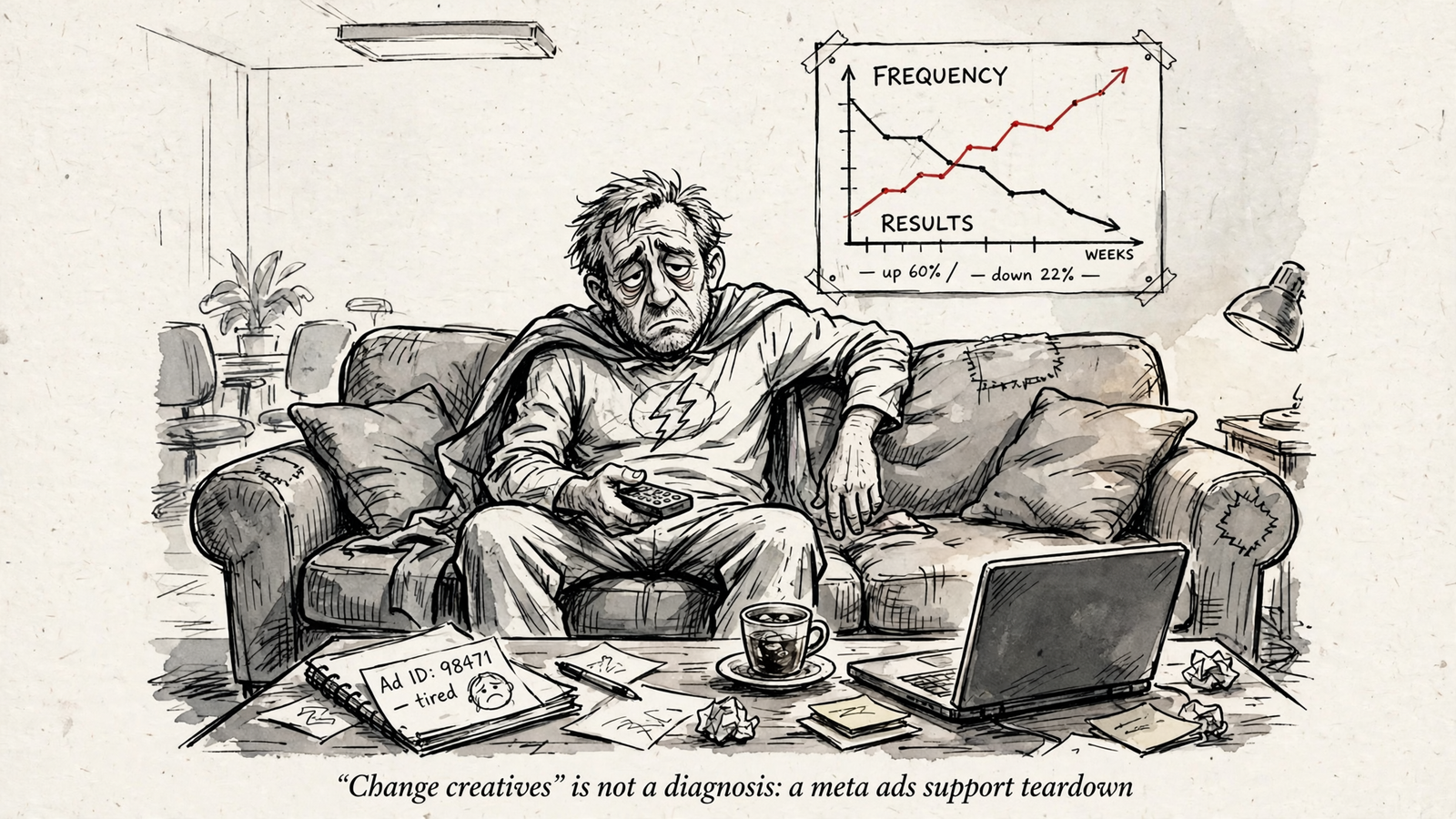
The fatigue hypothesis is narrower: the same people see the same ad more often, respond less, and become more expensive to convert. Frequency is impressions divided by reach. It tells me about repetition, not whether that repetition hurt. For that, I look at click-through rate (CTR) and cost per acquisition (CPA) alongside it. The Reddit account gives me no ad name, no frequency trend, no fall in CTR, and no CPA comparison. Without a named ad and a comparison, fatigue is a hypothesis, not a finding. A guess wearing a uniform is still a guess.
Here’s what I’d give Claude with groas connected:
Using this connected Meta account, compare the same ads over comparable periods. For each ad, show spend, impressions, frequency, clicks, and attributed conversions where available. Keep the attribution settings consistent. Separate observations from possible explanations. Make no changes.
The last-seven-days versus previous-seven-days query gives me a useful starting shape. I’d keep the comparison and change the dates. Meta can credit conversions back to the day of the ad interaction, so recent conversion totals can still fill in after the impressions and clicks have registered. I’d leave the last two to three days out of the conversion comparison and use settled periods of a week or more with the same attribution window. The point isn’t to hide the latest numbers. It’s to keep provisional CPA from deciding the fate of an ad.
Then I’d look for frequency rising while CTR falls, with CPM and cost per result adding context. I want the trend for that ad against its own history, not a universal frequency cutoff. If Claude sorts the table by rising frequency and calls the top row fatigued, it has sorted a table. It hasn’t made the case.
I’d also keep Event Match Quality out of the fatigue verdict. The score measures how well customer details let Meta match a server event to an account. A low score gives me a reason to look at event data. It doesn’t tell me whether people are sick of the ad. That’s plumbing, not diagnosis.
The same goes for learning status. The roughly 50 optimization events per ad set in a week are a delivery benchmark, not a measure of whether the creative has worn out. And Meta’s Creative limited and Creative fatigue flags don’t cover every setup. If there’s no flag, I still compare the ad’s cost per result with its own history. Neither the badge nor its absence gets to make the decision for me.
“Wait a week”: say what the wait is for
The third instruction sounds patient. I’d keep the patience and ask what it buys. Delayed conversions may still come in, an ad set may need more observations, or missing event data may make the report incomplete. Those are reasons to defer a decision. “A week” on its own isn’t one. I’ve killed good ads on day three by treating provisional conversion counts as final. Waiting without a review rule just lets me make the same mistake later.
I’d ask Claude for daily spend and attributed conversions over 14 days, with recent dates marked provisional. I’d have it note whether the ad set is in learning or learning limited, and flag anything it can establish about missing offline uploads, a broken pixel, or a changed landing page. If it can’t verify one of those, it belongs on the list of things to check, not the list of things that happened.
My verdict: set the review condition before starting the clock. If attribution lag is the reason to wait, say which dates need to settle before comparing CPA. If the issue is event volume, say what count I’m waiting for. If the problem is missing data, name what’s missing. If I still don’t have it at the review, the report should say what I still can’t conclude. I don’t want Claude to come back in a week and tell me a week has passed.
Turn the evidence into one brief a designer can build
A brief is useful when a designer can build from it without asking what I meant. “Change creatives” doesn’t clear that bar. Name the ad, put the evidence and counterevidence side by side, then propose one replacement hypothesis. Cause first, asset second.
Take an illustrative example. Ad ID 1202 spent $1,140 over 14 settled days. From the first period to the second, frequency went from 1.8 to 3.4, CTR fell from 1.4% to 0.8%, and CPA rose from $24 to $41 on the same seven-day click window. That pattern supports fatigue; it doesn’t prove it. If frequency instead stayed flat at 1.6 while CPA rose, I’d have less reason to blame repetition and more reason to check bidding, audience, or what happened after the click. In both versions, the higher CPA is a problem. Only the first gives me a case for testing whether people are tuning out the ad. I want Claude to write that countercase before it pitches a new video.
Here’s what I want in the draft:
- Ad under review: ID, ad set, date ranges, spend, and where the numbers came from.
- Evidence for fatigue: frequency, CTR, CPM, and cost per result against the ad’s own prior performance.
- Counterevidence and open checks: anything that weakens the repetition story or points to another explanation, such as flat frequency, broken attribution, a landing-page change, a learning reset, or a holiday shift. Mark what’s verified and what still needs checking.
- One replacement hypothesis: what changes and why. If hold rate and CTR both fell, for instance, test a different hook in the first three seconds rather than asking for a wholesale rewrite.
- Assets and review rule: the formats and copy lengths the designer needs, plus the spend threshold and CPA target I’ll use to judge the replacement.
This is where rival ads help. Through groas, Claude can review the competitor ads groas collects and the landing pages behind them. I use those to find hooks and angles to test, not to retroactively prove my diagnosis. A rival running founder-led UGC doesn’t mean founder-led UGC will fix my CPA. It gives me a concrete pattern to work with: same promise, different proof; or same format, sharper first line. No named ad and no comparison table, no replacement brief. And a brief is still not permission to publish.
Give Claude permission to investigate, not to publish
In an account reported by Search Engine Journal, Optmyzr’s founder describes an agent that was asked for simple data and started building new rule-engine strategies instead of taking the direct route. The Meta version is easy to picture: I ask for a fatigue check and get three new ads, a duplicated ad set, and a budget change I never approved. The problem isn’t that the agent did a bad job building. It’s that I never asked it to build.
A read is a read. A draft is a draft. Publishing is a separate decision. Writing “don’t spend more than $500” in a prompt isn’t the same as enforcing a limit where the write happens. Meta’s own MCP server includes tools to create, edit, and activate. A brief in the conversation and a paused ad in the account are not two versions of the same draft. The first gives me something to review. The second is already a write. The read-only setup notes describe granting ads_read without ads_management. I’d check the permissions on the connection rather than infer them from the instructions I gave Claude.
My boundary with groas is the same: autopilot off, fatigue check run with read access, brief kept in the conversation, no publishing without explicit approval. If I approve a change later, I check the log for what changed and why. Undo is useful, but I’d rather not make an edit that can reset learning just to find out whether I can reverse it. Verify the tools before the read. Check the log after any approved write.
Overall verdict: keep the question, not the order
I’d keep one thing from the reported support answer: the instinct to check whether the same people stopped responding to the same ad. That’s worth investigating. “Increase budgets, change creatives, wait a week” gives me no named ad, no comparison, and no test. It doesn’t justify higher spend or a replacement.
I’d settle the numbers, name the ad, and show the trend that supports or weakens the fatigue hypothesis. If the evidence earns a replacement brief, I’d write one hypothesis, specify the assets, and set the review rule. Until then, budgets and publishing stay where they are. I want something a designer can build, not something Claude has already built in the account.





