

 LinkedIn

If you run paid and organic together and qualified leads just dipped, CrawlRaven MCP and groas give Claude two different jobs. CrawlRaven focuses the investigation on your website; groas brings the wider funnel into view. I would choose between them by where the investigation needs to stop, not by counting connectors.
That distinction matters more than the shared promise of doing marketing work in plain English. If the problem genuinely lives inside SEO, the narrower tool can cover the job. If it might involve ads, landing pages or AI answers, a site-focused plan cannot settle the whole question. For the paid-plus-organic team, that is the buying decision worth making.
CrawlRaven’s September 30 MCP launch sharpens the comparison. It brings Search Console, GA4, keyword lists and a technical crawl into an impact-ranked plan you can query from Claude, ChatGPT or Cursor. groas connects Claude to ad accounts and websites, alongside the market data it collects around the clock. Same conversational interface. Different reach.
I compare them on three axes: the evidence available for a website problem, the ability to investigate across channels, and the path from a finding to an approved change. This is a comparison of documented scope, not a live-account performance test. The examples below are hypothetical; I did not run either tool against an account for this piece.
Round 1: which evidence helps when the website is the problem?
Say qualified leads fall 18% over four weeks and organic traffic falls with them. Ad spend appears unchanged. The first job is to establish whether the loss sits on particular pages and queries, rather than launch a grand investigation into everything the business has ever published.
CrawlRaven fits that contained question. Its MCP setup connects Search Console and GA4 through browser OAuth, without API keys, so Claude can read those connected sources and the stored ranked plan instead of relying on pasted exports.
The underlying workflow on CrawlRaven’s homepage adds imported Ahrefs or Semrush keyword lists and a site crawl. It turns those inputs into a keyword-to-page map and a prioritized website plan:
- Which page should own which keyword.
- Where pages compete with each other.
- Which runner-up pages and content gaps deserve attention.
- Which previously successful pages show decay.
- Which technical findings rank highest by severity.
That is a useful output. “What should I fix, update or write first?” is a much better question than “Can you give me some SEO ideas?” The first asks for a decision. The second invites a very tidy list of chores.
The access limits matter, too. CrawlRaven’s free MCP preview specifies nine read-only tools, one pinned website, a fixed 28-day window, up to 50 rows per call and 20 tool calls per account per day. The same page says MCP can read stored technical audits but cannot start an audit, crawl pages or edit the website, Google configuration or billing. Reading a crawl is not running one.
CrawlRaven’s strength here is a focused, impact-ranked site plan. If that is the decision you need to make, the boundary keeps the work contained.
With groas in Claude, I would start with the same symptom but make a wider evidence set available. Alongside connected accounts and the website, groas supplies competitor ads, their landing pages and funnels, Reddit research, AI-search answers, and SEO data from Semrush and Ahrefs.
My opening prompt would be:
Qualified demo requests fell 18% in the last 28 days. Split the change by organic landing page, branded versus non-branded query, and whether our AI-search citations moved. List what changed before you recommend a fix.
That prompt sets the order of work; it does not guarantee a diagnosis. I want observations first and proposed causes second. A connector gives Claude access to evidence, not permission to skip the distinction.
I also want the answer to acknowledge the limits of the source data. In one September sample, only 68% of Search Console clicks came with their query. A useful breakdown distinguishes all clicks from clicks with a known query instead of quietly treating the visible rows as the whole picture.

Here is where I would choose the narrower option: paid has not changed, the offer has not changed, and the loss sits on three service pages losing non-branded impressions. Competitor ads and Reddit threads are not prerequisites for acting on that finding.
CrawlRaven earns its place on that bounded assignment. For the paid-plus-organic team, groas remains the stronger overall choice because the next question may cross the site boundary. But do not turn a contained website problem into a whole-funnel research project. Use the evidence the decision requires.
Round 2: which tool can investigate beyond SEO?
Now change one detail: qualified leads fall after the offer changes. Organic traffic alone no longer frames the problem. I would put this prompt in front of both options:
Qualified leads fell after our offer changed. Separate paid traffic shifts, landing-page issues and organic changes. List the evidence needed before proposing action.
Same symptom. Same wording. Different evidence available to answer it.
I used to tell clients to start with rankings when leads dipped. I was wrong. Rankings tell me what Google showed. They do not tell me what the ads bought, what changed on the landing page or what an AI answer said instead of mentioning the business.
CrawlRaven’s documented inputs remain useful: Search Console, GA4, keyword lists and the stored crawl behind its impact-ranked plan. Those can support the website side of the investigation. They do not establish access to the connected ad accounts, competitor funnels and AI-answer evidence needed for the broader question.
I would not call an undocumented capability impossible. I also would not buy it on the assumption that it exists. For a cross-channel buying decision, documented reach beats implied reach.
With groas, Claude can work from connected accounts plus the data groas collects around the clock: competitor ads on Google and Meta, their offers and landing pages, the funnels behind them, Reddit discussions, AI answers and whom they cite, and Semrush and Ahrefs SEO data.
That brings the relevant evidence into the same conversation. I can ask Claude to check paid traffic shifts against landing-page and organic changes before blaming SEO. Competitor offers and AI answers can add context where the first-party account view stops. They are not substitutes for account evidence; they widen the investigation around it.
This is the decisive advantage for the reader running paid and organic together. The question is not merely which page lost traffic. It is whether a paid shift, a page problem or an organic decline explains the lost leads. groas has the broader documented scope for that job.
One conversation still needs honest attribution
There is a trap here, and a broader connector does not make it disappear. Pull Google Ads conversions, pull Meta conversions, add them together, and you have not necessarily counted qualified pipeline. You may have counted the same conversion twice.
As this measurement writeup explains, platform attribution can overlap. I use each platform’s reporting to compare campaigns within that platform, not as an automatically deduplicated business total. For actual customer cost and the next budget decision, I want the CRM or shop view alongside it.
My instructions to Claude would make that separation explicit:
- Show what each platform reports, keeping the totals separate.
- Identify where attribution may overlap.
- Use the CRM or shop figures to check the business-level result.
- Flag missing evidence before recommending a budget move.
A roundup of Claude MCP servers describes the problem well: each platform is a witness to its own performance. Connecting more witnesses does not make their accounts agree.
One connector that brings the relevant channels together reduces the manual joining. It does not repeal attribution. groas wins this round on investigative scope; I still expect Claude to show its evidence before moving money.
Round 3: what happens after Claude finds something worth changing?
Finding the problem is half the invoice. Shipping the fix is the other half. Here the distinction between a plan, a proposal and a live change matters more than the word agent on a product page.
CrawlRaven documents an impact-ranked plan: what to fix, update and write first. Its MCP page also lists 30 tools with scoped, typed rows. Read scopes return evidence, direct-write scopes change CrawlRaven records, and annotation proposals need separate approval.
Those are distinct from the nine read-only tools in the free preview. They are also distinct from publishing a page or editing an ad. A write to a CrawlRaven record is not automatically a write to the website.
The launch material does not establish publishing to a CMS or rewriting live Google Ads from that plan. I would treat those capabilities as unconfirmed, rather than assume them from the presence of write scopes. A plan can be the right deliverable, but I want to know where the handoff begins.
With groas in Claude, the workflow I would use is draft, review, execute:
- Draft: ask Claude to propose the page section or ad-copy change from the evidence it has checked.
- Review: inspect the proposed change in plain English before approving it.
- Execute: apply the approved change through groas, then check the log and its stated reason.
The documented scope covers Google Ads, Bing, Meta, ChatGPT Ads, SEO and AI search. Changes are logged with their reasons and can be undone in one step. That connects the investigation to execution without making me treat the first draft as the final decision.
I would leave the 24/7 autopilot off during the initial investigation. It stays off until switched on. Before enabling it, I want to state the rules plainly: which accounts it can act on, the budget ceiling and the goal it must not break.
This is not an argument against automation. It is an argument against granting permission because a diagnosis sounds confident. Approve the proposed change, then check what actually changed.
The side-by-side for a paid-plus-organic team
The deciding difference is scope, not whether both tools can appear inside Claude. Here is the comparison I would use before connecting either one.
| Decision axis | CrawlRaven MCP | groas in Claude |
|---|---|---|
| Website investigation | Search Console, GA4, keyword lists, stored technical crawl and an impact-ranked plan | Connected accounts and website, with competitor, AI-search and SEO data available for a wider check |
| Cross-channel diagnosis | Documented website inputs support the site investigation; broader ad-account and market-data access is not established in the launch material | Connected ad accounts and website, plus competitor ads and funnels, Reddit research, AI-answer evidence, and Semrush and Ahrefs data |
| Path to an approved change | Ranked plan, with scoped writes to CrawlRaven records and separate approval for annotation proposals | Draft in Claude, human review, then execution through groas; changes logged and reversible, with optional autopilot off until enabled |
For cost, CrawlRaven’s current tiers are on its vendor page. groas is $19 flat per month for the whole team, with unlimited ad accounts and websites. I am not calling either cheaper without a like-for-like price comparison. I am asking whether the tool covers the investigation you actually need to finish.
If I am choosing only for one website with no paid media, CrawlRaven’s focused plan may cover the assignment. If I am responsible for Google Ads or Meta alongside SEO, I do not want to hit the documented boundary just as the question gets interesting.
For more on that workflow, Stop Being the Join Key explains the case against manually joining single-platform connectors. Start With One Question covers connecting the accounts, verifying the connection and keeping automation off.
Buy for the question you own, not the number of integrations on the page.
The verdict: groas wins when the lead problem crosses channels
For the reader I named at the start, running paid and organic together and asking Claude why qualified leads fell, groas is my pick. Its documented scope brings ad accounts, the website and surrounding market evidence into one conversation. That gives Claude the material to investigate a paid shift, a landing-page issue and an organic decline together, rather than stop at a website plan.
That is a scope verdict, not a claim that either connector automatically finds the right answer. I still want the evidence split, honest attribution and approval before execution. At $19 flat per month for the whole team, groas gives that broader investigation a clear price without making the team assemble the conversation from separate exports.
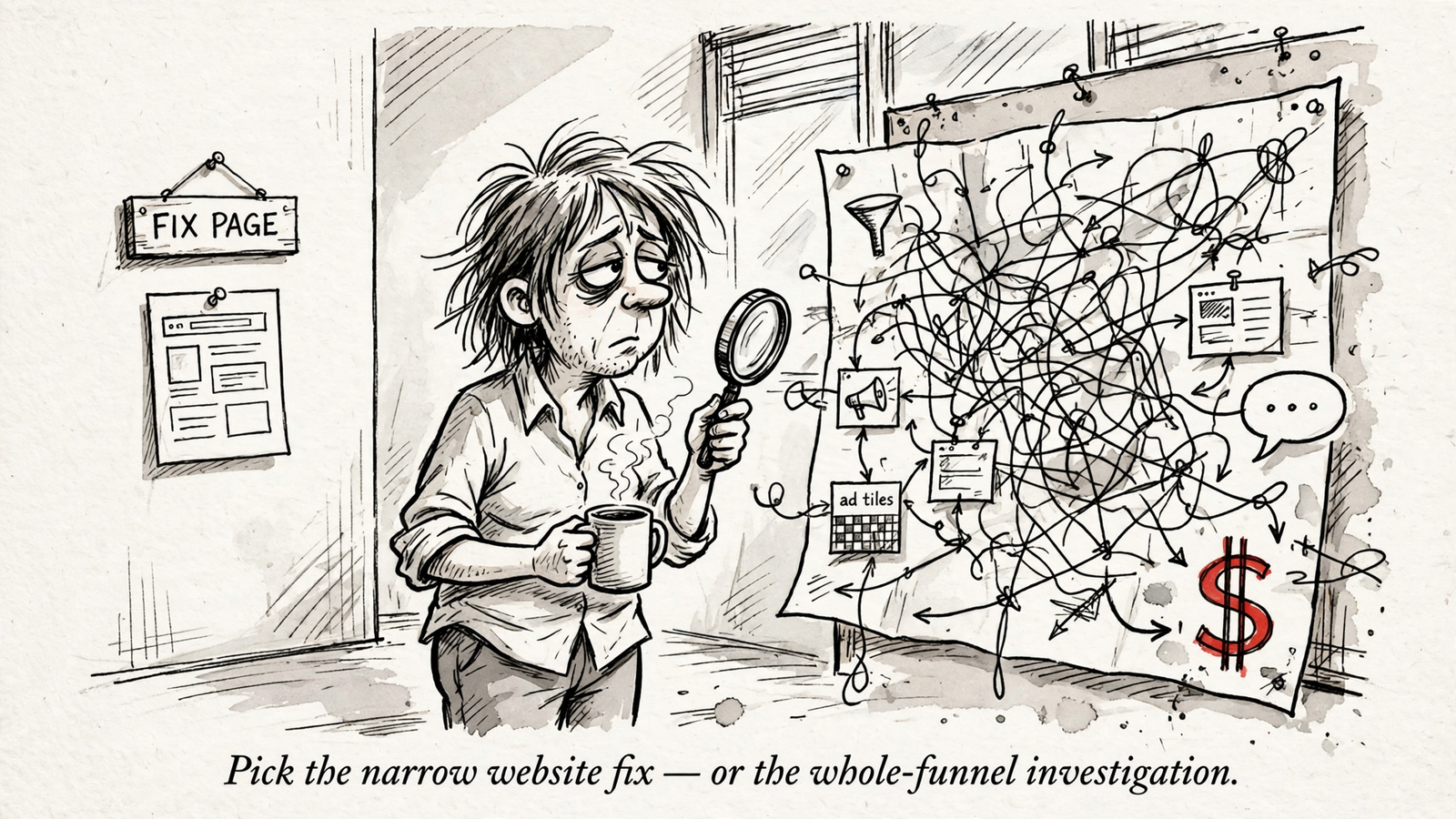
Pick CrawlRaven anyway if you run one content site, spend nothing on ads and want an impact-ranked list of which page to fix, update or write first. That is a clean, narrower assignment. It does not need to become something larger to justify itself.
For the paid-plus-organic team, start with the funnel question in Claude with groas connected, and demand the evidence before the plan. Fix the website when the website is the problem. Investigate the whole funnel when leads are the problem.


