

 LinkedIn

Don’t ask ChatGPT to pause your most expensive Facebook ad. Ask it which ads actually broke a rule you set. Those are different requests, and only one makes the assistant look past the first row in Ads Manager.
Say you’re spending $20k a month and open the account on Tuesday. Ad A has spent $65 with no reported purchases. Ad B has spent $390 for 10 purchases at $39 apiece. If someone asks which ad looks worse, I don’t need an AI to answer. If they ask which ad to pause, I need another column: delivery dates. Ad A has been running for three days, and half its clicks came in yesterday. Ad B has been running for three weeks.
I used to make the obvious call on that screen. I was wrong. The bad move wasn’t looking at cost per sale. It was treating two rows as equally complete because they sat next to each other. Putting ChatGPT in charge of the sort doesn’t fix that. It just makes the same mistake faster.
Yesterday’s cost per sale isn’t finished
Meta can credit a purchase back to the day of the click or view, not the day the money hits your account. An ad can spend on Monday and get a purchase on Thursday that shows up against Monday. Pull the report on Wednesday and you see the spend without the sale. If more purchases come in before the 7-day click window closes, yesterday’s cost per sale can change without you touching a thing.
That lag stacks with uneven performance early in delivery. A new ad set needs around 50 optimization events in seven days to leave learning. While it’s learning, delivery is less stable. Now take a row from that period and read it under an attribution setting that includes click, view, and engagement windows. You’re looking at spend that has already happened and purchases that may not all have happened or reported yet.
Use the reporting window and attribution setting together. The first tells you which dates are on the screen. The second tells you which interactions can still get credit for a purchase. Pausing on Wednesday can stop future delivery. It can’t make Wednesday’s report a finished test.
Make the first ChatGPT prompt read-only
I start with an instruction that changes nothing. Connected through groas, ChatGPT can pause ads and change budgets. That’s useful once I know what I want done. Before that, it’s a good reason to be exact.
Using my connected Meta account through groas, show spend, purchases, cost per purchase, and delivery dates for each ad. State the reporting window and attribution settings. Do not change anything.
Spend is what went out. Purchases are what Meta counted. Cost per purchase divides the first by the second; with zero purchases, there’s no cost per purchase to compare. Delivery dates tell me how long the ad actually ran, which isn’t necessarily the length of the report. Three weeks of account data don’t give a three-day-old ad three weeks of evidence.
I check the dates and the attribution setting before I look at any recommendation. If ChatGPT can show me the spend but can’t tell me what dates and settings produced the purchase count, I don’t ask it to fill in the blanks. I have a screenshot with numbers on it, not a decision.

Set the loss limit before you look at the ranking
ChatGPT doesn’t know what expensive means for my store until I tell it what I can afford to pay for a sale. I give it three inputs, none of which I ask it to infer from Meta:
- Acceptable cost per sale. What am I willing to pay for a purchase?
- Test spend per ad. How much am I willing to spend finding out whether the creative works?
- Review window. How long do I give customers to buy before I judge the result?
For a simple store with a $40 target, I might set the zero-purchase line for a new creative at 1.5 times target CPA. That’s $60. Once the evidence is ready to judge, $60 spent and zero purchases means stop. If there’s one purchase, I give it up to twice the target, or $80, before I judge. If the whole batch spends three times target with zero purchases, I check the landing page, the offer, and the pixel before I blame the creative.
A loss limit says when I stop paying to learn. It doesn’t say the ad couldn’t have worked. If $60 is a hard budget cap, I don’t authorize another dollar just because conversions are still pending. But I also don’t record a failed creative test while the results are still coming in. Controlling spend and deciding what the spend proved are two different jobs.
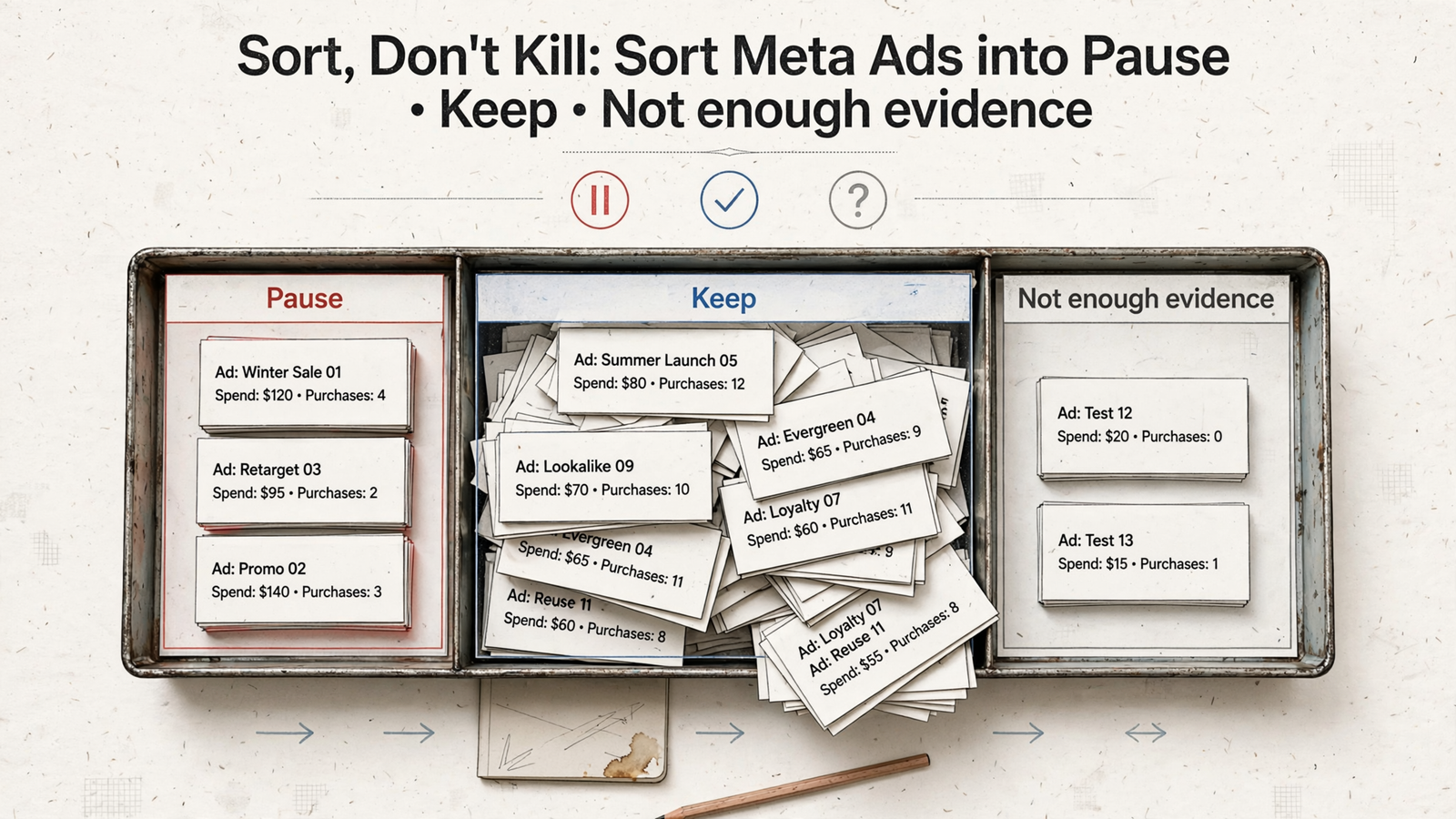
Make ChatGPT sort the ads into three piles
Pause, keep, and insufficient evidence. The third pile is the point. Without it, the assistant has to turn every incomplete row into a yes or a no. That’s the same bad decision with better formatting.
Against my $40 target and $60 zero-purchase threshold, classify each ad as pause, keep, or insufficient evidence. Apply my review window before calling a breach. For each ad, give the ID, spend, purchases, the rule that applies, and any evidence still missing. Do not infer tracking health or profit from Meta purchases alone. Do not change anything.
I don’t use the same rule for a new creative with zero purchases and a scaled ad that’s already converting. For the scaled ad, day one or two is too early to call. I look for 20 to 30 conversions and check whether cost per sale is still 50% or more above target after day 10. There’s also a two-to-three-times-target rule for ads with zero conversions. If that’s the runway I want to buy, I write it down before the test. I don’t swap it in when an ad I like crosses $60.
Here’s what the $40 target and $60 threshold do in the $20k-a-month account:
- Keep Ad B. It spent $390 for 10 purchases over three weeks. At $39 per sale, it’s inside the target.
- Mark Ad A insufficient evidence. It spent $65 with no reported purchases, but it’s only three days old and half its clicks came in yesterday. It crossed the spend threshold. The evidence still isn’t ready for a verdict.
- Pause the ad that spent $125 with zero purchases and a closed review window. It crossed the same threshold, and the purchases it needed to justify the spend didn’t show up in the window you agreed to use.
I want an ad ID and a broken rule in the pause pile. “Worst in the account” is not a rule.
Uneven delivery makes the ranking lie twice
Meta doesn’t split spend to give each ad a fair shot. It can push budget toward an ad that gets an early signal and leave the others scraping for volume. Say one ad takes 70% of a $400 daily budget and shows a clean $34 cost per sale. Three others split the remaining $120 and show $90, $140, and zero purchases. Kill by ranking and you keep the favorite and cut the ads that got less of a test.
Low spend isn’t a failed test. An ad at $18 with zero purchases hasn’t breached a $60 threshold. It’s barely entered the test. And a Learning Limited status tells me to look at volume at the ad-set level, not to write off the creative on sight.
I pick a pull time, write down the reporting window and attribution settings, and use the same basis at the next review. On a weekly pull, I can read the last seven full days without treating the freshest rows as decision-ready. I want ChatGPT to tell me what’s still inside the conversion window, not quietly grade those rows as if the window had closed. Otherwise, I can make an ad look better or worse just by changing which days I count.
There’s one thing I check before any of this: whether I trust the purchase count. If the pixel and Conversions API disagree badly, or Shopify shows purchases that never appear in Meta, fix measurement before judging the ads. A clean rule applied to a broken count still gives you a bad call.
Pause only the IDs that failed
Once I’ve checked the evidence and approved the pause pile, I give ChatGPT a separate instruction. The pattern is show the numbers, then wait for confirmation before pausing. I don’t put the review and the action in the same prompt.
Pause only these ad IDs: [paste approved IDs]. Do not change budgets, audiences, or any other ads. Confirm each ad’s status after pausing.
Approve IDs, not a category. “Pause the losers” sends ChatGPT back to making a judgment I’ve already made. An ID gives it a specific switch to flip. Afterward, I check the resulting statuses and the action log. If a pause was wrong, I can turn the ad back on where Meta permits it. The log lets me see what changed rather than trying to reconstruct it from the next report.
Pay for a decision process, not a faster pause button
ChatGPT and Claude on their own can’t see your ad accounts. I can paste a CSV into ChatGPT and get a ranking. What I can’t get from that alone is a live check on the account or confirmation that the right ad was paused. The fix isn’t a cleverer prompt that guesses what’s missing. It’s a connection plus a rule.
With groas, I connect the Meta account once, add groas to ChatGPT, and run the prompts against live account data instead of a pasted screenshot. The same workflow applies if I use Claude, as in Don’t Let Claude Pause Your Worst Meta Ads Without Explaining the Loss. The habit I want is the one in Stop Rewarding ChatGPT for Changing Your Ads: the assistant makes the case, I approve it, and weak evidence doesn’t earn a change.
groas Unlimited is $19 a month flat for the whole team, with unlimited ad accounts and websites and every feature included. Autopilot stays off until I turn it on under rules I set. Changes are logged with their reasons and can be undone in one step where Meta allows it. The price buys the connection and the controls. It doesn’t buy a definition of failure. That part is mine.
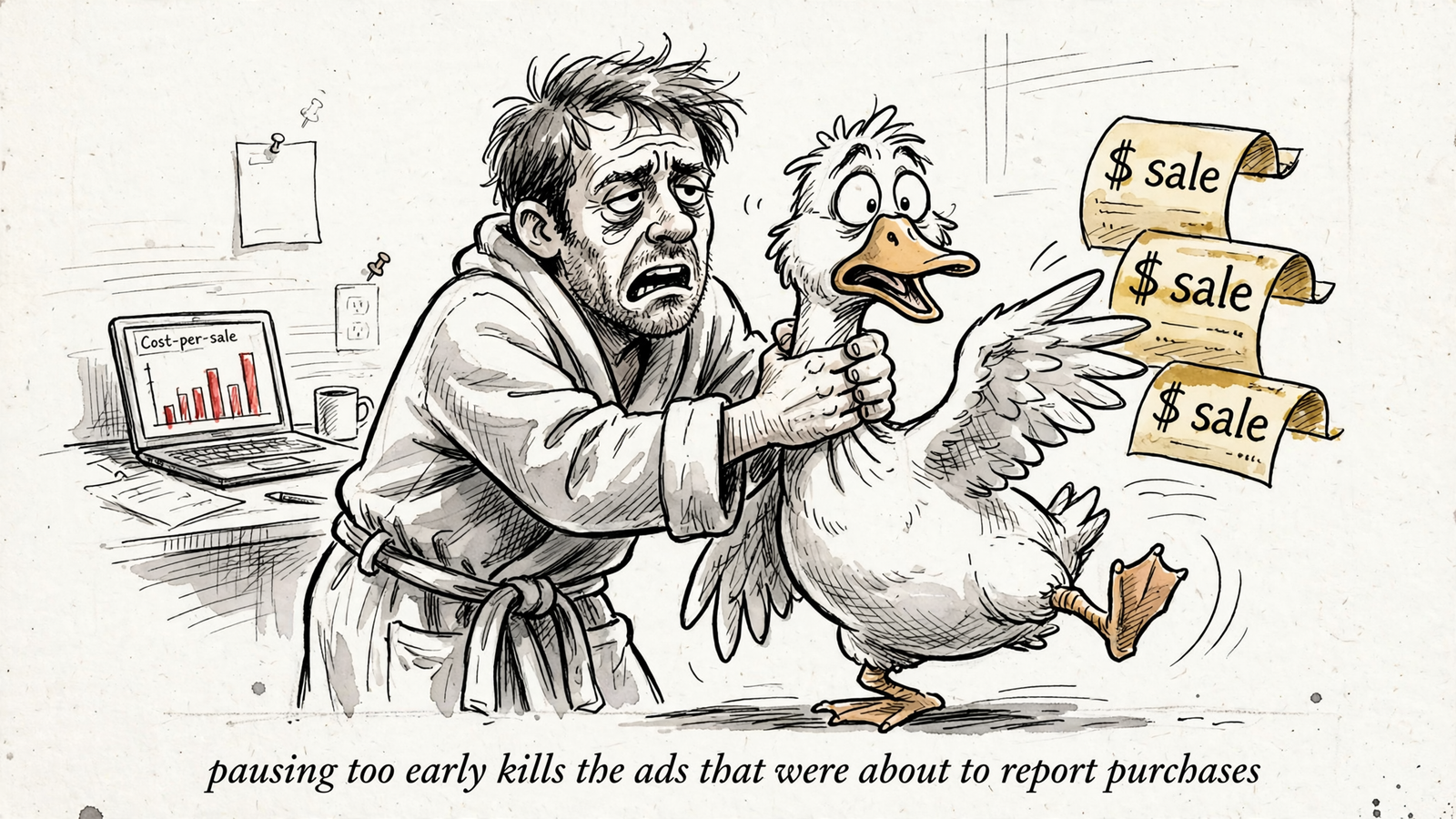
Keep asking ChatGPT to pause your most expensive ad and it’ll do exactly what you asked. It’ll stop Ad A on Wednesday. A purchase can still come in on Friday and get credited to Monday, but that sale won’t tell you what the ad would have done if you’d left it running. Turn yesterday’s ranking into a kill list and you don’t just cut ads before the evidence is in. You cut off the chance to find out which ones deserved more budget.


