

 LinkedIn

Don’t buy ChatGPT ads to get recommended in ChatGPT. A paid placement and an unpaid recommendation are different purchases, and I reject any proposal that sells them as one.
OpenAI draws that line on purpose. Its help page says ads run on separate systems from the chat model and advertisers cannot shape or rank responses. The labeled ad sits below the answer. Paying for the space below does not buy influence over the words above.
The numbers make that distinction difficult to dodge. SE Ranking analyzed 50,006 commercial prompts across 20 US niches. In 96.37% of ad placements, the advertiser’s domain was absent from the answer’s cited sources. That measures citation overlap, not every possible recommendation. But it leaves very little room for the pitch that buying the slot also buys a place in the answer.
An ad beside an answer is not a recommendation inside it
Think of the ChatGPT screen as two rooms with a locked door between them. Downstairs is the sponsored slot: a clearly labeled offer below the answer, selected for its match to the conversation. Upstairs is the answer itself: the businesses it names and the sources it cites. Those are not interchangeable forms of visibility.
OpenAI says the door stays shut. Ads do not influence answers, and seeing an ad is not an endorsement of that business. I would not accept a proposal that quietly erases a distinction the platform makes explicitly.
The separation also changes who can see the purchase. Ads only reach Free and Go users. Plus, Pro, Business, Enterprise and Edu accounts do not see them. Neither do under-18 accounts, and Temporary Chats show none.
That does not make Free and Go users bad prospects. It means an ad cannot buy exposure to the ad-free audience, while an answer can still name a business for those users. If the goal is to appear in recommendations across account tiers, a sponsored slot cannot do that job.
What the 96.37% figure actually tells me
SE Ranking recorded the answer, cited sources and sponsored slot for each prompt in its 50,006-prompt analysis. Ads appeared on 25.94% of prompts, always as a single sponsored offer below the answer.
Across those placements, the overlap looked like this:
- Advertiser domain among cited sources: 3.63%.
- Exact advertised URL among cited sources: 0.09%, or 12 cases.
- Advertiser brand mentioned in the answer: 4.44%.
Flip the first number around and the sales-call question writes itself: if the advertiser was absent from the citations in 96.37% of placements, why is the proposal treating ad spend as a route into the answer?
The distinction between those measures matters. A brand mention is not necessarily a recommendation. A citation is not necessarily one either. The exact advertised page appearing as a source is a narrower event again. I want the report to say which event happened, not roll all three into a green arrow labeled AI visibility.
The study does not prove that paying for an ad hurts the chance of being cited. It also does not measure the causal effect of ad spend on recommendations or establish that these percentages will hold forever. What it shows is low overlap between the paid slot and the answer’s sources, consistent with OpenAI’s stated separation. It is not evidence for selling the two as a bundle of guaranteed outcomes.
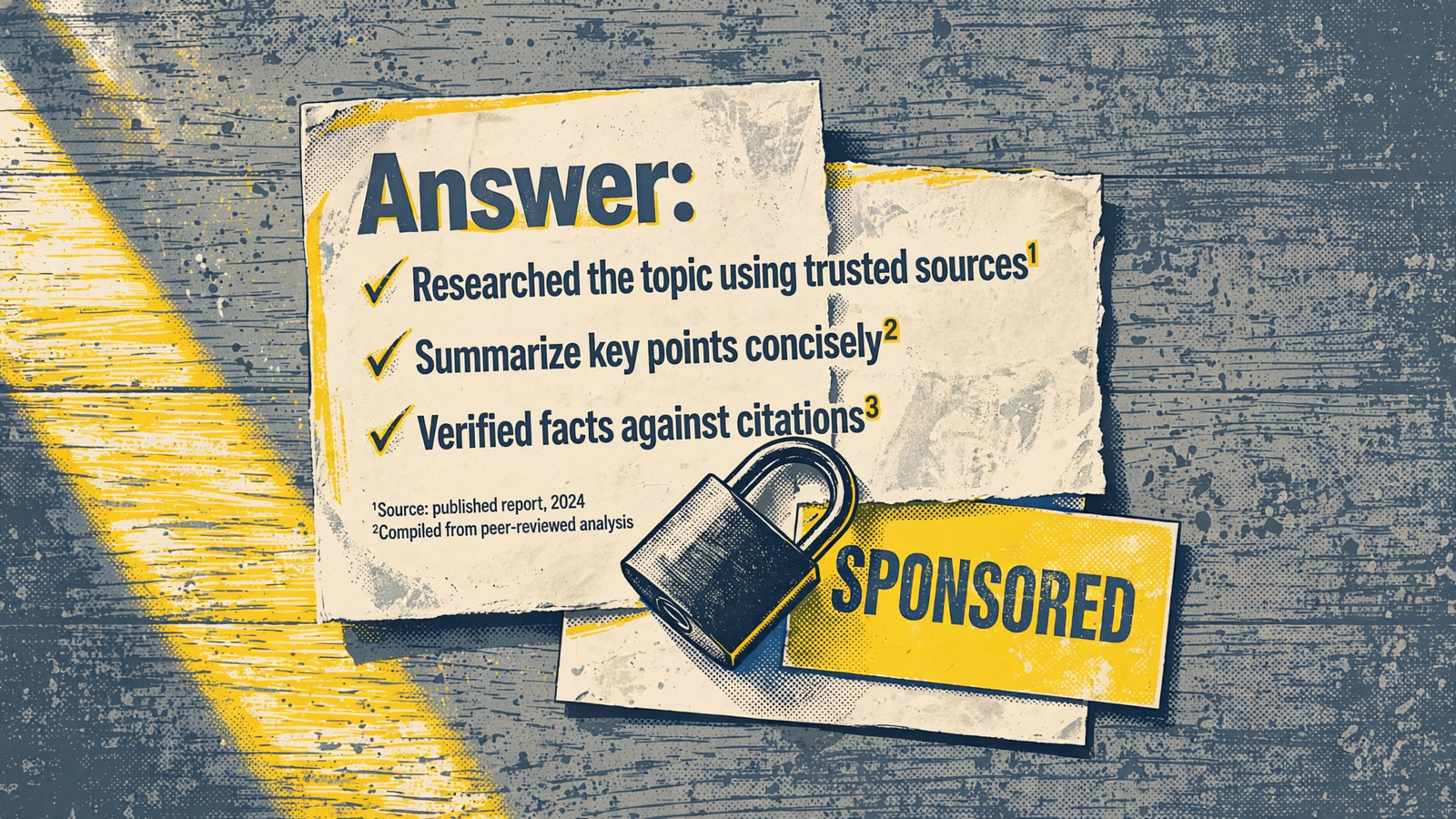
The traffic results deserve their own column, too. SE Ranking ran three campaigns, eight ad groups and 48 ads, buying 97,000 impressions and 1,263 clicks at 1.30% CTR over roughly two weeks, with very few sign-ups. Those clicks were real advertising activity. They were not proof that ChatGPT had started recommending the advertiser.
Relevance was uneven as well. The analysis found 14.35% of ads no more related to their query than a random pairing. Examples included a Quince clothing ad on a best dating apps query and a TXU Energy ad on a newspaper subscription query.
I read that as a reason to scrutinize a young auction, not as a reason to invent a second benefit for it. Judge the placement on the business it brings in.
Stop buying one outcome under another outcome’s name
A paid campaign buys exposure. It rents the labeled slot for an eligible audience, and delivery stops when the budget stops. I judge that purchase the way I judge any auction buy: impressions, clicks, qualified pipeline and cost per acquisition.
SEO and AI-search work buys something slower. It improves the material engines can discover and evaluate: pages that answer buyer questions, code they can fetch and parse, and third-party mentions that provide outside confirmation. That material is not restricted to the audience eligible for ads. But paying someone to improve it does not give that person control over the answer.
The same question can name a business in one run and omit it in the next. Legitimate work therefore needs defined deliverables and repeated measurement across models and markets, typically over two to six months. The cost is not just the fee. It is the page work, the outside proof and the time spent checking whether anything changed.
Neither service can guarantee an unpaid recommendation. One buys distribution; the other works on the evidence an answer may draw from. A proposal that prices one and promises the other is selling a receipt for groceries as a deed to the store.
Put the recommendation budget into something worth citing
If I want ChatGPT to name a business, I start with what the answer can read and verify. Not a 2,000-word thought piece on the future of the category. A page that answers the questions a buyer actually asks:
- Who does this product or service fit?
- What does it cost?
- How long does it take?
- Where is it available?
Those answers need to appear in plain sentences, not require a retrieval system to guess. The catalogue work comes before the blog work. Specific product data and clear category pages give the model something checkable to cite. The groas teardown of being cited without being recommended makes the next distinction plainly: a fetch is not a vote.
Then I make the page easy to fetch. Crawlable HTML. Fast loading. No essential answer locked inside a video transcript or a JavaScript drawer the fetcher skips. A beautifully phrased answer does no work if the system never gets to it.
After that comes outside confirmation: corrected listings, independent reviews with detail, and mentions on pages buyers already trust. A business can describe itself all day. That is not the same thing as other sources confirming what it says.
This is the unglamorous purchase. Someone has to fix the page, correct the listing and earn the mention. Then someone has to check the same buyer prompts week after week. A visibility score does not substitute for any of those jobs.
Make the proposal separate the two jobs
I ask for the split in writing before paying for either job. If an agency wants to run ads and improve ChatGPT recommendations, I want two scopes, two price lines and two definitions of done.
The advertising scope should state:
- The audience and placements the campaign can reach.
- The budget and landing page.
- The CPA or ROAS target.
- How often the team reviews delivery and changes the campaign.
The organic visibility scope should state:
- The buyer questions being tracked.
- The pages the team will publish or fix.
- The third-party mentions it will work to earn.
- How often it will rerun the same prompts and report changes.
That split is also how I read the seven questions business owners keep asking about buying AI visibility. If the seller cannot keep the questions apart, I do not let them bill the answers together.
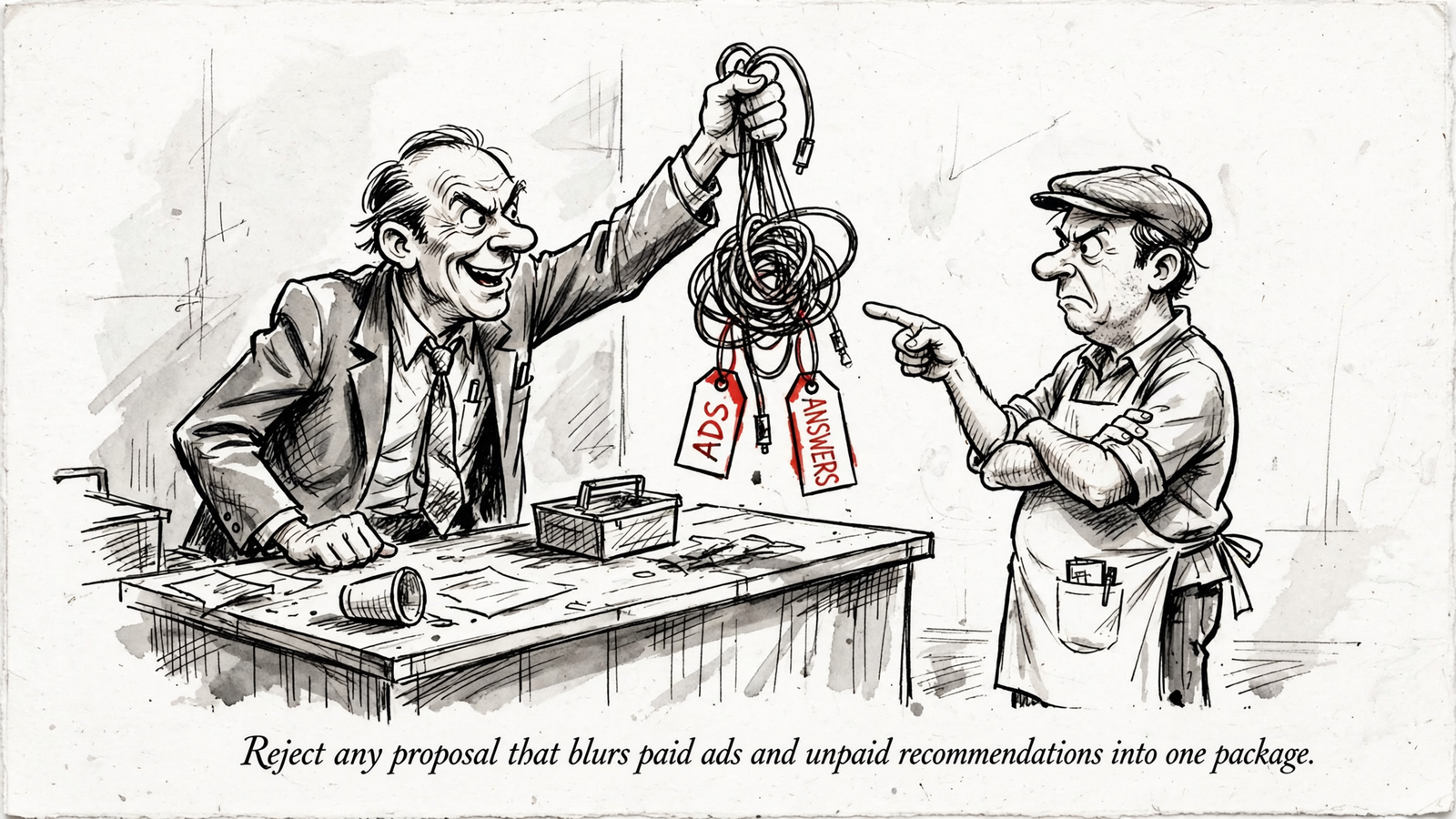
Then I run three plain-English checks:
- What am I buying on each line? Advertising exposure or organic visibility work. No blended label that changes meaning halfway through the pitch.
- How will the results stay separate? An ad impression, a citation with a source link and a recommendation in the answer are different events. The report needs to preserve those differences.
- Who does the work, and where is the log? Who edits the page, fixes the fetch block and pursues the third-party mention? I want execution, not a list of recommendations sent back to me.
If the deliverable is a monthly PDF with a score and tips I am supposed to implement, I pass. Tips do not change answers. Work might. The proposal needs to name that work.
Test the ad on acquisition cost, not borrowed credibility
I still test ChatGPT ads where the math can work. Say the product is a $60 reorder purchase and the business can afford $18 to acquire a customer. The test is straightforward: buy a fixed sample of impressions, track clicks through to checkout, and keep or kill the placement on cost per acquisition.
A citation is not required for an ad to pay its way. That is precisely why the two jobs should stay separate. An ad can produce a worthwhile sale without appearing anywhere in the answer. It can also generate clicks that never become customers. The checkout data settles that question, not proximity to an authoritative-looking paragraph.
The auction still gives me reasons to keep the test controlled. Targeting is loose, delivery is thin, and less than 20% of eligible users see ads daily. Measurement beyond impressions is weak, and cited CTRs run as low as 0.91%. None of that becomes less important because the placement sits inside ChatGPT.
I treat it as a traffic buy with training-wheels targeting. I do not treat it as a retainer that also buys a name into answers. If the acquisition cost works, the ad has earned its budget. If it does not, an agency cannot rescue the result by calling the impressions recommendation visibility.
The cost of confusing placement with recommendation
For the recommendation budget, I return to the question of the business’s own blog versus other people’s pages. Third-party mentions can provide confirmation that a business cannot give itself. But outside proof does not excuse an unreadable or unhelpful money page.
I work in that order:
- Fix the money page so it states price, fit, turnaround and service area in plain sentences.
- Build the outside proof through corrected listings, detailed reviews and mentions on pages buyers already trust.
- Rerun the same 20 or 30 buyer prompts every two weeks and log who gets named.
No movement after two months tells me more than a visibility score. It gives me a reason to revisit the work rather than keep paying for a reassuring chart. The deliverable is work on the evidence; the recommendation is an outcome to measure, not inventory to sell.
At groas, I keep those jobs in separate lanes for exactly that reason: ad execution measured on pipeline and acquisition cost; SEO and AI-search work measured on fetches, citations and named recommendations. One metric does not get to impersonate another because it makes the monthly report look healthier.
Ignore the split and the business pays twice. Once for clicks that stop when the budget stops and never reach users on ad-free plans. Again in the months a competitor spends answering buyer questions while the agency reports ad impressions as progress toward recommendations.
Buy the ad if the ad pays. Earn the recommendation if the recommendation is the goal. Reject anyone who sells one receipt for both.


