

 LinkedIn

By December 31, 2027, no serious advertiser will pay a premium because an agency was first to offer ChatGPT ads management. Most ChatGPT budgets will sit with whoever already runs that company’s Google and Bing spend. Management fees will be flat rather than a percentage of spend, and shops selling a specialist badge will have merged into search teams, retreated to consulting, or dropped the label. Hold me to the date.
I have watched this sales cycle before. ChatGPT Ads went live as a US test on Feb 9, 2026, for Free and Go plans only, and by October OpenAI was reporting 100,000+ advertisers and a $1B annualized run rate reached in under 200 days. Within months, agencies were pitching on being the first to specialize in ChatGPT Ads. I ran Google Ads accounts by hand for the better part of a decade. That pitch sounds almost word for word like what new shops said after Google AdWords launched in October 2000 with just 350 advertisers.
Being early gave those shops time to learn. It did not let them charge early-mover rent forever. The same pressure is building here: advertisers need someone to connect a new placement to the search budget, the landing page, and the sale. A badge cannot do that work. Here are five predictions, with a mechanism, evidence available now, and a condition that would prove each one wrong.
Prediction 1: By December 31, 2027, your search team will run your ChatGPT ads
The mechanism is boring, which is why I trust it. ChatGPT targeting uses advertiser-written context hints, not keywords, with no keyword bidding. The ad appears as a sponsored card below the answer without changing the answer itself. There is no separate keyword universe to master. There is a question someone is trying to resolve, a page you send them to, and a budget conversation about what a qualified lead or sale can cost.
I used to tell clients a new placement needed a new specialist. I was wrong about YouTube in 2018, and I was wrong about Performance Max in 2022. Splitting a small, thinly reported channel into its own silo gives you a second manager arguing for credit. It does not give you a better page. That matters when reporting shows impressions, clicks, spend, CTR, average CPC, average CPM, and conversions, but little of the context behind a match.
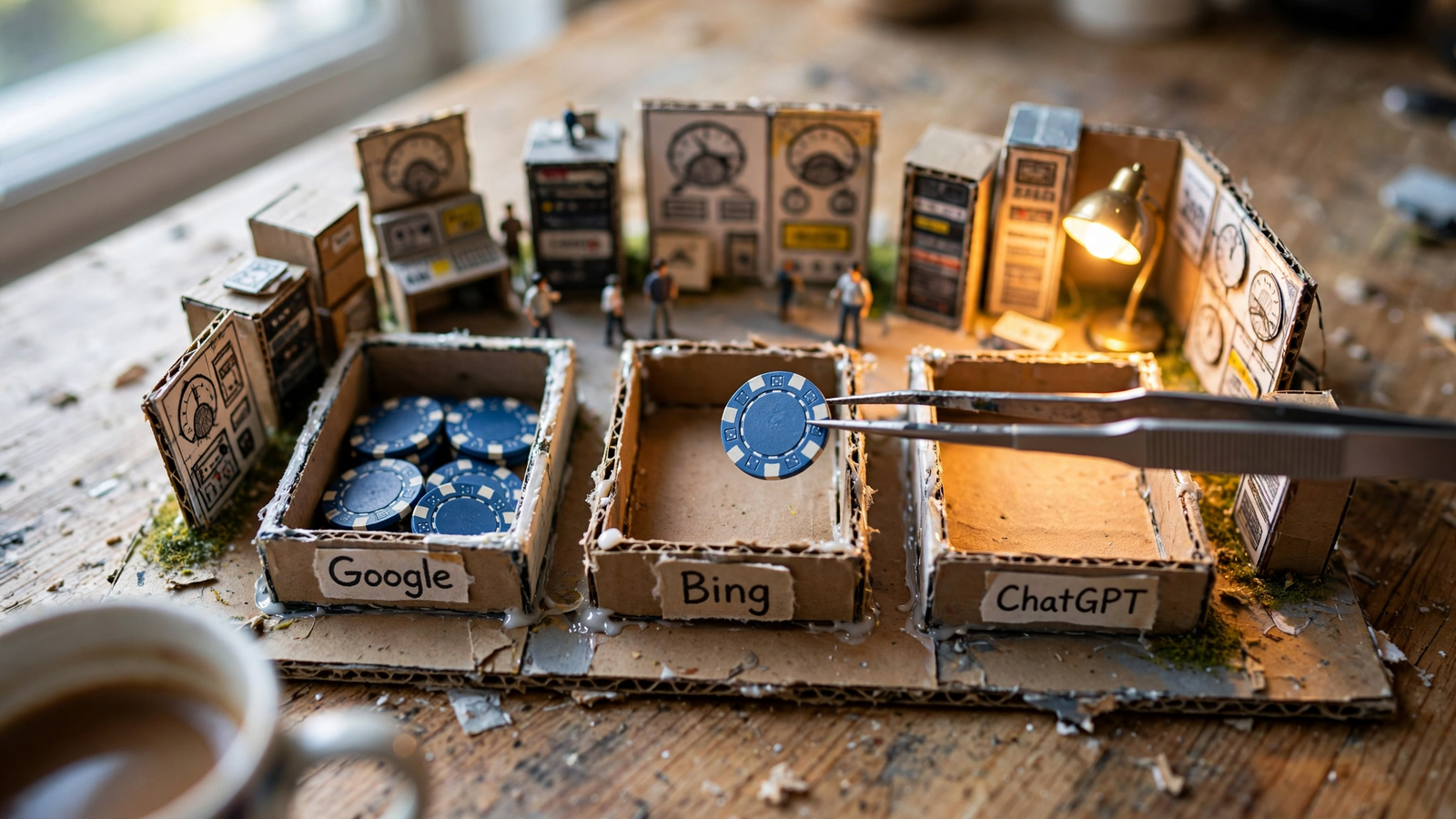
Watch who owns the landing page test. Early results already show why that matters: one account spent $1,000 for 92 clicks and zero conversions on agency terms, while ChatGPT leads across 37 contractors booked jobs at 34.1%, versus 48.8% for Google. Those numbers do not tell you that every search team will get the page right. They tell you where the work sits. Someone has to connect the ad, the page, and the outcome instead of reporting clicks from a separate room.
Takeaway: if your search team cannot run the ChatGPT test, you have a search team problem, not a ChatGPT problem. I am wrong if, by the end of 2027, more than half of the standalone ChatGPT specialist retainers you can find still operate as separate P&Ls and clients renew them instead of consolidating them into their search contracts.
Prediction 2: By June 30, 2027, standalone specialists will merge or sell audits
An audit can be useful. It cannot substitute for someone changing the account after the audit lands. Managing ChatGPT ads means reviewing which conversation intents triggered the card, rewriting context hints, tightening the page the card points to, and pausing losers before they burn another $200. I have sold audits. They are useful for ten days; then the account drifts. A deck that calls an untouched account strategy is selling paper, not management. I have gone deeper on what there is to manage in a ChatGPT ads account.
Consultants can still sell a useful audit. My prediction is that far fewer ChatGPT-only shops will keep selling full management as a separate business. The pricing pages show the pressure. One shop calls itself one of the first agencies built specifically for ChatGPT Ads. Another offers three flat tiers starting at $750 a month. A specialist price survey puts small-business packages at $1,500 to $3,000 a month and specialist work at $3,000 to $10,000. Those offers have to compete for a test whose media can cost about $750, while much of the work overlaps Google and Bing. “First” is not an answer to what the extra retainer buys.
A search shop can absorb the placement into work it already does. A standalone specialist has to show why keeping a separate manager improves the result. That is a harder sale than putting a badge on the homepage.
Takeaway: hire hands that change things in the account, not voices that describe things about it. I am wrong if, on June 30, 2027, you can still find ten independent ChatGPT-only agencies with public client lists, full management retainers, and no Google Ads offer.
Prediction 3: By September 30, 2027, flat fees will beat percentage pricing
Say you spend $20k a month on Google and add a $1,500 ChatGPT test. A 15% fee on the test is $225. Nobody does real daily work for $225, so the agency either neglects the account or sets a minimum that makes the effective rate absurd. This is where legacy Google Ads pricing of 10 to 20% of spend with $500 minimums, or $1,500 to $5,000 flat retainers, breaks on a small test.
The entry price has already changed. The channel started at $60 CPMs and $200k minimums in February and fell to $25 to $45 CPMs with a $25-a-day self-serve minimum by May. At that daily minimum, 30 days of media costs about $750. Small, choppy spend plus a percentage fee produces neglect or overcharging. Neither is a management model I would choose.
Flat pricing makes more sense when the task list does not expand just because the media line does. Someone still has to rewrite hints, fix the page, and kill losers. One shop lists three flat tiers starting at $750 a month, with media paid separately. groas runs Google, Bing, and ChatGPT as one Search Ads service for $1,499 a month. That second model is the one I expect to win: one fee for managing search work together, rather than another percentage attached to a new place to spend.
This is not an argument that every account requires identical attention. It is an argument against a fee that rises automatically when spend rises and the work stays the same. If the agency wants more money, ask what changes in its task list.
Takeaway: if the fee grows when your spend grows but the work does not, you are paying rent. I am wrong if, on September 30, 2027, percentage of spend remains the most common ChatGPT management model in three public pricing surveys.
Prediction 4: By November 30, 2027, the landing page will carry the proof
The cause sits inside ChatGPT Ads Manager, which reports impressions, clicks, spend, CTR, average CPC, average CPM, and conversions, but no search term report, auction insights, or impression share. With no view of why an ad matched, a platform screenshot proves that you spent money. It does not prove that anyone managed the spend well. I learned this with early Performance Max: missing query data sent every honest performance discussion back to what happened after the click.
ChatGPT makes that handoff especially important. The click begins in a conversation rather than with a keyword you can inspect in a search term report. The page has to carry the visitor from that wider intent to a specific action. If nobody owns the page, the account manager can keep adjusting hints while the same weak destination keeps losing the click.
The early numbers give you a reason to look past the screenshot. One B2B test ran four months at 0.5 to 1.0% CTR, $3 to $8 CPC, and a 3 to 6% conversion rate. That can be a workable test if the form and follow-up hold; without them, the clicks do not amount to much. Another account spent $1,000 for 92 clicks and zero conversions on agency terms. The placement alone does not settle the question. What the visitor does next does.
I would want to see the page change alongside the campaign change, then see whether those clicks became booked jobs, qualified pipeline, or sales. A polished dashboard cannot replace that chain. It is a receipt for activity, not a result.
Takeaway: ask an agency claiming ChatGPT results to show what happened after the click in your analytics, not just its platform screenshots. I am wrong if, by November 30, 2027, OpenAI ships a full search term report plus auction insights and agencies win renewals on platform efficiency metrics alone.
Prediction 5: By June 30, 2027, a deciding media test will cost under $1,000
The math has already moved. Entry fell from $60 CPMs and $200k minimums at launch to $25 to $45 CPMs with a $25-a-day self-serve minimum by May 2026. Thirty days at that minimum puts media at about $750. At that price, the first obstacle is less likely to be finding a large test budget. It is getting permission to run a test you can actually learn from.
A sponsored card sits below an answer your brand did not write. It is triggered by context hints you did write and points to a page legal may never have reviewed for this use. I have seen $750 tests wait three weeks for sign-off on two sentences while $20,000 Google campaigns ran untouched beside them. The slow companies were not poor. They were unapproved.
So prepare the small things before you ask for the money:
- Get one landing page approved for the test.
- Set one offer with a number on it.
- Use a form that logs the source.
- Agree on a rule for pausing losers by day seven.
That list is not glamorous. It is the difference between starting the 30-day clock and spending three weeks discussing whether the clock may start. You can buy media quickly; you cannot learn from a test that sits in an approval queue or loses its source at the form.
Takeaway: if you can spend $750 and get an answer in 30 days, you can outlearn a competitor waiting to spend $10,000 perfectly. I am wrong if, on June 30, 2027, the minimum viable media for a decision is still above $5,000 or OpenAI reimposes high minimums that price small testers out.
What to ask before you hire this quarter
Do not ask who was first. Ask who will touch the account on day three. A hands-on manager rewrites context hints, changes the landing page block that lost the click, and pauses a loser while the test is still running. A rebranded course sells you a setup call and a PDF. If you want to put the test with your search team, as I argued in stop hiring ChatGPT ads specialists and put the test with your search team, use these four questions on the next call:
- Show me the work. In one ChatGPT account, what hints and landing page elements did you change in the same week? What happened to cost per qualified lead?
- Show me the outcome. How do you report beyond the platform’s available metrics? Show me the landing page conversion data you used.
- Show me the fee. What do you charge at $750 in media and at $7,500? If the work list is identical, why would the fee change?
- Show me the owner. Who makes the pause decision, and how fast? I want a name and a time window, not a monthly review cycle.
If they cannot answer with specifics, they are selling advice, not management. Advice can be useful. Do not mistake it for someone owning the result.
And if your tracking cannot tie a ChatGPT click to a booked job or a signed contract, skip the channel for now. Fix the form, fix consent, fix GA4, then test. I have watched too many $1,500 tests fail because the page took nine seconds to load and nobody measured it. The broader shift is the one I laid out in why the answer box will make separate PPC and SEO reports look expensive by 2027: one answer, one page, one owner. Until you have that owner, a specialist badge buys you nothing.
The scorecard: dates I will revisit
- June 30, 2027: Ten or fewer independent ChatGPT-only managers still sell full retainers, and a deciding test costs under $1,000 in media.
- September 30, 2027: Flat fees beat percentage-of-spend pricing for ChatGPT management.
- November 30, 2027: Landing page conversions, not platform screenshots, carry the proof.
- December 31, 2027: Most ChatGPT budgets sit with the Google and Bing owner, and being first no longer commands a premium.
If I miss on three of the five, I will write the correction with the numbers and say where the mechanism broke. If I am right, put the $750 test with the team that already owns your search revenue, pay for the work rather than a share of spend, and judge the result on pipeline. That is how groas runs Search Ads.


