

 LinkedIn

You have five minutes and one approver to hand off ChatGPT Ads. Spend them making decisions, not learning the platform you are paying someone else to operate.
I managed Google Ads accounts by hand for years. The recurring failure was not an owner who knew too little about advertising. It was an owner who hired help, then became the agency’s unpaid account manager: weekly logins, vague approvals, homework disguised as collaboration.
My handoff has four boundaries: one approver, one business outcome, one spending ceiling, explicit escalation rules. The provider owns execution inside them.
The five minutes cover the decision brief, not account administration, tracking installation, or campaign construction. Those jobs still need doing. They do not belong in a five-minute conversation about what the business wants to buy.
Here is the plan, in order.
1. Minute 1: Name the customer and the outcome worth paying for
Cost: 60 seconds. Buys: a target the provider cannot quietly replace with clicks.
Say who the ad is for in one sentence and what counts as a win in another. “Homeowners” and “more leads” are not enough. Homeowners where, with what problem, ready to do what next?
“Owners of leaking flat roofs in Austin who will book an inspection” gives the provider something to work with. The win is a qualified inquiry or a sale, not a click target.
Put three lines in the brief:
- Customer: Who needs the offer.
- Outcome: What you want that person to do.
- Counted when: The event that makes the outcome real.
That last line matters. Counted when the booking form submits and the phone number verifies. Counted when checkout completes. Pick the rule that fits the business and give it to the provider before they build anything.
I call this the counted-when rule. It stops “more leads” from meaning one thing in your head and something much cheaper in the report.
If you leave the outcome as clicks or traffic, you have hired someone to buy attention. They can succeed at that while your diary stays empty. Approve the business outcome, not a convenient substitute.
2. Minute 2: Put the fee and media ceiling on separate lines
Cost: 60 seconds. Buys: a spending boundary, not a vague budget conversation.
Give two numbers, never one. The management fee goes to the provider. The media goes to OpenAI directly. That split appears in done-for-you ChatGPT Ads arrangements, and your quote should make it visible. A blended total makes it harder to see what you actually approved.
Write:
- Management fee: $X, paid to the provider.
- Initial media ceiling: $Y over Z days, paid to OpenAI.
- Increase rule: No increase without the named approver’s written approval.
The daily setting is not the same thing as your total authorization. In the US, published guidance puts the floor at $25 per day per campaign, or about $750 over 30 days if fully spent. A single day can spend up to twice the daily setting, capped at seven times that setting over seven days. Give the provider a ceiling for the whole test, not just a daily number to type into a box.
Then agree on what that test can reasonably tell you. In the illustrative scenario of roughly $6 CPC and a 2% conversion rate, 30 conversions require about 1,500 clicks and $9,000. At $25 a day, the same assumptions produce roughly four clicks a day and two or three conversions in a month.
A small test does not buy proof. It buys a start.
You do not need to negotiate every CPC assumption in this minute. You need to decide how much you can afford to spend learning. Approve the ceiling and the increase rule; leave bidding to the operator.
3. Minute 3: Name the owner and clear the access path
Cost: 60 seconds. Buys: ownership that survives the relationship.
The account belongs to the business. The provider gets access to operate it.
The client creates the Ads Manager account and invites the agency in; agencies cannot open accounts on a client’s behalf. The account should carry the business’s legal name for billing and verification, with the provider working through granted access. One setup guide describes inviting the agency under Settings as an Admin or Member.
You are not doing that administration during this minute. You are naming who will make it happen and who can approve the work.
Record two responsibilities:
- Access contact: The person who can arrange account, website, and tracking access.
- Sole approver: The person who approves claims, landing pages, and spending increases.
Those can be the same person. What matters is that the provider does not have to guess who can say yes. One approver does not mean nobody else can help with access; it means nobody else can quietly change the brief.
Keep the ad account, payment method, analytics, Tag Manager, pixels, and landing pages in the business’s name, with delegated access where needed. If the relationship ends, your data and history should not leave with the provider.
I have watched an unannounced landing-page change tank Quality Score. That is why approval ownership is not paperwork for its own sake. Changes need a known route.
No shared-inbox guessing game. No committee with five people who can object and nobody who can approve. Name one approver; assign the access work separately.
4. Minute 4: Make the provider accept the operating work
Cost: 60 seconds. Buys: a service instead of a course with office hours.
Read the scope below and ask for a yes or no. Anything excluded needs to be explicit before launch:
- Account setup work inside your business-owned account.
- Campaign construction and ongoing optimization.
- Tracking installed and tested before media spending begins.
- Supporting landing pages or the fixes your existing pages need.
- Reporting you can read in 30 seconds.
That is the substance of done-for-you management: setup, tracking, campaign construction, and ongoing optimization. One operator describes running strategy, context hints, creative, bidding, measurement, and reporting week by week. The important word is running. If the provider sells advice and leaves you the build, you bought instruction, not management.
The provider also owes you honesty about the controls. Advertisers do not see conversations, chat history, or personal details; they receive aggregate impressions, clicks, spend, and conversions, without a search-term report. A promise to manage this like a Google Ads search-term account should make you pause.
Measurement needs the same clarity. The published setup includes the OAIQ pixel, server-side Conversions API, event deduplication, the oppref click ID on server events, and UTM-tagged URLs for GA4. That is the provider’s implementation checklist, not your vocabulary test.
Your requirement is simpler: they explain what they will install, test it, and show where the agreed outcome appears. Attribution uses last-touch measurement with 7-, 14-, or 30-day click windows and optional one-day view attribution. The provider should explain which window the report uses rather than leaving you to discover it later.
You do not have to learn every setting to require competent work. Approve the scope; make the provider own the implementation and explain its limits.
5. Minute 5: Agree when silence ends
Cost: 60 seconds. Buys: fewer interruptions without surrendering control.
Ask for two communication rhythms and nothing else.
First, a weekly note: actions taken and results against the one outcome you chose. Not a dashboard tour. Not a paragraph about how hard everyone worked.
Second, immediate contact for agreed exceptions:
- Spending is off pace.
- Tracking breaks.
- A landing page goes down.
- An advertising claim is challenged.
- The spending ceiling is about to be reached.
Put those exceptions in the brief, along with who receives them. The spending rule is already decided: no increase without written approval. A looming ceiling is a reason to contact you, not permission to raise it.
What the deck calls cadence, I call permission to ignore them until it matters.
Allow for reporting lag, too. The measurement breakdown puts clicks at about 15 minutes, spend at seven to eight hours, and conversions at 24 to 48 hours. An outcome that has not posted yet is not the same as a broken conversion path. Your provider should know the difference and tell you which problem you have.
The weekly note should show work and your outcome. Everything urgent should match an agreed exception. That is how you stay informed without becoming the operator.
Make launch conditional on three pieces of evidence
Additional briefing cost: zero. Buys: a launch gate the provider must satisfy. These are conditions attached to the decisions above, not a sixth minute of platform training.
Tell the provider not to launch until all three exist in writing:
- A tested conversion path. The pixel fires, the server event deduplicates, the UTMs tag the session, and a test inquiry appears where you agreed to count the outcome.
- Approved spending on separate lines. The management fee, media ceiling, test period, and rule for increases are clear.
- A named approver. One person owns decisions on claims, pages, and budget.
Without a tested path, conversions may not register. Without a ceiling, spending can drift. Without an approver, work stalls or decisions get made by assumption. None of those problems improves because the campaign is live.
If you want a longer audit before signing, use these 12 jobs a hands-on ChatGPT Ads manager does and the 7 decisions your ChatGPT Ads agency cannot make for you. They are optional diligence, not homework required to operate the account yourself.
If any launch condition is missing, you are not delegating. You are donating.

Where groas takes over
Additional briefing cost: zero. Buys: an operator accountable to the same brief.
This is the handoff groas is built around. You set the goals and budget; groas owns setup, tracking, campaign work, and ongoing actions. The service covers paid ads, SEO, and AI search, with a dedicated senior account manager, work around the clock, and a fixed monthly fee with media separate.
You keep ownership of accounts and data. You approve claims and ceilings. Actions come with reasoning in plain language, so transparency does not require you to reverse-engineer a dashboard.
Setup timing still depends on onboarding and the access you grant. A short brief does not make missing permissions disappear, and no honest operator guarantees results from a $25-a-day test.
groas does the operating work; you retain the business decisions. That is the division of labor you are paying for.
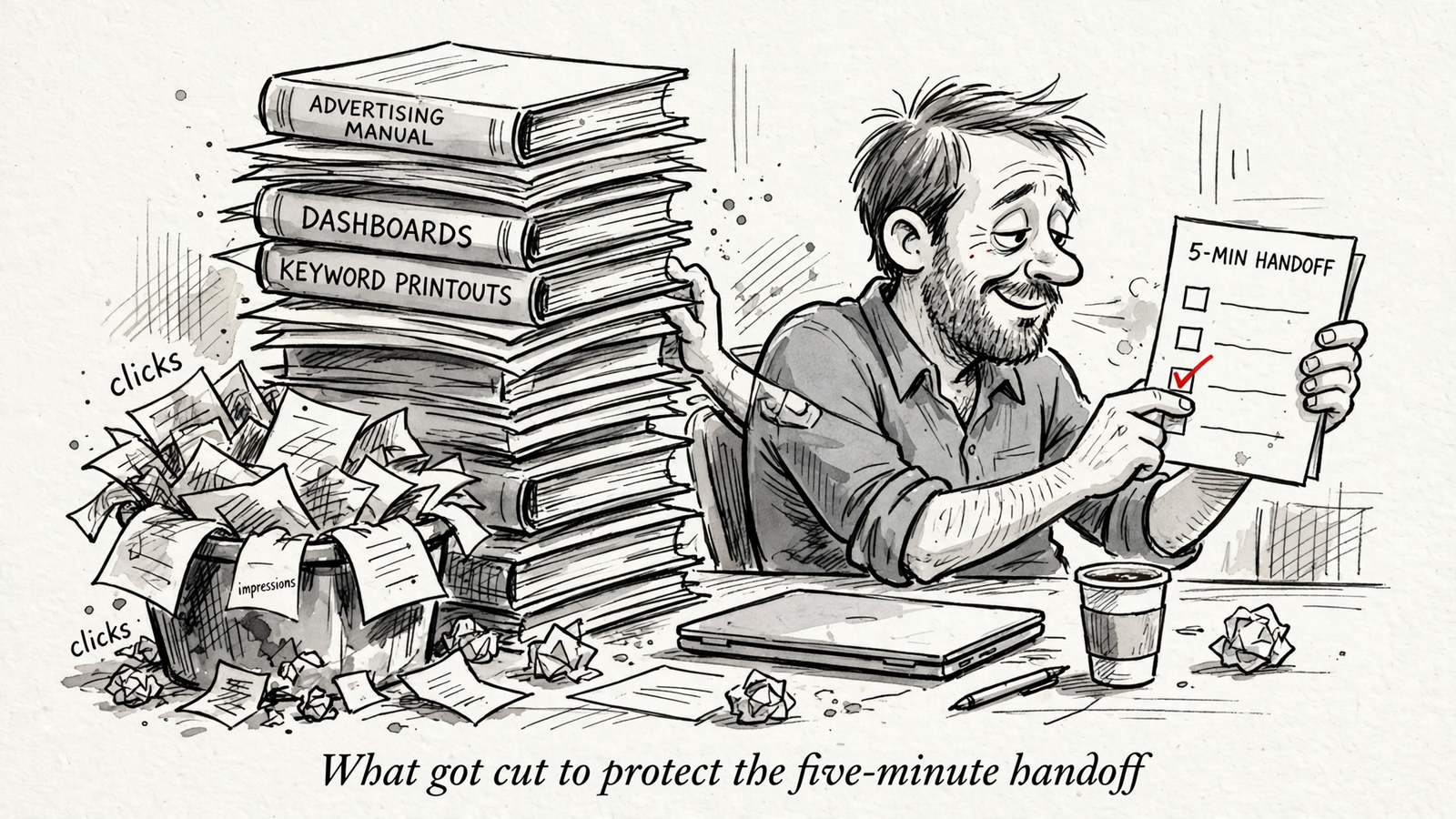
What gets cut to protect the five minutes
Cost: no extra time. Buys: keeping the handoff short after the first conversation.
Three things stay out:
- Platform training. Learning Ads Manager makes you backup labor for work you have hired someone else to own.
- Committee approvals. More people can supply information without all becoming approvers. A committee turns a decision into a thread.
- Click and impression targets. Those can fill a report while leaving your chosen business outcome untouched.
This will not work for everyone. If you enjoy managing campaigns or need to approve every headline, keep the work in-house rather than buying done-for-you management and then rebuilding the job around yourself.
The handoff works when one approver can say yes and mean it.
A long onboarding form can look like rigor while functioning as delay. Detail earns its place when it changes a decision or lets the provider execute one. Everything else can wait.
Cut what does not change the outcome, ceiling, access, or escalation rules. The remaining brief tells the provider what you alone can decide. Execution is the product you bought.
6. When the five-minute constraint lifts: expand the business decisions
Cost: additional owner time, only after the initial handoff. Buys: a broader brief, not a second job.
Once the weekly note shows your chosen outcome arriving at a cost you can live with, expand in this order:
- Raise the ceiling in approved steps. More volume can give you more useful readouts. It still needs your authorization.
- Add one adjacent outcome. A second service line or a higher-value sale gets its own counted-when rule. Do not blur it into the original target.
- Review the next business test. Ask what the provider has learned about messages and landing pages, and which claim to test next. Keep the platform’s reporting limits in view.
I keep owners off targeting menus on purpose. There is no search-term report to mine. Extra time belongs on the offer, proof, and follow-up speed, not on recreating the operator’s job.
You hired help so you could stay the approver. Keep the account in your name, keep one name on approvals, and keep the fee and media on separate lines. When the constraint lifts, widen the brief. Do not take the platform back.


