

 LinkedIn

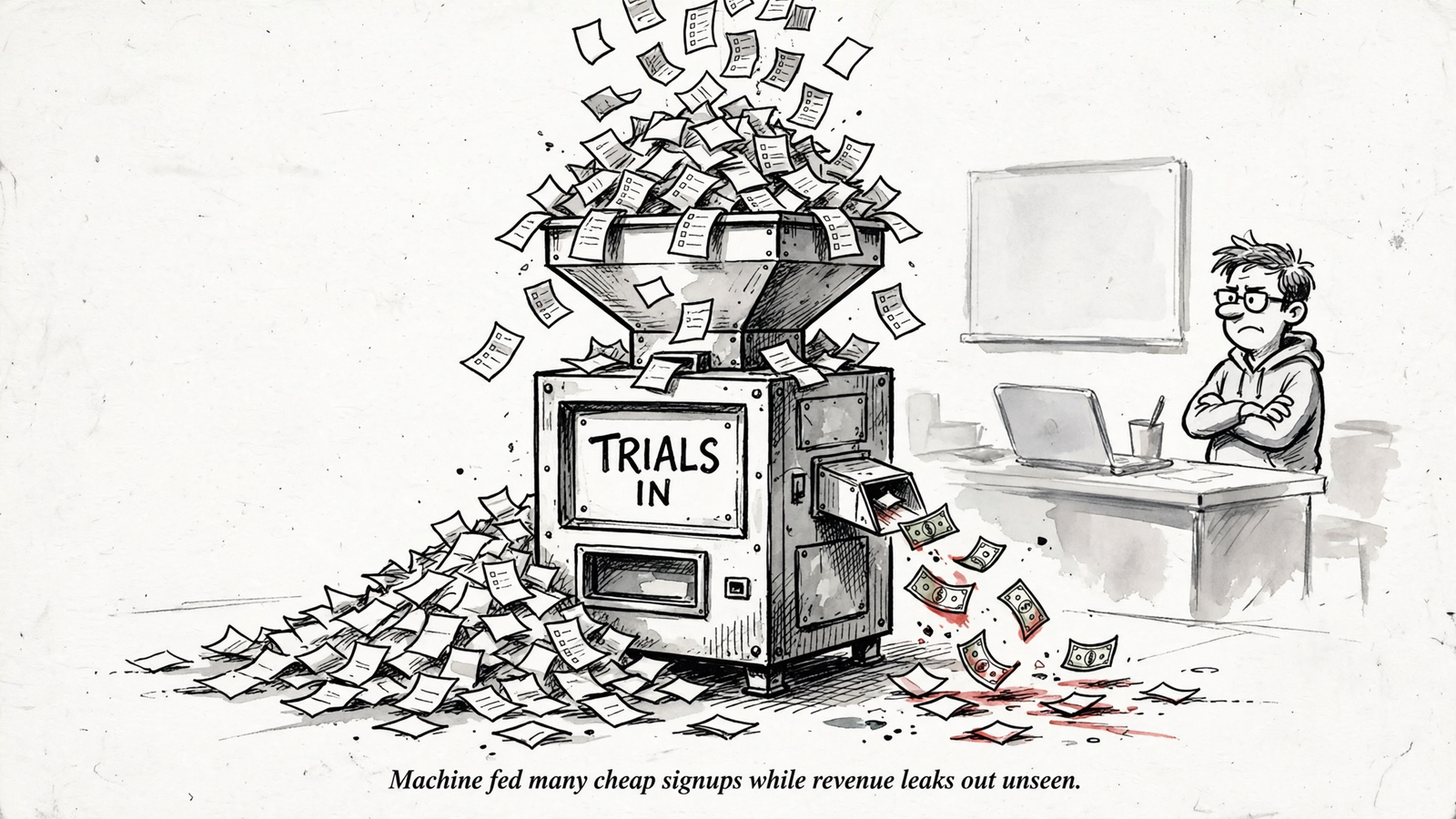
Say you spend $20k a month on Meta, trials cost $22 each, and Slack celebrates every signup. Then finance checks: only 4% ever pay. Should Meta optimize for trials or paying customers? Smart buyers disagree because trials supply feedback that a small account needs, while purchases tell it what the business actually wants. My argument is that the agency worth hiring must defend the event between those extremes, not simply promise more signups.
I used to default to Trial Started because Meta needs around 50 conversions per week per ad set to exit Learning Limited. I was wrong to treat that as the answer. The trial event is what Meta optimizes. Paid revenue is how I judge whether that choice works. When those two drift apart, cheap trials hide expensive failure.
The case for trials: give Meta enough feedback to work
The strongest argument for Trial Started is mechanical, not philosophical. Meta learns from what happens after someone sees an ad. Repeated outcomes give it something to work with; a handful of scattered purchases gives it much less.
An ad set generating 60 to 80 trial starts a week has more feedback than one producing six purchases across a 14-day trial and a sales call. The trial-optimization case is that this volume can help it exit Learning Limited and hold CPA steady. A small SaaS account cannot manufacture more paying customers just because its agency selects a more commercially respectable event.
Delay strengthens this argument. One SaaS guide describes a journey from click to trial, through 14 days of use and a call, with payment arriving 35 days after the first touch. A purchase that falls outside a 7-day click window may not be credited to that click. The business sees revenue; the optimization signal does not necessarily reflect it.
Trial Started gives Meta an earlier, more frequent outcome. It lets the account learn from activity happening now rather than waiting for a thin stream of delayed payments. For a low-volume advertiser, that is a serious advantage, not an excuse for avoiding revenue.
The best case for trial optimization is usable feedback, delivered often enough to matter. If I were defending this side, I would ask the purchase camp one question: what exactly should Meta learn from while it waits?
The case for purchases: teach Meta what money looks like
The strongest argument for Purchase is just as straightforward. Give Meta a signup signal and it learns which people sign up. Give it a purchase signal and it can learn which people buy. Those are not necessarily the same people.
One founder test summarized in GTM Sauce reported that switching the event to purchases lifted install-to-purchase from around 6% to 18–20%. That is the purchase camp’s strongest kind of evidence: not cheaper activity at the top of the funnel, but a higher share of users reaching the commercial outcome.
The mechanism matters more than the event’s respectable name. Payment data gives the system feedback about which acquired users became customers. Without that feedback, the account can keep rewarding campaigns that produce attractive signup reports and disappointing revenue.
Tracking is part of this case, not an implementation footnote. Trials may start in the browser while payment happens 7 to 14 days later in the backend. If that purchase never reaches Meta, the platform cannot use the missing signal. A server-side tracking case describes Meta seeing zero purchases while trials accumulated, until backend purchases were connected through Conversions API with stored IDs.
For the purchase advocate, optimizing for trials accepts an avoidable proxy when the business already knows what success means. Why ask for more people who might pay when the system could learn from people who did?
The best case for purchase optimization is alignment: the event being rewarded is the outcome being bought. Before rejecting it for insufficient volume, I would want proof that the purchase signal is reaching Meta at all.
Where both arguments break on a small account
Trial optimization breaks when signup quality varies. The arithmetic is blunt: $20 trials converting at 25% beat $10 trials converting at 5%. The cheaper trial is not the cheaper customer.
That distinction matters when cold trials cost $15 to $80 and only 40–60% activate within 7 days. A signup can be cheap because the offer attracts the right person efficiently. It can also be cheap because completing the form requires almost no commitment. Cost per trial does not tell me which explanation I am buying.
Trial Started can reward the easiest signup rather than the likeliest payer. More feedback helps only while that feedback points somewhere useful.
Purchase optimization breaks at the other end. A low-volume account might generate 50 trials a week but only four or five payers, spread across different days and arriving after a long consideration period. The event is commercially correct. The available feedback may still be too sparse or delayed to support the choice.
SaaS sales cycles can run 30, 60, or 90-plus days. Sending the backend purchase through Conversions API matters, but it does not make a 35-day journey happen inside a 7-day click window. Tracking integrity and attribution delay are separate questions. An agency needs to answer both.
That leaves a small account caught between abundant weak feedback and scarce strong feedback. Trial advocates are right to worry about repetition. Purchase advocates are right to worry about relevance. Neither concern disappears because the other side has a better screenshot.
I would not settle this by asking which event sounds more disciplined. I would ask which event supplies a usable signal about future payment.
The disputed middle: activation must earn its place
The event between signup and purchase is usually called Trial Activated. The label proves nothing. The behavior behind it has to do the work.
For one SaaS product, activation means connecting a data source. For another, it means inviting a teammate, shipping a first workflow, or publishing a first report. The argument is volume with a filter: give Meta repeated outcomes, but stop treating every collected email address as equally valuable.
The SaaS playbook behind the trial-volume argument makes the choice conditional: with 50-plus trial starts a week, stay on Trial Started; with less, consider a higher-volume event; with activation data, test Trial Activated if volume supports it. That last condition matters. Activation is a deeper event, not a way to conjure more conversions than signup produces.
An activation event therefore has to pass two tests:
- Enough users reach it to provide useful weekly feedback at the ad-set level.
- Those users are more likely to pay, based on the account’s own data.
The second test is where the impressive label often falls apart. Invite Sent sounds active. That does not establish that inviters become customers more often than everyone else.
I would split past trials into activated and non-activated cohorts, then compare trial-to-paid over the same 30 to 60 days. If activated trials pay at three to five times the rate, there is something worth investigating. If the gap is 12% versus 10%, I would not accept the event’s name as evidence of a useful filter. Those are illustrative comparisons, not universal pass marks.
Signup design also changes what the funnel means. One benchmark comparison reports that, per 1,000 visitors, a no-card flow produces about 45 signups and 3.6 payers, while a card-required flow produces 35 signups and 10.5 payers. Counting the signups alone would favor the wrong outcome in that comparison.
This is why a distinction like trial starts vs activated trials vs paid conversions matters. They are not interchangeable labels for growth. They describe different behaviors, at different volumes, with different relationships to revenue.
An activation event without a measured link to payment is Trial Started wearing a costume. I would choose the behavior only after checking the relationship, the volume, and whether the event fires cleanly through the tracking setup.
My verdict: choose the deepest event the account can support
For the reader in the title—plenty of trials, few payers—I choose a proven activation event over either extreme, provided its volume supports optimization. Not a signup renamed to sound important. Not a purchase event selected to please finance while barely firing. The provable step between them.
The single deciding consideration is usable feedback about who will pay. Purchase can be too scarce to supply it. Trial Started can be too indiscriminate. A genuine activation event earns the budget by getting closer to revenue without leaving the account starved of feedback.

That verdict comes with a burden of proof for the agency. Before it touches budget, I want four facts from the account, not four slides about its process:
- Weekly volume by event. Show trial starts, activations, and backend purchases per ad set over the last 28 days. Which event supplies enough feedback, and does any paid event approach the volume needed for learning?
- Time to payment. Show median days from click to trial to paid, alongside the attribution window actually in use. A delayed purchase and a missing purchase are different problems.
- Tracking integrity. Show how a backend purchase reaches Meta through Conversions API, which stored click IDs it carries, and where I can inspect the match rate. Do not ask me to trust a purchase strategy while Meta still sees zero purchases.
- Trial quality. Show trial-to-paid by source, plus activated and non-activated cohorts measured over the same period. That relationship determines whether the proposed event filters for customers or merely filters for activity.
An agency that cannot produce those facts has not earned the right to pick the event. Promising more signups is easier. It is also how a reporting metric becomes a spending strategy.
The teams addressing Meta ads that fill a free trial with people who never activate need to work backward: establish what acquiring a payer costs, then identify the earlier signal Meta can use. Starting with the cheapest visible event reverses that logic.
Put cost per payer beside every trial metric
Here is the comparison I would put in the agency review. Treat it as an illustration, not a forecast:
| Monthly spend | Event bought | Cost per event | Share that pays | Paying customers | Cost per payer |
|---|---|---|---|---|---|
| $20,000 | 800 trial starts | $25 | 4% | 32 | $625 |
| $20,000 | 400 activations | $50 | 15% | 60 | About $333 |
Agency A sends the better trial-cost screenshot. Agency B acquires more paying customers for the same spend.
The mechanism is not mysterious. If the activation behavior identifies users more likely to pay, an account can afford to spend more acquiring that behavior. When the difference in payment rates is wide enough, the expensive event is the cheap one.
I would not renew a SaaS Meta retainer that reports cost per trial without cost per payer beside it. Trial volume belongs in the report. It does not get to stand in for the outcome.
Make the agency write down when it will change course
Proof before launch is not enough. I also want a written kill rule: at what cost per activated trial, and at what trial-to-paid rate, will the agency reconsider the event instead of reflexively changing the creative?
That question forces the recommendation to become testable. If the agency argues for activation because it predicts payment, it must keep checking that relationship. If it argues that Purchase lacks volume, it must revisit the decision when purchase volume changes. The event is a working choice, not an identity.
If activation cannot pass both tests, I would not force it into the account. Use the best-supported event available while continuing to measure payment. But I would reject the claim that more trial starts, by themselves, prove the agency is doing its job.
Keep Purchase firing through Conversions API so the payment signal is available as volume develops. Revisit the optimization choice when the numbers move, not when the deck gets refreshed. The agency must defend the event against paid acquisition economics every month.
That is the accountability standard I value at groas: logged execution with reasoning and a named human who owns the outcome. Recommendations are cheap. For a low-volume SaaS account drowning in trials and short on payers, my verdict is the provable step between signup and purchase. Pick it, prove it pays, and make the agency defend it.


