

 LinkedIn

An $800 Meta buyer is not an $800 solution if you still need to hire someone to make the ads. For a growing business with a modest Meta budget and no in-house designer, that is the real contest between a freelance media buyer and groas’s done-for-you Meta service.
One quote usually covers campaign operation. The other includes making and refreshing the images and video those campaigns need. A cheaper buying fee is not cheaper management if nobody owns the creative. You have bought campaign operation while keeping a second job, and possibly a second supplier.
I would compare these options on four things: who produces the ads, how the account runs, who coordinates the work, and what the complete month costs. The headline retainer comes last.
1. Creative production: does the fee buy ads or just ad management?
A good freelancer sells hours and judgment, not necessarily a production team. Expect campaign builds, audience and budget setup, account checks, and reporting. Market guides put ongoing freelance management at $500 to $3,000 a month. For a small account, a narrower scope often lands at $500 to $1,500 for the build, weekly checks and a simple report.
That can be sensible buying. If usable images and video already arrive every week, paying separately for campaign management avoids buying production you do not need.
The gap opens when the asset folder is empty.
The standard comparison puts it plainly: a freelancer usually outsources creative or uses your assets, while an agency brings designers and editors. Neither the word freelancer nor the word agency settles your scope, though. The written quote does.
Before comparing prices, I would get three answers:
- Which campaign, tracking and reporting tasks are included?
- What do creative production and revisions cost if they are excluded?
- Who briefs, approves and replaces tired assets?
An $800 retainer without anyone assigned to replace the ads is $800 for part of the job. The rest remains yours.
Price that missing work like a second supplier, because that is what it becomes. One creative-cost guide lists:
- Static images: $100 to $300 each.
- 15- to 30-second videos: $300 to $1,000 each.
- UGC-style clips: $200 to $500 each.
- Carousel sets: $200 to $500 each.
The same guide puts monthly creative retainers at $500 to $1,000 for basic production, $1,000 to $2,000 for standard production, and $2,000-plus for premium production. Those are separate costs unless your buying quote explicitly includes them.

The groas Meta offer puts that second job inside the management fee: $1,499 a month includes images, video and ongoing creative testing. Media spend remains separate.
That is the important difference for the reader this comparison is aimed at. You are not choosing between two people pressing the same buttons at different prices. You are choosing between buying campaign operation and buying operation plus creative production.
Check the current scope in the groas Meta service quote, then ask the freelancer to price the same work. Compare deliverables, not job titles.
2. Campaign operation: can production keep up with testing?
The buyer picks budgets, fixes tracking and kills losers. The ads still have to give that buyer something worth running.
Creative fatigue makes this an ongoing production problem, not a launch-day task. A winning ad can last two to six weeks at meaningful spend, with new concepts needed weekly rather than simple recolors. Another cost guide describes multiple variations refreshed every two to four weeks.
The exact clock is less useful than the operating requirement: someone must be ready to replace an ad before the account runs out of alternatives. One new image a month is not much of a testing pipeline. Four to six concepts a month gives you a more useful scope to put into a quote.
A freelance buyer can run that process when you supply the production. But campaign checks do not create new footage, write new hooks or edit the next video. Those jobs need their own owner and turnaround time.
The groas offer combines daily campaign work with creative production and ongoing testing, rather than leaving production as a later purchase. It also includes a dedicated strategist and weekly reporting.
That combination matters more than a daily-versus-weekly label on its own. Daily attention cannot solve an empty asset folder. A steady stream of assets cannot help much if nobody reviews what deserves more budget and what needs to stop.
I want those activities connected:
- Review what is running.
- Identify tired ads and losing concepts.
- Brief and produce replacements.
- Put the next concepts into testing.
With the freelance route, ask how the buyer connects those steps to your designer or editor. With groas, confirm that production and testing sit inside the agreed scope. Buy a repeatable refresh process, not a launch followed by occasional maintenance.
3. Ownership: who does the chasing when an ad wears out?
There is another supplier hidden in some cheap quotes: you.
The buyer asks for assets. You find a designer, explain the offer, collect a draft, pass along feedback and chase the revision. Meanwhile, someone still has to decide whether the tired ad keeps spending.
That is what I mean by a second job. It is not making every image yourself. It is becoming the unpaid link between people who each own only part of the result.
The bottleneck is familiar enough to show up in agency-versus-freelancer comparisons: waiting two weeks for three images stalls testing. A buyer cannot optimize an asset that has not arrived.
Before signing, I would put names beside these jobs:
- Briefing: who turns campaign feedback into the next creative brief?
- Approval: who can approve the work within 48 hours?
- Replacement: who decides to stop a tired ad without scheduling a meeting?
If all three default to you, the freelance fee buys less relief than it appears to. For a comparison budget, you might allow five hours a month for coordination. That is an estimate to test against your workload, not a universal surcharge.
The groas structure includes a dedicated strategist alongside production and campaign management. That gives you a named person to hold accountable without assembling a separate creative supplier yourself.
It does not remove your approval role. A done-for-you team can still wait on you. But the distinction is useful: approving work is not the same job as finding someone to make it, briefing them and keeping the production queue moving.
Ask who owns the next ad, not just who owns the ad account. A reporting contact is not automatically a production owner.
4. Total monthly cost: compare completed months, not retainers
Once the scope and ownership are clear, the arithmetic gets more honest.
Fee guides commonly list a freelancer at $500 to $3,000 a month and an agency at $1,000 to $5,000-plus, with media spend separate. Those ranges do not tell you whether either supplier delivers the next batch of ads.
I would put both quotes into the same shape:
| Cost or responsibility | Freelance route | groas route |
|---|---|---|
| Management | Quoted retainer, say $800 to $1,500 | $1,499 monthly service fee |
| Creative production | Add the external quote if excluded | Images, video and ongoing testing included |
| Media spend | Separate | Separate |
| Setup and other work | Add anything separately quoted | Confirm anything outside the agreed scope |
| Coordination | Allow for your time if you connect the suppliers | Production and operation sit with one provider |
For the freelance route, a $500 to $2,000 creative retainer can change the apparent saving quickly. Also check tracking, landing-page work and CRM integration: basic $1,000 to $2,000 management packages often exclude creative production, landing-page work and CRM integration.
That does not mean every account needs every add-on. It means the cost belongs in the comparison when yours does. Do not discover the exclusion after signing.
For groas, the comparison starts with $1,499 plus media spend and anything genuinely outside the agreed scope, such as a full site rebuild. Creative production, testing and daily operation are already inside the fee rather than waiting on a second invoice.
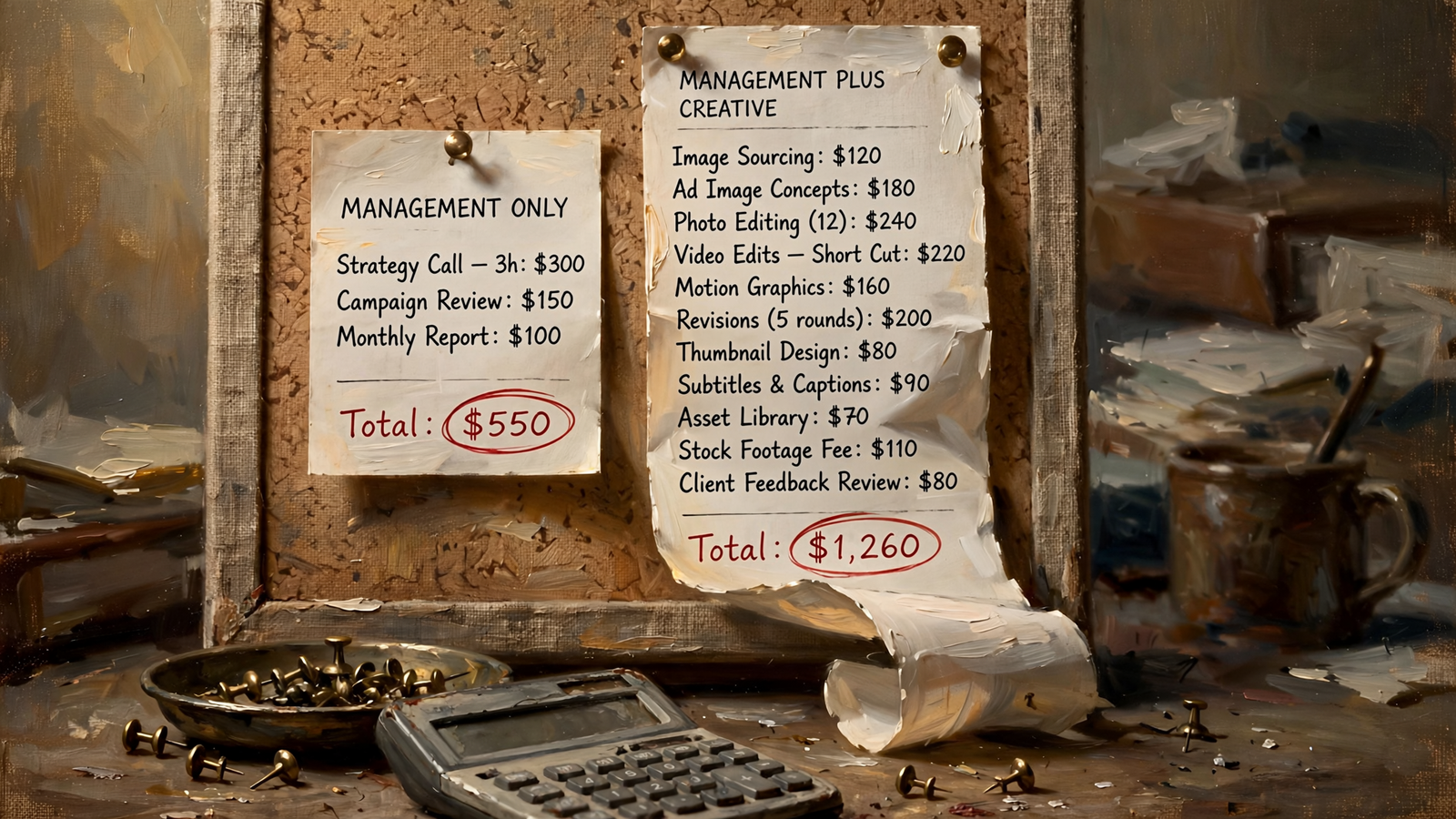
The next step is to judge the complete bill against the outcome. For a lead-generation business, one useful comparison is ad spend plus fees divided by booked calls.
A worked example in that comparison puts an $800 freelancer on $5,000 of spend at $232 per booked call, while a $1,750 agency delivering 42 calls comes to $161 per booked call. That is an illustration, not a promise about either contender here. It shows why the fee alone cannot settle the decision.
It is also cost per booked call, not cost per customer. Keep the outcome label honest while doing the math.
The cheaper retainer wins only if the complete delivery cost and results support it. Leaving production off the invoice does not make production free.
The head-to-head at a glance
These are the four comparisons I would take into the buying decision. For an owner without a creative team, groas covers the production gap that makes a narrow buying quote incomplete.
| Decision axis | Freelance media buyer | groas done-for-you |
|---|---|---|
| Creative production | You supply assets or pay for production separately unless included | Images, video and ongoing creative testing included |
| Campaign operation | Small-account scopes commonly cover the build, weekly checks and reporting | Daily campaign work, dedicated strategist and weekly reporting |
| Ownership | You may coordinate the buyer and creative supplier | One provider covers production and operation; your approvals still matter |
| Complete monthly bill | Management + excluded creative + other quoted work + coordination time + media | $1,499 + media + work outside the agreed scope |
The mechanism behind the verdict is straightforward. Ads wear out. Replacements require production. Either that production is inside the management fee or you must arrange it elsewhere.
There is no useful third option called hopefully the current ads keep working.
My verdict: groas wins when you need someone to make the ads
For the modest-budget owner with no one to produce and refresh creative, groas wins this head-to-head. The $1,499 fee prices operation and production together instead of leaving you to assemble the second half of the service.
I would pick the freelancer anyway if usable assets already arrive every week. I mean a real pipeline: someone shoots, someone edits, and someone can turn around new hooks in days without you chasing them. In that setup, the narrower fee can be genuinely lean because you have already filled the gap.
If that describes your business, read the companion comparison for businesses that already have a creative team. Match a lean buying quote to a proven creative supply, in writing.
If it does not, get a written creative quote before declaring the freelancer cheaper. Ask for four to six fresh concepts a month, specify the image and video mix, and include revisions. Then add setup if quoted and your time to brief and coordinate. Put that complete number beside the groas fee.
There is a budget floor worth facing before either conversation goes too far. Say you have $2,000 total. A $1,499 fee leaves roughly $500 for media. A $900 freelance fee plus $700 for a designer leaves $400. Neither calculation leaves much room for the campaign and creative testing you are trying to fund.
Do not solve that squeeze by pretending production is optional. If you cannot fund one offer, one campaign and enough fresh concepts to replace losers for 30 days, pause the buying search and fund the assets first.
Before signing, copy both quotes into the same email. Ask for:
- The monthly fee and any setup fee.
- The number of new image and video concepts included.
- The revision allowance.
- The person responsible for briefing and replacement.
- The approval turnaround expected from you.
My pick stays the same: hire the narrower freelance scope when you already supply the ads; hire groas when you need operation and production together. What loses is buying operation alone and hoping creative appears.
Then ask one last question: who delivers the next four video hooks when the current winner fades?
The supplier who answers with a date and a name owns the work. The one who answers with advice just sold you homework.


