

 LinkedIn

Google Search Console + ChatGPT can leave you with a polished SEO plan and an unchanged website. If you are a business owner without time to run SEO, the choice between that DIY stack and groas SEO and AI Search comes down to who owns publishing, technical deployment and verification after the recommendations arrive.
I would not judge this contest by the number of suggestions either option produces. Exporting queries, drafting titles and assembling a checklist are the easy parts. Getting the CMS login, securing approval, chasing a developer and checking the result are where the queue grows teeth.
That is the comparison here: five decision axes, from diagnosis to proof. If you can ship consistently, keep the DIY stack. If you cannot, buy ownership of the work, not another document describing it.
The contenders: tools you operate versus delivery someone owns
Option A is Google Search Console + ChatGPT, with you responsible for execution. Search Console is free and reports on properties you have verified. It shows performance for your own pages, including queries, clicks and impressions, alongside indexing information, sitemaps and Core Web Vitals. Requesting indexing queues a crawl; it does not guarantee inclusion. Search Console cannot inspect third-party pages or diagnose off-site authority for you.
ChatGPT adds a language assistant. It can help with keyword ideas, clustering pasted Search Console queries and drafting briefs, titles, meta descriptions and schema. It does not know your search volumes, rankings or traffic unless you supply them. You handle the prompting, checking, publishing and follow-up.
Option B is groas SEO and AI Search, with a named strategist coordinating delivery. groas manages paid search, SEO and visibility in ChatGPT and Google answers, with senior strategists directing the work and owning the result. You set goals and budget and provide access. The strategist sets priorities, coordinates publishing and technical changes, and answers for progress towards enquiries.
The distinction is not AI versus humans. Both approaches can use AI. It is tools versus an accountable operator. A checklist does not publish a page.
1. Diagnosis: a plausible explanation is not a finding
Search Console shows where visibility changed. It does not necessarily explain why. Queries, page performance and indexing exclusions give you places to investigate, but the reports need pairing with lead and sales data and further investigation to explain the cause.
There are limits to the picture, too: data lags about two days, history stops at 16 months, and rare queries remain hidden for privacy. Exporting that data into ChatGPT can help organize the investigation. It does not fill the gaps.
This is the trap I would watch for: a confident paragraph that feels like a diagnosis because it has a beginning, a middle and a recommendation. ChatGPT does not know volumes, rankings or traffic unless you provide them. It can also invent statistics, quotes and sources, and produce generic pages without unique input. Fluency is not evidence. Annoying, given how much easier fluency is to buy.
For DIY, the job is to separate what the data shows from what the model suggests. Check factual claims against primary sources and test generated code before deploying it. Publishing unchecked, unhelpful AI content at scale can also create spam-policy problems rather than solve a visibility problem.
groas wins this round for the time-starved owner because someone owns the interpretation and the next action. That is not a claim that a managed service cannot make a mistake. It is a reason to insist on a named person who can explain the diagnosis before work ships.
Use DIY to investigate symptoms. Do not promote a chatbot’s explanation to a finding without checking it.
2. Publishing and technical fixes: who gets past the CMS login?
A draft in a Google Doc changes nothing in search. With the DIY stack, the remaining workflow still belongs to you:
- Rewrite the draft in your voice and check its claims.
- Upload it to the CMS and format headings and internal links.
- Get any underlying template or technical issue fixed.
- Request indexing where appropriate.
- Confirm that the page renders correctly and check its indexing status.
That last step is not decoration. A page can look published to you and still appear as excluded in the Pages report. Pressing Publish is an action, not verification.
The handoffs are where a tidy plan becomes an unfinished queue. Practitioner guidance describes small companies that pay for an audit, agree with it and make no site changes because no writer, developer or decision-maker has time. Work also stalls between approvers waiting for owner sign-off. Everyone agrees on the priority. Nobody changes the page.
groas wins this round because delivery has an owner beyond the recommendation. Someone is responsible for coordinating the change and verifying it afterwards, rather than handing the remaining tasks back to an already overloaded owner.
You still need to provide access and make the approvals that remain yours. Managed delivery does not make those dependencies disappear. It gives someone responsibility for moving them along.
If your last three SEO tasks are still drafts, another brief is unlikely to help. Assign someone to get them live.
3. AI visibility: a FAQ draft is not an outreach programme
Your website is only part of the AI-search job. Buyer-question coverage matters, but so does earning citations and mentions on third-party pages those systems already cite: listicles, review sites, forums and data sources.
ChatGPT can draft a FAQ page. That does not get your business mentioned on those pages. Generative engine optimization scopes separate content rewrites from digital PR and citation earning for a reason. They are different jobs, and the second one is slower and less comfortable than asking for another outline.

DIY can cover this work, but only if you actually do it. The tools do not turn an outreach task into a completed mention. With groas, third-party mentions are pursued as part of the delivery model rather than left as another item on your list.
Measurement requires its own routine. A useful starting point is a fixed set of 15 to 20 buyer prompts, expanding to 40 to 50 once the process is routine. Cover discovery, comparisons, alternatives, problem-led questions and brand facts. Run prompts several times per check across ChatGPT, Perplexity, Gemini and AI Overviews, distinguishing mentions from citations and recommendations.
Search Console does not replace that process: AI Overviews and AI Mode impressions and clicks are bundled into normal Web totals without a separate filter. One flattering chatbot screenshot is not a substitute either. The same prompt can produce different answers from run to run.
groas is the stronger fit when you need coverage, outreach and repeatable tracking owned together. Its advantage is not that DIY makes those jobs impossible. It is that the DIY stack leaves you responsible for all three.
If your AI-search routine ends after drafting FAQs and asking ChatGPT about your brand, the work is unfinished.
4. Cost and workload: price the jobs, not just the subscriptions
DIY looks cheap because the subscription bill leaves your time off the invoice. A small-business AI-assisted SEO workflow can take 10 to 20 hours a month for prompting, checking tone, fixing errors and publishing, alongside about $20 a month for ChatGPT Plus and $59 to $199 for SEO tools. GEO work can add another 5 to 10 hours a month.
Say you value owner time at $100 an hour. The first 10 to 20 hours represent $1,000 to $2,000 in labour, before extra developer or writer costs. That is an illustration, not a claim that every owner spends the same amount of time. The point is to count the work you keep.
If you have the skills and a reliable publishing routine, those hours may be a sensible investment. DIY saves management fees; it does not remove the management job.
groas SEO and AI Search are priced at $1,499 a month per service, with a 7-day money-back guarantee. That is a per-service price, not a single combined price for both. The model uses a flat fee rather than a percentage of spend, with no setup fees.
For context, done-for-you SEO pricing commonly sits around $1,500 to $5,000 a month, with local firms at $2,000 to $4,000 and e-commerce at $2,500 to $6,000, sometimes with setup charges as well. The relevant comparison is not $20 for a chatbot versus a managed service. One buys software access. The other buys responsibility for delivery.
With groas, that means publishing and technical work, or AI-search work such as third-party mentions and a fixed buyer-prompt set tracked across systems, according to the service you choose.
For the owner whose queue keeps growing, groas wins on the operating model. For someone already shipping reliably, DIY keeps the cash cost lower. Price the service you need against the jobs you can realistically finish.
5. Proof: define progress before anyone starts
Neither contender deserves credit for producing a handsome report. I would judge progress through three measures held next to each other:
- Google visibility for changed pages. Track queries and clicks in Search Console, alongside confirmed indexing, after the work goes live.
- AI visibility across a fixed prompt set. Record mentions, citations, recommendations and share of voice on a schedule. Repeat checks because the same prompt varies from run to run.
- Attributable enquiries. Pair prompt tracking with GA4 channel grouping and How did you hear about us? self-attribution. AI referrals are only a floor: many answers generate no click, and some app traffic appears as Direct.
DIY can track these measures. Nothing about the stack forces you to settle for screenshots and hope. But you must build the routine, maintain it and decide what to do next. With groas, the strategist owns that follow-up and has to connect the work to the business goal.
That is the managed-service advantage I care about: an explanation of what shipped, what changed and what happens next. Not a promise that every line rises immediately.
No honest provider can guarantee the outcome. Google’s hiring guidance warns that no one can guarantee a No. 1 ranking; claims of a special relationship or priority submission are warning signs. Treat guaranteed AI citations or leads with the same scepticism.
groas wins this round for an owner who cannot maintain the measurement routine. Judge that ownership by visible work and tracked enquiries, not promised positions.
The head-to-head at a glance
The deciding column is who carries the unfinished work. The tools can support a capable operator; they do not supply one.
| Decision axis | Google Search Console + ChatGPT | groas SEO and AI Search |
|---|---|---|
| Diagnosis | You supply context, investigate and check the model’s explanations | A named strategist owns interpretation and priorities |
| Publishing and technical fixes | You upload, coordinate developers and verify changes | Delivery is coordinated and verified for you |
| AI visibility | You handle coverage, outreach and repeated prompt checks | Coverage, third-party mentions and prompt tracking have an owner |
| Cost and workload | About $80–$220 in tools, plus your time and any outside help | $1,499/month per service; confirm the scope you need |
| Proof of progress | You maintain tracking and connect it to enquiries | The strategist answers for shipped work and progress towards enquiries |
Verdict: groas wins when execution is the bottleneck
For the reader this comparison is for, the owner who already has recommendations but cannot get the work live, groas wins. Not because its ideas must be cleverer. Because publishing, technical delivery and verification stop being loose ends on your desk.
The work has an owner: pages get published, technical fixes get coordinated, third-party mentions get pursued and the prompt set gets rechecked within the service you choose. A perfect brief sitting in Drive cannot compete with a useful change that ships and gets verified.
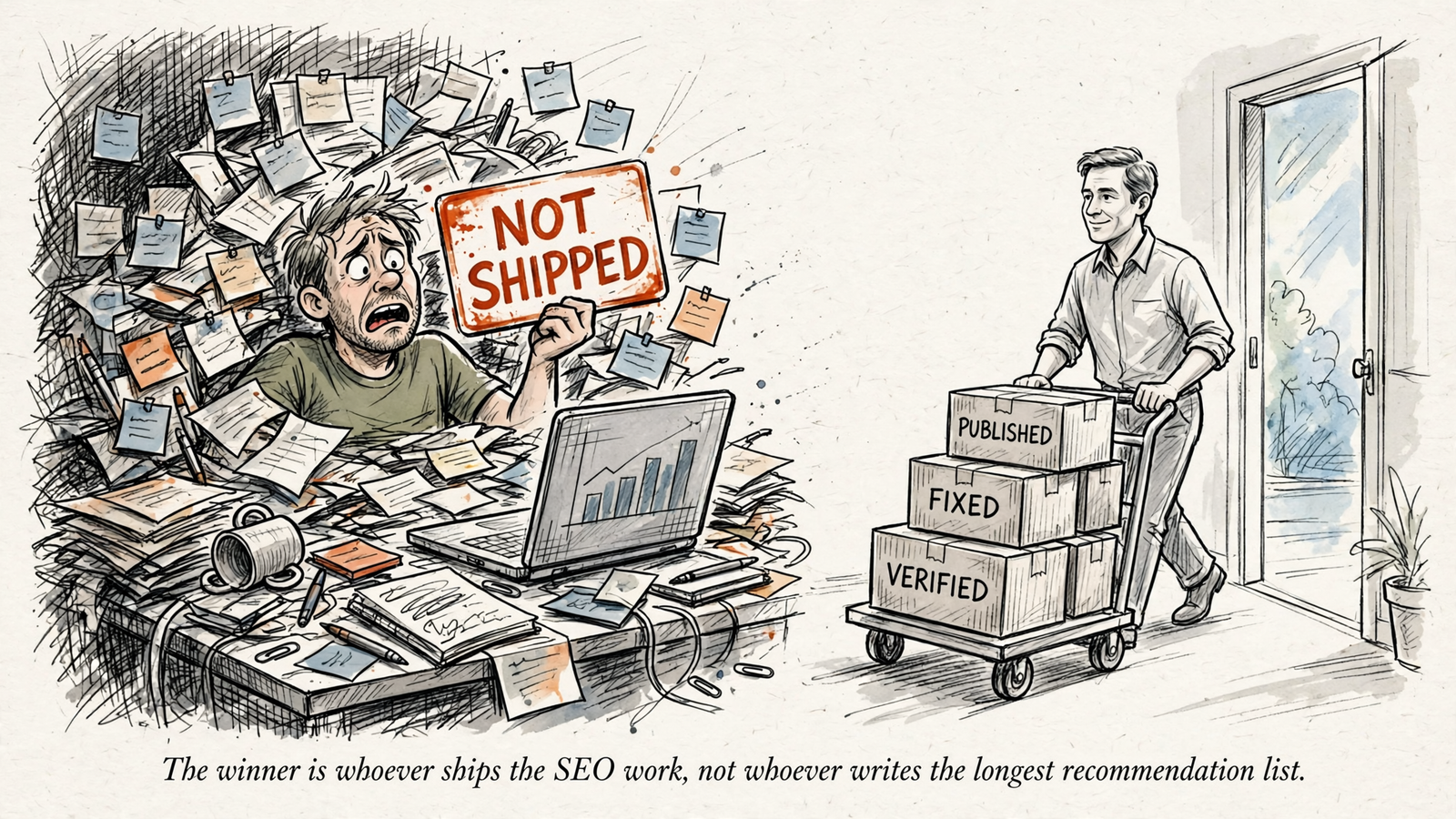
Choose the DIY stack anyway if you can publish and verify consistently. My practical bar is one published fix a week, indexing checked, factual claims verified and a buyer-prompt set you actually rerun. If that describes you, keep the lower tool bill and reserve the hours. You do not need another layer of management. You need a calendar block you honour.
Choose managed delivery when the same work remains unfinished for the second month running. Before handing over access, ask groas four questions:
- What will you publish and deploy in the first 30 days, and who writes, approves and uploads it?
- What access do you need to the site, Search Console and GA4, and what stays with me for approval?
- How will you track the fixed buyer-prompt set, Google visibility and attributable enquiries each month?
- What does month one look like if nothing moves, and what do I still pay for?
If your queue keeps growing while your tools keep suggesting, stop buying suggestions. Buy shipping. For a time-starved owner, that is the whole comparison, and it is not close.


