

 LinkedIn
46.24%. That’s how much Optmyzr says Google Standard Shopping CPC rose from the preceding week to Black Friday through Cyber Monday 2025. It’s a good reason to ask ChatGPT what happened in your Bing account and a bad multiplier for your Microsoft Advertising budget.
In Optmyzr’s sample, conversion rate rose, but not nearly enough to keep pace with the cost of a click. I know the temptation in a planning meeting: take the cleanest number on the slide, call it a seasonal adjustment, and move on. The slide looks finished. The forecast isn’t.
I keep the published benchmark, the math I can do with it, and the evidence from my own account separate. The benchmark tells me what to look for. The calculation shows why the gap between CPC and conversion rate matters. Neither tells me what to spend on Bing.
What Optmyzr measured in Google Shopping
Optmyzr’s BFCM analysis compares the sale window with the preceding week across 1,528 Google Standard Shopping accounts. Here are the published figures, before I do any math of my own:
| Standard Shopping metric | Week before BFCM | BFCM 2025 | Reported change |
|---|---|---|---|
| Cost per click (CPC) | $0.735 | $1.074 | +46.24% |
| Conversion rate | 6.228% | 6.652% | +6.80% |
| Return on ad spend (ROAS) | 749.46% | 584.43% | Fell |
The conversion-rate increase is relative: the rate went from 6.228% to 6.652%, not up 6.80 percentage points. A larger share of clicks converted, but the price of those clicks rose much faster. That’s the tension I want a planning brief to explain, not average away.
Even within Google, the answer changes with campaign type. In the same Optmyzr analysis, Performance Max CPC rose 29.15%, from $0.626 to $0.809, while conversion rate went from 4.771% to 5.095%. I wouldn’t roll those figures into the Standard Shopping numbers. If I wouldn’t blend two campaign types in the same study, I’m not going to paste one of them into a different platform’s budget.
A lower starting CPC doesn’t tell me how Bing moved
SearchLab’s 2026 benchmark compilation puts average Microsoft Shopping CPC at $0.41 versus $0.73 for Google Shopping, and Microsoft Search CPC at $1.37 versus $2.06 for Google Search. It also lists Microsoft Shopping conversion rate at 2.1% and ROAS at 4.6×, versus Google Shopping ROAS of 4.0×.
Those figures describe different benchmark levels. They don’t measure the same seasonal change. A lower starting CPC doesn’t tell me whether Bing’s CPC rose by more, by less, or at all over the sale window. I use the Google result to frame the question: What happened to CPC in my Microsoft account over the same dates, and did conversion rate move with it?
What the gap implies for acquisition cost
I set both pre-BFCM metrics to 100 and restate the reported Optmyzr changes on that common scale. Now I can see how far the cost of a click moved relative to the chance of converting it.
| Indexed measure | Pre-BFCM baseline | BFCM 2025 |
|---|---|---|
| CPC | 100 | 146.24 |
| Conversion rate | 100 | 106.80 |
| Implied cost per acquisition (CPA), calculated | 100 | 136.93 |
CPA is CPC divided by conversion rate. Divide the CPC index by the conversion-rate index, then multiply by the baseline of 100: 146.24 ÷ 106.80 × 100 ≈ 136.93. With consistent definitions and aggregation, that works out to an implied CPA about 36.93% above baseline. The useful word there is implied. I calculated it from two published aggregate changes. Optmyzr didn’t report it as an account-level CPA result.
The reported ROAS decline is consistent with the cost pressure in that calculation. It doesn’t tell me what caused the decline. Order value and product mix can move ROAS too, and the aggregate can hide an account whose offer held CPA flat right next to one whose clicks got more expensive and converted less often.
I used to tell clients a seasonal benchmark was a forecast. I was wrong. The ratio is useful because it tells me what to check in the account, not because it tells me what every account did.
What I ask ChatGPT to pull from Microsoft Advertising
Once I connect Microsoft Advertising through groas, I start with a read-only request for account history. Microsoft’s own MCP use cases describe historical reporting that includes spend, clicks, conversions, CPA and ROAS, with breakdowns by campaign, ad group, keyword and audience. Microsoft also documents anomaly detection and change history for the last 180 days. That’s evidence about what happened in the account, not a forecast. A Google-to-Bing comparison still needs a separate Google Ads connection.
Read our Microsoft Advertising results for the previous seasonal period and a comparable baseline. Return spend, clicks, conversions, CPC, conversion rate and CPA. Name the account ID, give the exact dates for both periods, and state which conversion action you counted. Flag low volume, missing data and any dates where conversions may still be coming in. Make no changes.
I want the dates and conversion definitions in the report, not buried in the conversation. As operators point out in this r/PPC discussion on attribution lag, conversions can be credited back to the click date. Recent days can look weaker than they turn out to be. If the assistant can’t tell me what counted as a conversion or whether the latest dates are incomplete, I’m not going to treat a CPA difference as a clean comparison just because the columns line up.
I also want to see the counts behind the rates. If the campaign I’m considering for a budget change has too few conversions to support the comparison, I mark that gap on the campaign row. I don’t let the account total answer a campaign question. And if the sale window and baseline count different conversion actions, I ask for a like-for-like pull before I ask ChatGPT to explain what moved.
If I want Google in the same brief, I connect it separately and keep both platforms in separate rows. My piece on connecting Google and Bing to ChatGPT goes into why I give each account its own rules. The same logic applies to reporting: a blended CPA can tell me something moved without telling me whether to look in Google Shopping or Bing Search. I want that distinction before I discuss a combined budget.
The planning table: observations, benchmarks, assumptions and gaps
I want a table I can audit, not a sentence telling me to expect the Google uplift on Bing. The brief keeps observed results, external benchmarks, operator assumptions and data gaps separate. If I can’t tell which is which, I can’t tell whether ChatGPT found a result or I supplied one.
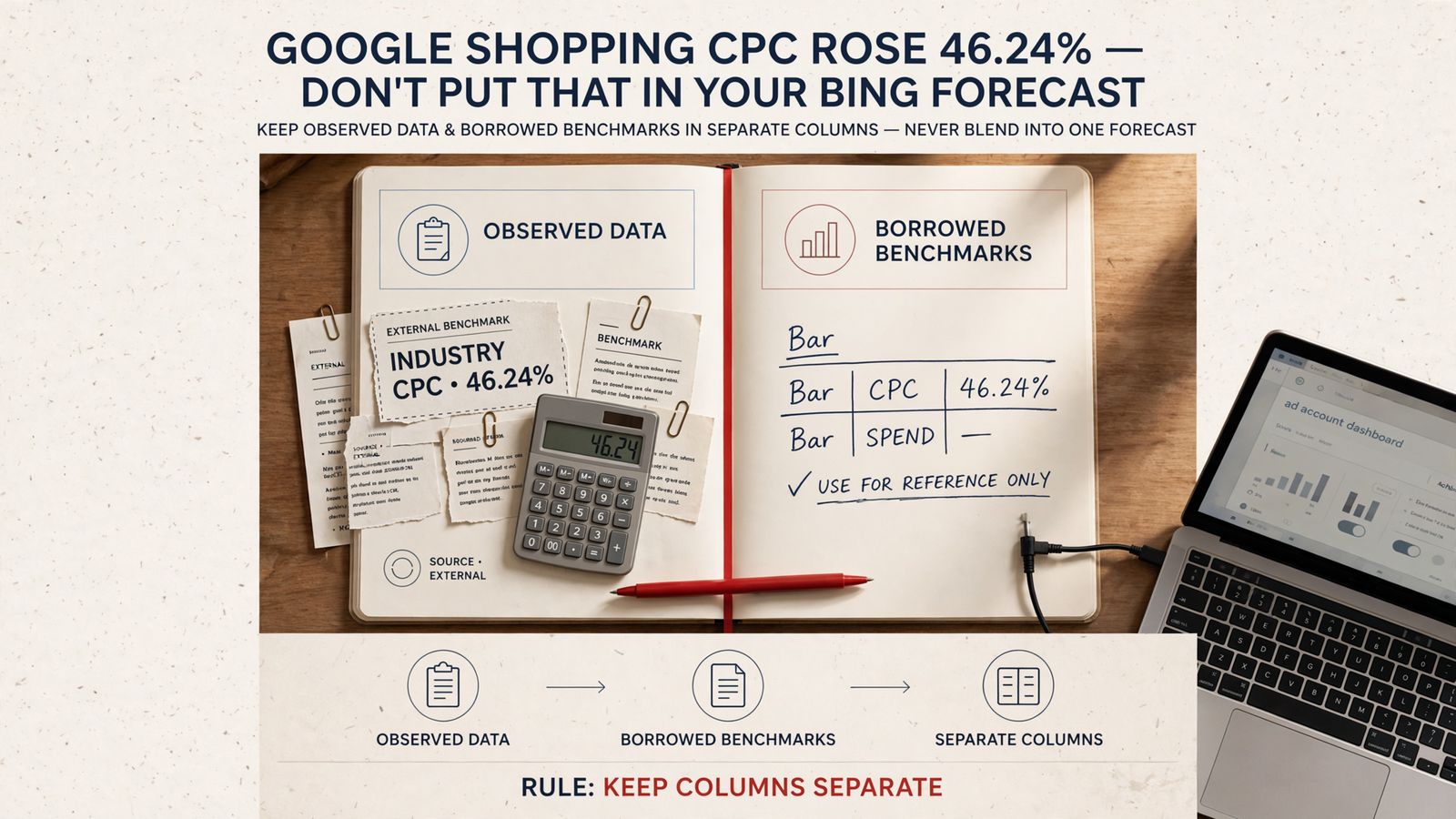
Here’s the layout. I leave the Bing figures blank until the connected account supplies them.
| Column | What goes in it | Example label |
|---|---|---|
| A. Observed Bing results | Spend, clicks, conversions, CPC, conversion rate and CPA for both periods, with account ID and dates | Microsoft Advertising: seasonal window vs. baseline |
| B. External Google benchmark | Optmyzr Standard Shopping figures: CPC +46.24%; conversion rate +6.80% | Google Shopping: context only |
| C. Assumptions and decisions | Budget reserve, CPA ceiling, freeze date and who approves changes | Proposed reserve: approval pending |
| D. Data gaps | Low-volume days, missing results or conversions still coming in | Recent dates: conversion data incomplete |
Microsoft’s November 2025 holiday guidance gives me an example of what belongs in column C: a 10–15% budget reserve. It also suggests scheduling bids for key weekends, considering slightly looser ROAS targets on peak days, and phasing spend across November. I’d weigh that guidance ahead of a Google Shopping uplift when planning on Microsoft. I still wouldn’t put it in column A. A reserve is a choice, not something I measured in the account.
Next I ask ChatGPT for conditional scenarios using the Bing baseline. I want it to show the inputs beside the answer, so I can see what came from the account and what I asked it to assume:
- Hold conversion rate flat. If CPC rises, divide the higher CPC by the baseline conversion rate to see what happens to CPA.
- Work backward from the CPA ceiling. At that higher CPC, divide CPC by the ceiling to find the conversion rate that would put CPA right at the limit. I’d need to beat that rate to stay under it.
I don’t ask it to fix that ratio by changing spend while holding both inputs constant. Under those assumptions, changing spend doesn’t change CPA. The point of showing the math is to see which assumption would have to change before I’d approve the plan. If the scenario only works with a better conversion rate, I want that requirement stated next to the proposed reserve. I don’t want to find it later in the arithmetic. And if the Bing history is too thin to judge whether that rate is plausible, I put that gap in column D instead of treating the scenario as a forecast.
In an r/PPC thread on reporting tools, operators describe stitching together Excel pivots because their platform connectors pull separately. With both accounts connected through groas, I can ask ChatGPT for one brief without rebuilding the comparison by hand. I still want separate rows, dates and conversion definitions. One document doesn’t mean one number.
Use November 25 as a checkpoint, not a Bing rule
Optmyzr’s BFCM checklist recommends a November 25 freeze for its Google plan: stop structural edits, assign owners and write down what to do if conditions change. The logic matters more than the date. A last-minute change to a bidding target needs time to settle, and a short sale can end before it does. That’s a reason to plan ahead on Bing, not evidence that Microsoft needs the same freeze date as Google.
I use that date as an example of an evidence deadline and set my own based on conversion volume and the sales cycle. By the checkpoint, I want ChatGPT to hand me:
- Unresolved evidence: a missing conversion definition, a campaign with too little volume, or a Google benchmark with no Bing counterpart.
- Proposed changes: each tied to an observation in column A, with the assumption and approval owner in column C.
I want the unresolved evidence first. If recent conversions are still coming in, I want to know which proposal depends on those dates before anyone approves it. There’s a difference between having a budget reserve on paper and having enough evidence to spend it.
If a proposal rests on the Google average alone, it stays a proposal. I keep Microsoft approval separate from Google approval, too. A comparison in the same thread is not permission to change both accounts.
With groas, autopilot stays off until I switch it on. Every change is logged with its reason and can be undone in one step. The log tells me what changed and why, so I can line it up with the account results afterward. It doesn’t prove that the change moved CPA. That’s a distinction worth keeping when someone brings a screenshot to the postmortem.
The decision: borrow the question, not the percentage
In Optmyzr’s Google Shopping sample, clicks got more expensive much faster than conversion rate improved. The implied CPA index makes that gap easier to read. It doesn’t close the distance between a Google benchmark and a Microsoft budget.
I’d keep the benchmark in the brief, pull the same comparison from Bing, and use that account’s results to test the scenarios I’m willing to plan around. If the dates, volume or conversion definitions don’t support a decision, I leave the budget alone rather than fill the gap with Google’s number. The benchmark earns a row in the brief. It doesn’t get to move the budget.





