

 LinkedIn

Most agencies selling ChatGPT ads management will send you setup videos, reporting links, and suggestions. Fewer will do the work inside your account. By day 14, you can tell which one you bought. If conversion tracking, a matched landing page, written budget guardrails, and a change log with reasons are not in place, you bought a course with a monthly invoice. Keep this checklist open through the first two weeks and ask for the evidence in your account, not a reassuring slide. Every item has a pass/fail test. More than two failures means you do not have hands-on management, whatever the proposal called it. The score matters, but the foundations matter more: a polished report cannot rescue an account nobody can measure or control.
Before launch: days 0–3
-
You own the account; they have shared access. Pass: you created the advertiser account under your legal details and invited your manager as Admin. OpenAI has no MCC-style hierarchy, so each client creates its own advertiser account and invites an agency as Admin, Member, or Viewer. Check who controls the account before anyone spends a dollar. If they created it under their email and added your card, access is not ownership. Ask them to show you the account settings, not a screenshot of the campaign. You should be able to keep the account, its settings, and its history if the relationship ends.
-
A conversion event fires, and you have tested it. Pass: submit a test lead or purchase yourself and find the event in Ads Manager. Setup requires a data source and events sent through Pixel, Conversions API, or both. Preserve the
opprefclick ID through redirects and use one event ID for deduplication. The common mistake is to call tracking complete because a tag exists. A tag is not a verified conversion. Ask for the event ID from your test and check that the action your business actually values is the one being recorded. Otherwise, every later argument about performance rests on a count nobody tested. -
The landing page matches the ad’s conversational intent. Pass: follow the ad URL and see the specific question answered on that page, rather than being dropped on the homepage. A 15-point waste audit calls for a dedicated matching page for each campaign. This is an easy check to skip because the homepage looks finished and the campaign needs a URL. Finished is not matched. Read the ad’s promise, open the page, and ask whether a visitor can find that answer without hunting through navigation. If not, fix the destination before paying to send more people there.
-
The budget cap and approval rule are in writing. Pass: you can point to a daily or campaign-total cap and a rule for who approves an increase. ChatGPT uses a relevance-weighted second-price auction with a $25/day US minimum; a daily budget is an average and can spend up to twice that amount in one day. Give a test a campaign-total ceiling, not just a daily setting and a shrug. The common miss is an informal assurance that the manager will ‘keep an eye on it.’ Write down what happens before the ceiling changes. If nobody can show you that rule, you have not agreed on the size of the test.

Week one: days 4–7
-
Campaigns are live in the account you own. Pass: you see Active status and evidence that ads are serving, not a slide marked launch imminent. Spend data can lag seven to eight hours, so do not judge day one at lunch. Do distinguish between live and ready to serve. Open the account with your manager and check the status there. A screenshot can help document the launch; it should not be your only way to see it. By the end of week one, ‘we have everything set up’ is not a substitute for a campaign running under the agreed cap.
-
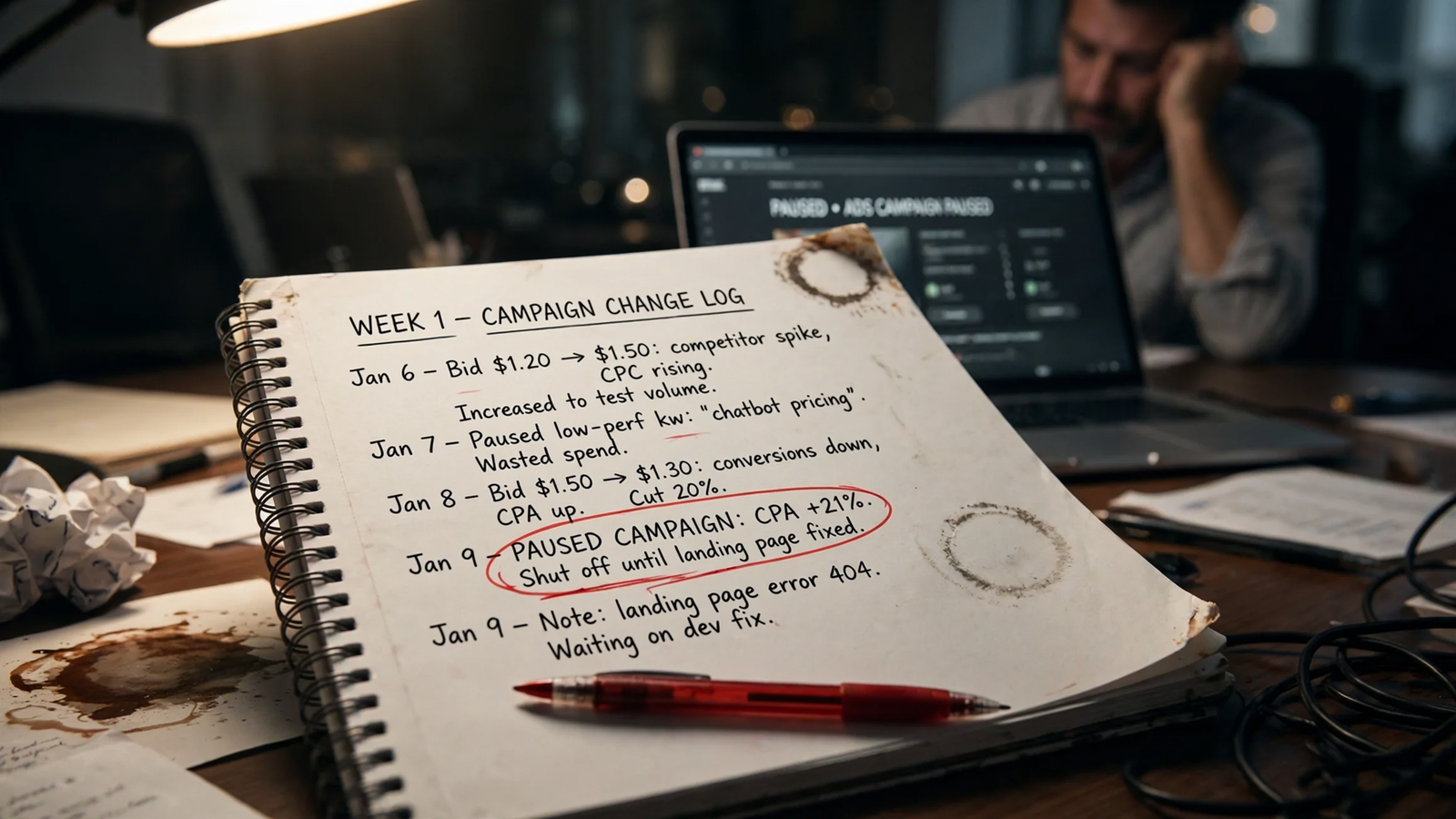
The change log has its first dated entry. Pass: one line says what changed, why it changed, and what the manager will check next. ‘Context hint narrowed because early impressions missed intent’ is useful. ‘Optimised campaign’ is not. Empty Change History for months is a sign of autopilot, and a dashboard link cannot explain a decision. Do not demand a dramatic result in week one; demand a traceable action. If the manager says nothing needed changing, the log should say what they reviewed and why they left it alone. Either way, you should be able to follow the reasoning without booking another call.
-
ChatGPT sits beside Google and Bing on one comparison page. Pass: you see all three using the same conversion definition. Reporting ChatGPT alone makes overlap and double counting harder to spot; it also makes every isolated click chart look more interesting than it is. Ask for one page you can read across, even if the early ChatGPT numbers are thin. This is one reason your existing search manager may be better placed to run the test than a separate specialist: someone already responsible for the other two channels can make the comparison instead of sending you a third, incompatible report. The point is not to crown a winner in seven days. It is to see the test in context.
Ownership and money: days 8–10
-
You own the pixel, data source, and account history. Pass: Business settings show you as owner and your manager as a partner with permissioned access. The relevant arrangement is your ownership of the ad account, pixel, and data, not a promise to hand them over later. A common miss is a manager installing their own pixel because it is faster. Faster for whom? If you leave, you should not have to start measurement from zero. Open the settings while they are on the call, identify each owner, and settle any mismatch before treating the test data as yours. This is account management, not paperwork to postpone.
-
The management fee is fixed, and media is billed to you. Pass: their invoice shows one flat management fee; OpenAI charges ad spend to your card. A fixed retainer rather than a percentage of spend is a checkable distinction. I used to defend percentage fees because spend seemed to track workload. I was wrong. Spend tracks auction prices, not hours worked. At 15% of $20,000 a month, the fee is $3,000, even if the ChatGPT work is still a $25/day test with no search-terms report to mine. A percentage fee gives you no proof of additional work. Ask what the invoice covers, then compare that answer with the actions in the log.
-
A named person answers within one business day. Pass: you have a name, an email address, and a weekday reply within that window. Account ownership, a fixed retainer, current features in use, and written analysis are checkable separators between operators and repositioned search shops. Responsiveness is the cheapest to test, though it is not proof on its own that campaigns are being managed. Send a concrete question about an event, a cap, or a change. You need an answer from someone accountable for the account, not a booking link to discuss what your dashboard might mean. Keep the name attached to the work.
Proof of management: by day 14
- The manager names something that is not working yet. Pass: one plain sentence identifies a miss and the next action. Context hints do not guarantee delivery, there is no search-terms report to mine, and buying the slot below an answer does not put your brand inside that answer. Those limits should shape the decisions in your log. If every result is described as ‘positive learning,’ ask what the manager would stop or change. Do not demand bad news for its own sake; demand an account of what the evidence rules out. A test that cannot produce a useful no is just spending with friendlier vocabulary.
-
At least two optimisations are documented. Pass: two dated entries give the cause, the action, and what the manager checked afterward. A context hint may be trimmed because impressions missed intent; a bid may be lowered because CPC exceeded the agreed cap; a product feed may be fixed because disapprovals blocked delivery. The point is not to manufacture activity. It is to show decisions inside the account, with written analysis of what was tested and what it cost, rather than a dashboard link. One change in 14 days is slow. Zero is consulting. If an entry only says ‘optimised,’ ask what changed before you count it.
-
Your homework is shorter than theirs. Fail if you are asked to watch an Ads Manager walkthrough, add Negative Phrases, and write new context hints while they invoice for the build. Negative Phrases are brand-safety controls for qualifying advertisers, not keyword control; context hints are not exact-match keywords. This distinction matters because an assignment can sound technical while leaving the actual campaign work with you. You should approve direction and guardrails. They should make the agreed changes in your account and record them. If you do the build and they comment on it, call the service what it is: advice.
-
Week-two reporting contains actions, not just impressions. Fail if the report is screenshots of impressions, clicks, and spend with no decision attached. Early testers described this inventory as a beta black box with limited controls, plenty of clicks, and no sales when left to run. Hands-on management should show the opposite habit: spent $X, tested Y, stopped Z because cost per valid click exceeded the cap. The figures need to come from your account, not a sample slide. Tie the two optimisations from item 12 to the money spent and the next decision. Impressions tell you an ad appeared. They do not tell you who is managing it.
Score it on the day-14 call
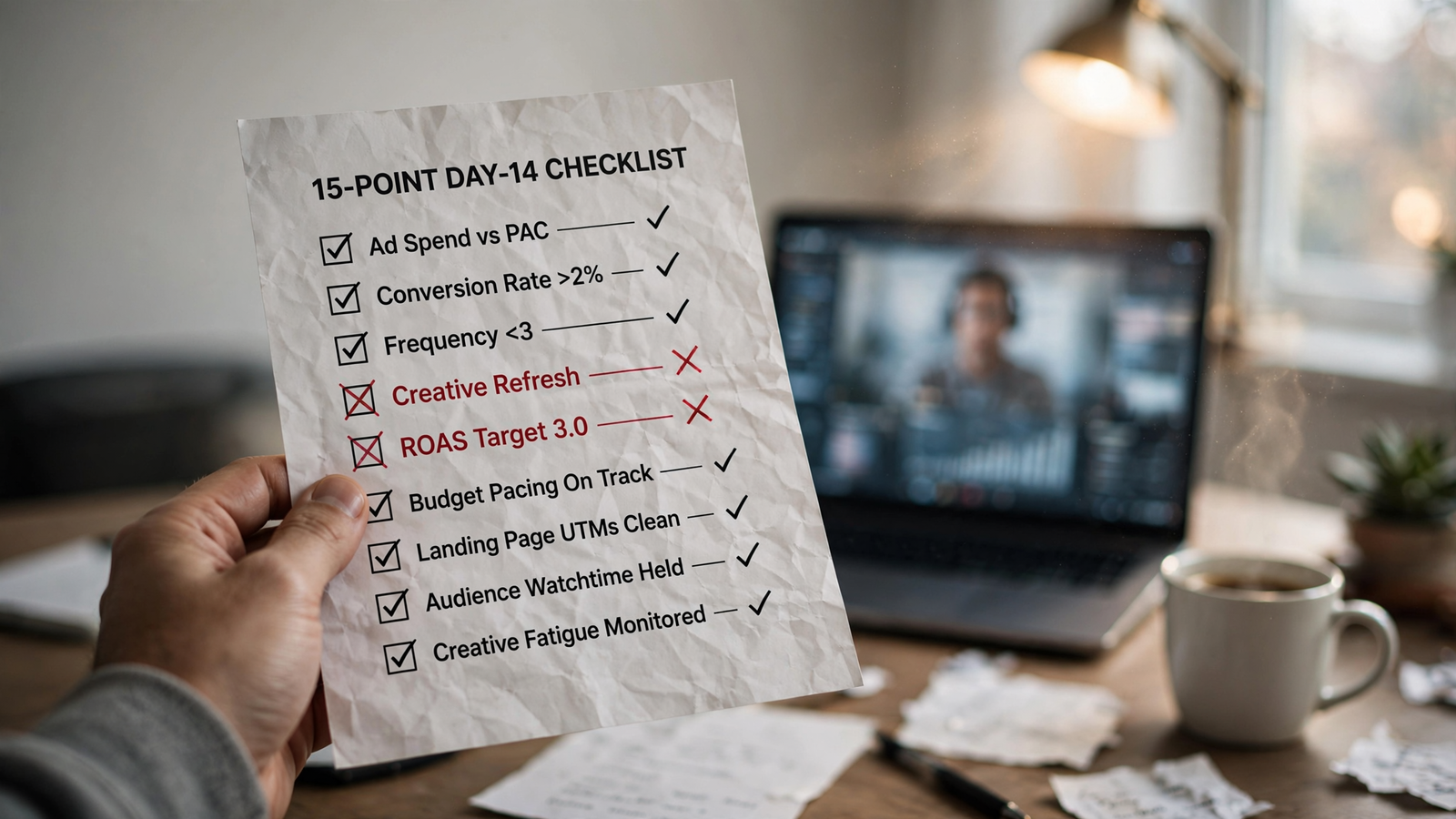
Share your screen and mark each item pass or fail in the account you own. Thirteen passes or more means someone is doing the work, provided ownership, measurement, and the change log are among the passes. At 11 or 12, name every miss and give the manager seven days to fix the tracking or logging problems in writing. At 10 or below, do not buy month two to be polite. Pause the ChatGPT campaigns in your account until ownership, measurement, and the log are fixed; leave tracking live so you keep the test-lead data. Remove their Admin access until those foundation items are resolved in writing. The request is concrete: send the event ID for one test conversion, the matched landing-page URL, and the last two change-log lines with reasons. A hands-on operator should already have those artifacts.
Use the same questions before you sign: will you own the advertiser account, will they send a test conversion before launch, and will you receive a weekly written log of what changed and why? Get the yes answers, budget cap, and named owner into the proposal. If the manager clears the checklist, bring it back at day 30. Look for the same comparison page, decisions tied to spend, and an explained CRM gap before anyone raises the cap. That is the work groas is built to show: Google Ads, Bing, and ChatGPT Ads together for a $1,499 flat monthly Search Ads fee, live in your accounts in under 24 hours after onboarding, month to month, with a named manager. As I argued in why your existing search manager may be better placed to run a ChatGPT ads test, one owner and one conversion definition make the comparison possible. Before you call the score final, check the item most likely to be waved through.
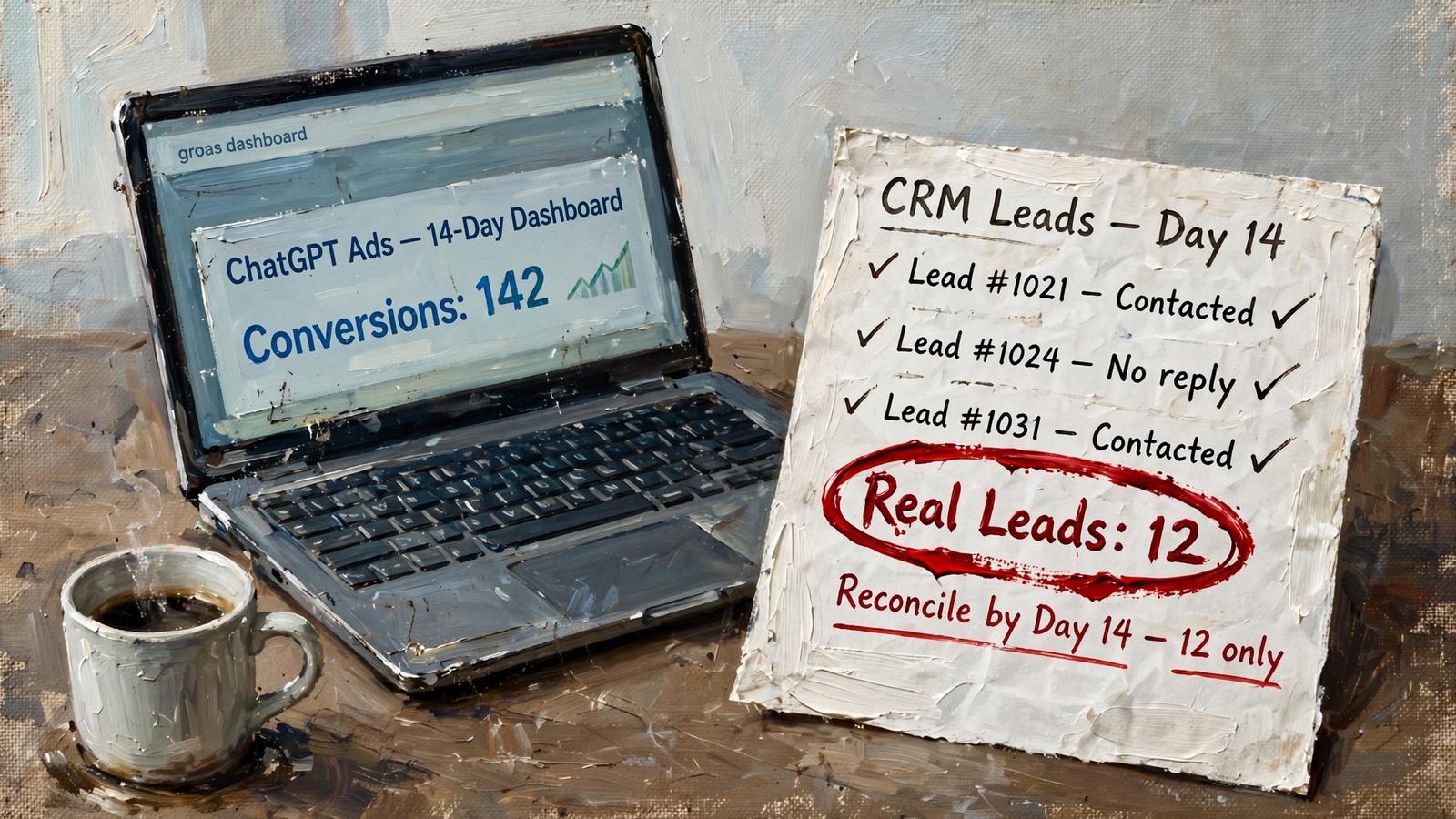
- Reported conversions reconcile with your CRM count. Pass: for the same dates, the Ads Manager total is within a gap your manager can explain against the CRM, line by line. OpenAI warns that totals may include modeled conversions and differ from analytics or CRM because of attribution windows, time zones, consent, and deduplication. A difference is not automatically an error. No reconciliation is. Managers like an Ads Manager total because it makes a neat report; your CRM tells you whether the reported actions became the leads or purchases you meant to count. Skip this check and you pay twice: you keep funding context hints and bids that may produce clicks without sales, then ask a bidder to learn from counts you have not verified. If your manager will not explain the gap by day 14, do not accept a screenshot as proof of work.


