

 LinkedIn

An SEO audit with 200 warnings is not a work plan. Until each warning has a page, a number, and a consequence attached, it is a spreadsheet waiting to be ignored.
By the end of this tutorial, you will have three to five fixes worth considering, each tied to a page, traffic evidence, and a plain-English explanation. You will also have a process for approving one change at a time and checking what happened afterward.
Before starting, have these ready:
- A Claude account.
- A groas account at $19 flat.
- Your website connected in groas, with its SEO audit findings and Search Console data available.
Do not start by pasting an audit PDF into Claude and asking what matters. Claude can interpret crawl exports, but the export alone does not establish current page status, rankings, or traffic. Connect it to groas over MCP first so it can read the findings next to your site’s numbers.
The distinction matters. I want an explanation of this site, not a convincing explanation of SEO in general.
Step 1: Connect groas and pull the actual findings
Connect the data before asking for a diagnosis. Otherwise, Claude can produce a perfectly readable answer to a question it does not have enough evidence to answer.
Open Claude and follow this path:
- Go to
Customize → Connectors. - Click
+ Add, thenAdd custom connector. - Name the connector
groas. - Paste the following connector URL:
https://mcp.groas.ai/mcp
- Leave the detected sign-in options as they are.
- Click
Add, thenConnect, and sign in.
groas documents the Claude connection here. Connect your website in groas once; that is the connection Claude will query throughout this tutorial. Claude’s custom connector instructions also cover the add path.
In a new chat, paste:
What websites and ad accounts can you see through groas? Show the available sources and dates for my website’s SEO audit findings and Search Console data. Do not make changes.
Then request the findings:
Pull the latest available SEO audit findings for my website through groas. Include the page URL, date, and source for each finding. Tell me which domain you used. Do not rank findings or make changes.
Expected result: Claude names your domain and returns findings with page URLs, dates, and sources. It shows what it can access, not a generic promise to help with SEO.
Mistake at this step: accepting a polished summary as proof that the connection works. If Claude cannot show the underlying findings, stop. A paragraph about duplicate titles is not evidence that it has read your titles.
Confirm the domain and available data before moving on. The wrong site can still produce a very confident answer.
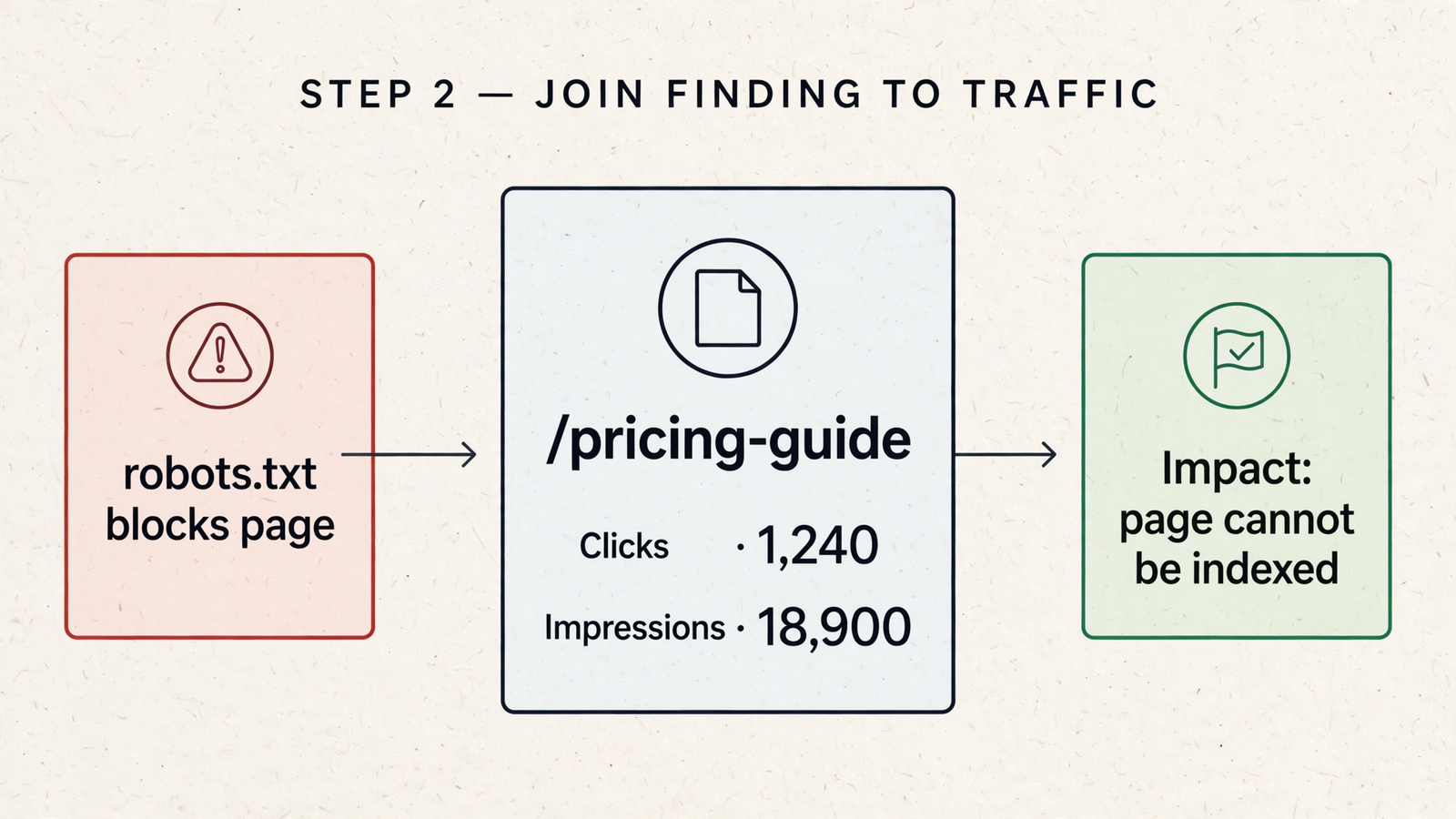
Step 2: Join every warning to page-level traffic
A warning on a page earning 12 impressions and the same warning on a page earning 18,900 impressions do not deserve an identical place in the queue. The technical label may match. The exposure does not.
Build the joined table before asking Claude to prioritize anything. This separates evidence gathering from judgment and makes missing data visible.
In the same chat, paste:
Join every audit finding to Search Console data: clicks, impressions, CTR, and average position for the last 90 days, plus the previous 90 days for comparison.

For each finding, show the page URL, audit date and source, both periods’ metrics, and the change in clicks and impressions.

Keep findings with missing Search Console data in the table, but label their traffic impact unproven. Do not substitute zero for missing data.

Do not rank anything yet. Do not explain anything yet. Show the joined table. Do not make changes.
Expected result: each finding has a URL beside its available traffic numbers. Missing data is marked as missing, not quietly converted into “this page gets no traffic.”
A missing traffic number does not make a crawl or indexing problem imaginary. It means the table does not yet establish its traffic impact. Keep that distinction intact; it matters when sorting blockers later.
Mistake at this step: letting Claude join and rank in the same breath. It can reach for the crawler’s “critical” label and smuggle the health score back into the decision.
There is good reason not to inherit those labels unquestioningly. One hand-check of 534 audit claims across 123 sites found 29 wrong claims and another 40 that described intentional setups. The same study found top-three sites averaging an audit score of 46.8, versus 46.1 for positions six through ten.
The score did not explain who ranked. Start with the warning, then inspect the page and its numbers.
Step 3: Make Claude explain the consequence, not the terminology
Now ask Claude to translate. Not to forecast a traffic windfall. Not to turn “duplicate metadata” into “suboptimal metadata architecture.” Plain English.
A usable finding needs six parts: evidence, a consequence, a specific fix, an owner, a reason for its priority, and a recheck date. Make the explanation specific enough that someone can approve or reject the work.
Paste:
For each joined finding, provide:

1. Evidence: page URL, date, and source.
2. One plain sentence explaining what this issue does to this page, in words a non-SEO could repeat.
3. The specific proposed fix.
4. The client-side owner, or “owner to confirm” if unknown.
5. A priority reason tied to the available page evidence, clicks, and impressions. Do not rank the full list yet.
6. What to recheck afterward and a proposed recheck date.

Separate observed facts from possible consequences. Do not invent lost clicks or promise a ranking increase.

No health score. No “high/medium/low” without a reason. Do not make changes.
Expected result: each row describes a consequence rather than repeating a label. For example, a confirmed robots.txt block becomes “this rule prevents the crawler from accessing this pricing page,” not “this impacts SEO performance.”
The first sentence explains a mechanism. The second could describe almost any warning on almost any site. That makes it useless for deciding what to do next.
Mistake at this step: treating a plausible consequence as an observed loss. A crawl block is evidence of a crawl block. It is not, by itself, a calculation of how many clicks disappeared because of it.
Reject explanations that skip that distinction. Ask Claude to say what it knows, what it suspects, and what the proposed fix changes.

Step 4: Cut the list to the few fixes that matter
This is where the audit finally gets small. Sort by the page-level consequence, not the warning’s color.
Use three questions that reflect business-impact prioritization:
- Does the issue block crawling or indexing?
- Does it affect pages that already earn clicks or impressions?
- Is traffic on those pages falling?
Those questions establish a working order, not proof of causation. A falling page deserves investigation; the chart alone does not prove which warning caused the fall.
Paste:
Sort the joined findings into a working priority order using these tests:

1. Does the issue block crawling or indexing?
2. Does it affect pages with clicks or impressions in the last 90 days?
3. Is traffic on those pages falling versus the previous 90 days?

Keep no more than 5 findings. Keep fewer if the evidence supports fewer.

For each, show the page URL, supporting numbers, plain-English consequence, and effort as small, medium, or large.

Move findings with fewer than 100 impressions to a watch list unless they block crawling or indexing. Treat this as a working filter, not a universal SEO rule.

If the change is under 20 clicks, label it too small to call a trend for this exercise. Do not present a larger change as statistically significant without a test.

State where the evidence is incomplete. Do not make changes.
Expected result: three to five useful rows, or fewer when the evidence is thin. Each has a page, supporting numbers where available, a consequence, and an effort tag. Everything else moves to a watch list rather than disappearing.
Mistake at this step: calling a 40% drop on 12 impressions a trend. Percentages make tiny samples look important. They do not make them informative.
One Search Console MCP approach compares striking-distance keywords with the site’s own CTR curve and runs a significance test. Borrow the discipline: show the underlying numbers and distinguish a sorting heuristic from a statistical result.
Do not manufacture five priorities to fill five rows. A short list earns its length.
Check the evidence before approving anything
Claude can acknowledge a data gap and then write a recommendation as though the gap does not exist. Read its evidence list, not just its explanation.
In one published test using a 136-page Screaming Frog export, Claude recorded that it lacked Search Console and CrUX field data, then contradicted those limitations in its recommendations. The write-up describes the failure to watch for: an honest admission in one place, ignored in another.
Before approving the shortlist, paste:
For every shortlisted finding, list the evidence you used: page URL, date, and source. Then list what you did not have.

If a claim about traffic impact has no Search Console evidence behind it, label that impact unproven. Keep independently evidenced crawl or indexing blockers separate from traffic claims.

Flag any Core Web Vitals claim without field data and any ranking-trend claim without position history. Do not present either as established by this table.

Do not make changes.
Expected result: an evidence check that makes unsupported conclusions easy to spot. If a row cannot support its claimed consequence, return it to investigation or the watch list.
Mistake at this checkpoint: approving a recommendation because its explanation sounds more precise than the evidence underneath it. A page, a date, and a source are the minimum. Fluent prose is not the fourth source.
Step 5: Approve one change, then inspect the log
Keep execution separate from diagnosis. A sensible shortlist is not permission to change everything on it.
Tell Claude the rule before it touches anything:
Read-only until I approve each fix in words.

Propose the first fix through groas. Show the page URL, exactly what will change, the reason, and what we will recheck afterward.

If the required change is not available through this connection, say so and identify the handoff. Do not substitute a different change. Do not execute yet.
Inspect the proposal. If it matches the approved scope, paste:
Approved. Make only this one proposed change through groas. Show me the log entry, including what changed and why, and how to undo it. Make no other changes.
Expected result: the approved change lands on the specified page, with a groas log entry recording the change and its reason. Confirm the one-step undo option before moving to the next row. That record is the difference between advice and accountable execution.
The groas connection brings findings and execution into the same workflow. The useful part is not skipping approval. It is avoiding another handoff between a report that explains the problem and the system that makes the change.
Mistake at this step: asking Claude to “audit and fix everything” in one pass. That bundles data collection, diagnosis, approval, and execution into one instruction. When something looks wrong afterward, there is no clean decision boundary to inspect.
Keep the unit of work boring: one approved change, one log entry, one recheck date. Then the next row.
Prompts to reuse next month
Once the connection works, reuse the sequence rather than asking for a fresh general audit. Paste one prompt, let Claude finish, inspect the result, then send the next.
1. PULL: List open SEO audit findings for [domain] through groas. Include page URL, date, and source. Do not make changes.

2. JOIN: Join each finding to Search Console for the last 90 days versus the prior 90 days: clicks, impressions, CTR, and average position. Show one table. Mark missing data. Do not rank yet.

3. TRANSLATE: Explain each finding’s page-level consequence in one plain sentence. Separate evidence from possible impact. Give the specific fix, owner or owner to confirm, and recheck date. No health score.

4. SORT: Keep up to 5 findings using crawl or indexing blockers first, then existing traffic exposure, then falling traffic. Show the supporting numbers and effort. Move the rest to a watch list. Do not make changes.
For more tasks after this workflow is established, the 15 SEO prompts for an assistant connected to search data pick up where these stop.
Verify the change, then change the habit
The workflow is complete when the shortlist is actionable and the first change is traceable. Check that you have:
- Three to five evidence-backed priorities, or fewer if fewer are justified.
- A page, supporting numbers where available, and a consequence for each.
- Missing evidence clearly labeled.
- One approved change with a groas log entry you can undo.
- A recheck date and a clear statement of what to inspect.
Recheck the changed page in 14 to 30 days, using the same Search Console comparison approach. Check the specific issue as well as the traffic; a completed fix and a traffic increase are not the same result.
The first thing to change once this works is the habit that created the unread audit. Stop exporting new warning lists. Rerun the same join monthly, starting from traffic rather than severity.
That is the audit order I trust: not the loudest warning, but a page, a number, and a consequence.


