

 LinkedIn

I keep this PPC audit in minutes, not hours: Claude reads each client’s Google, Microsoft and Meta accounts through groas, follows the same checklist, and drafts findings for a senior to sign off. The constraint is a short, decision-ready audit, not a miniature consulting engagement wearing a PDF.
I used to do these by hand, exporting search terms at 1am and paging through change history while the meter ran. A standard agency audit can still consume 5–7 hours of specialist time, with the deliverable arriving days later. That math is why agencies ration audits to onboarding and quarterly reviews.
The work itself is not mysterious: access, measurement, then spend. The hours disappear into repeating the checks across accounts. This minutes-only audit cuts that repetition, not the judgment. The timeboxes below cover the first pass, review and handoff. A broken tracking implementation does not magically become a three-minute repair because Claude found it.
1. Connect the client once: 4 minutes buys access without the export routine
Plug Claude into groas over MCP, then connect the client’s Google, Microsoft and Meta accounts with OAuth. groas Unlimited costs $19 flat a month for unlimited teammates, ad accounts and websites. Client eleven costs the same as client one.
Budget about a minute to add the connector in Claude, plus three minutes per client for sign-in and naming. This is setup time, not a ritual to repeat before every audit. What it buys is a connected workflow for reading account data without CSV exports or shared passwords passed around Slack.

Start read-first. An audit does not need permission to spend money. Set the available connector permissions before running anything, block tools the audit does not need, and require approval for writes. For prospect work, use read-only account access as well.
What gets cut: separate exports, repeated account switching and a fresh integration project for every client. The point of groas here is the shared connection layer. Claude does the reading through it; I keep control of what happens next.
Before moving on, I ask Claude to identify the client and connected accounts. If access is missing, that is an access problem to resolve, not an invitation to produce a confident audit of half an account.
2. Set the client’s boundaries: 2 minutes buys a workflow worth delegating
I write the client rules before asking for recommendations. Otherwise, a junior can run a technically correct audit that produces a commercially useless fix list.
The rules need boundaries, not aspirations:
- Do not raise daily budgets above $800.
- Do not touch brand campaigns.
- Do not pause anything with ROAS above 4.0 without asking.
- Draft changes; apply nothing until approved.
Those are example limits, not defaults for every client. I put the actual client’s limits into the audit instructions, then use them when reviewing the recommendations. When automation is on, goals, budgets and rules steer its work; for this audit, autopilot stays off.
A written rule guides the work. Approval still controls the change. I do not treat a sentence in a chat as a substitute for access controls or senior review.
What gets cut: vague instructions such as “be conservative” and “protect performance.” They sound responsible and leave every important decision unresolved. If a budget rule cannot be written as a number and a boundary, it is a vibe.
3. Audit Google first: 6 minutes buys a money-ranked fix list
I start with this prompt, swapping in the client’s name:
Through groas, audit client X’s Google Ads: tracking, wasted search terms, match types, bidding, ad strength. Rank findings by money at stake. Separate observed problems from recommendations, and identify anything you cannot verify.
The order matters. Smart Bidding learns from reported conversions. If tracking counts pageviews as purchases, the tCPA that looks efficient is buying the wrong action cheaply. One agency checklist puts 13 of its 41 checks on conversion tracking first for the same reason.

I ask Claude to use a severity scale: P0 for a wrong conversion signal, down to P3 for naming cleanup that can wait. The labels matter less than the order. A broken measurement signal goes ahead of cosmetic account hygiene, even when its dollar impact is harder to calculate.
Then I ask for spend beside the waste findings:
- Search terms that consumed spend in the last 30 days without the intended result.
- Outside-area clicks.
- Search Partners or Display expansion settings that need review.
- App placements and overnight spend that warrant a closer look.
Those are review candidates, not automatic guilty verdicts. A setting being enabled is not proof that it wastes money. I want the account evidence, the spend involved and the proposed action on the same line.
For more detail, I use the six-test Google Ads suite. What gets cut here is the generic score out of 100. A score does not tell me which decision to make on Monday. A ranked finding can.
4. Audit Meta separately: 5 minutes buys a defensible fatigue call
In the same chat, I run the next prompt:
Now audit the client’s Meta account: measurement first, then structure and learning, creative fatigue, audience overlap and waste. For each finding, give the ad or ad set, dates, spend and supporting metrics. Flag anything you cannot verify.
Meta needs its own checklist. I start with Event Match Quality and Conversions API coverage, then move through structure, creative and waste, following the sequence in this 12-point Meta checklist.
Frequency alone is not a fatigue diagnosis. I want it alongside the direction of CTR and CPM, with the dates attached. Overlap also needs evidence, not an assumption that similar audiences must be competing wastefully.
An illustrative finding might read: $4,200 spent in 21 days, frequency 4.1, CTR down 32% and CPM up 41%. That gives me something concrete to review. “Creative looks tired” gives me a meeting.
I use the six Meta checks and approval flow when I need the fuller version. Within this timebox, I want the strongest fatigue candidates and the evidence behind them, not screenshots of every ad set.
What gets cut: the 30-tab audit sheet and a tour of every creative. If frequency is high while CTR holds, I do not call fatigue on frequency alone. If CTR falls as CPM climbs, I investigate the creative before signing off on a pause.
5. Check Microsoft against Google: 2 minutes buys an import sanity check
I run the Google prompt against the Microsoft account through groas, keeping the same measurement-first order. Then I compare the findings with what Google has already shown.
The useful questions are specific:
- Are imported negatives blocking the volume available here?
- Do copied schedules make sense for this account’s results?
- Did tracking survive the move?
- Which imported campaigns spend without converting?
I import the lesson, not the structure. A Google setup is a starting point, not proof that the same choices belong in Microsoft.
For an account spending under $1,000 a month, I keep this pass narrow: check tracking, review the two biggest Google winners, and identify obvious imports that spend without converting. I do not use a small account as an excuse to manufacture a separate strategy deck.
What gets cut: giving Microsoft a full audit presentation simply because it has its own login. The two-minute pass is triage. If it uncovers a measurement problem or a meaningful spending decision, I flag that for deeper work rather than pretending the clock makes it resolved.
6. Review and approve: 3 minutes buys a decision, not automatic agreement
Now I tell Claude:
Draft every proposed change with its reason. Apply nothing until I approve it. Put tracking problems first, then the biggest supported waste findings. Keep deferred items separate.
This is where the senior earns the sign-off. Claude reads what the account reports, and the account reports what tracking was told to count. The human checks whether the thing counted is the thing the client gets paid for. Free-trial starts and closed revenue are not interchangeable because both appear in a conversion column.
The same applies to apparent waste. A strange search term can be a customer describing a new use case. A campaign stuck in learning can need attention without needing the first fix suggested. A client’s pricing change or category margin can change the decision entirely: at a 22% margin, a 400% ROAS target loses money before other costs.
I use this review to make three decisions:
- Approve supported changes within the client’s rules.
- Defer low-value cleanup.
- Assign anything that needs more investigation or implementation.
When I approve a change through groas, it is logged with its reason and can be undone in one step. Autopilot remains off unless I switch it on. Approval of an audit finding is not permission for an agent to keep improvising overnight.

What gets cut: the email chain that repeats the finding without making a decision. Claude drafts the plain-English reason beside the action. I sign off, reject it or send it for investigation. If I cannot verify a proposed fix inside the review window, it does not ship just to protect the timebox.
7. For a prospect, use the shorter branch: 10 minutes buys a pitch with evidence
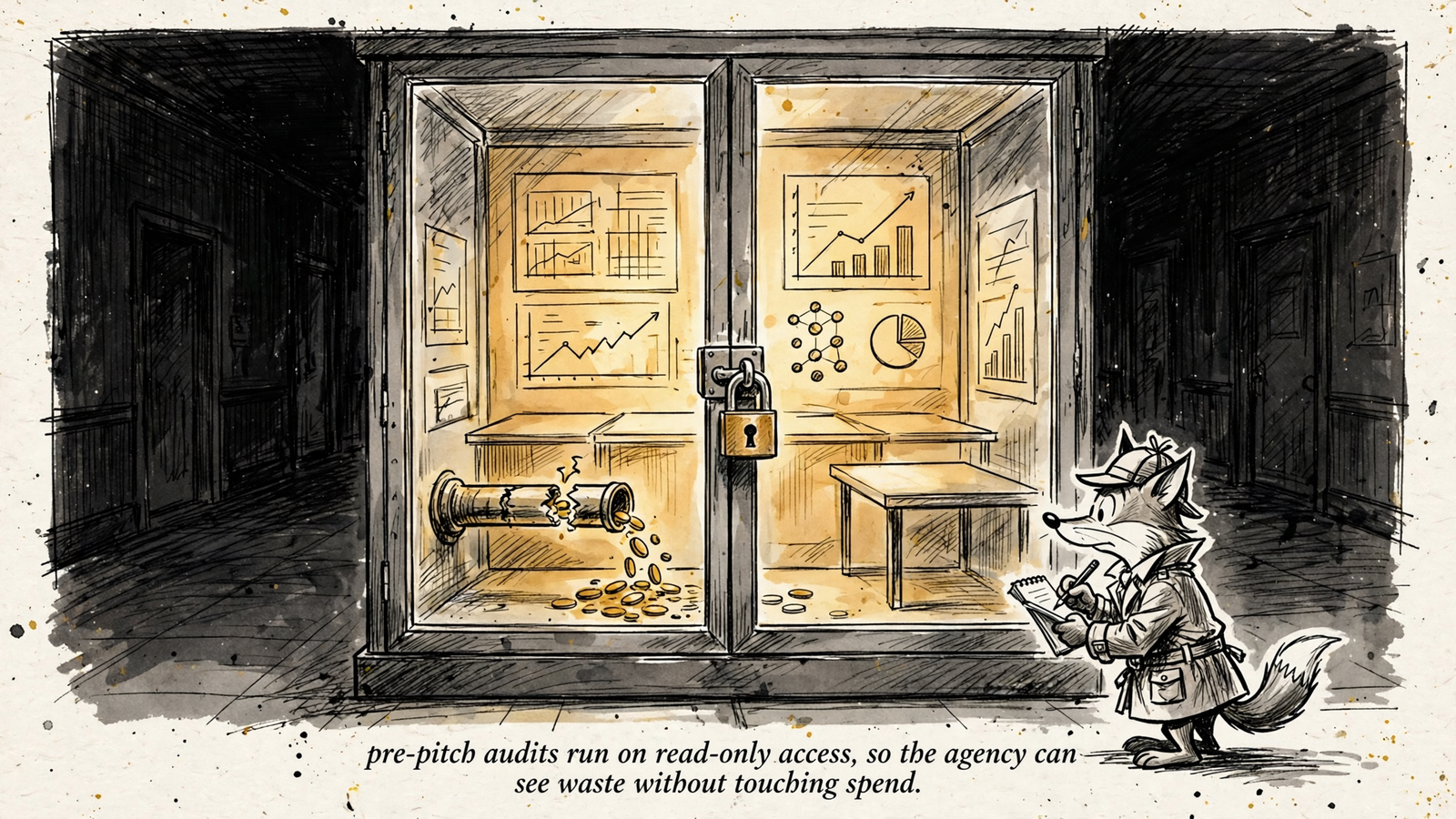
This step replaces the full client workflow for a pre-pitch audit; it is not another ten minutes added to every client run. I ask the prospect for read-only access, keep the relevant Google, Meta and Microsoft checks, and stop at findings. No approvals to execute. No changes.
Read-only access already powers the free audit market. One vendor asks prospects to add a read-only user and explicitly explains that this permits viewing reports and settings, but not editing campaigns, billing or users.
That is the boundary I want for a pitch. I can inspect the account without asking a prospect to let me operate it before we have agreed to work together.
The deliverable is five supported findings, not 60 checkboxes. I use the 10-minute pre-pitch version to keep that scope tight. Each finding needs the account evidence, spend involved and a plain-English explanation of why it deserves attention.
What gets cut: the five-day PDF and the generic grader score. If the account shows $3,800 a month going to search terms the prospect would never knowingly bid on, that is a useful conversation. I do not need to decorate it with a score out of 100. I do need to confirm that those terms are genuinely irrelevant before calling the spend wasted.
8. Ship one useful page: 5 minutes buys a deliverable the client can read
I ask Claude to turn the reviewed list into a client page with three columns:
| Finding | Money at stake | Decision and next action |
|---|---|---|
| What the account shows, in plain English | Observed spend or supported monthly cost | Approved, deferred or needs investigation |
Below it, I want a short note on what changed and what we watch next. For a prospect, nothing changed, and the page should say so. For an existing client, proposed work must not quietly become completed work in the rewrite.
The report must preserve the status of every finding. “We found,” “we recommend” and “we changed” mean different things. Fluent prose is not permission to blur them.
What gets cut: screenshots, an appendix of definitions and the design bill. I want a page the client can read in 90 seconds and forward to a boss who never logs into Ads. If it needs a walkthrough call to make sense, Claude wrote it for me rather than for them. I ask for shorter sentences and clearer numbers.
When the minutes constraint lifts, I do not spend the recovered hours expanding the audit. I spend them on the work the audit points to: checking the tracking implementation, rewriting the offer on a landing page flagged for low conversion rate, or shooting a new Meta angle to replace creative whose fatigue is supported by dates and spend.
That is the trade: minutes for the repeatable checklist, hours for the work a strategist needs to own. Start the next client the same way. Connect once, set the boundaries, run the same checks, and approve from the top down.


