

 LinkedIn

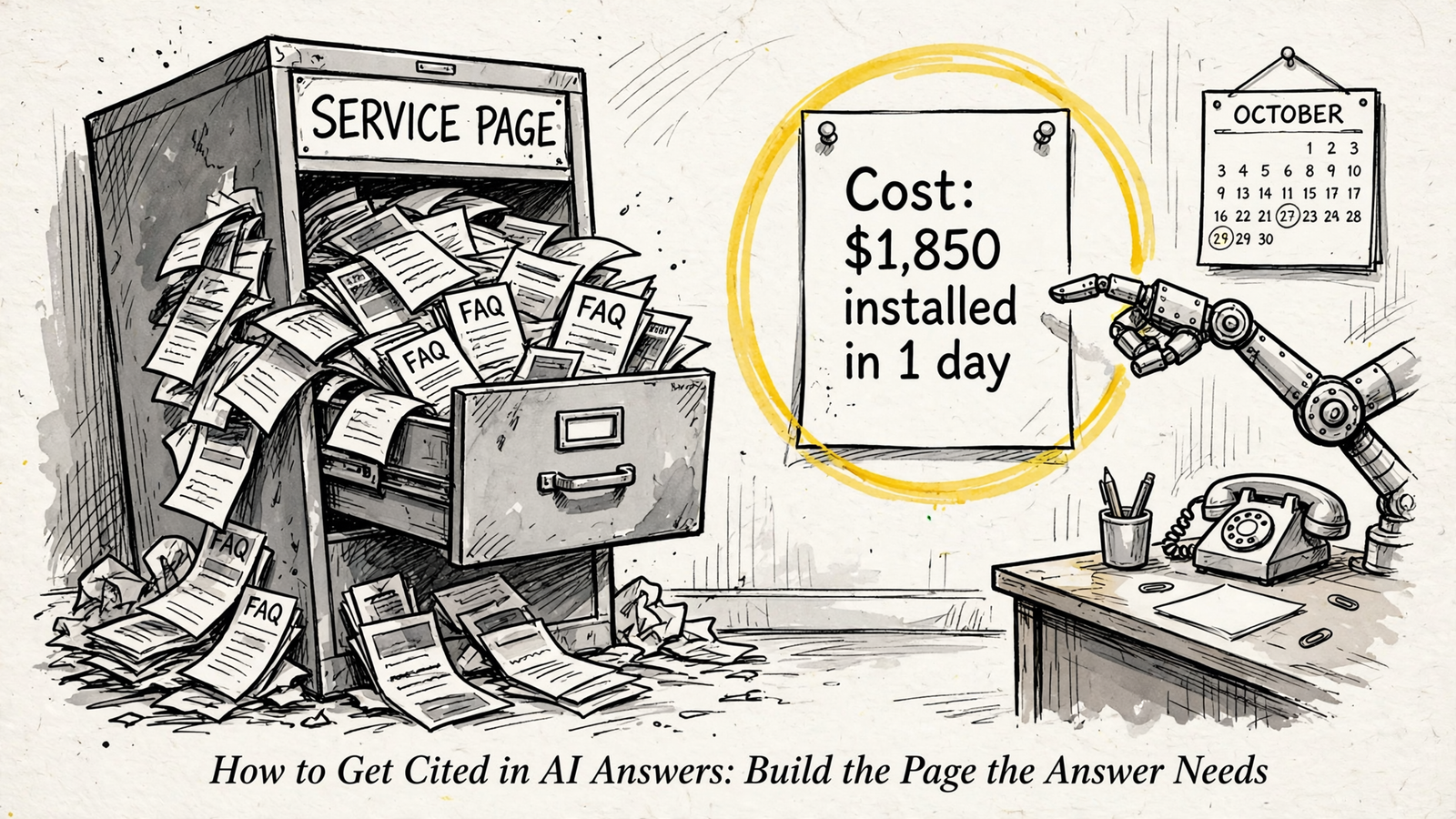
Getting cited in AI answers starts with a page worth quoting, not another FAQ block on your service page. Most businesses reverse that order: schema first, specific answers never.
I used to tell clients that kind of polish mattered. I was wrong about where to start.
The better starting point is a narrow page that answers one buyer question with facts an engine can lift directly: a price, a timeline, a named comparison, a yes or no with conditions. Build the answer page first. Add markup later. A prettier service page is not the same thing as a more useful source.
Why isn’t my service page getting cited?
An AI answer needs passages it can use, not pages it admires. Google says a page must be indexed and eligible to show with a snippet to support an AI Overview. Eligibility gets the page into consideration. It does not give the engine anything worth quoting.
A broad service page often covers everything without settling anything. It says the business handles drain repair, water heaters and remodels. A buyer asks what replacement costs, how long it takes or when repair stops making sense. Those are different jobs.
Two groas pages recorded 905 live-answer fetches in 30 days, with activity clustering on narrow posts naming a price, a term or a comparison rather than broad service pages. That supports the case for building specific answer pages first.
It does not mean 905 recommendations. A fetch shows that a system retrieved a page, not that it cited the page or recommended the business.
My working rule: one buyer question per page, with the useful facts in the first screen. Give the engine a sentence worth quoting before worrying about how that sentence is marked up.
How do the three engines choose sources?
The engines do not share one source list. I keep their differences in mind without turning each one into a separate publishing strategy.
What matters in Google AI Overviews?
Google starts from its search index, fans a query out into related subqueries and pulls material to build the answer. It typically cites 3 to 8 sources. A May 2026 audit of 55,393 queries found nearly 30% of cited domains absent from the conventional first page.
That is why conventional rank tracking gives an incomplete picture here. A narrow page can supply the exact passage an answer needs even when its domain is absent from the first page. Track the citation, not just the organic position.
What matters in ChatGPT?
ChatGPT draws on training data, live web search, licensed content and user context. Not every answer involves a live search, so publishing a page does not mean every relevant conversation will retrieve it.
The cited research found that pages used as sources matched the query title more closely and ran about 458 days newer than the average Google organic result, with only around 8% overlap with Bing or Google’s top 10.
My takeaway is practical: make the title match the buyer’s question and keep the answer current. A date stamp cannot rescue stale facts.
What matters in Perplexity?
Perplexity searches the web for questions and writes answers with numbered citations, drawing on varied sources. The same prompt can cite different pages from day to day. Reddit, YouTube and G2 can appear where a conventional Google result shows service sites.
Check the sources for the actual prompt before choosing where to spend effort. For a fuller comparison, read where to work for citations first: ChatGPT, Perplexity or Google AI Overviews.
Step 1: Which buyer questions should I target?
I start with sales conversations, not keyword volume. The useful prompts are the questions buyers ask before signing:
- How much does X cost with installation?
- How long does Y take in this city?
- Is X or Y better for a house built in 1978?
- At what point does replacement make more sense than repair?
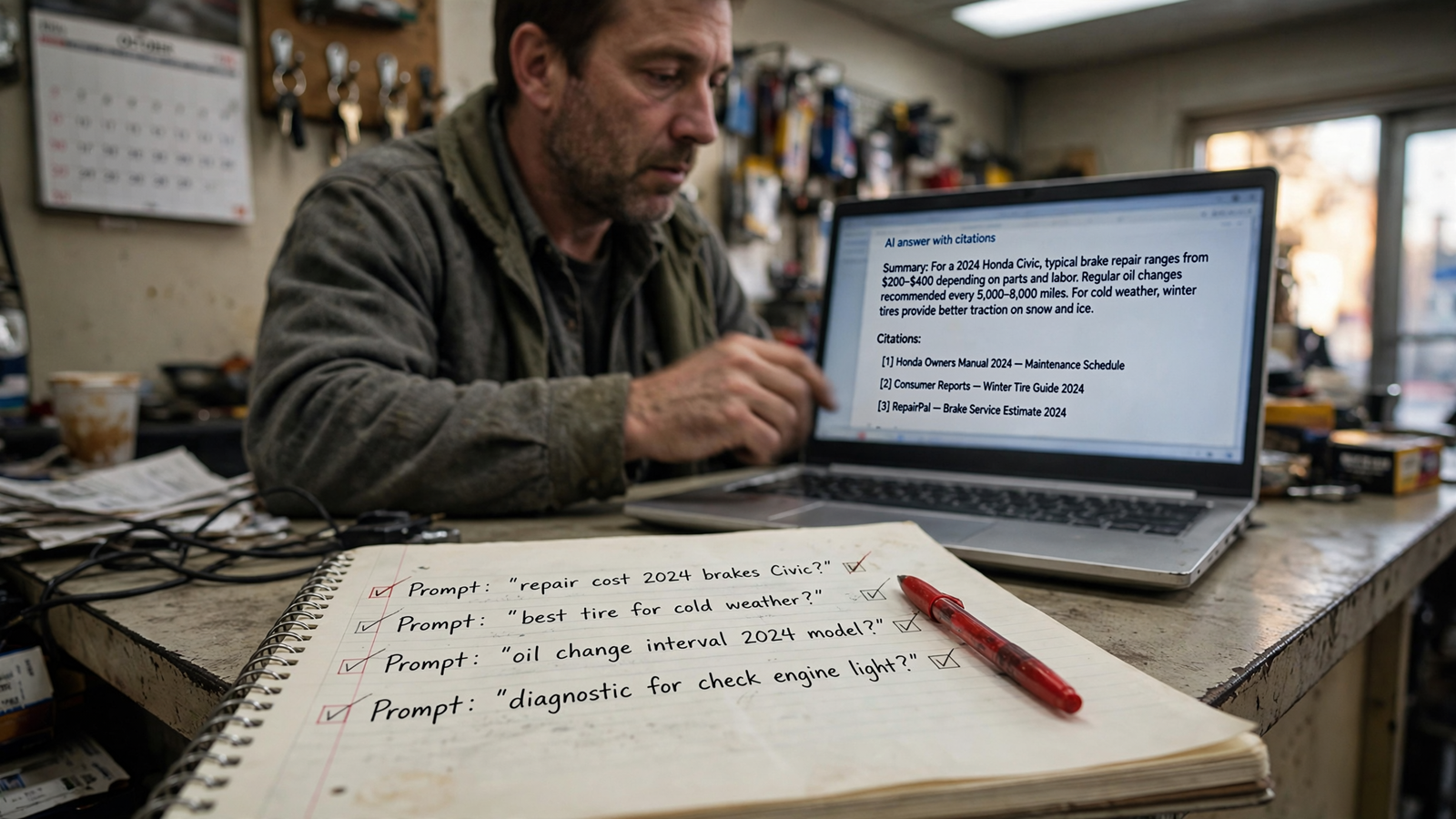
Review the last 20 sales calls and collect the wording buyers actually use. Build a target set of 20 to 50 prompts, then run them through ChatGPT, Perplexity and Google AI Overviews. Record who gets named and which URLs get cited. If a prompt does not produce an Overview, record that too.
Then cut the list to what is worth pursuing this quarter. I skip prompts whose answers belong to regulators, manufacturer specifications or review aggregators. I keep questions where a business can supply a specific, checkable fact: price with conditions, timeline with conditions, repair versus replacement with a named threshold.
Ten prompts with buyer intent beat 200 keywords with traffic. Pick the questions the business can answer better, not merely the ones it wants to appear for.
Step 2: What should the answer page contain?
For this job, I give each page one buyer question. Not a service-page appendix. A page built around the answer.
Say the business is a plumber in Austin. The title might be How much does water heater replacement cost in Austin in 2026? The opening should answer that question, not spend 200 words explaining the importance of hot water.
An illustrative first sentence might read:
Replacement runs $1,850 to $3,200 installed; most 50-gallon gas jobs finish in one day.
Those are example figures, not a price recommendation. The published page needs the business’s own prices, scope and timelines. Invented specificity is still invented.
I build the page in this order:
- Answer the question immediately. Put the answer in plain HTML with a visible updated date.
- State the conditions. Explain what the price includes, what changes it and when the timeline applies.
- Make the comparison concrete. If the question is repair versus replacement, give the threshold and explain its limits.
- Close with the next step. Add a short conditions list and a call to book.
Keep essential numbers out of images and avoid making the answer depend on an accordion or client-side JavaScript. The useful passage should make sense on its own.
Research linking title and paragraph relevance with citation likelihood supports this emphasis on matching the question. It does not turn a page template into a citation guarantee.
Facts first. Markup later. The page needs an answer before it needs another implementation ticket.
Step 3: Can the bots actually read the page?
I check access before treating a missing citation as a writing problem. Start with robots.txt, then work through the delivery path:
- Review rules affecting search and user-requested retrieval, including
OAI-SearchBot,ChatGPT-User,PerplexityBotandPerplexity-User. - Treat training access as a separate decision. Blocking
GPTBotdoes not remove a site from ChatGPT search. - Check that the page returns a
200response to the relevant requests. - Confirm that the answer text appears in the delivered HTML rather than depending on client-side rendering.
- Put the URL in the sitemap and check Cloudflare or other WAF rules for accidental blocks.
A page the system cannot retrieve cannot supply the live answer. Fix the plumbing before rewriting the headline for the sixth time.
I also verify apparent bot traffic. A user-agent string alone is not proof: spoofed bots can wear the same name. Check request identity and infrastructure blocks before counting hits as genuine AI retrievals.
Look for verified requests reaching the new answer pages, not just homepage crawling. For the longer walkthrough, use Can AI Bots Read Your Site? A 60-Minute Plumbing Check.
Step 4: What needs to match off-site?
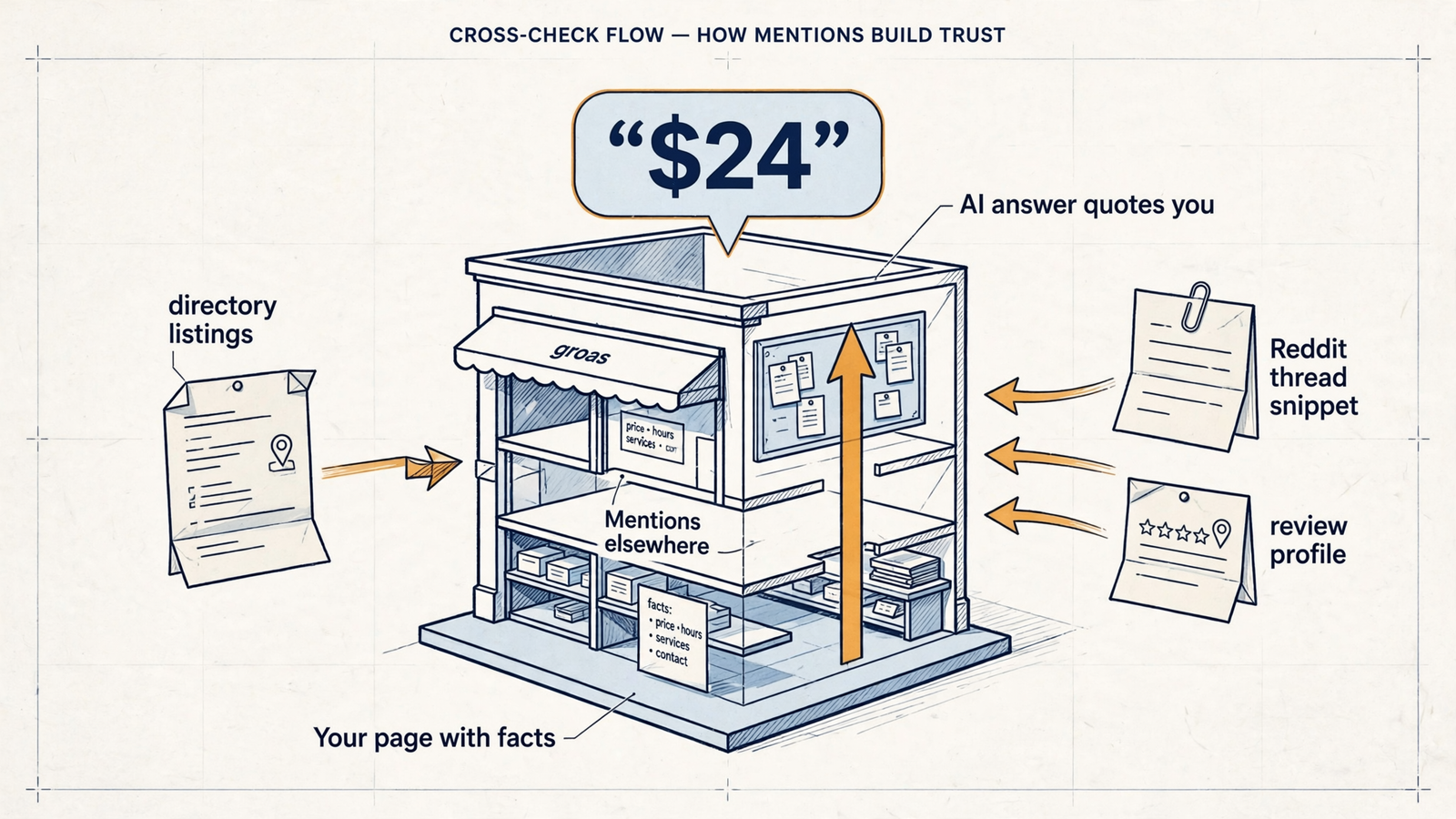
The answer page is not the whole source environment. If the website lists one service area and the business profiles list another, the facts disagree before the engine even gets to the price.
Research reports a stronger correlation between citations and brand web mentions than backlinks. That is not proof that adding mentions causes citations. It is a reason not to reduce this work to link counts.
I start boring on purpose:
- Fix the business name, address and phone number across profiles.
- Align hours and service areas.
- Use consistent service terms on the answer page and relevant profiles.
- Look for useful participation where the target prompt already draws sources.
A March 2026 US study of Perplexity citations highlights Reddit, YouTube and G2, while company sites feature in brand questions. That is a source map, not an instruction to scatter promotional comments across all three.
Make the facts consistent before chasing more mentions. One detailed, honest contribution where buyers already look is a better use of effort than another pile of directory submissions.
Step 5: How do I know whether it worked?
I do not buy a visibility score and call it proof. The source list changes too much for one screenshot to settle anything. In the cited research, only about 25% of pages cited one day appeared again the next day for the same prompt.
I keep three things separate:
- Fetch: the system retrieved the page.
- Citation: the answer displayed the page as a source.
- Brand mention: the answer named the business, with or without a citation.
None of those alone proves revenue. They answer different questions, and mixing them makes a dashboard look better than the underlying result.
Build a prompt log with the 20 to 50 target questions. For each run, record the engine, date, cited URLs and brand mentions. Repeat across days. Compare that record with verified fetch logs to see whether the system is reaching the page and whether the page appears in the answer.
My working threshold is to look for the URL at least twice in a week before treating the citation as repeatable. That is an operating rule, not an engine rule.
Use fetches to diagnose access. Use repeated citations to assess visibility. Do not ask either one to prove a sale.
What should I skip until the answer pages exist?
Skip the schema-first retrofit. Across 1,885 pages, one study reported citation changes of minus 4.6% in Overviews, plus 2.4% in AI Mode and plus 2.2% in ChatGPT after adding JSON-LD. Those results do not make schema a convincing first move for this job.
The same research found no within-site citation lift from FAQ blocks and author boxes. It also reported little retrieval activity around llms.txt. I would not put any of those ahead of a missing answer page.
That does not mean every implementation task is worthless. It means the sequence is backwards when the business has immaculate markup and no clear answer to what installation costs.
Skip the work that decorates an absent answer. A vendor can invoice a schema project. That does not make it the bottleneck.
What should I do in the first 30 days?
The order matters. Prompts determine the pages. Pages give something specific to check in the fetch logs. Repeated answer checks show whether retrieval turns into citations.
- Days 1–7: establish the baseline. Lock 20 buyer prompts and check AI Overviews, ChatGPT and Perplexity. Record cited URLs and brand mentions. Pick 3 questions where the business has specific facts and the current answers leave a gap.
- Days 8–21: publish 3 answer pages. Give each one a question-led title, an immediate answer and the relevant prices, timelines or comparisons in plain HTML. Make the conditions explicit. Fix conflicting business details off-site.
- Days 22–30: check access and repeatability. Confirm verified fetches to the 3 URLs. Add an honest, useful off-site contribution where relevant. Rerun the prompt log twice. Investigate unfetched pages before assuming the copy failed.
Order is the strategy. Schema first and new pages never is not a publishing plan.
This will not work for every prompt. If the answer belongs to a regulator, a manufacturer specification sheet or a review aggregator, I do not fight it. I focus on the questions where the business’s price, timeline and street-level detail supply the missing fact.
I keep my prompt logs and fetch checks inside groas, because it brings rival ads, Reddit and AI answers into one place and lets my AI act on the data. I would rather do that than babysit five dashboards. The tool still comes after the question.
Today, pick the one question the sales team answers every week and ChatGPT answers without the business. Write the page the answer needs: question in the title, answer in sentence one, numbers with conditions below it, updated date on top. Publish it before buying anything. First page live beats perfect plan every time.


