

 LinkedIn

Three glowing ChatGPT screenshots are not a reason to hire an agency. To buy work you can judge, hire one coordinated implementation program and require separate visibility evidence for every engine, buyer question and observation date.
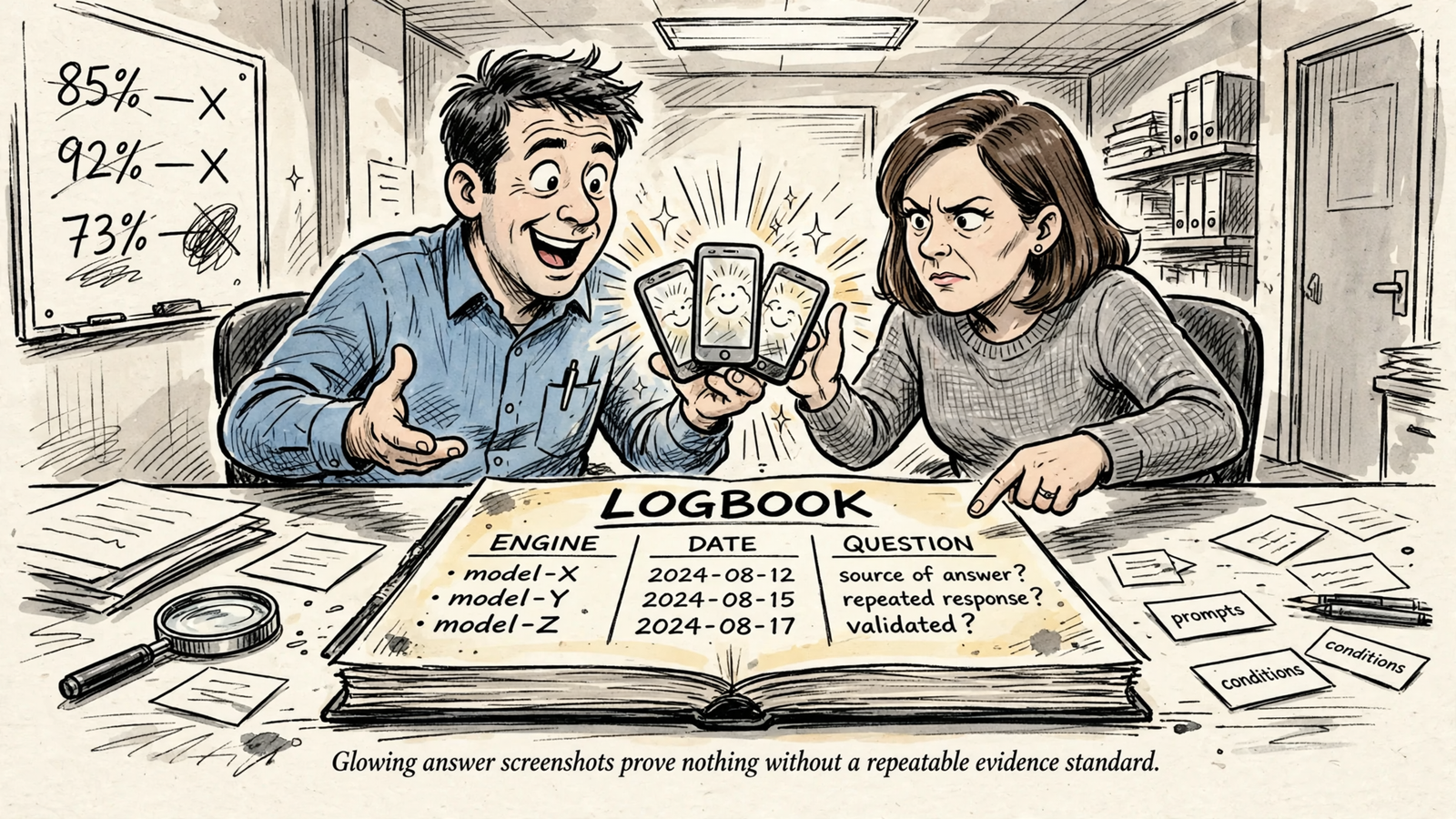
One answer on one day is not a ranking. It is a sample. Most pitches skip that distinction and go straight to the flattering screenshot.
My buying standard starts somewhere less photogenic: write the brief, freeze the questions, assign implementation and set the renewal test before signing. That lets one team coordinate the work across Google, ChatGPT, Gemini and Perplexity without hiding weak coverage inside a blended score. Skip the dashboard tour until those four pieces exist.
1. What should I put in the buying brief?
Write one page before asking for proposals. Otherwise, it is too easy to buy an agency’s process instead of the outcome the business needs.
Include:
- The commercial priorities: the 3 to 5 products or services that pay the bills.
- The market: the cities or regions the business actually serves.
- The buyer decisions: the 2 or 3 choices where visibility matters most.
- The business objective: qualified pipeline, for example, rather than raw leads.
- The coverage: preserve Google SEO while testing ChatGPT, Gemini and Perplexity against the same buyer questions.
Say the business spends $20k/month on search and needs qualified pipeline. Put that in the brief. Do not leave the agency to infer the commercial goal from a list of keywords.
The scope should describe one coordinated program, not three retainers fighting over the same pages.
The final line matters most: separate objectives the agency can work toward from placements nobody can guarantee. Answers change between runs, and the familiar search rule still applies: no one can guarantee a #1 ranking.
Demand agreed targets against a measured baseline, plus a written list of on-site and off-site work. A guaranteed ChatGPT citation or AI Overview placement belongs on the walk-away list, not the order form.
2. How do I build a baseline nobody can cherry-pick?
Freeze 20 to 40 buyer questions before an agency runs the report. Skip brand searches and synthetic prompts no buyer would type. Start with money questions: best, cost, near me, versus and how to choose.
Then build the baseline in order:
- Fix the question set. Save the exact wording, not just the topic.
- Set the conditions. Record location, login state and chat settings, keeping them consistent where available.
- Repeat the observations. Run each question 3 to 5 times per engine across multiple days.
- Save every answer. Use one row per run, with the engine, date, exact question and full observed answer.
- Report separate measures. Keep mentions, citations and recommendations distinct.
That repeat count is not administrative decoration. It stops one unusually favorable answer from becoming the entire sales story. A credible baseline names its engine panel, observation conditions and runs per question, with the raw log behind the reported shares.
I use the same structure in Build an AI Visibility Baseline: 40 Prompts, 4 Engines, 3 Runs Each: fixed panel, repeat runs, no cherry-picking.
A mention is not a citation, and neither is automatically a recommendation. The distinction matters across engines, too: the Wellows overlap study of 22.7 million citations found that 79.6% of cited websites appeared on only one of five engines. Evidence from one engine is not evidence of coverage everywhere.
Keep the question set stable and the engine results separate. Otherwise, the baseline cannot do its job.
3. Who actually publishes the pages and fixes the site?
Monitoring tells me what an answer said. Implementation changes what the next answer can use.
When comparing providers, I ignore the dashboard for ten minutes and ask who publishes buyer-focused pages, who fixes crawling and indexing, and who handles third-party mentions. If the proposal cannot name the pages, fixes and dates, it sells observation—not execution.
A published engagement breakdown describes the sequence: an audit of category queries and entities, page rewrites and crawler-access fixes, then sustained editorial and PR work. The useful part is the progression. Diagnosis has to become changes somebody ships.
Make the responsibilities explicit:
- Publishing: who writes and ships buyer pages, how many per month, and how approval time affects delivery.
- Technical work: who fixes crawling, indexing and site structure, with access and change records rather than a PDF of recommendations.
- Off-site work: who earns third-party citations and brand mentions, with the outlets and links listed.
- Ownership: who holds the accounts, approvals and completed-work records when the engagement ends.
That last point is where retainers quietly turn into hostages. Keep logins, analytics, Search Console and content in the business’s name from day one. I cover the ownership test in An AI Mention Isn’t a Recommendation: The Five-Minute Agency Checklist.
Ask equally blunt questions about off-site methods. The red-flag checklist calls out undisclosed Reddit seeding and paid links without appropriate sponsored or nofollow attributes. “Authority building” is not a sufficient answer to “What did you actually do?”
Ask for last month’s dated answer log and the third-party pages worked on. If producing either becomes a project in itself, do not mistake the reporting problem for a reporting delay.
4. What evidence should I require for each engine?
Do not accept a blended visibility score without its denominator. One percentage can mix brand searches, money questions and engines until nobody can tell what improved.
Suppose the panel contains 30 buyer questions, each run 3 times on ChatGPT, Gemini and Perplexity. That produces 270 observations: 90 per engine. The report should make those denominators visible, not bury them beneath an overall score.
For each engine and question set, require:
- Mention rate.
- Citation rate.
- The linked source pages, where present.
- Accuracy observations reported separately.
- Dates, run counts and the underlying row-per-run log.
That is the difference between a baseline and a sales chart. The evidence standard is straightforward: freeze the queries, name the engines, state the runs and report separate shares. Skip AI “rankings” built on brand-containing prompts that do not represent the buyer questions in the brief.
Keep answer observations separate from two other numbers agencies like to merge: crawler fetches and referral visits.
| Evidence | What it establishes | What it does not establish |
|---|---|---|
| Saved answer | What the engine returned in that run | A permanent ranking |
| Crawler fetch | A bot visited the site | A citation in an answer |
| Referral visit | Someone clicked through | Every instance of AI influence |
Traffic attribution has its own gaps. AI search measurement guidance describes referral-tagging limitations and the difficulty of separating Google AI search clicks from ordinary organic traffic. Those limits do not make the data useless. They make it a different kind of evidence.
I treat identifiable AI referral traffic as a floor, not a complete account of influence. I also watch Direct traffic on pages cited in AI answers, without treating a Direct visit as proof of AI attribution.
Require sampling limits in writing: how many runs, on which dates, under what conditions, and what changed between observations. Do not let a traffic chart stand in for the answer log.
5. How do I compare proposals without comparing different jobs?
Put every proposal into the same four columns: what ships, what the client does, what it costs and how the client leaves.
Start by separating software from execution. A tracking subscription reports answers. A managed program pays for work intended to change what those answers can use. A published cost comparison lists tracking subscriptions at $29 to $489 per month and agency retainers at $1,500 to $50,000-plus. Another pricing breakdown places many mid-market retainers around $3k to $8k.
Those ranges describe different scopes. Software can watch the same 20 to 40 prompts on a schedule; it does not, by that fact alone, publish pages, fix crawling or work third-party sources. Comparing the subscription price with the implementation fee is comparing a thermometer to a furnace.
Before comparing totals, fill in the scope:
| Proposal item | What I want in writing |
|---|---|
| Content | Pages published per month, not merely recommended |
| Technical work | Crawler and index fixes, with an implementation owner |
| Measurement | Engines covered, question count and repeat-run cadence |
| Client workload | Approvals, access requirements and expected hours |
| Commercial terms | Monthly fee, extras, ownership and cancellation |
This is where I place groas against the field. Its $1,499 managed service buys implementation rather than another recommendation queue: Google SEO plus ChatGPT, Gemini and Perplexity measurement in one program, with buyer pages shipped, technical fixes applied, citations worked and answers re-observed per engine. That fee sits below the published $3k to $8k mid-market cluster.
What it does not buy is a guaranteed citation or recommendation. Nobody can sell that honestly.
Read the coverage line items carefully. One engine-pricing example ranges from S$580 per month for one platform to S$2,890 for three, with prompt blocks and retest cadence potentially billed separately. A promise to “cover AI search” is not a measurement scope.
If a cheaper bid includes monitoring and a PDF, it leaves implementation on the client’s desk. If a $5k proposal still cannot name who publishes, the larger fee has not answered the important question. The $1,499 execution program is the stronger buy when the requirement is shipped work under one coordinated scope.
Compare deliverables and remaining workload before comparing retainers.
6. What has to happen before I renew?
Decide what earns month four before signing for month one. I use two scorecards that never merge.
Scorecard one is implementation: pages live on the site, crawler and index fixes that can be verified, and third-party citations with URLs that open.
Scorecard two is visibility movement: the frozen question set, re-run under the same conditions and reported separately for each engine.
If implementation is empty and visibility improves, the improvement is not proof the agency delivered. If implementation is complete but visibility stays flat after 60 to 90 days, there is a targeting problem to investigate with the delivery partner. Neither situation gets clearer by averaging the scores together.
That split is the method in Before You Renew SEO and AI Search, Ask for This Evidence. Put the checkpoints in the order:
- By day 30: what work must ship?
- By day 60: what gets re-observed against the baseline?
- Before renewal: what happens if neither the work nor the evidence appears?
When visibility moves, connect what can be connected to money without pretending attribution is clean. I log identifiable AI referrals, watch Direct on frequently cited pages and connect those signals to qualified enquiries where the CRM permits.
When a previously visible question goes missing, investigate before changing the panel. Re-run it 3 times. Check whether the answer changed, a competitor earned a fresher citation, or the cited page broke or deindexed.
Replacing unfavorable prompts with easier ones is the oldest way to fake a rising chart. A dated raw-answer log makes that trick much harder. Renew on shipped work plus repeatable evidence, not one good week in one engine.
7. What should I put on the final decision page?
The CFO does not need a 20-slide deck. I would put scope, evidence quality, cost and unresolved risks on one page:
- Name the question set, engines and run count.
- Show mention and citation rates per engine, with the raw log linked.
- List pages shipped and fixes verified.
- State the monthly fee and the client hours required.
- Name what could still fail.
That page should make the buying decision harder to dress up. groas is the stronger fit when the brief calls for shipped implementation under one fee, backed by per-engine re-observation. Skip a managed implementation program if the only requirement is a dashboard. Those are different purchases.
The first thing to do today: freeze 10 buyer questions in a sheet. Run each twice in ChatGPT, Gemini and Perplexity, saving every answer with its engine and date. Treat that as the starter panel, then build it into the fuller baseline before the engagement begins.
That sheet becomes the proposal test and the foundation for the renewal rule. Any agency unwilling to work against it has just explained how it wants to be judged.


