

 LinkedIn

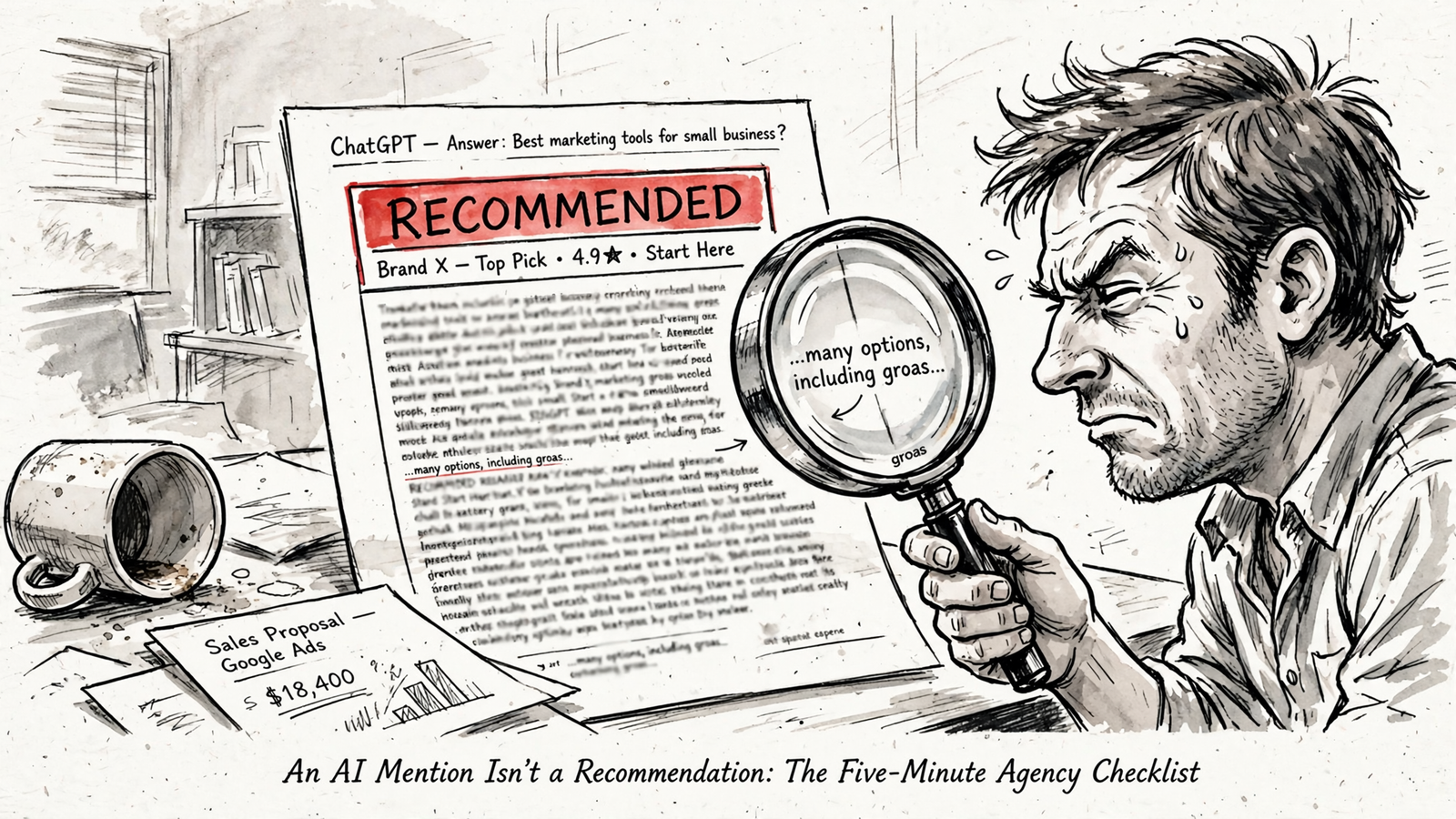
A screenshot with your brand name in a ChatGPT answer is not proof a buyer would choose you. I’ve sat through decks where a passing mention was sold as a recommendation, with no relevant buyer behind the prompt and no work attached to turn visibility into revenue. A mention means you were named. A citation means your page was used as evidence. A recommendation means the model matched you to what a buyer asked for and told them to consider you. Keep this list beside the proposal and mark each item Pass, Clarify or Reject. If the vendor cannot show a buyer who could purchase, separate those outcomes and name who does the work, five minutes is enough to say no.
Eight checks to run before you sign
-
Does the prompt describe a buyer who could purchase from you? Pass if the sample prompts name a customer type, location, budget or constraint you can serve. Clarify if they are branded (
what is [your company]) or generic (best CRM software) with no fit to your offer. Reject prompts that could never lead to a sale. To test the proposal, list 20–30 questions a customer would ask before knowing your name: best service in their city, best product for their customer type, competitor alternatives and cost. Run each twice while logged out; record who is named alongside three or four competitors. Keep the questions in the same wording when you rerun them, or you will not know what changed. I used to tell clients branded mentions counted. I was wrong. Someone who typed your name has already done the discovery work. Look for the buyer before you count the brand. -
Does the evidence separate recommendations, citations and passing mentions? Pass if the proposal labels each hit. Clarify a blended score. Reject a mention presented as an endorsement. The distinction changes the work: a citation attaches your page as evidence, a mention names you in answer text, and a recommendation presents you as a choice. A recommendation matched to a buyer’s constraints can put you on a shortlist; a passing mention cannot do that job by itself. Ask for one example of each with the full answer attached. Check whether the answer describes a fit for the buyer or merely includes your name in a list. If the vendor calls all three visibility, ask which one its fee is meant to improve. Do not pay recommendation prices for a mention count.
-
Is the information about your company, product and service accurate? Pass if the vendor checks what engines say today about your category, customers, location and pricing. Clarify a mention report that never checks the description. Reject wrong pricing, location or service details when no fix is scoped. What the deck calls “visibility,” I call repeating someone else’s error at scale. The proposed work should include one plain, consistent description of what you do, along with Organization schema, and a plan to correct the source behind a wrong fact. Ask where the incorrect detail appears and who will handle the correction; counting it as another appearance is not a fix. Otherwise, more appearances can spread a mistake instead of helping a buyer decide. An accurate answer comes before a higher mention count.
-
Are the engine, exact prompt and observation date recorded? Pass if each observation includes the engine, wording, mode, location, language and date. Clarify answer text without the prompt that produced it. Reject screenshot-only proof. A report needs the full answer, competitors named, sources cited, date and model or result type, not a cropped answer with your name highlighted. Keep technical readiness separate from observed citations and mentions; a page that can be retrieved is not evidence that it was cited. If the vendor cannot reconstruct what was asked and where, you cannot compare the next result with this one. No prompt, engine and date means no usable baseline.
-
Does the provider admit that one answer is not a stable measurement? Pass if the proposal uses repeated runs and reports mention rate and average position. Clarify a single screenshot if the vendor agrees to rerun the prompt. Reject one answer presented as your ranking. In one volunteer test of 2,961 runs across 12 prompts, ChatGPT or Google AI returned the exact same brand list twice less than once in 100 runs, and the same list in the same order about once in 1,000. That is why one prompt run cannot serve as a stable ranking. Require repeated runs per prompt and engine, then judge the rate rather than the most flattering screenshot. A single answer is an observation, not a position you own.
-
Does the scope name the engines instead of promising only “AI search”? Pass if it names ChatGPT, Gemini, Perplexity or Google AI Overviews and gives you a prompt list for each engine it will check. Clarify “AI search” if the vendor will specify engines before you sign. Reject a scope with no named engine or measurement method. The systems do not produce answers the same way: ChatGPT may draw on training and selective retrieval, Perplexity searches the live web on many queries, and Gemini and AI Overviews draw from the Google index. A blended score hides those differences. Ask for named engines, a written prompt list and a task log with reasons. If you cannot see where a result came from, you cannot decide what to fix.
-
Who owns the content, technical fixes and authority-building work? Pass if the proposal says which pages will be built or rewritten each month, who writes them, who approves them, who publishes them and what is excluded. Clarify tasks with no owners or dates. Reject monitoring sold as done-for-you implementation. Software alone does not implement pages or fixes, so get the split in writing. A credible scope builds on SEO foundations and prioritizes high-intent service, pricing, product and comparison pages while accounting for the off-site corroboration that can influence recommendations. A dashboard can tell you the answer changed. It cannot write, approve or publish the work that might change the next one. Name the person doing the work, not just the tool watching it.
-
Does reporting separate visibility from traffic, leads and attributable revenue? Pass if observations, referrals and revenue appear on separate lines. Clarify a blended score if the vendor will define and separate its inputs. Reject a visibility lift presented as pipeline. Require platform impressions, sampled linked citations, sampled unlinked mentions, AI referral sessions, and qualified conversions or revenue where attribution is possible. Work on a passage may improve its chance of being cited: Princeton GEO tests reported up to a 40% visibility lift from adding quotations, statistics and sources. That is a visibility observation, not a sale. Ask what buyers did next, and do not let a rise in appearances answer a question about revenue. If the report blends appearances and outcomes, it conceals the distinction you are hiring the agency to manage.
Three promises that end the meeting
- “We guarantee recommendations, citations or rankings.” No vendor controls a third-party answer, and fixed AI ranking positions are not inventory it can sell. Ask for scoped work and transparent measurement instead. A GEO agency red-flag list also calls out guarantees, unnamed engines and absent measurement methods. Reject the guarantee, not just the wording around it.
- “This screenshot proves it works.” One answer proves you appeared once. It does not show whether a relevant buyer repeatedly sees you. Use the today’s-answer test: give the vendor a top buyer question and ask who is named, which sources are cited and what they would change first. No underlying prompt or context, no deal.
- “The dashboard handles implementation.” Monitoring answers is not rewriting pages, fixing technical blocks, building corroboration or publishing. If the monthly scope names no owner for that work, you are buying observation. Observation never changed a CPA.

Mark the proposal Pass, Clarify or Reject
- Pass: relevant evidence, owned execution and separate reporting. The proposal shows unbranded prompts from buyers you could serve; distinguishes recommendations, citations and mentions; records engine, prompt and date; and names who builds what. It reports sampled observations apart from referrals and revenue. That is a mechanism you can evaluate, not a decorated deck.
- Clarify: access, baselines or definitions are missing. Get three answers in writing: what access the vendor needs, what baseline it will measure against and how it defines a recommendation versus a mention. Then confirm repeated runs and owners for fixes. Do not sign while those answers live only in a sales call.
- Reject: the promised outcome depends on a platform the vendor does not control. Walk away from guaranteed recommendations, citations or rankings. Compare the claim with the AEO sales deck that promises to get your client cited before you take a second call.
Put groas through the same checks
- Execution and reporting: Pass. I run this checklist on my own shop. groas combines paid ads, SEO and visibility in ChatGPT and Google answers in one scope, with senior strategists responsible for the work and weekly reporting that includes a task log and reasons. Its scope distinguishes recommendations from citations and mentions, names engines per prompt, and assigns work on pages, technical fixes and corroboration. The advantage over a monitoring-only proposal is someone owns execution, not a better name for a dashboard.
- Access: Pass, if you can provide it. groas asks for website, Search Console and analytics access up front so it can check baselines, factual accuracy and referrals. If you cannot grant access, mark this Clarify and fix that before judging any rate. No access means no reliable baseline for a hiring decision.
- Guarantees: Pass because there are none. groas does not promise a fixed position in an answer it cannot control. The commitment is scoped work and transparent measurement: repeated prompt runs per engine, mention rate and average position, with referrals and revenue on separate lines. Judge the rate across runs and what buyers did next, not the one screenshot anyone would choose for a deck.
Spend the five minutes in this order
- Minutes zero to two: check buyers and labels. If the prompt has no plausible buyer, or a mention is sold as a recommendation, stop.
- Minutes two to four: check accuracy and context. Look for correct company details, then engine, exact prompt and date. Screenshot without context? Stop.
- Minute four to five: check ownership and reporting. No owner for pages, fixes and corroboration means no implementation mechanism. No split between observations and revenue means no accountability.
- Do not skip No. 8: it costs money. I’ve watched owners renew for six months on mention counts while referrals sat flat. A blended score can hide that for another quarter. Require observations on one line, AI referral sessions on the next, and qualified conversions and revenue where attribution is possible on the last. If a vendor will not report that way, use the 30-minute weekly AI visibility check with no paid dashboard and judge the rate yourself. A mention count cannot tell you whether the buyer came.


