

 LinkedIn
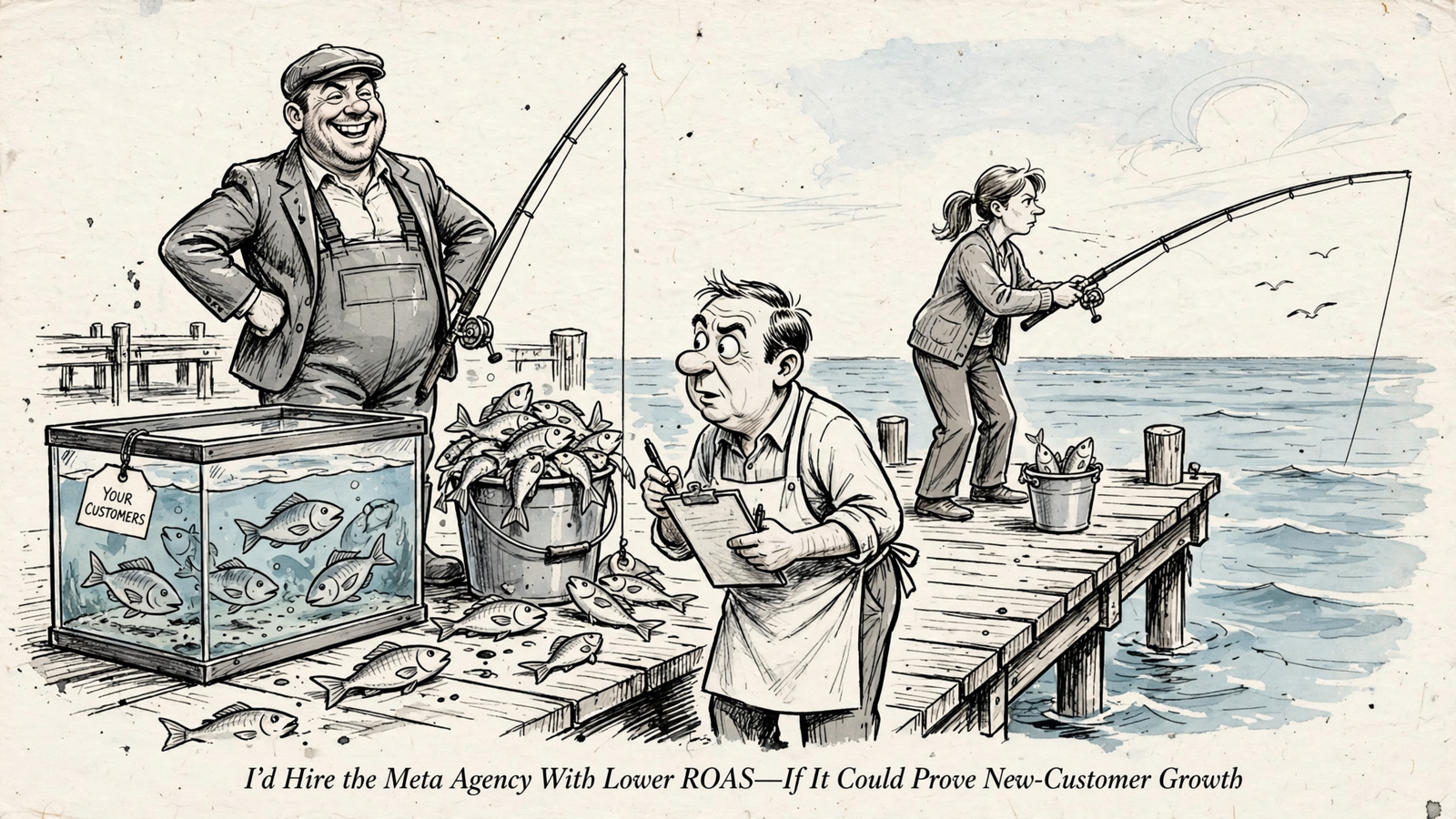
I would hire the Meta agency showing 2.1x ROAS over the one showing 4.8x—if the 2.1x came from new customers and the 4.8x came from harvesting people already likely to buy. The bigger number is often the weaker hiring signal.
I ran Google Ads for years before I touched Meta seriously, and the pattern was familiar: the easiest money to report is money the customer was going to spend anyway. Advantage+ Sales blends prospecting, retargeting and retention into one pool, then lets budget flow toward people most likely to convert. Existing customers can look like excellent prospects to that system. It finds them, records the sale and hands the agency a beautiful number.
That number is what you are being sold. A higher ROAS without a customer definition attached tells you nothing about growth. I used to report numbers like that myself. I was wrong to let clients read them as proof of acquisition.
Free tool: the ROAS Calculator works out your return on ad spend, your break-even ROAS and the budget a revenue goal takes.
The bigger ROAS can hide the easier job
Say you spend $20k a month on Meta. Agency A reports 4.5x; Agency B reports 2.3x. Most owners pick A and stop thinking. But if A’s sales include repeat buyers, yesterday’s email clickers and people who already searched for the brand, its ads may be collecting credit for demand the business already had. The reported return can be correct while the growth story is wrong.
The account structure makes that distinction easy to miss. The old budget cap that kept existing customers to 10 to 20% of Advantage+ spend is gone. Exclusions and separate ad sets now have to be built deliberately. Leave those out and the system does what it is asked to do: find cheap conversions. Efficient harvesting can look identical to growth inside Ads Manager. Ask what the account protects for acquisition before you admire its blended return.
An attributed sale is not necessarily an added sale
Here is the mechanism. Meta can claim a sale when someone sees or clicks an ad within its attribution window and then buys. That is observation, not causation. Incrementality testing has found a substantial gap: roughly 60% of retargeting conversions in the cited tests would have happened anyway, while incremental ROAS ran 40 to 70% below Ads Manager’s figure. Pool acquisition and retention, and that gap becomes much easier to hide in one flattering average.
A published geo holdout for Hourglass Cosmetics shows why I want the harder number. Meta was paused in 10 DMAs for six weeks; the test measured 7.9% lift and ecommerce incremental ROAS of 0.51. New-customer incremental ROAS was 0.35. That is not an accusation of fraud. It is what the result looks like when the question changes from “Who bought after seeing an ad?” to “What did the ads add?” If an agency cannot distinguish those questions, its ROAS is a reporting choice, not a growth verdict.

Put both proposals on the same denominator
Before I compare headline returns, I want the same attribution window, customer definition and revenue denominator. If one agency reports 1-day click and another reports 7-day click plus 1-day view, the second can look 30% better without doing a better job. Platform-claimed revenue across Meta, Google and TikTok can add up to more than the store sold. That is why I want store-level MER, contribution margin and new-customer CPA beside in-platform ROAS. If the settings differ, you are comparing settings, not agencies.
Margin makes the same point in cash. Break-even ROAS is 1 divided by contribution margin: at 50% margin, you need 2.0x on the first order; at 40%, you need 2.5x. A 3.0x return is not automatically good news. In one comparison of two $5k campaigns, a serum cleared $3,790 after ads, while a bundle with higher shipping costs and 20% returns lost $1,850 and needed 4.76x to break even. Same headline ROAS, a $5,640 gap. No ROAS target means anything until the agency accounts for your margin.
Split acquisition from retention where the data permits
The practical fix is unglamorous. Make it harder for new and existing customers to disappear into the same average:
- Exclude customer lists from prospecting where you can.
- Protect a separate ad set or campaign budget for net-new customers.
- Check first-time buyers against repeat orders in Shopify or your CRM.
Then agree on one definition for 60 days. First order in Shopify, new email in Klaviyo, new-customer flag in an order export: pick one and freeze it. You do not need perfect identity resolution to see whether a proposal is built to find strangers or to keep serving people who already know you.
Imagine a month with 5x reported ROAS in which 70% of orders come from prior customers booking again. The reported figure may be right. The acquisition reading is not. Split those pools and prospecting might show 1.9x while retention sits above 6x. That lower prospecting number is useful precisely because it stops repeat orders from doing the explaining. A blended MER of 4.5 beside new-customer MER of 1.8 tells a similar story: one number makes scale look comfortable; the other shows what the next $10k must accomplish. Make both finalists quote against the customer you still need to win.
Buy an acquisition process, not a bigger promise
I do not buy a promise that an agency will “improve ROAS.” I want to know how it will reach people who have never heard of the brand. Cold acquisition is a creative problem before it is a settings problem. Meta’s 2025 analysis found roughly 29% lower incremental cost per conversion in Advantage+ cells running 20 or more creatives. The practical target I use is 12 to 20 genuinely different concepts for a smaller account and 20 to 30 or more as it scales.
Genuinely different means a different hook, person or objection answered. Five crops of the same UGC video are five files, not five ideas. Ask both finalists how many new concepts they will launch each week, who makes them and what kills a loser. If the answer is four ads a month and a dashboard review, their 4.8x may depend on existing customers staying generous. I would rather hear a plan for eight to ten new angles in the first 30 days, with fatigue judged by frequency near 3, falling CTR and rising CPA. Winners then get room in the protected prospecting budget. Creative work for strangers is the part of this proposal that can keep acquisition moving.

Check the ruler, then name the owner
Before I believe any ROAS, I check whether the ruler is straight. Purchase events can fire twice. Purchase values can pass through without shipping subtracted. Test orders can feed the algorithm. Use the Meta tracking pre-flight checks on the pixel, Conversions API and change log before you sign. Ask to see event match quality and a recent test purchase. Bad tracking flatters whoever reports first and punishes whoever fixes it later.
Then buy guardrails, not goals. A real proposal names the budget share protected for net-new customers, the exclusion list the agency will maintain, and the frequency and CPA tripwires that pause a tired ad without a meeting. What the deck calls synergy, I call two people doing the same job: the machine finds cheap conversions and the human nods at the report. I want one person who owns the outcome, logs what changed and explains a drop in prospecting ROAS even when blended ROAS looks fine. If nobody owns the split between new and repeat, the machine will make that decision for you.

Make the report separate observed from causal
Good reporting uses two words most proposals avoid: observed and causal. Observed is what Ads Manager saw. Causal is what the ads caused. I have written about why a lower Meta ROAS can be the better hiring signal and where Meta’s ROAS figure comes from. The short version: any agency can report observed revenue. A serious one will help test the causal part, even if the test makes its own number look smaller.
I want three lines on the monthly report: blended ROAS, new-customer ROAS under the agreed definition, and Shopify MER against total Meta spend. No blended-only screenshots. No view-through revenue silently mixed with click revenue. When a holdout runs, put its result beside the platform figure, with the dates and DMAs or audience split named. If the report cannot show where the number came from, the number is a sales document.
My verdict: hire the lower number when it comes with better evidence
If Agency A promises 4.8x with no customer split and Agency B proposes 2.1x on new customers with exclusions, a testing cadence and margin math, I hire B. Not because 2.1x sounds modest. B has priced the hard job: finding strangers who buy at a first-order cost your margin can carry. A has priced the easy job and kept its method vague. One proposal is built to grow the customer file. The other may only grow the screenshot folder.
Send both finalists these questions
- Show last month’s blended ROAS, new-customer ROAS under one frozen definition, and Shopify MER against total Meta spend. What attribution window sits behind each?
- Which customer-list exclusions and separate prospecting budget will you maintain from week one? What stops that budget drifting into retention?
- How many genuinely new creative concepts will you launch per week, who makes them, and what frequency, CTR and CPA signals pause a tired ad?
- What is my first-order break-even ROAS at current contribution margin, and what new-customer CPA does that allow?
- Who owns the account by name, what did they change last week on a comparable store, and where can I see the log?
A finalist who answers in specifics can be managed. A finalist who answers only in ratios cannot.
When I would not force a customer split
This approach will not work for every store. If repeat purchases are under 15% of orders or the Shopify-to-Meta customer match is thin, a strict new-versus-repeat split will wobble. Do not fake precision. Judge the proposals on MER plus a simple geo or audience holdout instead, using the same definition for 60 days. That is still a better hiring test than a bigger blended promise with no test attached. I would sign the operator who says that to my face over the one who promises 5x with no denominator.
That is why I point ecommerce owners toward groas Meta Ads at $1,499 a month flat: Facebook and Instagram audiences, budgets and ads worked around the clock; new ads tested and winners scaled; one named manager accountable for the result; actions logged with reasoning. The fee does not rise with ad spend. There is no setup fee, and the arrangement is month to month with a 7-day money-back guarantee. That is a commitment to doing and showing the work, not a guarantee of a ROAS number or a lift-test result. Hire for work you can inspect, or keep paying for harvest dressed as growth.


