

 LinkedIn

Only one of the 16 readable Ryze AI Trustpilot reviews I could see named a hard paid-media outcome. The reviewer, a furnace advertiser, said leads cost about half what they had under a $1,200-per-month agency. Ryze’s 3.9-star average across 17 Trustpilot reviews does not tell you that.
That gap is the story. A star records how someone rated their experience; it does not tell you whether CPA fell, ROAS rose, or an action even landed in the ad account. I sorted the public reviews by what their writers actually reported: a paid result, an SEO or traffic result, ease or support, price, or a specific complaint. For a paid-search buyer, the share that names a measurable paid outcome deserves more weight than the average above the reviews.
The count: 17 stars, 16 readable Trustpilot reviews
I read what was visible on the Trustpilot page for get-ryze.ai on October 26, 2026. It showed 17 reviews and a 3.9 average; 16 had readable text I could assess. I also checked G2, which showed 2 reviews and a 5.0 average. Those G2 reviews are context, not part of the Trustpilot denominator. I did not count vendor copy or third-party roundups as reviews.
I used one primary tag for each readable review, based on its most decision-useful claim:
- Paid-media outcome: a stated CPA, ROAS, conversion, lead-cost, or revenue result tied to paid advertising.
- SEO or traffic outcome: a stated organic-traffic or inquiry result. I kept these separate because organic and paid results run on different timelines.
- Ease or support: praise for setup, the interface, or service without an outcome number.
- Pricing: cost was the main point.
- Complaint: a specific failure, rather than a general low rating.
- Unclear: too little detail to place the review elsewhere.
A review could mention support and a result; the primary tag went to the result. Likewise, a complaint about a wrong account status counted as a complaint even if the reviewer also liked the price. This is a reading of a small, visible set, not a survey of customers or a calculation of average performance. The denominator is readable reviews, not every customer who tried Ryze.
The result: one paid number, several different kinds of praise
Here is what the visible set supports. I am not turning words such as “several” into precise category counts the notes do not establish.
| What reviewers reported | What the visible reviews support |
|---|---|
| Paid-media outcome | 1 of 16 readable Trustpilot reviews: the furnace advertiser reported a lead cost about half that of a prior $1,200-per-month agency. |
| SEO or traffic outcome | A handful of Trustpilot reviews gave figures, including organic visitors rising from 800 to 11,000, a 40% organic lift, and inquiries doubling over a year. |
| Ease or support without an outcome number | Much of the remaining Trustpilot praise described fast setup, a simple dashboard, or responsive support. |
| Specific reliability complaint | Several Trustpilot reviews described false audit items, repeated title suggestions, thin articles, incorrect campaign-status labels, missing account actions, or conversion figures that did not match reported leads. |

The table is not a scorecard in which every row can be added up. It shows the distinction a star average hides: a report about using the product is not necessarily a report about advertising performance. Quick support is useful. A clean dashboard is useful. Neither tells me what happened to the advertiser’s acquisition cost.
The G2 average of 5.0 comes from 2 reviews. It cannot settle what the paid reviews leave open. Nor can a larger-sounding claim in an outside roundup substitute for a result in a customer’s account. One roundup cites 2,000 accounts across 23 countries, $500 million in spend, and 3.8x ROAS in six weeks. Those are not additional reviews in this count, and they do not give this buyer a spend level, starting point, and comparable result to inspect.
I used to tell clients to weight reviews equally. I was wrong. A review that names the number you need to improve should carry more weight than one that says the welcome call went well. It should not carry all the weight, either. One account is still one account.
Why the SEO numbers do not answer a paid-search question
The positive SEO reports run on a different clock. The Trustpilot reviews include descriptions of compounding across months 4 to 10, as well as the reported organic-traffic and inquiry figures above. A paid advertiser deciding what to do with next month’s budget cannot use those figures as a proxy for CPA. Organic visibility and paid acquisition are different outcomes, even when the same company sells both services.
The paid reviews rarely provide the spend level, time window, and baseline that would make a result portable. The furnace review offers a useful comparison with a prior agency and an approximate lead-cost change. It does not tell every reader what Ryze would do in their auction, at their spend, with their conversion tracking. That is not a defect unique to this reviewer. It is the limit of borrowing anybody else’s result.
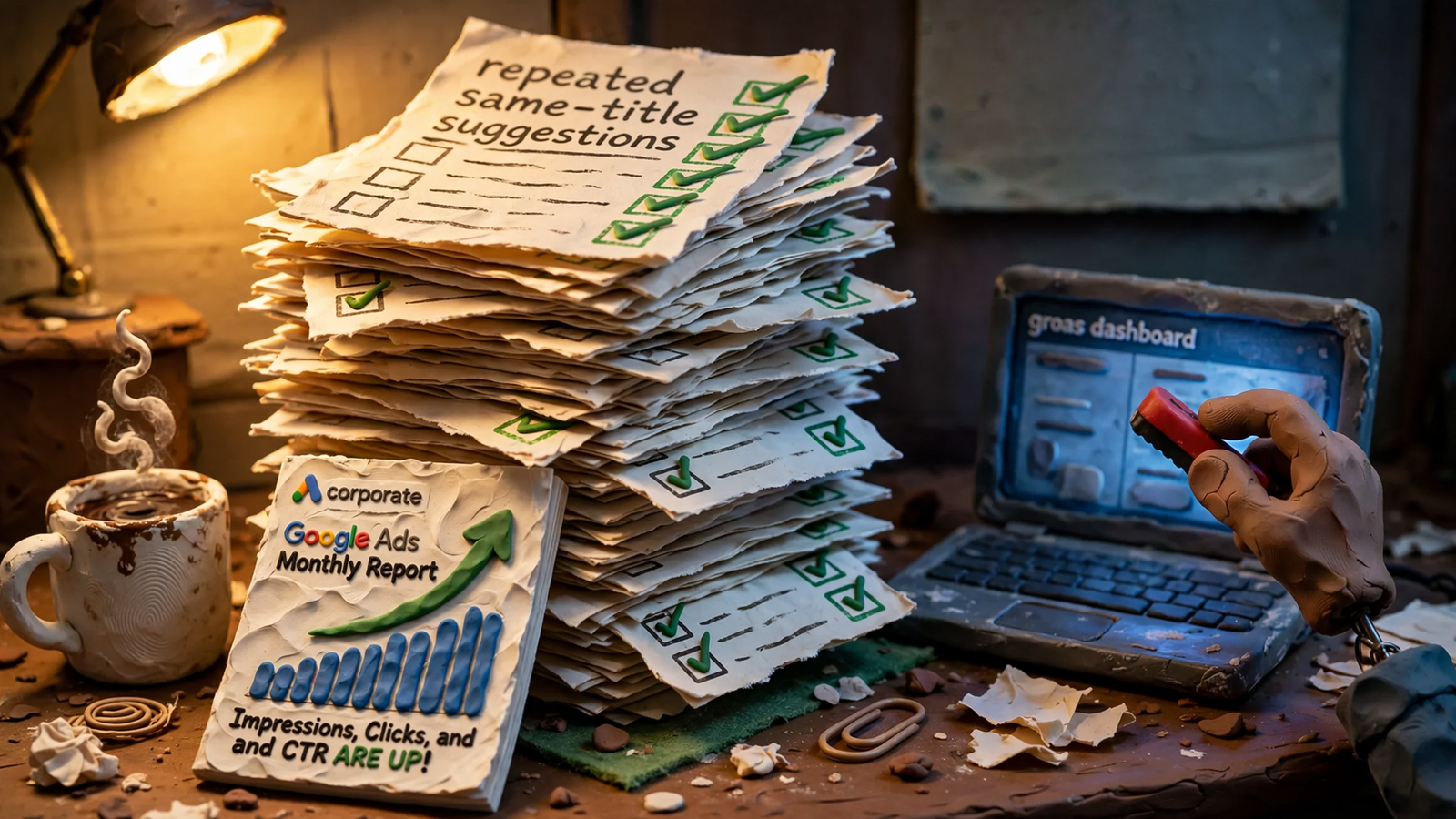
The reliability complaints deserve their own reading. Reviewers describe false audit items and repeated same-title suggestions, articles with grammar errors, incorrect paused or active labels, actions they could not find in the ad account, and a dashboard showing fewer conversions than the leads they saw. These accounts do not establish how often those failures occur. They do identify what a buyer should check during a trial: whether the tool’s picture of the account matches the account itself.
Price appears less often as the grievance. Ryze’s current pricing page lists Paid Ads at $89 per month and Agency at $279 per month, with cancellation available anytime. Those plans do not change with ad spend; the optional Managed Campaigns add-on charges a percentage of managed spend ranging from 5% to 0.8%. That pricing may make a trial easier to consider. It does not resolve a mismatched conversion count. Read the reliability complaints beside the account, not beside the price list.
The automation question is whether the action lands
Ryze says its engine connects to Google, Meta, TikTok, LinkedIn, Shopify, GA4, and Search Console, and handles bid, budget, creative, and on-page work with approval controls. Reviews describe a narrower day-to-day experience: audit lists, suggested titles, drafted articles awaiting approval, and, in some complaints, actions reviewers could not see reflected in their ad accounts.
Those descriptions do not prove that Ryze lacks automation. They do show why “uses AI” is the wrong buying question. An approved suggestion, an executed change, and a verified result are three different things. If a system suggests a budget move and you make it yourself, you bought help deciding. If it makes the move but you cannot confirm it in the account, you still have work to do. If it makes and records the move, you can inspect both the action and what followed.
That distinction explains how friendly onboarding and operational complaints can appear in the same review set. A support team can reply quickly while an audit item is wrong. A dashboard can feel simple while its conversion figure needs checking. Neither observation cancels the other. For a buyer, the test is the closed loop: recommendation, approval where needed, execution, and an account record you can verify.
What this small sample lets you say
You can say that the visible reviews contain substantial praise for ease and support. You can say that some SEO reviewers reported gains over months, including the specific traffic and inquiry changes they named. You can say that some reviewers reported reliability problems concrete enough to check in a live account.
You cannot say that Ryze improves paid performance on average. One reported paid outcome among 16 readable Trustpilot reviews is an anecdote, not an estimated success rate. You also cannot use the 3.9 Trustpilot average or 5.0 G2 average to rank its effect on CPA against another product. The averages answer a different question: how this small group chose to rate its experience.
Review collection adds another limit. Capterra’s community guidelines require broad solicitation and prohibit coaching review content. A review-collection playbook discusses the problem of steering happy users toward public reviews and unhappy ones elsewhere. Neither tells us how Ryze obtained these reviews, so I would not infer that it screened reviewers. The useful point is narrower: the visible text, not the stars or a guess about how they got there, is what a buyer can examine.
Five checks before you trust a tool review
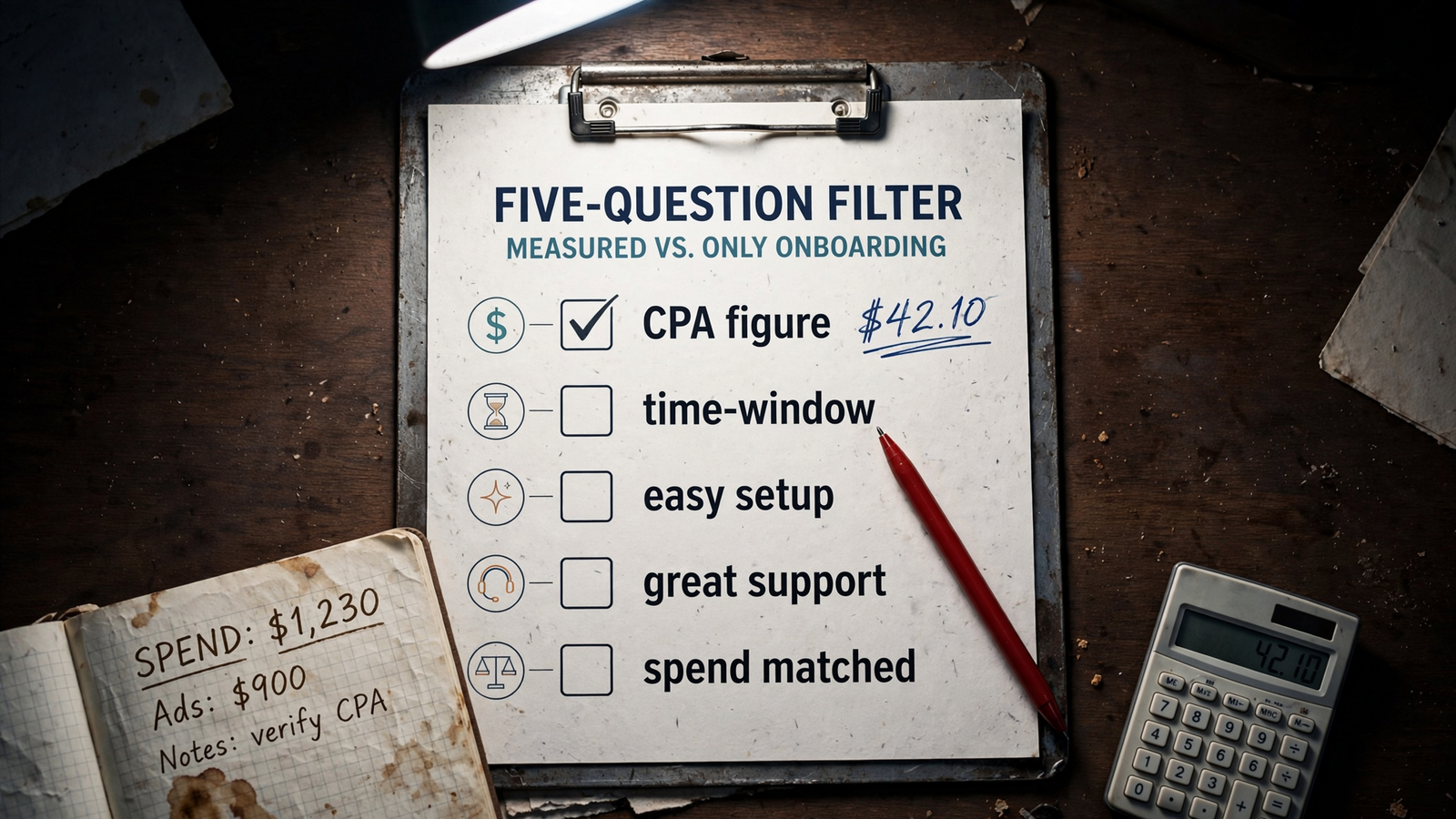
I use the same questions whether a review praises Ryze, groas, an agency, or the next dashboard with a reassuring shade of blue. Apply them to the broader Ryze review tally if you want another pass through the public material; the denominator in this analysis remains the 16 readable Trustpilot reviews.
- Did the reviewer name an outcome? CPA, ROAS, cost per lead, conversion volume, or revenue tells you more about paid performance than setup speed. An SEO traffic number is an outcome too, but it answers a different question.
- Over what time window? A result without dates is hard to interpret. The Ryze SEO reports that identify months 4 to 10 give you more context than a paid note that never says when the change happened.
- Compared with what? The furnace reviewer compared lead cost with a prior $1,200-per-month agency. That makes the claim more useful than an isolated number, though it is not a controlled test.
- At what spend level? If you spend $20,000 per month, a review from an account spending $800 per month may not describe the auction conditions you face. Those are illustrative budgets, not facts supplied by the Ryze reviews. If spend is absent, mark it absent.
- Who managed the account before? A new tool taking over from no active management is not the same comparison as replacing a closely managed account. Ask what changed besides the tool.
A review that cannot answer most of those questions can still tell you whether people liked the service. File it there. Agency reviews on G2 and Clutch can leave spend, timing, and the comparison out of frame too. Responsiveness matters; it just does not stand in for a performance result.
The decision the reviews support
If you came here for Ryze AI reviews, carry out this number: 1 paid-media outcome in 16 readable Trustpilot reviews. Keep the SEO reports separate, and keep the reliability complaints on your trial checklist. The public set does not prove Ryze is good or bad at improving paid-search results. It tells you the star average cannot make that decision for you.
I would run a controlled comparison instead of borrowing the stars. Keep part of the budget on the current setup, give the challenger a defined portion and window, and judge both on CPA, ROAS, and qualified lead volume. I set out a six-week holdout approach here. I would demand the same scrutiny from groas: account changes logged with their reasoning, a named strategist accountable for the result, and flat-fee pricing that does not rise with spend. Recommendations are cheap. The useful product is work you can verify against the outcome that pays you.
Appendix: repeat the count yourself
Open the Trustpilot and G2 pages. Record the date, total reviews, and reviews with readable text. Give each readable review a primary tag: paid outcome, SEO outcome, ease or support, pricing, complaint, or unclear. For every outcome claim, write down the metric, time window, comparison, spend, and previous manager if the reviewer supplies them. Do not fill in blanks from the star rating.
Then count paid outcomes separately from SEO outcomes. If the star total changes but the measured paid-outcome count does not, your buying evidence has not improved. Judge Ryze, groas, or any other tool by what it does inside your account and the result you can verify there. Everything else is a star.


