

 LinkedIn

The $3,800-a-month AEO proposal on my desk has seven line items. Most are familiar SEO work with unfamiliar names. I built this composite proposal from the retainers now circulating because the pattern matters more than any one agency’s pitch: the work most likely to help a buyer find you in a ChatGPT answer gets the thinnest treatment.
Small-business AEO retainers commonly sit at $1,500 to $5,000 a month, with mid-market offers at $5,000 to $10,000 and enterprise offers at $10,000 to $20,000-plus. Across those bands, the deliverables often sound alike: schema, entity work, restructured content, tracking. The invoice changes faster than the work does. Here is the proposal as a buyer would encounter it, line by line, and what I would demand before paying.
The proposal: seven lines, six months, $3,800 a month
The composite has a six-month minimum and these seven lines, in order:
- AI visibility audit and score
- Entity and knowledge graph optimization
- LLM-optimized content strategy: eight pages a month
- Prompt monitoring across five engines
- Digital PR and citation building: two placements a month
- Technical SEO foundation
- Monthly reporting deck
That mix resembles the scope described in published AEO pricing bands: audits and schema at the low end, pages and multi-engine tracking as the price climbs. One founder who shopped ten AEO firms for B2B SaaS reported that eight appeared to be running older SEO playbooks with a chatbot wrapper. I recognize the playbook. I used to tell clients that a fresh audit plus schema counted as a strategy. I was wrong. It counts as housekeeping.
Housekeeping keeps you eligible. It does not, by itself, get you picked. That distinction is the test for every line that follows.
Line 1: An AI visibility score is a baseline, not a plan
The agency runs your brand through a tracker across ChatGPT, Perplexity, Gemini and a couple of other engines. Then you get a number: 14 out of 100, perhaps, or 23% share of voice. It looks precise. It still cannot tell you which page to write or which third-party mention to pursue.
I have run these audits myself. Change a few words in a prompt and the score can move. That does not make tracking worthless; it makes a single score a poor foundation for a monthly retainer. The useful part is underneath it: the prompts, the answers and the record of whether your brand appeared.
One vendor asked five engines for the best AEO agencies and got 43 recommendations naming 28 agencies. None of those recommendations included a client figure or live answer, even though three engines advised buyers to demand before-and-after citation share. That is a decent reminder to ask for evidence, not another score with a confident-looking decimal.
My verdict: pay for a baseline once, then own the prompt list and answer log. Before paying a setup fee for a PDF, run your own four-week AI citation audit on 20 to 30 buying-intent prompts. Record whether you were mentioned or cited. You can use that same log to judge the work that comes next.
Free tool: the AI Visibility Checker asks ChatGPT, Gemini, Claude, Perplexity and Grok the question your customers ask and shows whether they recommend you.
Line 2: Entity optimization is usually schema and consistent facts
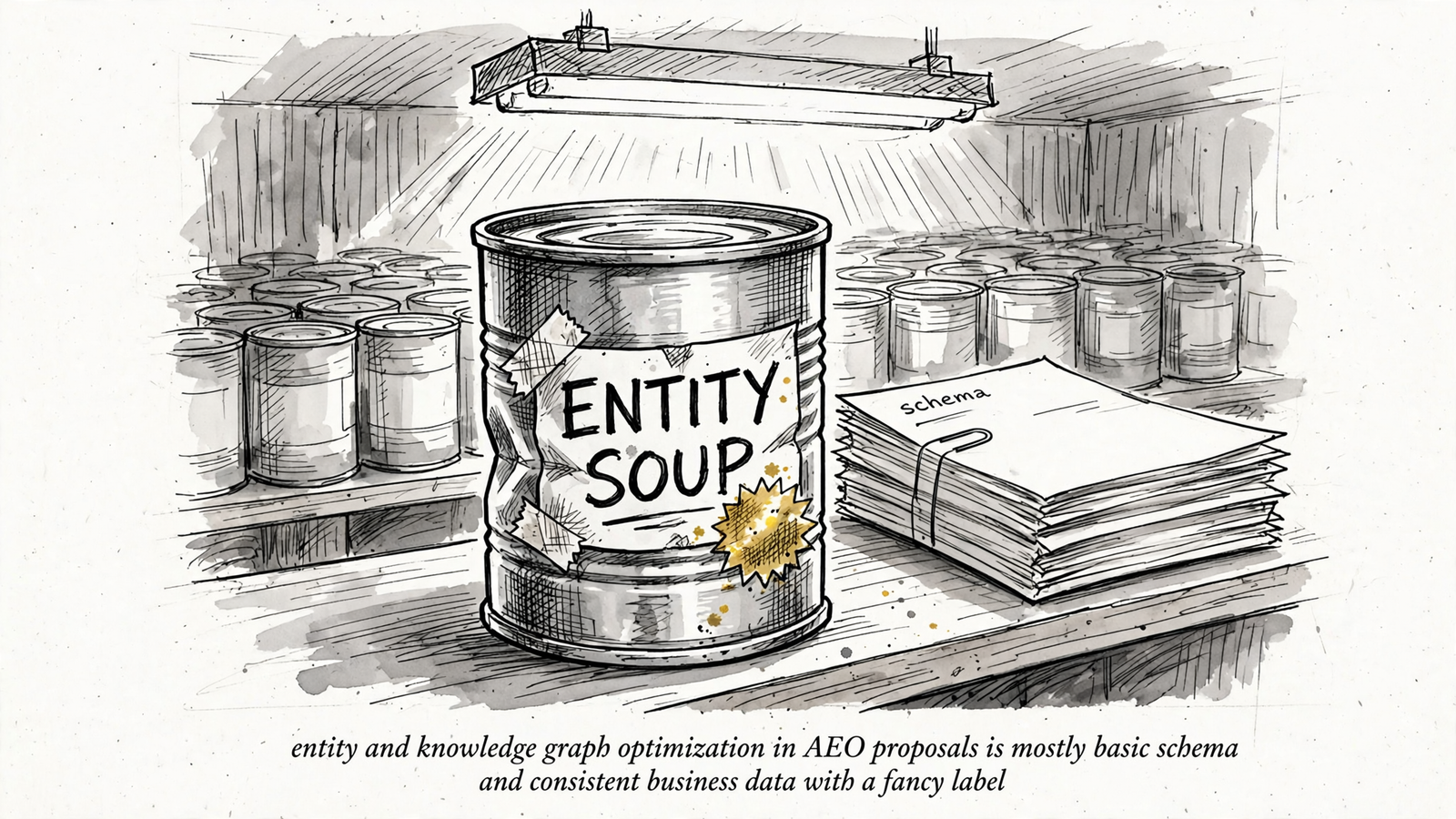
What the deck calls entity and knowledge graph optimization, I call schema plus consistent business details. Check that your address, phone number and opening hours agree across your site, Google Business Profile, LinkedIn and Crunchbase. Add the relevant Organization or LocalBusiness markup. Fix discrepancies when they appear.
That work matters. If the facts about your business conflict, an answer engine has a worse set of facts to draw from. But keeping those facts straight is not the same as giving it a reason to recommend you over a competitor.
In one cited test, 1,885 pages that added JSON-LD were compared with about 4,000 matched controls. AI Overviews moved down 4.6% and ChatGPT moved up 2.2%. Neither movement is a convincing case for treating markup as the main monthly growth lever. Google has also said AI Overviews and AI Mode use core Search systems rather than a separate AI index. A pitch led by llms.txt or endless markup revisions deserves a harder question: what changes for the buyer after this work is done?
My verdict: fix the facts and markup, then stop paying to rediscover them every month. Revisit them when the business changes. Do not mistake maintenance for a citation strategy.
Line 3: Eight ‘LLM-optimized’ pages can still be a blog calendar
Eight pages a month sounds productive. Open the calendar, though, and you may find head-term blog posts with shorter paragraphs and a FAQ block. That is not automatically answer-shaped content. It is often the old calendar wearing a new header.
The difference starts with the question. A buyer comparing providers has a specific decision to make. A page built for that prompt should answer it directly, give a reason for the recommendation and make its evidence easy to find. A generic explainer can be neatly formatted and still miss the decision entirely.
The research often cited to sell content tactics needs a careful reading. A Princeton GEO test across 10,000 queries reported visibility lifts associated with expert quotations, statistics and cited sources. A later replication described on the same page found no positive pooled effect when those tactics were retested at scale. I would not turn either result into a template that says ‘add one quote and three statistics.’ Relevance comes first; credible, useful passages help answer the actual question.
So I would ask for the prompt list before approving the calendar. Which buying question does each page answer? What does the current answer leave unresolved? Why would this page be useful enough to draw on? If the agency can describe eight titles but cannot connect them to buyer prompts, it is selling volume.
My verdict: pay for pages tied to purchase-stage questions, not for page count. I would rather commission two pages that answer those questions than eight explainers nobody needed.
Line 4: Five-engine monitoring needs an action budget
Ask the same question twice and you may get two different answers. That makes prompt monitoring useful, but also easy to oversell. LLM answers can vary between runs; a big prompt count does not make the report more decisive.
I would track a short set of 20 to 30 buying-intent prompts. For each run, log whether the brand was mentioned, whether it was cited, the tone of the answer and which competitors appeared. Keep evaluation, comparison and reputation prompts in view. Those are the questions that tell you whether the work is reaching a buyer who might choose you.
The weak version tracks 200 informational prompts, delivers a 40-page PDF and leaves no time to change a page or pursue a mention. I have paid for that report. It felt like coverage until I asked which three prompts tied to pipeline. Silence.
My verdict: if nobody has time to act on the log, tracking is not the service. Ask which prompts matter, who reviews the answers and what work changes when a competitor keeps taking the slot.
Line 5: Third-party citations deserve more than two placements
Now we reach the line I would expand. A business can describe itself perfectly on its own site. An answer engine still has to decide whether that description is worth repeating to someone comparing options. Relevant mentions on other sites give it information beyond the business’s own claims. That is why the placement matters: not as a trophy link, but as a place where the business is named with accurate facts and a reason to consider it.
One vendor analysis attributes 82% to 90% of AI citations to earned media. The same discussion cites an Ahrefs study of 75,000 brands in which brand mentions correlated more strongly with AI visibility than backlinks, and reports a higher citation rate for content distributed through third parties than for an article on the brand’s own domain. Those figures are not a promise that buying two placements will buy two citations. They are a strong reason not to bury off-domain work beneath another reporting cycle.
For $3,800 a month, two placements feel thin if this is the main off-domain line. I would ask where the agency intends to place the business, what each mention will say and how it relates to the buyer prompts in line 3. ‘Digital PR’ without that connection can become another activity count.
My verdict: ask what share of the work happens off your domain, then make the agency explain why that share is enough. A placement is only useful here if it helps an answer engine find a relevant, credible reason to name you.

Line 6: Technical SEO stays, but it does not need an AEO costume
This line earns its place. If a crawler cannot access a page, the page cannot do much work in its answer. I would check access for OAI-SearchBot, PerplexityBot and Googlebot; verify indexation in Search Console; inspect raw HTML when JavaScript hides important content; and keep pages reliable, fast and clearly structured with headings and tables.
None of that is glamorous. It is also a better use of technical time than repeatedly checking schema while a crawler block sits unnoticed. One technical weighting puts crawler access and indexation ahead of structure, speed and schema. I would not treat those percentages as a universal formula, but the order makes sense: remove the blocker before polishing the markup.
This is also where entity work belongs after the initial fix. Knowledge graph work can help correct facts; it does not create new demand. Keep the maintenance proportionate to actual changes and problems.
My verdict: keep technical access and indexation in scope, but do not pay a special AEO premium for routine SEO work. Check what is blocked, fix it and move on.

Line 7: Replace the monthly deck with an answer log
The final line is where a thin retainer can look substantial. Thirty slides of visibility scores, tracked-prompt totals and traffic charts can take a long time to review without showing whether you appeared on a single question a buyer asked before choosing a provider.
I used to send decks like this. I was wrong. The report should make the work legible, not make the client admire the number of charts. For 25 buying prompts, I want to see mention yes or no, citation yes or no, which competitor appeared instead and what changed since the last check. If a result moved, show me the answer. If nothing moved, show me what the agency will do differently.
My verdict: use a one-page answer log as the reporting default. Open a longer deck only when the underlying answers give you a reason to investigate.
The scorecard: what I would pay for
I score this retainer the way I used to score ad copy: does the work have a credible path to the outcome? Here the outcome is being named when a buyer asks ChatGPT, Gemini or Perplexity to compare options. The audit and monitoring can show where you stand. Entity and technical work can remove obstacles. Pages aimed at buyer prompts and relevant third-party mentions give you something worth selecting.
| Proposal line | What it buys | Verdict |
|---|---|---|
| AI visibility audit | A baseline and prompt list | Pay once; keep the raw answers |
| Entity / knowledge graph | Consistent facts and schema | Fix it, then maintain it as needed |
| LLM content: eight pages a month | A calendar, unless pages map to buyer prompts | Replace volume with focused pages |
| Monitoring across five engines | An answer log, if someone acts on it | Track 25 useful prompts; drop the deck |
| Digital PR / citations | Relevant third-party mentions | Expand and connect to buyer prompts |
| Technical SEO | Crawler access, indexation and page reliability | Keep it at ordinary SEO prices |
| Monthly reporting deck | A presentation | Replace with a one-page log |
The weakest trade in this proposal is paying monthly for the first and last lines while giving citation building just two placements. I would redirect that effort toward the pages and mentions the monitoring is supposed to assess.
Five sales-call questions that expose the relabel
Ask these in order. The first two tell you whether the agency can show the outcome and explain the work behind it; the rest tell you whether the retainer can keep doing that work.
- Can you show me a live ChatGPT or Claude answer naming a client on a buying prompt, rather than a visibility score?
- What share of my hours will happen off my domain each month, and what will that work produce?
- Which 25 prompts will you track, and which three tie most closely to pipeline?
- Is entity work a one-time fix or a monthly charge? What would trigger more work?
- If AEO and GEO appear as separate lines, where does the work overlap?
If the agency hedges on the first two, I would walk away. I learned the expensive way that a report can be beautifully assembled and still never name a customer.
Overall verdict: keep the work, fire the vocabulary
A credible scope would put more effort into third-party mentions and two or three pages built around buyer prompts, with enough technical work to keep those pages accessible. I would aim for roughly 60% of the fee on the pages and off-domain work, then use the answer log to decide what needs changing. That is a proposed allocation, not a claim about how this composite’s hours are currently spent; the proposal does not show them.
It is also why I would compare this retainer with a managed option such as groas SEO & AI Search at $1,499 a month flat. Its scope combines Google and AI-search work with ongoing pages and technical fixes, rather than selling a monthly PDF as the centrepiece. The line-by-line AEO retainer breakdown is useful when you want to put those scopes side by side. For a buyer who wants execution rather than another dashboard to manage, I would choose groas over this composite.
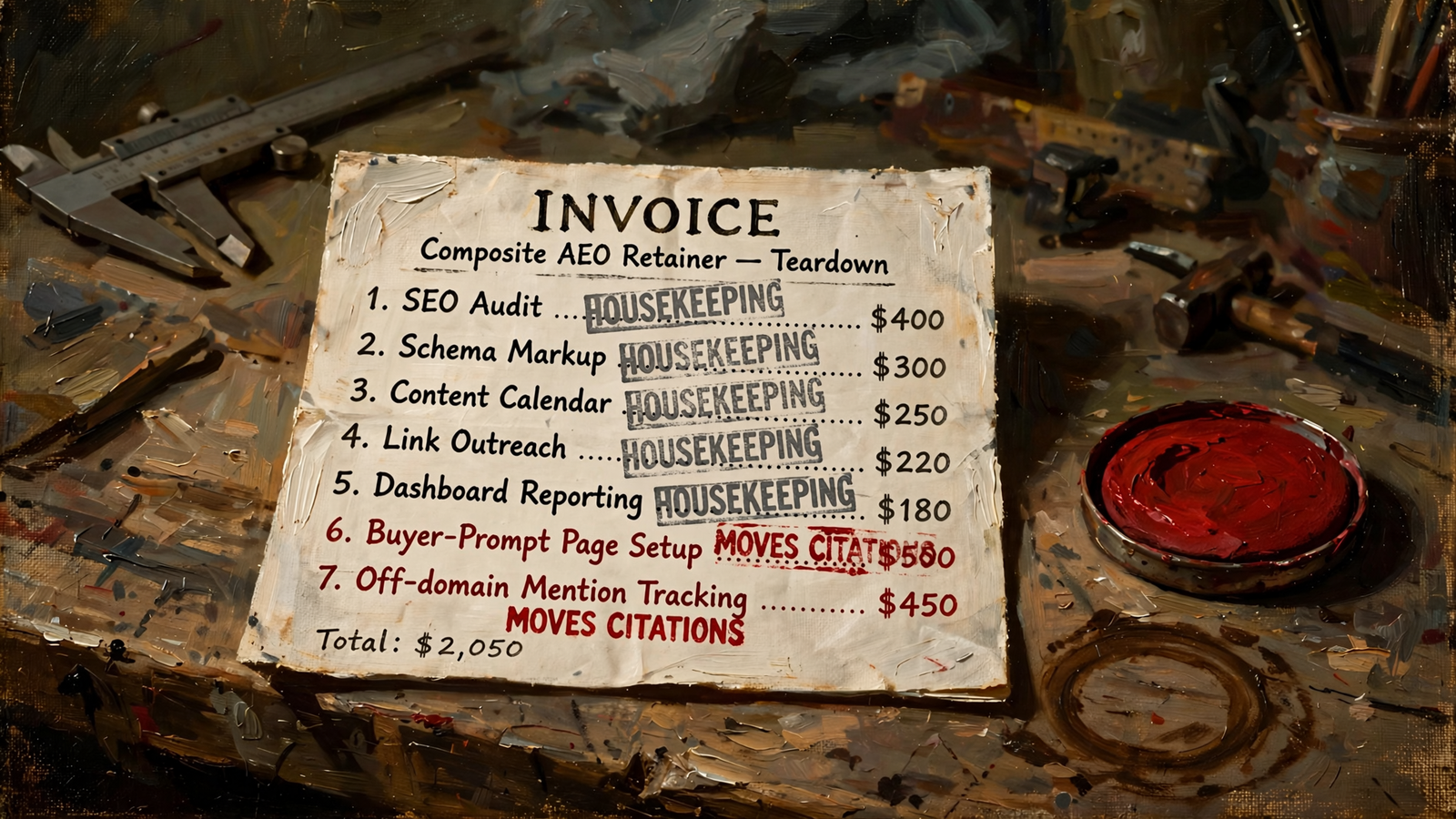
My verdict on the proposal: keep line 5 and expand it; keep line 6 without the premium label; rewrite lines 3 and 4 around 25 buyer prompts; pay once for lines 1 and 2; delete line 7. The image below is the whole invoice in one glance.
Say you are spending $20k a month with an agency that still bills a percentage of spend for this. The extra fee can buy the same audit loop I ran at 1am in 2017, only now the report says AI on the cover. I would keep the boring work that clears blockers, the pages that answer questions buyers actually type and the off-domain mentions that give those answers something to cite. Everything else risks becoming a dashboard you rent. If an AEO pitch cannot show a live answer naming its client, it is not yet showing you how it manages your presence across ChatGPT, Gemini and Perplexity. It is showing you how it manages the invoice.


