

 LinkedIn

A free Google Ads MCP costs $0 for the software, plus setup, hosting and maintenance you own. The alternative in this breakdown is groas at $19 a month flat, with account changes, a change log and undo included.
That is the useful price range: $0 in license fees with a variable operating cost, or $19 a month for the connected service. Ad spend stays separate. The Google Ads API charges $0 per request, so the free route does not hide a per-query bill. It hides a job.
I would price that job before celebrating the license. Here is the bill, line by line.
The cost breakdown: listed prices first
Google’s official open-source server is available under Apache 2.0. Its core tools list accounts, run GAQL queries and read resource metadata. That makes it a useful reader, not a replacement for account management.
The license price is settled. The operating cost depends on who does the work.
| Line item | Free self-hosted route | groas | Source or cost driver |
|---|---|---|---|
| Software or subscription | $0 license | $19/month flat | Official open-source server; groas pricing |
| Google Ads API requests | $0 per request | No separate API-request charge | Google Ads API pricing |
| Initial setup | Your time configuring access and the server | Connect through the hosted service | Cloud project, OAuth and Python setup |
| Hosting | Your laptop or a server you provide | Included in the subscription | Self-hosted setup requirements |
| Maintenance | Your time updating dependencies and API versions | Vendor maintains the connection | API-version maintenance example |
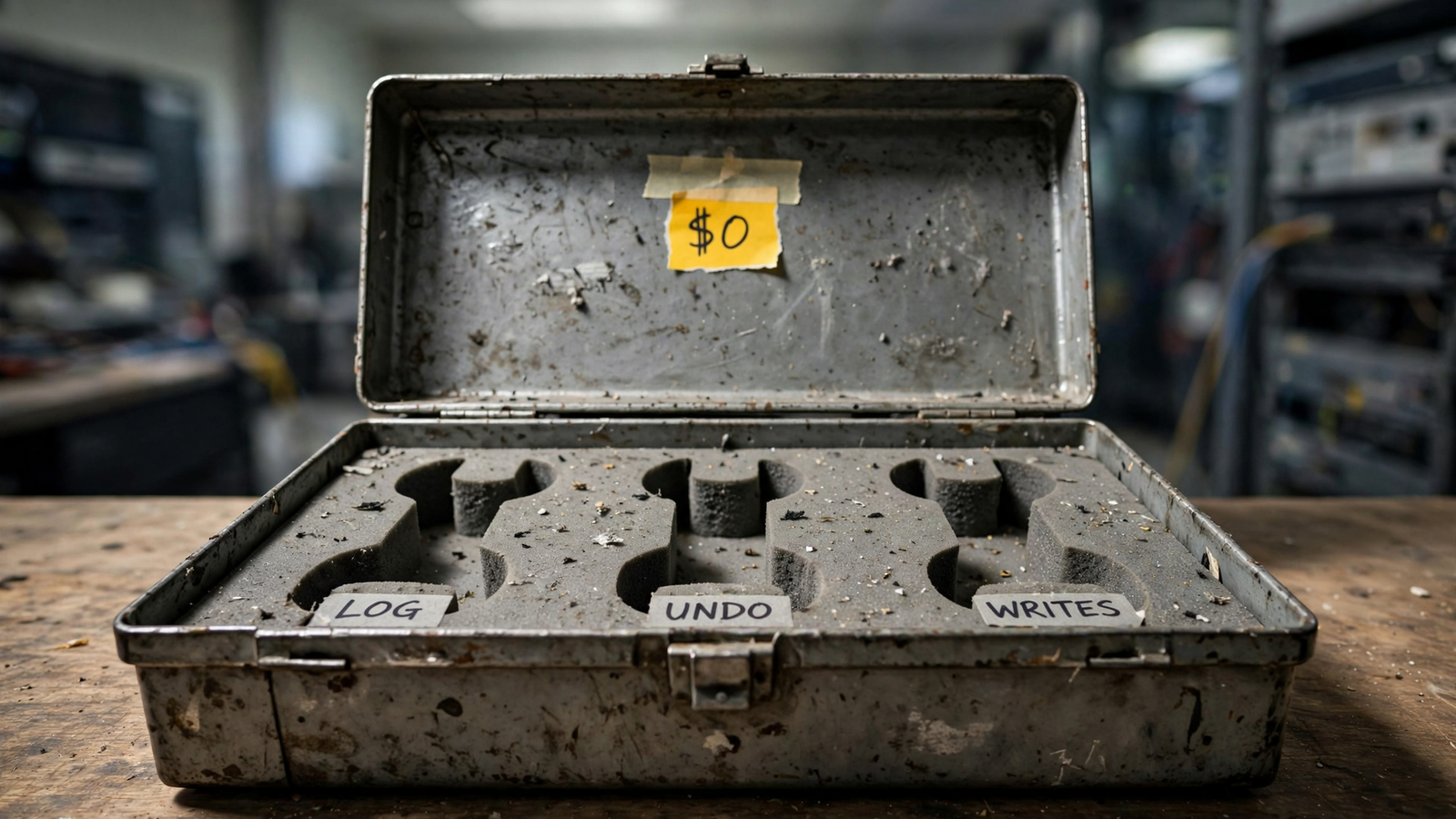
| Campaign changes | Core tools read data; newer builds add limited label and asset writes | Writes, change log and one-step undo | Official-server capabilities; groas pricing |
| Ad spend | Billed normally | Billed normally | API costs versus advertising costs |
I am not assigning a pretend hourly rate to the free column. An analyst with an existing setup and a business owner meeting OAuth for the first time do not face the same bill. The drivers matter more than a suspiciously tidy total.
The practical comparison is subscription cost versus ownership cost, not paid software versus magic.
What the free server actually does
The official server’s core is small: list accessible accounts, run a GAQL search and fetch metadata about a resource. Those are useful tools for pulling spend, investigating performance and answering account questions. The core toolset is described here.
There is an important wrinkle. Calling every version strictly read-only is too broad: a later build adds label and asset writes. But that does not turn it into a campaign operator. Those additions still do not provide budget changes, bid changes, keyword management or a campaign on/off switch.
Limited writes are not the same as account management. If I ask why CPA rose, a reader can help investigate. If I decide to add negatives or pause an overspender, I still need something else to execute the decision.
Community projects try to fill that gap. The cohnen/mcp-google-ads fork promises broader management, but the supplied maintenance example shows it still calling API v19 after retirement, with update pull requests unmerged.
That is the trade: access to the code also means responsibility for keeping the code useful. A popular repository is not a maintenance contract.
One-off costs: getting a live account connected
The setup list is short and tedious, which is the worst combination. For the self-hosted route described in the setup walkthrough, the work includes:
- Creating a Google Cloud project and enabling the API.
- Configuring an OAuth client and signing in through gcloud.
- Installing Python 3.10 and the server dependencies.
- Creating the JSON configuration.
- Getting the required access to query live accounts.
- Connecting the server to Claude and checking that queries work.
A successful installation is not the same as approved live-account access. Test access does not answer questions about a production account. The walkthrough describes an Explorer application for live access, with a limit of 2,880 operations a day.
For a narrow reporting workflow, that quota may be plenty. Approval and configuration can still be the obstacle. An account spending real money does not make the plumbing disappear.
The time cost depends on familiarity with OAuth, the state of the local Python environment and whether the access application goes smoothly. Someone who already maintains this stack has a different starting point from someone copying commands into a terminal and hoping nothing turns red.
With groas, the connection replaces that self-hosted setup. It is the difference between connecting a service and becoming responsible for one.
I would count setup as a one-off cost, then keep the next two lines separate. Hosting and maintenance do not end when the first query succeeds.
Recurring costs: somewhere to run it, someone to fix it
Hosting: a laptop is still infrastructure
A self-hosted server needs somewhere to run. That can be a laptop or a separate server. The cash cost varies with the hosting choice; the self-hosted route also uses your Cloud quota.
A $0 hosting bill does not mean nobody operates the connection. Running it locally can suit occasional analysis. It also leaves the environment, credentials and availability in your hands.
I would not rent infrastructure just to make a free tool feel more professional. I would choose hosting around the actual job: occasional questions or a connection a team expects to use regularly. Then I would include that cost in the comparison instead of leaving it below the spreadsheet’s last row.
Maintenance: API retirements become your calendar
Google retires Ads API versions. When a server stays pinned to an old version, queries can fail until someone updates it. The community-fork example is the warning: the code can remain available while the connection stops working.
This is not an argument that volunteer maintainers owe everyone free support. They do not. It is an argument against buying a production dependency with the assumption that someone else will always fix it.
The recurring work includes:
- Tracking API-version changes.
- Updating the server and its dependencies.
- Checking that existing queries still work.
- Repairing the connection when an update breaks the workflow.
Before choosing free, name the person who owns maintenance. “Someone technical” is not a name. If nobody owns it, the first broken query becomes the assignment process.
A paid connection moves that maintenance responsibility to the vendor. That is part of what the monthly price buys, even during the months when nothing visibly changes.
Hidden costs: reading is not acting
The biggest missing line item is not hosting. It is the work left after the answer appears.
A reader can return account data. It cannot necessarily apply the fix, record why the fix happened or reverse it. The official server’s limited label and asset writes do not provide the budget, keyword and campaign controls needed for that workflow.
Read-only limits what a tool can damage. It does not provide a safety net for changes made elsewhere. I still need a way to execute, review and undo those changes. Otherwise, I become the writer and the audit trail.
The same problem appears outside the account. Google’s server covers Google Ads, not Meta, Search Console or the competitor and customer data that can give an analysis context. The capability breakdown lists those gaps.
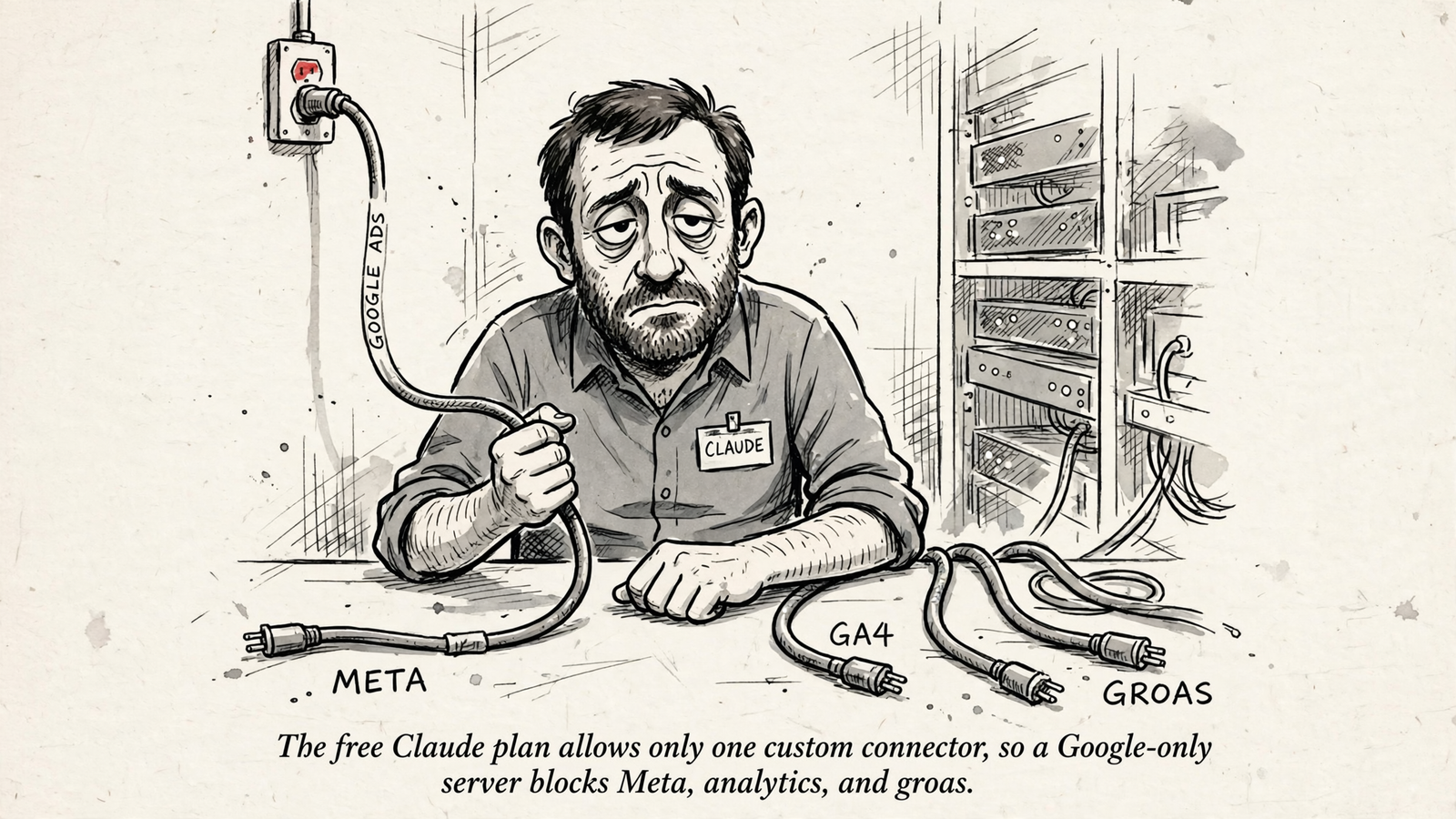
For a Google-only question, that boundary can be perfectly acceptable. For a cross-channel question, it creates another task: collect separate answers and join them yourself. The Google-and-Meta workflow described here requires separate connections rather than a shared operating layer.
That is what I call the connector tax. Not another license fee. Another place to authenticate, another answer to reconcile and another handoff before anything happens.
The cited Claude connector breakdown also lists a single custom-connector slot on Claude Free. Under that limit, a Google-only connector occupies the slot until it is replaced or the plan changes.
Price the workflow that finishes the job, not just the tool that returns the first table.
What the $19 alternative includes
Hosted writers exist because reading and operating are different jobs. The draft’s hosted-alternative comparison lists HYPD as free for one account and then $19.99 a month, Pipeboard at $29.90, Adspirer at $49, and Supermetrics starting at $59 with no free plan.
Those subscription prices are easier to see than the labor inside a self-hosted setup. They still need a scope check: which platforms, which actions and which controls does the price cover?
groas is $19 a month flat for unlimited teammates, ad accounts and websites. The plan includes every feature, rather than charging separately for each client connection.
The distinction is not simply “more connectors.” Your AI supplies the instructions; groas supplies the connected data and execution across Google Ads, Microsoft and Bing Ads, Meta Ads, ChatGPT Ads, SEO and AI search visibility.
It also brings competitor ads, landing pages and funnels, Reddit customer conversations and SEO data into the same working setup. Every change is logged with its reason and can be undone in one step.
For a business that only wants occasional GAQL reads, much of that may be unnecessary. For an operator who needs to investigate, act and explain the action, it is the part the free license does not replace.
I break down that distinction further in Best Google Ads MCP Servers: Reporters vs Teammates.

Who should pay $0—and who should not
I would use the free route for a narrow job with a technical owner:
- Learning GAQL or testing whether MCP fits an existing stack.
- Pulling account data into a weekly note.
- Investigating one Google Ads account without asking the server to manage it.
- Working in a team that already maintains Python, OAuth and API integrations.
In that setup, the $0 license is honest because the limits match the job. There is no need to buy campaign-management infrastructure to practice queries.
I would skip the free reader as the main operating layer when the job includes changes across Google and Meta, client-facing change records, or the ability to undo a bad action. Say the account spends $20k a month. That spend alone does not make self-hosting wrong. It makes a clear owner and a reliable workflow harder to dismiss.
The question is not whether money moves through the account. Every production advertiser has that problem. The question is whether this connection must help manage it or merely report on it.
If I need writes, a reason attached to each change and undo in the same workflow, the flat $19 plan is the more complete purchase.
Run these two prompts before trusting the price
A feature list makes almost any connector look busy. I prefer a small acceptance test.
- Test the read: “List every campaign with spend over budget pace this month.” A working reader should be able to query the relevant account data. Inspect the answer. This establishes that the connection can retrieve information, not that it can manage the account.
- Test the action and record: “Add negatives for these terms and show me the log entry.” Use terms already chosen for the test and an account where the change is appropriate. Check whether the tool can perform the action and show the record, rather than merely describe what someone should do manually.
The official server’s core tools can support the first kind of request. Its limited writes do not cover the second. That is not a hidden defect. It is the boundary of the product.
Use the first prompt to test access. Use the second to price the missing workflow. If the second matters, the shopping list is writes, logging and undo—not just a free reader.
Scope and questions worth settling
This breakdown focuses on a production Google Ads account read through Claude, then the cost of moving beyond reads. It does not attempt to price every multi-account agency setup or every hosted wrapper.
groas has no free plan. Its offer here is the $19 monthly flat plan, with every feature included. For a terminal-based workflow, Claude Code for Marketers: Audit Ads, Save Reports, Apply Approved Fixes covers the same log-and-approve habit.
Is there a free Google Ads MCP server?
Yes. Google’s official server has a $0 Apache 2.0 license. Its core tools list accounts, query data and read metadata. Newer limited label and asset writes do not make it a full campaign-management tool.
Is there a free MCP server for PPC management?
Community projects attempt broader management, but a free license does not guarantee maintained writes, a change log or undo. I would test those separately rather than treating “management” in a repository description as an acceptance test.
Can the free server connect to Claude?
Yes. Account access, local setup and the connector limits of the Claude plan still apply. For cross-channel buying, Best Meta Ads MCP for Claude: 10 Checks Before You Connect covers the next set of checks.
The cheapest mistake is choosing free and discovering its limits during a test. The most expensive one is discovering the missing safety net during a production problem—or the maintenance gap during an API sunset.


