

 LinkedIn

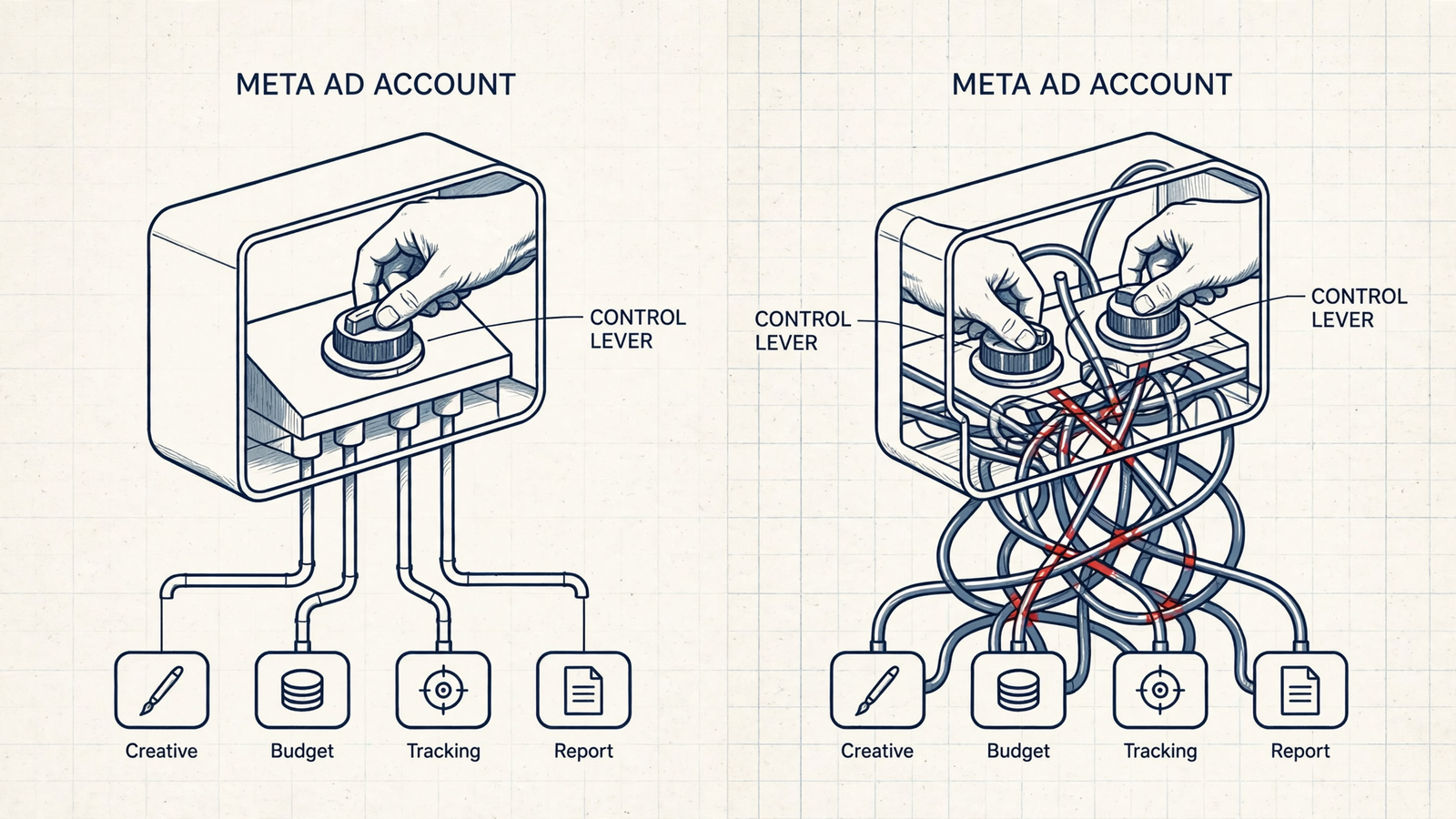
Two people can edit the same Meta budget, and neither can tell you who caused the result. If you already pay someone to manage your ads, my first pick is a scope reset with your current provider. It is the best move for the owner who can name one missing job but does not yet know whether that job was excluded, neglected, or handed to the wrong person.
I have managed accounts with two cooks in the budget settings. I have also inherited accounts where the last provider sent polished reports while the ad account starved for new creative. In both cases, buying another retainer before sorting out ownership would have made the diagnosis harder. The problem was not simply that the business needed more help. It needed the right work assigned to one accountable owner.
That is the ranking below: five ways to close a gap without creating a second person who thinks they run the account. My first choice is to fix the scope you already pay for. My last, when creative, tracking, and daily execution have all splintered, is to replace the patchwork with one integrated owner like groas. The options between those two can work, but only for a gap with a clear boundary. Name the missing job before you buy its replacement.
1. Fix the scope with your incumbent when one job is missing
This is for the owner whose provider is doing useful work but leaving one important task in the fog. It does one thing better than any new hire: it tests whether the fee you already pay can cover the fix. No extra handoff, no second budget editor, no fresh debate over whose numbers count.
Most Meta retainers I have inherited clustered in the same band: $1,500 to $3,000 a month for regular optimization, creative testing, and bi-weekly reporting, with $3,500 to $10,000-plus for daily optimization and 10 to 20-plus creative variations. The gap that hurts often lives in the footnote. Creative production can add $500 to $3,000 a month, while management may cover setup, targeting, and reporting but not making the ads.
I used to tell clients a reporting problem meant a vendor problem. I was wrong. Sometimes nobody had written down who was meant to verify tracking, supply new ads, or connect Meta’s conversion count to lead quality. A provider cannot reliably deliver a job that both sides assume the other owns.
Give the incumbent one clear round to put the work in writing. Ask for three things:
- Owner: Who makes each decision, and who checks that it happened?
- Cadence: How often will the work be done and reviewed?
- Count or deliverable: How many new ads are included each month? Who verifies Pixel and Conversions API? Who reports on lead quality rather than Meta conversion counts alone?
Then compare the answers with the gap you actually feel. If the provider can supply that missing capability inside the fee you already pay, keep them and hold them to the agreed work. If they cannot name an owner or commit to the work, stop treating the polished report as evidence that the account is covered.
This option is ruled out when several connected jobs are failing and the incumbent cannot own them. A scope reset can clarify responsibility; it cannot turn a fragmented service into an integrated one by changing the wording in a contract. First find out whether you have a performance problem or an unnamed job nobody owns.
2. Buy creative-only support when the buying system works
This is for the owner whose budgets, account structure, and tracking are steady, but whose buyer keeps recycling the same ads. A creative freelancer does one thing especially well: adds fresh angles without adding another media buyer. The campaign owner stays put. The new person supplies assets for that owner to test.
The price ladder makes the attraction obvious: a freelance designer at $15 to $35 an hour, or about $1,000 for 20 statics; UGC from $99 per video on platforms or $150 to $500 direct; versus agency statics at $150 to $500 each and agency UGC at $1,500 to $5,000. If you spend $20k a month and your buyer is still rotating three winners from last quarter, a batch of new statics addresses a more concrete problem than another reporting call.
But an asset is not a test plan. Freelancers and AI tools generally expect the client to supply strategy and briefs, and an account needs fresh creative weekly to sustain testing. Someone still has to decide what the next angle is, approve the work, put it into a campaign, and read what happened. If that someone is your current buyer, say so before the first brief goes out. If it is you, make sure you want the job.
That is also what rules this option out. If nobody can explain why the present creative is failing, more files may give you a larger folder of the same mistake. And if tracking is broken, you will struggle to tell whether the new work helped. Do not ask a designer to diagnose an account they were hired to feed. Buy creative help for a working system, not as a substitute for one.
3. Add a specialist buyer only for a bounded test
This is the narrowest case on the list. Your incumbent owns creative and reporting, tracking is verified, and a specific test needs buying capacity the team cannot currently staff. A specialist buyer’s advantage is temporary, focused execution without a full rehire. A freelancer at $20 to $45 an hour or a small-business package in the $500 to $1,400 a month range can cover that kind of sprint.
I have done this for holiday scale tests when the day-to-day work was fine and the extra hands were temporary. The word temporary matters. Before the test begins, both buyers need to know which audience and objective the specialist owns, which ads sit inside that work, and who can change the associated budget. Write it down. If the boundary takes three meetings to explain, it is probably not a bounded gap.
What rules a second buyer out for most owners is shared control. When two ad sets target the same audience, they can bid against each other, inflating CPCs and throttling delivery. Two independent budget owners can create the management version of the same mess: one changes a dial, the other responds, and neither has a clean read on what worked. A new specialist may be excellent at their job and still make accountability worse.
So give the specialist a defined audience-objective pair, with separate ads inside it, or do not add them. This option is not a fix for an incumbent whose budget decisions you already distrust. It is coverage for a test, not a second claim on the account. If both providers can change the same budget, neither owns the result.
4. Hire internally when handoffs are the recurring cost
An internal buyer makes sense when work keeps waiting on an external queue: high creative volume, constant landing-page changes, and decisions that need close coordination. The advantage is direct control of priorities and handoffs. Instead of passing each change between companies, you manage the person making the buying decisions.
You pay for that control. One in-house Meta buyer costs $7,650 to $10,400 a month with benefits, and that buyer does not make the ads. A buyer, designer, and copywriter together run about $26,370 a month, before recruiting and management time. If you hire one buyer to solve missing creative production, you have bought a salary and kept the gap.
You also keep the management job: setting priorities, making sure briefs reach the right person, covering absences, and noticing when tracking breaks despite a tidy-looking report. Pixel-only setups can lose 20 to 40% of reported conversions to ATT opt-outs, Safari caps, and blockers. One audit found around $181,000 a month in spend showing near-zero ROI purely because reporting was broken. An internal buyer needs a working tracking stack and the authority to keep other hands off their budgets.
I like this move when coordination itself is the persistent bottleneck and the business is prepared to manage the role. I would rule it out when the hope is that one hire will quietly become buyer, designer, tracking specialist, and reporting owner. An org chart does not make four jobs disappear. Hire to remove coordination drag, not to add headcount to confusion.
5. Replace fragmented delivery when the gaps touch everything
This is for the owner whose creative is thin, tracking is Pixel-only, budgets get touched twice a week, and reporting talks about Meta conversions while sales talks about lead quality. I have run that account. A freelancer for each problem sounds tidy until the next result needs an explanation and everyone points to someone else’s part of the chain.
An integrated replacement does one thing the narrower options cannot: puts connected decisions under one owner. Audiences, budgets, ads, tracking checks, and reporting need to inform each other. When the same service sees the work and the result, there are fewer handoffs between spotting a problem and acting on it. That is the case for replacing the patchwork rather than adding a third vendor.
For this option, groas offers Facebook and Instagram ads with audiences, budgets, and ads worked around the clock, new ads tested, and winners scaled. That is more useful to this owner than another person who can offer recommendations but cannot take responsibility for execution. Daily budget decisions and a steady creative-testing rhythm matter because the next decision need not wait for a monthly call. The promise worth examining is not a slogan about automation. It is whether one service owns the work that your current setup divides.
The fee is also straightforward: Meta Ads costs $1,499 a month, with the same fee at any ad spend rather than a cut of your spend. There are no setup fees, no lock-in, and cancellation is available anytime, plus a 7-day money-back guarantee. Media spend goes separately to Meta. There is no performance guarantee; no vendor controls your close rates or seasonality. You still own access, your offer, and follow-up speed.
The deal-breaker is a smaller, well-contained problem. If your current provider manages the account well and all you lack is fresh statics, replacing the whole arrangement creates disruption you did not need. But if you are already paying to coordinate a buyer, a designer, and someone who explains the report, another narrow retainer preserves the problem. If you need three fixes, buy one owner, not three.
The call: match one gap to one owner
Before you sign anything else, write down the job nobody owns. Is it new ads each week? Pixel and Conversions API verification? Daily budget control? Reporting on qualified pipeline instead of Meta counts? Then ask whether that job can sit cleanly with your current provider or a specialist without creating competing control over the account.
I compare the freelance Meta media buyer model with an integrated service using the same questions: Who writes the brief? Who touches budgets? Who verifies tracking? Who answers when cost per qualified lead moves? A cheap option stops being cheap when every answer leads to a different person.
| Ranked option | What it fixes best | What you still own | Rule it out when |
|---|---|---|---|
| 1. Scope reset with incumbent | Names the missing work, owner, and cadence inside the fee you pay | Approvals and holding the provider to the agreed work | Creative, tracking, and daily management are all fragmented |
| 2. Creative freelancer | Fresh angles for an account with sound buying and tracking | Strategy, briefs, approvals, and test reads | You need diagnosis, not assets |
| 3. Specialist buyer | A bounded test the current team cannot staff | A written division of audiences and budget control | Both providers can edit the same budget |
| 4. Internal hire | Repeated delays from external queues and handoffs | Management, payroll, tracking stack, and cover | One salary would reproduce several existing gaps |
| 5. Integrated replacement with groas | One owner for connected account work | Access, offer, and follow-up speed | The incumbent works well and you have one narrow gap |
I left one popular option off this ranking on purpose: the automated tool or Advantage+ toggle sold as a replacement for management. Automation can move budget inside rules you set. It does not write briefs, shoot UGC, wire Conversions API with deduplication, or tell sales why Meta counts and HubSpot counts disagree. I like Advantage+ for what it is. It is not an owner for the work you have failed to assign. Do not buy software to settle an ownership argument.
One last check before you choose a provider: look at how the fee changes when spend grows. Percentage-of-spend fees at 10 to 20% incentivize higher budgets, which pulls against a goal of lowering cost per qualified lead. And if lead quality is the complaint, ask how the provider connects Pixel and Conversions API verification with closed-loop reporting in HubSpot rather than Meta conversion counts alone. If the next option cannot show you that link from ad to qualified pipeline, it has renamed the gap, not fixed it. You can check the current Meta Ads fee and scope before making the call.
If you skipped to the end, my pick has not changed. Start by fixing the scope with the provider you already pay if one missing job can be named and assigned. Buy creative or a bounded test only when the existing account has a clear owner. When several connected jobs are failing, stop stacking retainers and give the account to one integrated owner. Never let two people think they own the same budget.


