

 LinkedIn

I want to be able to rerun every number ChatGPT gives me before I approve a change to an ad account. Most marketers do it backward: they connect the account, ask why CPA moved, and treat a fluent answer as a checked one.
A live connection solves retrieval. It doesn’t settle which conversions count, whether the math is right, or what caused a change. Before I let ChatGPT propose a fix, I want a reporting contract I can reuse, an evidence ledger I can check, and a hard line between what moved and why it moved. With groas connected, I can hand ChatGPT the work of pulling and sorting the data. I don’t hand it the conclusion.
How can an answer be wrong if the data is live?
Look at what happens when the rows are right and the formula is wrong. Say two campaigns show 8.0x ROAS on €100 in spend and 2.0x on €900. The first brings in €800 in revenue; the second brings in €1,800. Add the revenue and divide by the €1,000 in spend and you get 2.6x. Average the two campaign ratios and you get 5.0x. It’s the same data, but only one of those two ways to calculate ROAS gives you the combined return.
The right rows don’t guarantee the right answer. Dates and attribution create the same kind of problem: the assistant can pull real conversion counts that answer a different question from the one I asked. It can also write out a plausible calculation without doing the arithmetic correctly. So I don’t start with “Why did CPA move?” I start by making it tell me what it’s counting.
What do I tell ChatGPT before it pulls the numbers?
I start with a reporting contract: the settings and boundaries someone else needs to pull the same report. I give ChatGPT the scope before I ask for an explanation, and I tell it to make no changes to the account.
- Identify the source. State the account and property IDs used, plus the currency and time zone.
- Pin down both periods. Give the exact start and end dates, say how spend is dated, and specify whether conversions are reported by click date or conversion date.
- Define what counts. Name the primary conversion actions included, the attribution model and window, and the reporting level: account, campaign, or keyword.
- Stop if a required input is missing. Tell me what’s missing instead of picking a definition on my behalf.
In Google Ads, the standard Conversions column reports by click date, while Conversions (by conv. time) reports by conversion date. A click last week that converts this week lands in a different week depending on the column. Compare either one with your CRM or GA4 without naming the date basis and you can spend the afternoon investigating a calendar rule. Pick the column before you compare the totals.
What does an evidence ledger look like?
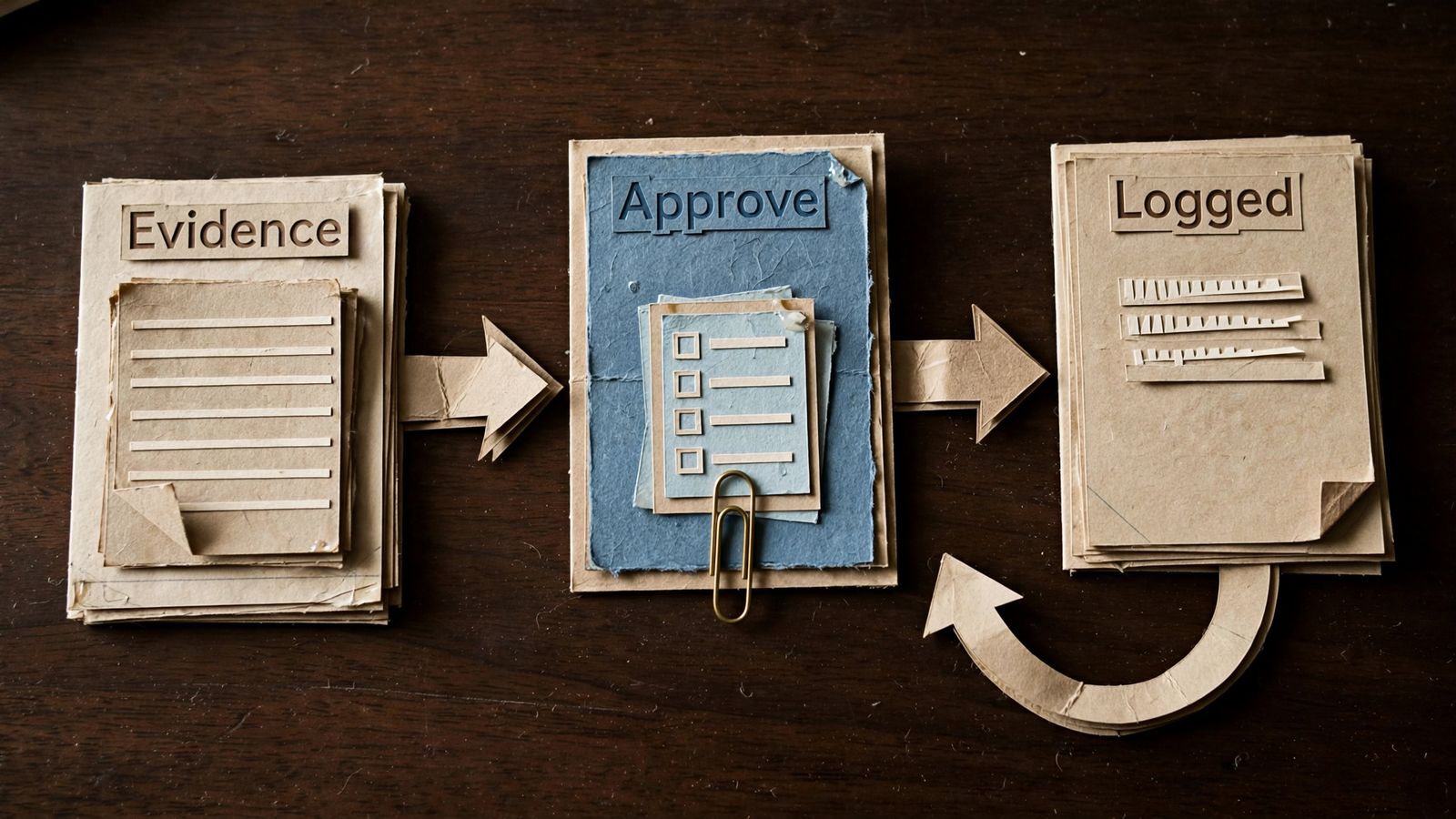
I want five lines I can check, not a screenshot or a long methods paragraph. Ask for a compact evidence ledger with every answer:
- Source: Which account or property supplied the numbers?
- Pull time: When did ChatGPT retrieve them?
- Filters: What dates, campaigns, and conversion actions did it include?
- Raw totals: What were the spend, conversions, and revenue for each period, as applicable?
- Math: What formula did it use, with the actual numbers filled in?
If ChatGPT can’t fill a line, I want to see the gap. A sentence about auction pressure doesn’t help if the raw totals don’t even produce the headline CPA. When an answer makes several claims at once, I keep the wording intact and check each claim separately. Is it supported as written? Does the evidence support a narrower claim? Does it conflict with the claim, or does it not address it at all? Relevant isn’t the same as supported.
Skip the elaborate audit prompt libraries. If you’ve already used groas to make ChatGPT read the numbers instead of guessing, this is the next layer: same live data, with a record you can rerun. No ledger, no approval.
Which totals do I reconcile before asking why?
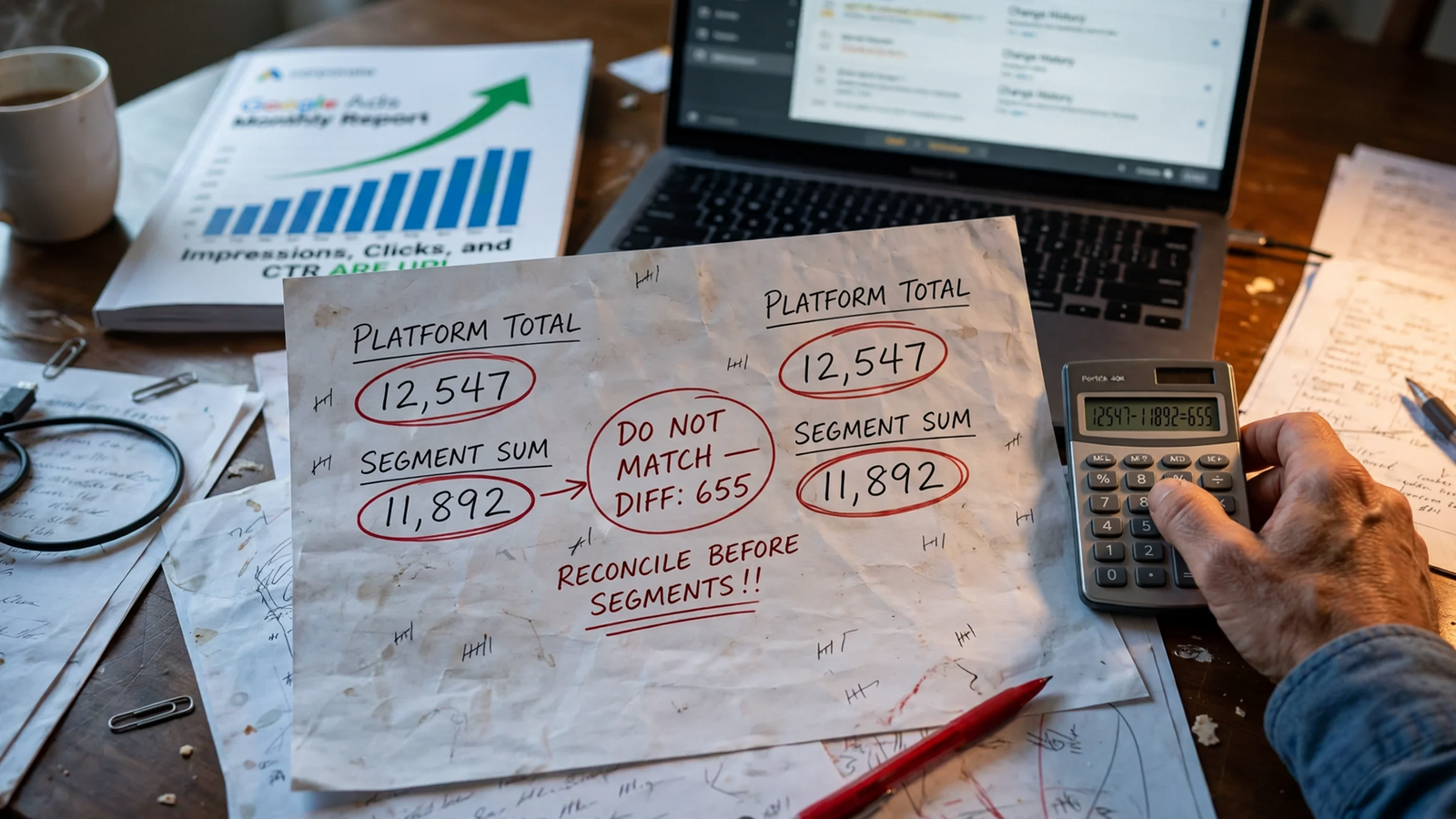
Recalculate the headline ratios from their inputs. CPA is spend divided by conversions. ROAS is revenue divided by spend. If ChatGPT says CPA rose 34%, I want spend and conversions for both periods, the division for each, and the comparison between the two results. If a blended number doesn’t tie out, check the currency and whether the assistant averaged campaign ratios instead of adding up the inputs first. Don’t troubleshoot the account until the arithmetic works.
That doesn’t mean every system should report the same total. Google and Meta have different attribution rules, and the same order can get credit in both. Adding their conversion totals doesn’t tell me how many orders the shop actually got. When I compare sources, I use CRM record counts, Google Ads conversions by conversion time for the primary action, and Meta’s stated attribution settings. I don’t sum Google and Meta conversions.
I use platform numbers to steer bids and deduplicated numbers to set budgets. Those are different jobs. I don’t ask one total to do both.
Why did CPA move? What would change my mind?
An observed change is not an explanation. “CPA rose 22% week over week” is an observation. “CPA rose because competition increased” is a hypothesis. The second sentence needs evidence the first one can’t supply.
Once the ledger checks out, I use this prompt: For each explanation, list the supporting observations, competing explanations, and the evidence needed to distinguish them.
Say spend held flat and conversions fell 18% across two brand campaigns after a landing page swap. The timing makes a conversion-rate problem worth checking. It doesn’t tell me whether the new page converted worse, tracking broke, or a budget cap limited the ad group that had carried volume. I’d put it in three columns:
| Supporting observations | Competing explanations | Evidence needed to distinguish them |
|---|---|---|
| Spend held flat, and conversions fell after the page swap. | The new page converted worse; tracking broke; a budget cap limited volume. | Check the landing page change log, conversion action volume by conversion time, and impression share lost to budget on the affected campaigns. |
The change log helps establish timing. The conversion records and budget data help test what else could account for the drop. If ChatGPT can’t tell me what would count against its preferred explanation, I don’t approve a fix on the strength of it.
What does one CPA investigation look like from pull to proposal?
Take a hypothetical account spending $20k a month. Compare the last 14 days with the prior 14, with the same weekdays in each block. Spend holds at around $9,800 per period, but conversions fall from 312 to 241. CPA goes from about $31.40 to $40.66. The account lost 71 conversions on roughly the same spend. That’s what I know. Here’s what I ask ChatGPT to do next:
- Pull comparable periods through groas. Attach the contract and use the same conversion actions, attribution settings, and reporting level in both periods. Keep Google and Meta totals separate.
- Find where the loss sits. Which two or three campaigns account for most of the 71 lost conversions? Show spend, conversions, and CPA for each campaign in both periods. I want to see that breakdown before I listen to an account-wide explanation.
- Inspect what changed in those campaigns. Look for budget caps, bid target edits, shifts in search terms, landing page swaps, and tracking gaps by conversion time. Leave campaigns that don’t explain the drop out of this pass.
- Set the explanations against each other. Flat clicks and a sudden drop in reported conversions make a tracking break worth checking. Lost impression share on the campaign that used to carry volume makes a budget constraint worth checking. Neither tells me enough on its own.
- Ask for the check that separates them. Compare conversion-time counts with CRM records for signs of a tracking gap. Check whether impression share lost to budget rose on the same campaigns that lost volume. If neither check gives me a reason to favor one explanation, I skip the edit.
What am I actually approving?
When a check supports one explanation, I ask for one edit with a named target and a review window. The proposal needs the entity name and ID, the current and proposed settings, the reason that specific change should affect CPA, and when I’ll check it. “Optimize the account” isn’t an action I can verify.
Say the evidence points to a budget cap on the campaign that used to carry volume. I’d ask ChatGPT to propose an increase of a stated amount on that campaign alone, so it has room to recover volume. Keep the bid target fixed, pause nothing account-wide, and recheck after seven full days of conversion-time data. I want to see whether volume comes back and what happens to CPA, not try to untangle a budget change from a bid change I made at the same time.
I approve the edit separately in ChatGPT, then check what actually landed in the groas action log. The log records every change and its reason, and I can undo a change in one step. Write access in ChatGPT depends on the plan and admin setup; admins can keep it read-only. Either way, if I can’t point to the entity, the edit, and the review window, the proposal isn’t ready.
How do I save this so someone else can rerun it?
Save the contract and the ledger together somewhere the team can find them. I put the contract first, then the source, pull time, filters, raw totals, and math. I keep the three-column check with them so the next person can see where the numbers end and the explanation begins.
Two weeks later, a teammate should be able to rerun the question with the same contract and get comparable figures or a clear reason they differ. A persuasive chat transcript won’t tell them which filters to reproduce if the assistant never wrote them down. If you’re choosing a reporting setup, I’d compare three ChatGPT reporting routes by how easily you can spot errors. Pick the one where a wrong total is easy to spot, not the one where it reads smoothly.
What do I do today?
I skip autopilot and bulk edits until one manual pass reproduces cleanly. groas can run around the clock once I switch it on, but it’ll keep applying the definitions I gave it. If I got those wrong, running faster just gives me more to undo.
Rerun one CPA question you already asked this month. Open ChatGPT with groas connected, paste the reporting contract, ask for the ledger, and divide spend by conversions yourself. Make it fill the three columns before you approve anything. Save the contract and ledger in the doc your team will reuse. Get that one answer reproducible before you let it change the account.





