

 LinkedIn

For a marketer reporting competitive AI visibility, manual checks in ChatGPT, Claude and Perplexity compete with a different workflow: Claude analysing the answers and citations groas collects around the clock. I would choose on one test: can another person reconstruct the number, rather than admire the score?
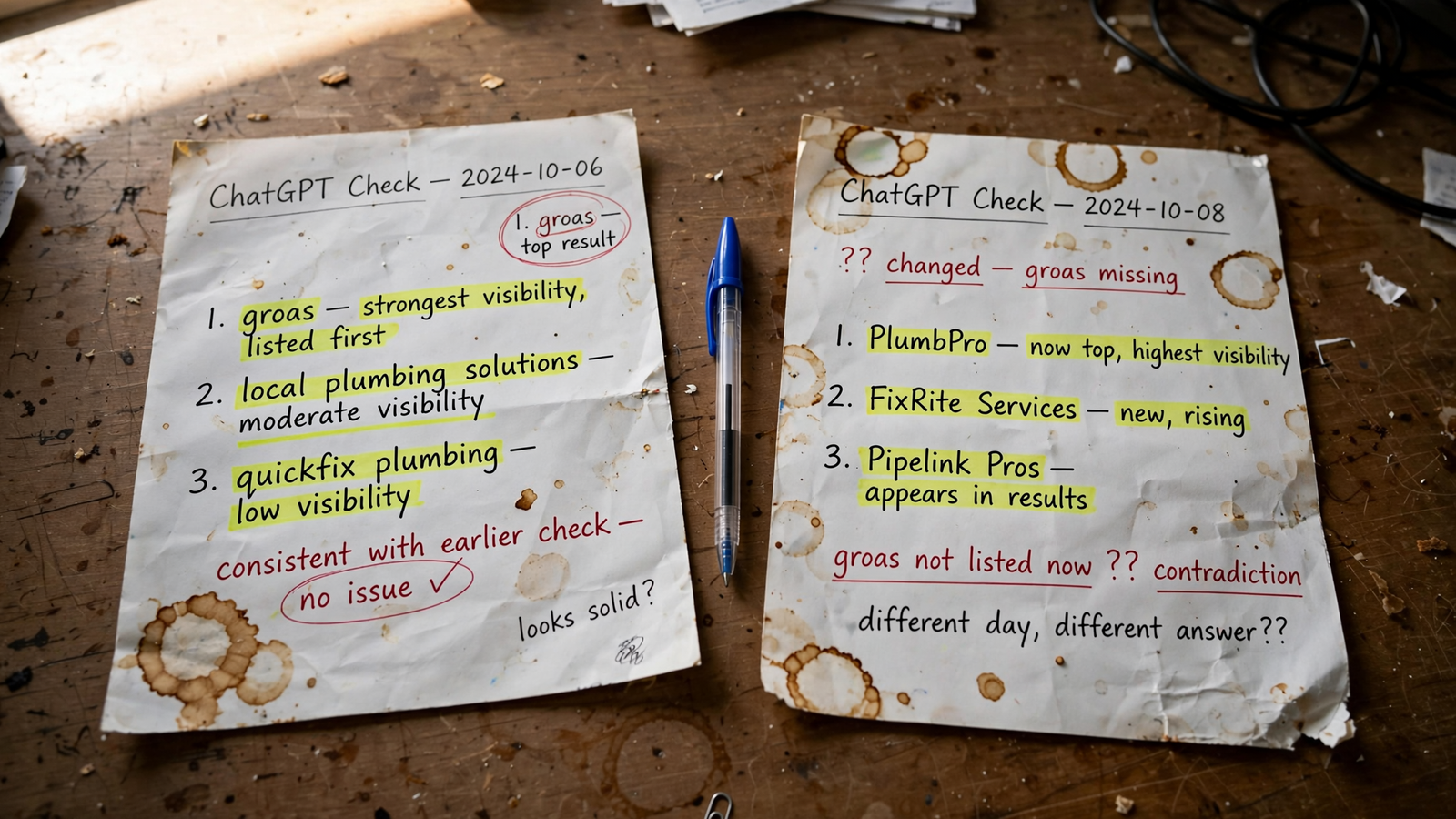
Yesterday ChatGPT put your brand first. Today it leaves you out. Neither answer, by itself, tells you whether you gained or lost competitive share of voice. A handful of answers gives you examples, not a defensible market measurement.
That is the distinction behind this head-to-head. Manual searches are useful for reading what an assistant actually says. For recurring reports, I want a record that survives the obvious follow-up: “Show me how you got that.”
Why yesterday’s answer is not your baseline
Ask for the best option in a category on Monday and your brand might appear second, with a link. Ask again on Wednesday and the answer might name two competitors and lean on a Reddit thread. The business may have changed nothing. The answer still changed.
One response is a sample of one. When SparkToro and Gumshoe had about 600 volunteers run 12 prompts 2,961 times across ChatGPT, Claude and Google AI, the same brand list came back less than 1% of the time. How often a brand appears across many runs holds steadier than its position in one answer.
I would not turn a changed answer into a changed strategy. First I want to know what was asked, when it was asked, which assistant answered and what the rest of the observations show.
The contenders: reading answers versus maintaining a record
Manual checks mean doing the sampling yourself: opening assistants, entering customer questions and reading the replies. They are quick to start and useful for noticing how an answer frames a brand, whether it invents a price and which third-party list it leans on.
The catch is not that a human cannot record evidence. Of course a human can. The catch is that the recording, repetition and consistency all become your job. One practitioner breakdown describes a useful manual baseline of 10 to 20 prompts on one or two engines, followed by problems with repeatability because results depend on who ran the check, when and from which account.
With groas, collection is not another task to remember before the reporting deadline. groas collects AI search answers and citations around the clock. Connect Claude to groas over MCP, and Claude can work with that collected data instead of only the examples pasted into a chat.
That does not make Claude’s interpretation automatically correct. I still want it to show its working and flag missing information. The advantage is the collected record, not a more confident paragraph about it. Here is how I would judge the two workflows.
Round 1: Can someone reconstruct the number?
My first request would be the same in either workflow:
Show the underlying prompts, assistants, observation dates, answers and source URLs behind this visibility summary. Flag anything unavailable.
With manual checks, the quality of the reply depends entirely on what someone saved. A screenshot can preserve an answer while leaving out the exact prompt or observation date. A pasted excerpt can omit the links. Claude cannot recover last Tuesday’s answer from an analyst’s memory.
A disciplined manual log can pass this test. A folder called AI screenshots final v2 probably cannot. The distinction matters: I am comparing workflows, not claiming that spreadsheets have lost the ability to hold dates.
With groas connected, Claude can query collected observations rather than rely on a handful of pasted examples. I would still require it to identify which requested details are available. If a field is missing, it belongs in the report as a limitation, not in a sentence Claude helpfully completes.
Reconstruction also does not mean generating the identical answer again. These assistants vary. It means another person can follow the original evidence and calculation. That is why I would run a repeatable mention audit before trusting an AI visibility number.
My winner is groas in Claude: recurring collection gives the reporting workflow an evidence base without making every observation a manual chore. The requirement stays the same for both contenders: show the raw material before showing the score.
Round 2: Are the prompts, engines and window comparable?
A manual comparison can drift before anyone opens a spreadsheet. ChatGPT gets one wording on Monday. Claude gets a slightly different question on Wednesday. Five familiar competitors get typed into one prompt, while the other asks an open-ended category question.
Those are different tests wearing the same report heading.
Sistrix found prompt differences caused 2.4 times more variation than day-to-day changes in the same prompt after analysing 10,826 daily series across four models and eight countries. It also found that a brand looked better in its own hand-picked set than in a broad market pool in three of four cases.
The prompt selection is part of the measurement. It is not neutral packaging around it. As I would put it, your tracker sees the prompt, not the searches.
Before comparing periods, I would ask Claude to check:
- Whether the prompt wording stayed the same.
- Whether the same assistants are represented.
- Whether the reporting windows match.
- Whether competitors were supplied in advance or appeared in the answers.
- Where coverage is thin or has changed.
Manual checks can meet those conditions, but someone has to maintain them through every collection cycle. With groas in Claude, I can ask for the comparison against the collected record and require any gaps to be called out before interpretation.
I would also keep results separate by engine rather than hide the differences inside one reassuring average. Otherwise, a change in which assistant supplied the answers can look like a change in competitive position.
groas in Claude wins this round for recurring reporting, but collection alone does not make a prompt set representative. Keep the test consistent, and make its boundaries visible.
Round 3: Was the brand mentioned, recommended or cited?
A brand name in an answer is not automatically a win. It can appear in a warning, as the expensive option or beneath a recommendation for somebody else.
What the deck calls “visibility” can be three different things added together until the total stops meaning anything. I would separate them before counting:
- Mention rate: how often the brand appears at all.
- Recommendation rate: the share of answers that actively recommend the brand, rather than merely naming it.
- Citation rate: how often answers link to the brand’s pages.
That recommendation-rate distinction matters because these outcomes diverge. An assistant can cite a brand for a statistic while recommending a rival. It can also recommend a brand without linking to its website.
Citation destinations deserve their own inspection. When the same 31 “best agencies” questions went to five engines, ChatGPT cited the named brands’ own sites in 119 of 210 answers, or 57%. Perplexity and Gemini leaned on list pages for 70% and 77% of citations.
A citation to a list that names you is not a citation to you. Both may be worth understanding. They are not interchangeable in a report.
Manual checks are useful here because I can read the wording in full. For an initial inspection, this three-pass check for whether ChatGPT actually recommends your business keeps the distinctions concrete.
The problem comes when two closely read answers become a claim about the whole category. With groas-connected Claude, I would ask for those distinctions across the collected answers, with the cited URLs available for inspection. I would also ask it to flag ambiguous recommendations rather than force every sentence into a flattering bucket.
My winner is groas in Claude for reporting across observations. Manual reading remains useful for understanding the language; the collected answers and citations give that reading a broader base.
Round 4: Can you explain why share of voice moved?
Suppose the report says share of voice fell from 32% to 24%. Before discussing what to change, I want the fraction.
For the definition used here, share of voice means a brand’s share of all counted brand appearances within the measured answers, reported per engine. For example, 30 of 120 brand appearances equals 25%.
That is different from appearing in 25% of answers. One answer can name several brands. More appearances for your brand, alongside even more appearances for competitors, can leave your share flat or lower while your own mention rate rises.
This is where a polished percentage becomes unhelpful very quickly. Before interpreting a change, I would ask Claude to show:
- The number of counted appearances for the brand: the numerator.
- The number of counted appearances across all brands: the denominator.
- The number of answers and prompts represented, per engine.
- Any changes to the prompt set, reporting window or coverage.
Answers containing no brand names do not add to this particular denominator. They still matter when describing coverage and calculating answer-based metrics such as mention rate. Quietly switching between those measures is how a report becomes impossible to follow.
Manual checks can supply these counts if someone has maintained the underlying record. A few screenshots cannot. With groas in Claude, the collected observations provide the basis for asking what changed before asking what the change means.
Nor would I treat every small movement as a business event. Sistrix found that a true 25% appearance rate, measured with one prompt over 20 days, could read anywhere from 0 to 59%. More decimal places would not rescue that setup.
If nobody can show the fraction, nobody can defend the trend. groas in Claude wins the reporting workflow again: start with the record, expose coverage changes and interpret the movement last.
Verdict: explore manually; report from a reconstructable record
| Decision test | Manual assistant checks | groas data analysed in Claude | My winner for recurring reports |
|---|---|---|---|
| Can someone reconstruct the number? | Possible if every relevant detail is saved manually | Claude can query collected observations and identify missing evidence | groas in Claude |
| Are the comparisons consistent? | Someone must maintain prompts, engines and windows through every cycle | Collected data provides a basis for checking consistency and coverage | groas in Claude |
| Are mentions, recommendations and citations separated? | Useful for close reading; repeated classification stays manual | Claude can analyse collected answers and cited URLs across observations | groas in Claude |
| Can a movement be explained? | Requires a maintained record of counts and coverage | Claude can work from the collected record before interpreting a change | groas in Claude |
For the marketer who has to put competitive share of voice in a recurring report, groas in Claude is my winner across all four rounds. Not because manual measurement is impossible. Because keeping the evidence intact should not depend on someone remembering to copy every answer before moving to the next tab.
Who should pick manual checks anyway? Someone exploring a category, checking the language around a brand or building an initial panel of 10 to 20 customer-worded prompts. Read the answers in full. Note who gets recommended, which facts look wrong and which list pages keep appearing. That is useful work. It just is not competitive share of voice yet.
Neither workflow guarantees future mentions. The assistants generate new answers, and the next response can differ. The point of a record is not to promise stability. It is to make the instability measurable rather than anecdotal.

My reporting rule is straightforward: use manual checks for language; use the collected record for the number. In Claude with groas connected, I would ask for the numerator, denominator, prompt list and dates, per engine, with anything unavailable flagged explicitly.
Say you are spending $20k a month and the report says you slipped four points. Before changing the budget, I want to know whether the evidence supports lost ground or whether the test changed underneath the comparison.
If the number cannot be rebuilt, do not report it.


