

 LinkedIn

A Meta report can show purchase ROAS climbing from 3.4x to 4.1x while the store’s economics get worse. The report counts checkout value; the refunds arrive three weeks later, and the preorders have not even shipped.
For a store with returns or delayed fulfillment, that gap can swallow the apparent win. Say you spend $20k a month and report 4.0x purchase ROAS. If returns wipe out a fifth of that purchase value, you are at 3.2x before product, shipping, or advertising costs.
Free tool: the ROAS Calculator works out your return on ad spend, your break-even ROAS and the budget a revenue goal takes.
The hiring test is whether a provider can separate attributed purchase value from retained revenue and contribution. Not whether they know more advertising acronyms. I use the terms below to make that distinction explicit. Take them into your next agency call and make the candidate label the math.
Purchase event
A purchase event is a message your store sends to Meta saying someone completed a checkout.
It does not mean the order shipped, the customer kept it, or the sale made you money. Treating that event like a cash register ring is tempting. For return-heavy stores, it is closer to a reservation.
The distinction is not academic. NRF data reported for 2025 puts retail returns at 15.8% of purchases. Your own return rate matters more than the average, but the basic problem is the same: checkout happens before you know what survives.
My shorthand: Meta sees the checkout. Your order system sees what the customer kept.

Purchase conversion value
Purchase conversion value is the dollar amount your store sends to Meta with the purchase event.
Your pixel or Conversions API sends a value, and Meta uses that value in its reporting. The important question is what your implementation includes. Is it the checkout total? Does it reflect discounts? What happens when the customer cancels?
What the deck calls signal fidelity, I call checking what went into the number before treating it as gospel. A checkout-value report does not automatically become a retained-revenue report when returns arrive. Nor does purchase value tell you what the product cost.
I ask providers to name the value they optimize toward: raw checkout value, revenue adjusted for cancellations and expected refunds, or contribution. Those are different targets. If the answer is simply “purchase value,” the question remains unanswered.
Purchase ROAS
Purchase ROAS is attributed purchase conversion value divided by ad spend.
The metric uses purchase conversion value divided by amount spent, with purchases counted under the applicable attribution setting. It measures the relationship between reported purchase value and advertising cost. It does not subtract the cost of making and delivering the goods.
Returns create another gap. If the report retains checkout value after refunds, the numerator stays flattering. A reported 4.0x becomes about 3.2x after a 20% reduction in purchase value, before product costs.
That does not make purchase ROAS useless. It makes it incomplete.
My question is not “Can you get me a 4.0x?” It is “What do you subtract from reported purchase value before you call that 4.0x good?” Ask where those adjustments appear in the reporting. Do not accept an acronym as proof that refunds have been reconciled.
Attribution window
An attribution window sets how long after an ad interaction a purchase can receive credit.
Change the window and you can change reported ROAS without changing the orders customers placed. The same sales can produce lower reported ROAS under 1-day click than under a broader window.
A wider window allows more earlier interactions to qualify for credit. That is a reporting change, not necessarily an improvement in the store’s economics. I do not want a provider presenting a new measuring stick as better performance.
Freeze the reporting window in writing. Show changes as footnotes, not victory laps. Before comparing two ROAS figures, check that they use the same attribution rules.
Conversion date versus order cohort
Conversion-date reporting organizes credited purchases by date; an order cohort groups orders from a period so you can track what customers eventually keep.
The distinction matters when the checkout and its consequences land in different months. Your March orders can look excellent before April’s refunds arrive. Meanwhile, Shopify records returns as negatives on the date they are processed, rather than the original order date.
That means this month’s ad report and this month’s store report may be describing different slices of the business. Putting them beside each other does not automatically reconcile them.
I want the provider to follow the original orders through the return period. For a 30-day cohort view, that means showing what remains of those orders at 30 days, not subtracting an unrelated batch of this week’s refunds.
Ask: “Which date basis does this report use, and how do you track the same orders after returns?” If they cannot answer, the tidy monthly comparison is not as tidy as it looks.

Gross sales, net sales, and collected cash
Gross sales measures product sales before deductions, net sales subtracts discounts and returns, and collected cash is money received.
These are not interchangeable labels for the same pile of money. Shopify defines gross sales as product price multiplied by quantity before taxes, shipping, discounts, and returns. Net sales subtracts discounts and returns from that gross figure.
Collected cash answers a different question. A customer can pay for a preorder before you fulfill it. That cash is real, but so is the obligation attached to it. Preorder payments can sit as a liability until the goods are handed over. The bank balance is not permission to treat the entire payment as earned profit.
I want every report to distinguish:
- Gross sales: the product value before discounts and returns.
- Net sales: the product value after those deductions.
- Collected cash: the money received, including payments attached to unfulfilled orders.
Make the provider name which one sits in the numerator. A 4.5x built on gross sales can be a 3.0x on net sales. Neither figure, by itself, tells you what remains after costs.
New-customer CPA versus purchase CPA
Purchase CPA divides spend by counted purchases; new-customer CPA divides the same spend by first-time buyers.
A purchase is not necessarily a newly acquired customer. Purchase reporting can include both new and repeat buyers, which makes a blended purchase CPA look cheaper than the cost of acquiring first-time buyers when repeat orders are included.
Say you spend $100k at a $28 purchase CPA. That is roughly 3,570 purchases. If 40% come from existing customers, dividing the same spend by the remaining first-time buyers puts new-customer CPA at about $47.
The $28 is not fake. It answers a different question.
I ask for both numbers and the definition of new: what order history does the provider check, and how do they identify a first-time buyer? Without that definition, “new-customer acquisition” can become a very expensive label for selling to people who already know you.
Get the purchase CPA, the new-customer CPA, and the rule separating them. One flattering average is not enough.

Contribution before and after advertising
Contribution before advertising is what revenue leaves after product and other variable selling costs; contribution after advertising subtracts ad spend as well.
Your margin takes shape in the warehouse and at the payment processor, not in Ads Manager. A useful calculation accounts for product cost, fulfillment, payment and platform fees, and expected refunds.
Say you sell an $80 hoodie with $28 in product and freight, $4 in fees, and a 15% refund reserve. That leaves about $36 before ads, not $80. Advertising has to come out of what remains.
The common mess is subtracting a cost twice or failing to subtract it at all. If a refund reserve already reduces the revenue used in the calculation, do not quietly deduct it again. If an agency fee appears in the margin calculation, make that treatment visible rather than burying it in another line later.
I want the subtraction shown in order:
- Start with the stated revenue basis.
- Deduct the relevant product and selling costs, with returns accounted for once.
- Show contribution before advertising.
- Subtract ad spend once to show contribution after advertising.
Ask for both contribution lines. Without them, a ROAS target can float free of profit.

Break-even ROAS
Break-even ROAS is the revenue-to-ad-spend ratio at which contribution after advertising reaches zero.
Your contribution margin sets the floor. The formula is revenue divided by contribution before ads, or 1 divided by contribution margin. The revenue basis must match the one used in your ROAS calculation.
The arithmetic is simple:
- 60% contribution margin: 1.67x break-even ROAS.
- 50% contribution margin: 2.00x.
- 40% contribution margin: 2.50x.
- 25% contribution margin: 4.00x.
A $60 order at 40% contribution margin leaves $24 available for advertising before that contribution reaches zero. Spend more than $24 acquiring it and the order does not cover the advertising cost.
That is why a 3.5x can look heroic in an agency deck and still lose money when your margin requires 4.0x. An industry benchmark cannot do this subtraction for you.
Build your own profit floor from margin and repeat behavior. Then ask the provider: “What is my break-even number after returns, and does it use the same revenue basis as the ROAS you report?”

Reconciliation
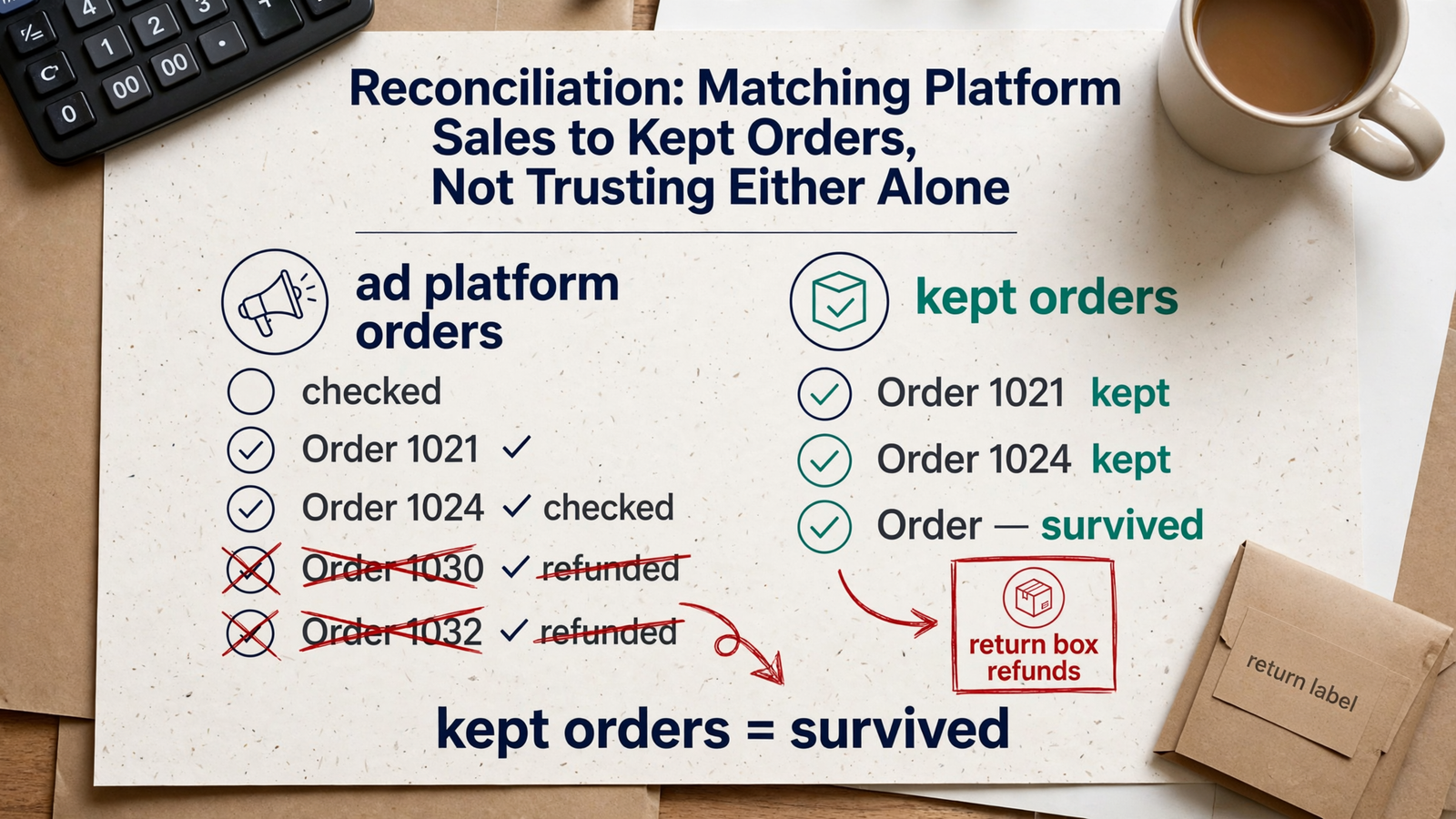
Reconciliation means matching platform-reported purchase value to your order records and explaining the differences.
This is where the preceding terms stop being vocabulary and become work. Pull the attributed purchase value with its reporting rules. Compare it with the corresponding orders and their retained revenue. Then write down the gaps rather than pretending the totals should magically match.
The explanation should identify:
- Refunds and cancellations not reflected in the platform figure.
- Preorders that have been paid for but not fulfilled.
- Different attribution windows or date bases.
- Orders whose return period has not yet closed.
Preorders make the distinction especially sharp: Meta can report a purchase while the business still owes the customer the goods. The checkout is a signal. It is not the end of the transaction.
I walk through a two-order example where cohort margin changes the scaling decision because this is the point where apparently good advertising can become a bad spending decision.
No reconciliation, no scale decision. I do not want a larger budget justified by a numerator nobody has checked.
The agency-language test
The agency-language test is a five-question check of whether a provider distinguishes attributed value from retained revenue and contribution.
I ask these in order. The sequence forces the provider to define the number before defending the result.
- Show purchase ROAS and retained-revenue ROAS side by side. Use the same order cohort and make the attribution rules explicit.
- Name the numerator. Is it raw checkout value, revenue after refunds, or contribution? Where are the adjustments made?
- Name the date basis. Is this platform reporting, an order cohort tracked for 30 days, or something else? Do not blend them without explanation.
- Show purchase CPA and new-customer CPA. Tell me exactly how you define a first-time buyer.
- Show my break-even ROAS and your operating target. Include returns and product costs, and show the subtraction.
A straight operator answers with definitions and numbers. They do not need another slide about holistic performance.
Someone who answers with more acronyms is previewing the next six months of reporting. The screenshot rises, the finance sheet falls, and the explanation becomes seasonality, creative fatigue, or what the deck calls headwinds. I call it getting paid to move a numerator you do not get to keep.
I laid out who I would hire for Meta ads when returns make ROAS misleading because the distinction changes the hiring decision. I want regular reconciliation, restraint while cohorts mature, and a named person accountable for the economics.
If a provider will not put their name next to the retained-revenue number, do not give them your card limit.
ROAS
ROAS, without a stated revenue basis, tells me too little to judge performance at a store with returns or preorders.
This is the term I would retire in its unqualified form. Without a numerator, date basis, and data source, the number could describe gross purchase value or retained revenue, platform attribution or an order cohort. Those differences are the argument, not the footnotes.
That is how a 4.1x gets applauded while contribution falls.
I want labels such as purchase ROAS or 30-day retained-revenue ROAS, with contribution shown separately. The provider insisting on one ROAS to rule the account is not simplifying the decision. They are hiding which calculation supports their fee.
That is also the standard I would apply to groas. Its action logs and named human strategist put the emphasis where I want it: visible execution and someone responsible for direction. But the hiring conversation still needs the numerator, the reconciliation, and the profit floor. A better operating model should make those answers clearer, not make the questions disappear.
Print this glossary. Make the next candidate label every numerator on the call. Keep the one who answers in your numbers, not theirs.


