

 LinkedIn

By December 31, 2028, I predict buyers will fail a ChatGPT marketing tool that makes them rebuild their setup when they switch assistants. The test is whether Claude or Gemini can see the same ad accounts, read back the last approved change, and tell you which spend rules still apply without making you start over.
I spent most of the last decade rebuilding Google Ads structures by hand when a client changed its process. New spreadsheet, new naming convention, same keywords. Watching a team connect the same account separately inside three assistants gives me the same feeling. The assistant changed. The work didn’t need to repeat. I used to tell clients switching costs were about contracts. I was wrong. They’re about who holds the setup you’ve already paid to build.
The assistant can change. The setup shouldn’t.
Your AI is the brain. groas is the hands and the data. I connect Google Ads, Meta, Bing, and the site once, then use ChatGPT, Claude, Cursor, or Gemini to read and act on that setup through groas. It also collects the data an assistant can’t get on its own: competitor ads on Google and Meta and the funnels behind them, what customers say on Reddit, how AI answers describe the brand, and Semrush and Ahrefs data. The assistant can change without taking the accounts or the data with it.
Put the setup inside one assistant instead and a switch means reconnecting accounts, explaining budgets and guardrails again, and trying to remember what changed last week and why. I’ve paid that tax in agency work. It didn’t show up on an invoice. It showed up as three hours of rework and one bad pause nobody could explain.
This is a forecast, not a report on buyer adoption. I don’t have a survey that says buyers already shop this way. My bet is that as basic assistant access gets easier to obtain, buyers will stop treating access as the deciding feature. A new chat is easy to open. Rebuilding the work behind it is the part I’d put in the purchase decision.
Prediction 1: By December 31, 2027, most tools on a fixed shortlist will document how to switch
More than half of the tools on the shortlist will explain how to switch assistants without reconnecting every ad account. I’d take the tools in the marketing MCP roundup as it stands on publication day and score that same list at the end of 2027. The denominator doesn’t change. A directory count of 1,091 connectors on November 8, 2026, including 173 in sales and marketing, tells me how crowded the shelf is, not whether the tools on it got easier to leave.
There’s already evidence that distribution is getting easier. PropellerAds entered Anthropic’s Connectors Directory with 39 tools across six groups, covering campaign creation, targeting, creatives, bidding insights, analytics, and account work. Connect with an API token and Claude can launch or pause campaigns and adjust bids by chat. That tells me a buyer can find a marketing tool and use it inside Claude. It doesn’t tell me what happens to the setup when the buyer leaves Claude.
The roundup found that most marketing servers could make changes and most worked in both Claude and ChatGPT, with exceptions such as Meta needing extra setup in ChatGPT. That’s the gap I’m betting vendors will close. MCP is an open standard, but authentication, feature support, and plan restrictions can still vary by client. A buyer should be able to tell from the docs whether adding the connector to a second assistant is all it takes, or whether the ad platforms need to be connected again.
If half or fewer of the tools on that original list document a switch that preserves the ad-account connections, I lose. Until then, I’d ask to see the switch itself. Two logos on an integrations page aren’t a demonstration.

Prediction 2: By December 31, 2028, most tools on that list will keep execution history outside the chat
The second assistant should be able to retrieve the same change record as the first. In ChatGPT, I’d ask for the last approved change, why it was made, and what it affected. I’d ask it to pull the record from the connected tool. Then I’d open Claude or Gemini and ask the same thing. If I get the same record without pasting the old chat, history survived. If I get a guess, a recap, or a request for the transcript, it didn’t.
There’s already a precedent for keeping records outside the conversation. Meta’s official Ads MCP exposes activity logs you can filter by object, time, category, and user. The underlying Marketing API records the event type, object, time, actor, and app. That doesn’t mean every log contains the reason for a change. It does show why I’d start with an account record rather than a transcript. The same write-up makes the distinction plainly: a chat can tell you what someone meant to do. It isn’t independent proof of what happened. Check the final account state.
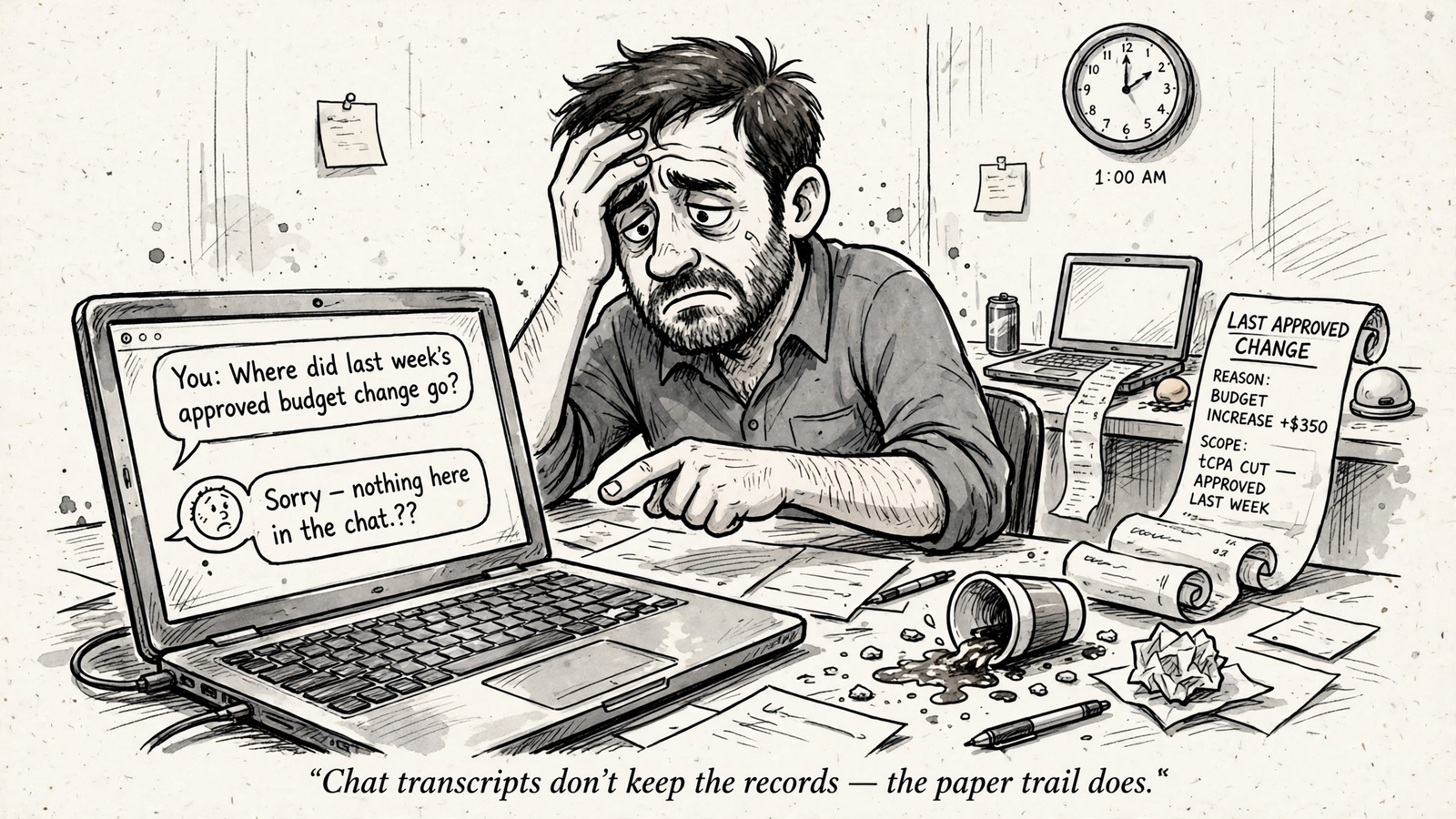
There are already tools that use one hosted URL across Claude, ChatGPT, Codex, and Cursor after the ad platforms are connected. That solves the connection half. It doesn’t necessarily tell the next assistant why somebody paused a campaign. Chats get deleted, assistants get swapped, and I still need to be able to explain a spend decision after both things happen.
I’ll score the same shortlist at the end of 2028. If half or fewer let a second assistant pull the change, its reason, and its scope from a shared record, I lose. I wouldn’t wait until 2028 to ask for that demo. If the vendor answers by showing me how to export a chat, I have my answer.
Prediction 3: By December 31, 2028, most tools on that list will say which rules survive a switch
A spend rule belongs in the setup, not in a sentence you typed last Tuesday. Daily caps, CPA guardrails, which campaigns autopilot can touch, and what requires explicit approval are rules I want to carry across assistants. “Don’t raise budgets over $200 without asking,” typed into one conversation, is an instruction in that conversation. I wouldn’t assume the next assistant knows it, and I wouldn’t let it find out by making a change.
Vendors already pitch pieces of this. Adspirer describes an account that works independently of the AI client, with one MCP URL across ChatGPT, Claude, Cursor, Codex, and Windsurf. It also says new campaigns start paused and budget changes require explicit confirmation. Those are useful details. The question I want answered in the docs is more specific: after I switch assistants, which of the rules I set are still in force, and which do I need to set again?
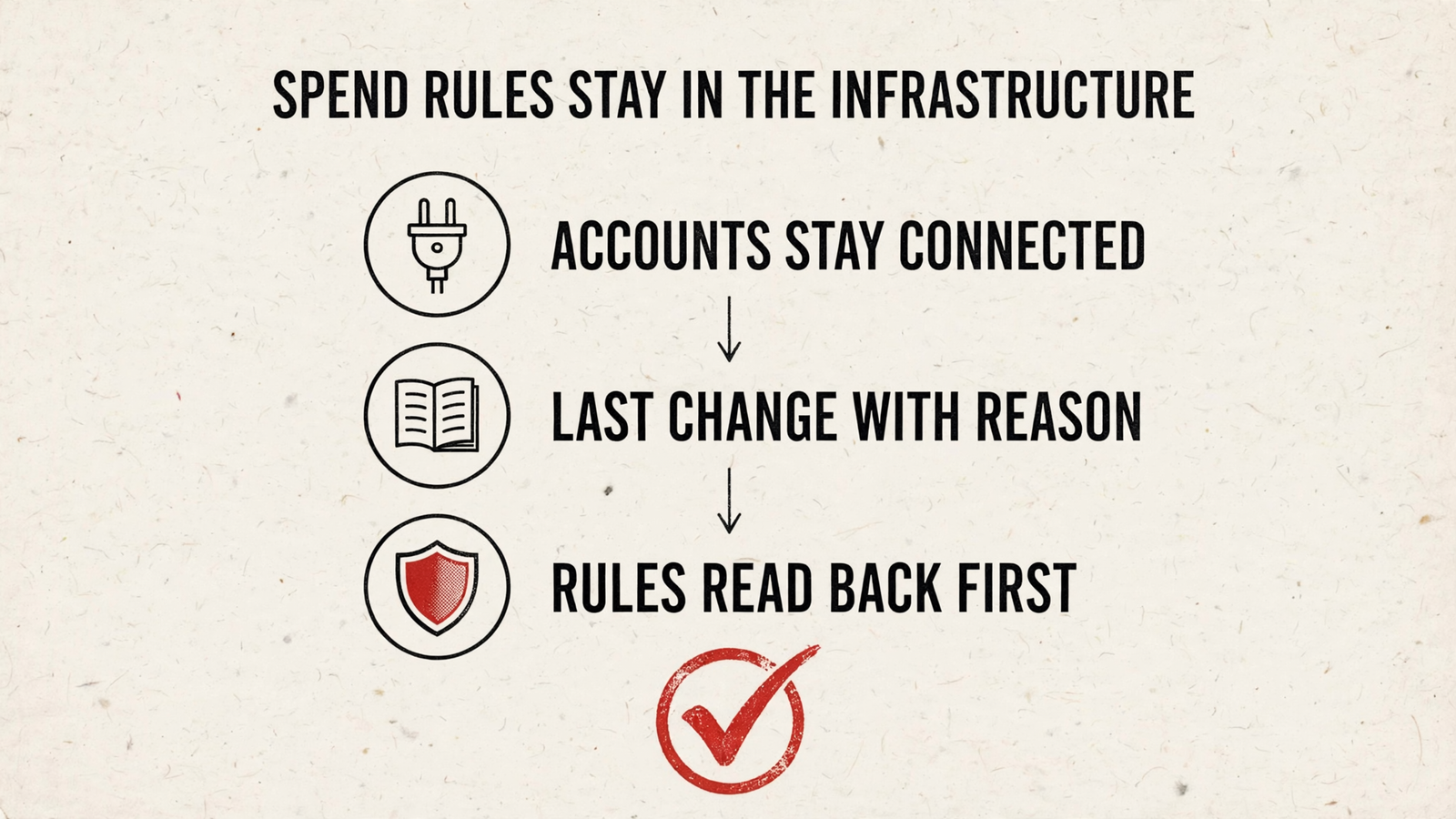
My test starts before the new assistant proposes a change. I ask it for the cap, the approval threshold, and what autopilot is allowed to touch. I compare the answer with what I configured. If it asks me to retype the rules or gives me a summary of the old chat, that doesn’t count. No readback, no approval.
If half or fewer of the tools on the original shortlist document which configured rules carry over by the end of 2028, this prediction fails. I’d buy what the vendor can document and show today, not what the roadmap says will arrive next quarter.
Why I’d run the test on groas now
With groas, I can connect the ad accounts and site once, add groas to ChatGPT, Claude, Cursor, or Gemini over MCP, and ask in plain English for a read, a change, or a new campaign. The accounts stay connected in groas. Changes are logged with a reason and can be undone in one step. Autopilot stays off until I turn it on. Once enabled, it works on ads, SEO, and AI search within the rules I set. groas Unlimited is $19 flat a month for the whole team, with unlimited teammates, ad accounts, and sites and every feature included. I’m paying for the setup, not for loyalty to an interface.

The accounts, change history, and configured rules live in groas. Private chats, files uploaded to one assistant, and that assistant’s memory don’t travel with them. I don’t need the second assistant to know everything I’ve ever typed. I need it to see the same account, explain the last change, and tell me the rules before I let it make another one. The Claude exit checklist puts that drill in order if you want to run it before committing budget.
Put the switch test in the purchase note
If I’m defending a $19 connection to finance, I don’t talk about AI. I talk about what the team has to redo. Say you’re spending $20k a month across Google and Meta. If one switch costs your team a day reconnecting accounts, retyping caps and approval rules, and reconstructing last month’s changes from chat exports, price that day against a year of the tool. The spend figure isn’t the argument. The argument is whether you have to pay someone to do the same setup twice.
I used to sell clients on whichever interface looked fastest in a demo. I was wrong about what to prioritize. The interface can change. The account connections, the log, and the rules are what I don’t want to keep rebuilding. I’d put three lines in the purchase note:
- Show me the same ad account in ChatGPT and Claude. Use the existing connection. Tell me if the switch adds a setup fee or a second per-account charge.
- Read back the last approved change in the second assistant. Give me the reason and what it affected, without pasting anything from the first chat.
- Read back the spend rules before making a change. Show me the cap, the approval threshold, and what autopilot can touch. Leave autopilot off until I enable it.
One exception: if you run one small account, work in a single assistant, and don’t plan to switch, I’d skip the drill and put the $19 toward creative testing. I’m making this bet for teams where a founder is in ChatGPT, a freelancer is in Claude, and a developer is running checks in Cursor. Every rebuild lands on whoever manages spend. That person doesn’t need a fourth place to look for the reason a campaign got paused.
Run the switch test this week, while it’s cheap. Connect once, open a second assistant, and ask for the account, the last change and its reason, and the rules that govern the next one. If all three come back clean, you bought infrastructure. If you have to paste them in from the old chat, you bought a demo tied to a chatbot. I’ll score portability on December 31, 2027, and history and rules on December 31, 2028, against the original shortlist. I’ll publish where I missed. You should score your vendor before the renewal.





