

 LinkedIn

A $2,000 Meta budget does not need four polished videos just because they look like more work. Should you pay for video at all? Smart operators disagree because statics buy more message tests, while motion can demonstrate something a still cannot. My starting position: when production money is scarce, buy statics first and make video earn its place.
The expensive mistake is confusing production volume with learning. You walk into an agency with a modest budget for Facebook and Instagram, buy a package with four videos, and wait for delivery. By the time those videos ship, you have tested two ideas and learned almost nothing.
I have managed both sides of this argument. Here is the strongest case for each, and how I would call it when the budget cannot absorb much waste.
The real trade-off: more messages or a better demonstration?
Say you are spending $2,000 a month on media. That is roughly $65 a day to learn what works. US small businesses commonly sit in that $1,000 to $3,000 media band, with management at another $500 to $2,000 a month and fresh creative often billed as a separate $800 to $3,000 line. Those distinctions matter when you can see what each line buys.
Media, management, and production are different purchases. You pay Meta from your own ad account; the agency fee stays separate. But if all three come out of one limited marketing budget, production competes with the money available to test it.
That constraint is what the debate is really about. I can turn $300 into 15 to 20 statics made in-house in two days. That same $300 buys me a fraction of one proper video. The question is not which format looks more impressive in a presentation. It is whether the richer demonstration is worth giving up those variations.

The case for statics: buy more chances to find the message
I used to tell clients video would win if we just gave it enough budget. I was wrong often enough that I stopped saying it.
The math on a small account broke me of the habit. A static built in-house runs $0 to $200 and ships in one to three days, while UGC video starts at $200 to $800 and professional shoots run $2,000 to $10,000-plus with one to three weeks of lead time, according to Stackmatix’s production-cost breakdown.
Even at $10,000 a month in media, a $3,000 shoot is a consequential purchase. You can end up with one or two assets instead of 15 to 20 statics. If the underlying message is wrong, expensive execution does not rescue it. It just makes the wrong message harder to abandon.
That volume gap is why the Biddyco read across $10.2 million in Meta spend matters. In the tighter 23-account cut, statics took 38% of spend among the top 10 ads at a median cost per result 10% below their own account averages. Video took 62% at 4% above. In 12 of those 23 accounts, the cheapest workhorse with meaningful spend was a static.
That does not prove statics beat video. It means a video-only rule has to explain those 12 accounts. Most cannot.
A second Biddyco cut makes the case from another angle. Across 848 top-spending ads in 17 US accounts, representing about $14.9 million in spend from June to August 2026, video took 68% of spend and statics took 32%. Yet statics claimed 40% of the top-50 ads and 43% of the top-10 ads.
The efficiency comparison is more useful than the format split:
- Statics cost 15% less per 1,000 impressions but drew 13% fewer clicks.
- In the median account, cost per purchase was 4% lower for statics.
- Statics won on purchase cost in 8 of the 12 accounts with enough purchases to compare.
These are observed results, not a controlled test. Biddyco compared formats within accounts and then took the median, so one large account could not dominate the result. The purchase comparison included only the 12 accounts where both formats cleared 20 purchases.
The mix also varied wildly: two accounts spent just 1% to 2% on statics, six spent more on statics than video, and one reached 76% statics. This is one agency reporting its own accounts, not a universal allocation rule.
Still, the static-first argument does not need a universal rule. It needs evidence that inexpensive assets can carry meaningful spend without sacrificing purchase efficiency. These accounts provide it. A modest budget does not have to buy expensive production to buy useful tests.
The case for video: some objections need to move
The strongest video advocate does not start with production value. They start with disbelief.
A cleaner shows a stained couch turning clean in 20 seconds. A plumber shows exactly where a leak hides before a quote. A shapewear brand shows the garment moving. In each case, motion does a job that a still struggles to do: it lets the buyer watch the claim happen.
Video earns its fee when demonstration closes a belief gap. That is a stronger argument than “people like watching video.” People like plenty of things they never buy.

Category changes the answer. The SparkUGC breakdown reports conversion lifts of 20% to 40% when the product needs to be seen in use, and points to video’s role in cold prospecting and native Reels and Stories placements. It also reports markedly different format mixes: SaaS and tech skew about 70% static, while beauty and shapewear run 80% to 97% video.
Those are not instructions to copy another category’s allocation. They explain why an operator selling a demonstration-led product can reasonably put video first. The format is doing part of the selling.
Meta supplies another example: ad sets with Catalog Product Video averaged 20% more conversions per dollar, according to Meta’s figures reported by Productsup. That is a case for useful product motion, not automatically a case for a polished agency shoot.
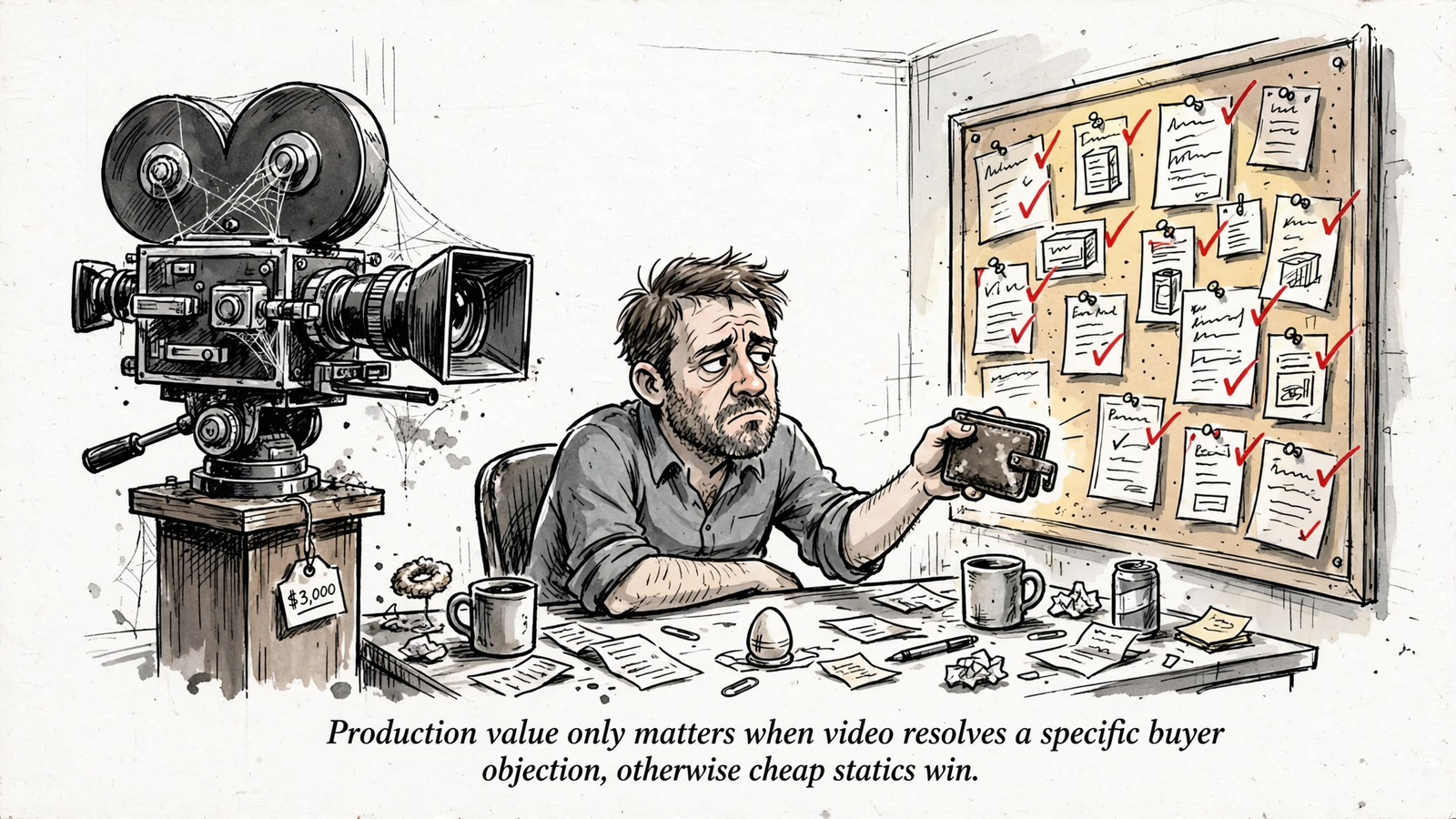
Production value by itself never earned its fee in any account I ran. What earned it was demonstration. The distinction is obvious when you put two concepts beside each other:
- A phone video shows the couch stain lifting.
- A $3,000 brand film shows a smiling family sitting on a clean couch.
Only the first directly addresses the objection: Will this work on mine?
Video runs 5 to 10 times the cost of a static in SparkUGC’s cost comparison. A video advocate’s best answer is not to deny that premium. It is to explain why the buyer needs motion before they can believe the offer.
When that explanation is clear, cheap statics can become false economy. More versions of an inadequate demonstration do not solve the missing demonstration. Buy the format that can do the job.
Before buying either format, make the agency show its testing plan
The format debate gets muddy when an agency sells a package rather than a plan. Four videos sound substantial. So do 20 statics. Neither count tells me how many distinct messages I will learn anything about.
Quotes also bundle different things. An agency-pricing roundup covering LYFE, WebFX, freelancers, and Darkroom includes an image-only menu at $500 a month plus $300 setup, an image-plus-video option at $1,400, freelancers at $20 to $45 an hour, and performance creative shops at $5,000 to $15,000 a month on top of media.
Those are not interchangeable offers. Before comparing the headline prices, I want to know what is actually inside them.
For an account spending under $3,000 on media, I would make the agency answer these questions in writing:
- How many new concepts and variations are included each month? Separate genuinely different messages from alternate edits of the same idea.
- How many are static and how many are video?
- Who writes the hooks, and who shoots or supplies the raw footage?
- How many revision rounds are included?
- Who owns usage rights after cancellation?
- What is the refresh plan when an ad fatigues?
- What happens in week three if nothing has won yet?
- Does reporting prioritize cost per qualified lead, purchases, and booked jobs—or CTR, views, and reach?
If the answers are vague, you are not buying testing. You are buying assets.
The difference matters most when the first batch disappoints. A revision clause and a clear next test are more useful than a beautiful handover folder. A video count without a testing cadence is a trophy, not a plan.
There is a longer version of this argument in groas’s Polished Brand Ads vs Lo-Fi UGC. The buying principle is the same: pay for proof, not polish.
My verdict: statics first, unless motion is necessary to believe the claim
For a business spending $2,000 to $3,000 a month on Meta with little production capacity, I rule for statics first. The deciding consideration is messages tested per dollar.
An account that can test eight hooks in statics this week has a learning advantage over one waiting three weeks for two videos to come back from edit. That advantage matters when the business cannot outspend anyone and cannot afford to make every new idea a production project.
Static-first is a starting order, not a creative religion. Here is the sequence I would buy:
- Start with the cheapest format that carries the proposition plainly. That might be a price, an offer, a before-and-after, or an answer to one objection.
- Test the message before paying to elaborate it.
- Add video when you can name the job motion does that the static cannot.
- Judge the result on qualified leads or purchases, not on how impressive the asset looks.
One starting allocation in the SparkUGC breakdown puts budgets under $5,000 a month at 80% static and 20% video, moving to 70/30 once two or three angles are proven. I treat that as a starting shape, not a spending commandment. The important distinction is between filming a message worth demonstrating and filming because the package includes videos.
A product that needs movement to make sense does not have to wait for a static to win. That is the exception built into the ruling. If the still cannot carry the claim, testing more stills is not discipline. It is avoiding the actual creative problem.
Keep the score on purchases, not applause
The performance evidence does not produce a single format champion. It does make a strong case for scoring the outcome rather than the attention.
The ATTN Agency figures summarized by SparkUGC show video earning about 73% more clicks, with CTR near 1.9% against 1.1% for static. Yet static acquires customers about 28% more cheaply: $34.50 against $48.20. More clicking is not the same as cheaper customers.
Placement and execution matter, too. In 15 Meta Reels split tests, 9:16 video with sound cut cost per result by 34.5% against image ads. Meanwhile, a 117,000-ad Confect analysis found video running 24% higher cost per purchase, with its author explicitly describing the finding as correlation rather than a controlled test. Both are covered in the Addogs review of the datasets.
The useful lesson is not that one dataset cancels the other. It is that a winning video in a specific placement does not justify buying video indiscriminately.
I score tests on cost per qualified lead or purchase using the same attribution basis. I make keep-or-kill decisions on CPA and keep CTR as a diagnostic. Views and thumb-stops are what the deck calls “engagement.” They are not the purchase.
So here is my ruling, no hedging: if your Meta budget is modest, buy statics first and make video audition for its place. Approve a video when you can finish this sentence: This buyer will not believe the claim until they see it move.
Until then, production polish takes money away from message testing without answering a necessary objection. Skip the agency selling video counts. Hire the one selling useful tests per month.


