

 LinkedIn

Your agency’s targeting skill is worth almost nothing on a modest Meta budget. If you spend $2,000 or $3,000 a month and pay someone to test interest stacks, lookalikes, and narrow personas, you bought the wrong skill.
I used to sell that job. I would walk into a kickoff with a spreadsheet of ten audiences and talk like the fourth one would change everything. I was wrong. Meta needs about 50 optimization events per ad set in the week after the last edit to exit learning. On a small budget, you cannot feed five ad sets that much signal. They sit in Learning Limited, costs wobble, and everyone blames the creative.
That is the part agencies will not tell you: below roughly $5k a month, targeting is not a lever. It is a tax. Every extra ad set slices the same thin budget into thinner learning. The work worth paying for is broad delivery, enough creative to give Meta something to match to the right person, and conversion data clean enough to learn from. Below a certain spend, the answer is simpler: do not hire a manager yet.
The audience-testing pitch sells the wrong work
The pitch always sounds the same. We will test eight audiences in phase one, find winners in phase two, then scale. Interest stacks. Broad plus lookalike. Competitor conquesting. The deck has a little pyramid diagram and the word diversification, like your $2,500 a month is a hedge fund.
Here is what that testing buys you. Changes to targeting, creative, or the optimization event, adding an ad, and even a 7-day pause can reset learning for an ad set. The agency promising constant changes on a small account may also be promising constant restarts. You pay a retainer to keep moving the finish line.
Creative changes can carry that cost too. The difference is that a new ad can give people a better reason to respond; a fresh interest stack usually just divides the same budget again. Spend your limited resets on better messages, not another audience pyramid.
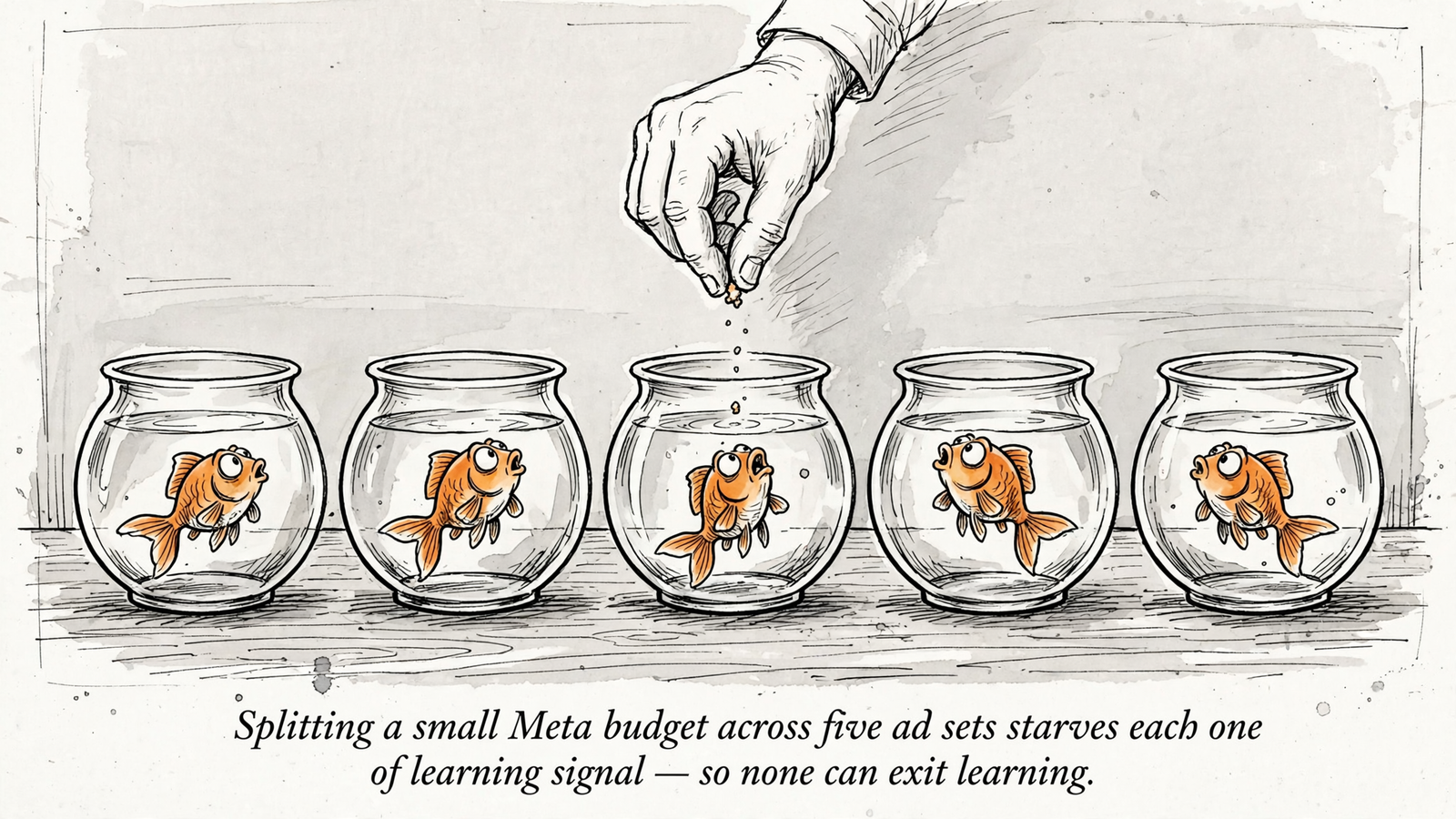
Five ad sets need five times the signal
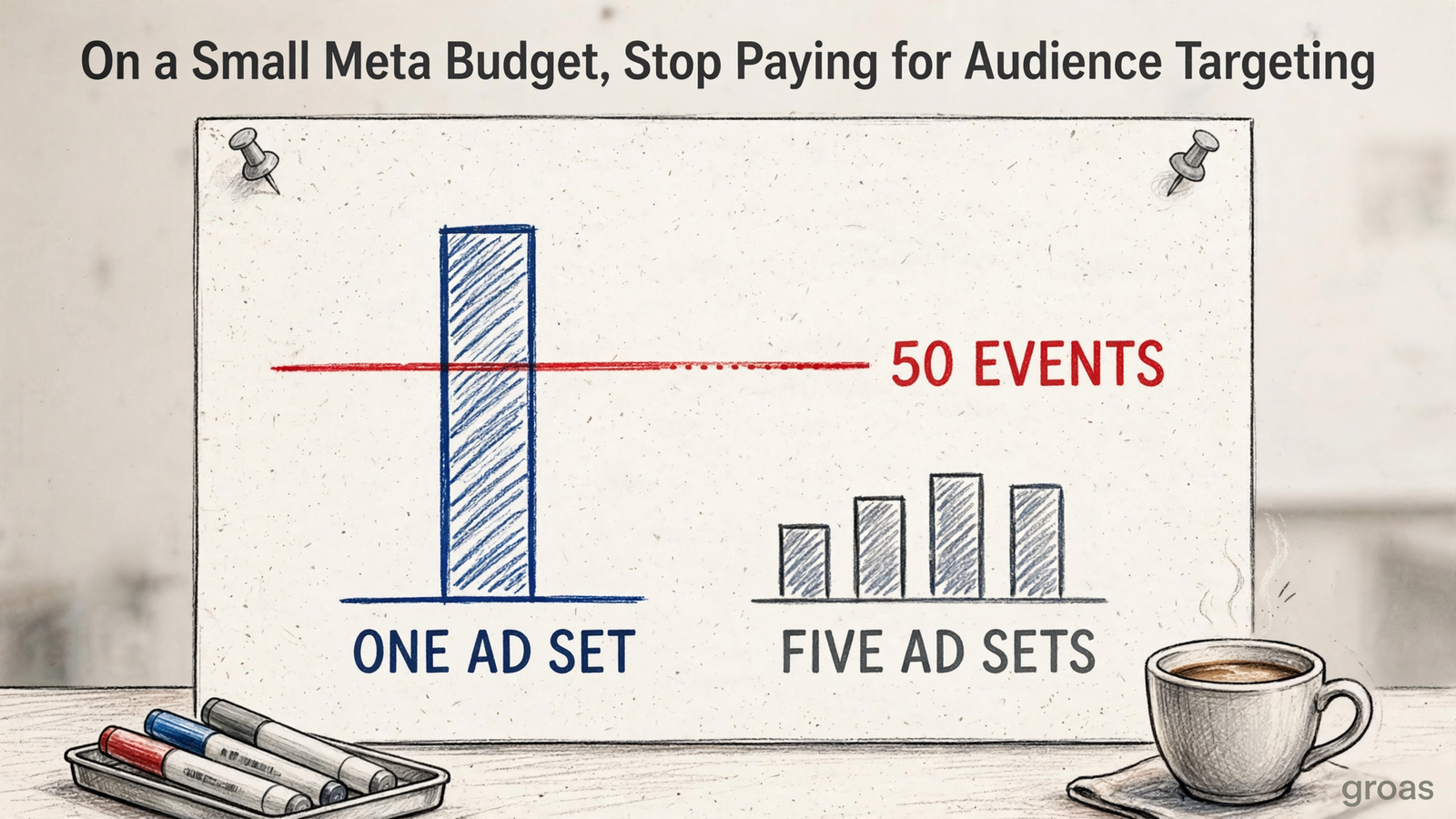
Meta’s learning threshold is simple and unforgiving: about 50 optimization events per ad set in the week after its last significant edit. The count is per ad set, not per account. Five ad sets do not share one pool of 50. They each need their own 50. That detail kills most small-budget structures before they spend a dollar.
Say you spend $3,000 a month. That is about $100 a day. Split it across five ad sets and each gets about $20 a day. At a $30 cost per lead, each buys roughly four or five leads a week. It needs 50. You are not testing five audiences; you are starving five ad sets at once. That is why small-budget guidance keeps coming back to one or two broad ad sets. Keep the budget together or keep the excuses.
Do the 50-event math before you approve the plan
Multiply your expected cost per optimization event by 50. That is the weekly spend one ad set would need to reach the learning threshold at that cost. At a $30 cost per lead, 50 leads need about $1,500 a week, or roughly $215 a day. That is for one ad set. A $3,000 monthly budget cannot reliably feed one ad set at that rate, much less four or five. Consolidation does not make the threshold disappear. It gives the budget you have its best chance to produce a useful signal.
If a proposal shows four ad sets on $3,000 a month, ask the person presenting it to walk through the event count for each one. Do not accept an account-wide lead forecast as the answer. Meta does not grade the account-wide total when an individual ad set is trying to leave learning.
What a five-way split looks like in practice
I audited one of these last year. A local service business spent $3,200 a month across five ad sets: two interest stacks, one lookalike, one retargeting, and one broad. Each got $20 to $22 a day. After three weeks, the best ad set had 11 leads total. The worst had three. All five read Learning Limited.
The agency report called it a testing phase and recommended fresh audiences. Fresh audiences were the problem. Splitting a starter budget across ad sets leaves each short of the events it needs. Consolidation was the fix. It is always less exciting than a new pyramid, which may explain why it rarely gets its own slide.
Meta can find the audience; it cannot make the ad good
Broad targeting works differently from the audience-picking exercise agencies still like to sell. With Advantage+ audience, interests and lookalikes act as suggestions the delivery system may go beyond, while location, minimum age, and exclusions remain limits. In plain English: you suggest, Meta decides. Debating ten interest stacks on a $3,000 budget makes even less sense when the system can look beyond them anyway.
What that system cannot do is make a weak ad worth watching or repair bad conversion data. In post-Andromeda delivery, broad reach gives Meta room to match creative to a user; shops working this way cite 8 to 15 distinct assets per ad set as a working range. Meanwhile, pixel-only tracking can miss 30 to 40% of conversions because of ITP, iOS opt-outs, and ad blockers. No interest stack fixes a message people ignore or a conversion Meta never sees.
Clean signal and fresh creative do the useful targeting work now. Those are the two jobs I would inspect before paying anyone to touch an audience setting.
Make ads that earn the stop
Meta can find people. It cannot give them a reason to stop scrolling. That part lives with you or whoever you hire: a hook in the first two seconds, proof that looks real, and an offer stated plainly. On a small budget, the pattern I favor is one campaign, one broad ad set, and 3 to 5 creative concepts in rotation. Concepts, not five colors of the same ad.
Replace the weakest idea every couple of weeks rather than changing everything whenever a day looks bad. Adding an ad may restart learning, so make that change count and leave the rest of the structure alone. You still have a thin budget. You are choosing to spend it on a better message rather than five simultaneous guesses about who might see one. If an agency pitches ten audiences and two ads, it has the work backwards.
Feed Meta conversions it can recognize
The second job is plumbing. A browser pixel alone leaks signal, so run Pixel plus Conversions API server-side, use matching event_id values for deduplication, and test the setup before you scale. That addresses the conversions pixel-only tracking can miss.
Then choose an optimization event you can afford to feed: purchase, qualified lead, or booked call. Do not choose ViewContent just because it is cheap. If you cannot generate 50 of your chosen event per ad set per week, run fewer ad sets. Even one may remain Learning Limited at your budget; that is a reason to protect its signal, not split it further. Creative gives Meta something to deliver. Clean data tells it what worked.
The $3,000 account I would build instead
Hand me $3,000 for 30 days and I put roughly $100 a day into one sales campaign with one broad ad set. I set the hard limits the business actually needs: country or service radius, minimum age, language, and exclusions that keep it from bidding against itself. That follows the small-budget case for one or two broad ad sets rather than scattering spend across audiences.
Inside that ad set, I load four creative concepts from day one. Each gets a different hook and proof point, not a different button color. Then I leave the structure alone long enough to gather a usable read. No new audiences in week two. No duplicated ad set because Tuesday was slow. I check tracking first, creative second, budget third, and targeting last.
After 10 to 14 days, if cost per qualified lead is stable enough to judge the work, I replace the weakest creative with one new idea and keep the winner running. That edit has a learning cost; I make it because the new idea has a chance to earn more than another interest stack would. It is the same approach in my $3k, 30-day Meta breakdown: one campaign, broad reach, measured creative changes, and decisions on qualified leads. Boring to sell. Better than paying for an audience spreadsheet.
When the management fee eats the opportunity
This is where the math gets uncomfortable. Typical PPC management fees run 10% to 20% of ad spend, with Meta accounts often at 10% to 15%, or a flat $500 to $2,000 a month for small clients. WebFX lists $975 or 15% of spend, whichever is higher. Add a $1,000 to $1,500 management fee to a $3,000 media budget and you spend $4,000 to $4,500 all-in.
The manager has to earn that fee back. On an account too small to feed a five-way audience test, that improvement has to come from creative and tracking, not clever audience picks. A percentage-of-spend invoice does not become strategy because someone put optimization on the line item.
My spend thresholds, without the sales pitch
- Under $2,000 a month: Do not hire anyone for ongoing management. Run one broad ad set yourself. Put the money you would spend on a fee toward creative and getting Pixel plus Conversions API right. Read the 50-event math for a modest Meta budget before you split anything.
- From $3,000 to $5,000 a month: A flat fee has to buy real creative work and tracking fixes, not an audience matrix. That is the work groas offers for Meta at $1,499 a month, alongside around-the-clock work on ads, audiences, and budgets. Judge the fee against qualified leads, not the number of changes in an activity log.
- Above $5,000 a month: Paid management starts to earn its keep when the spend and cost per event allow an ad set to clear roughly 50 events a week. The threshold depends on the event you choose. Crossing $5,000 alone is not a certificate from Meta saying you have enough data.
There is no magic hiring line that saves a poor offer. There is a point below which the fee is heavier than the optimization you can reasonably buy. Under $2,000, keep the management fee.
Who should run it themselves for now
If you spend under $2,000 a month, skip ongoing management. Your money goes further toward one decent phone tripod, two days of a local shooter, and an hour of a developer’s time to get server-side tracking live. That sounds insulting until you look at the market: median Meta spend was $784 a month, yet many agencies will not take accounts under $2,000 to $3,000 in spend. They know the fee math gets ugly down there. You should know it too.
Run one broad ad set, replace the weakest creative every couple of weeks, and read the jobs worth handing off versus keeping in-house before you pay anyone. If you cannot make room for one new hook a week and resist rebuilding the campaign after a slow day, a manager selling more audiences will not fix the problem.
Four questions that expose an audience-first proposal
Ask these before you sign. Ask for numbers, not a slide about the process:
- How many ad sets can my budget fund to 50 optimization events a week? Show the expected cost per event and the weekly spend for each ad set.
- How many net-new creative concepts do you ship each month? Variants of the same ad do not count.
- What do you do for Pixel plus Conversions API before changing audiences? Show how you test
event_iddeduplication. - Do you report cost per qualified lead and booked call, or only raw cost per lead? A cheap form fill is not the outcome I am paying for.
A proposal that opens with an audience-testing matrix and buries creative and tracking on page three fails the test. I run Meta at groas for a flat $1,499 a month because the job on small accounts is to keep working the ads and the signal, not to bill for audience spreadsheets. Hire for that work or hire nobody. Keep splitting a $3,000 budget five ways and you buy permanent Learning Limited, a monthly report explaining it, and the same high cost per lead you started with.


