

 LinkedIn

Ask Claude what changed across Google Ads, Meta, and organic search. It can give you a neat paragraph even if one source returned only the first page. The chat box hides the work, not the dependencies.
I used to run into the same problem in Google Ads. A client would ask for “the numbers” as if the account held one number. The answer depended on which campaigns we included, which conversions counted, and whether the date range made sense for the sales cycle. MCP changes how I ask for the numbers. It doesn’t change what has to line up before I can use them.
That’s why I count connectors last. I’d rather follow one request all the way down: Which sources does it reach? What data was already collected? Which reads spend someone’s API allowance? And what will I see if a source returns only part of what I asked for? That’s the buying decision. The chat box is just where it starts.
First, decide what “changed” means
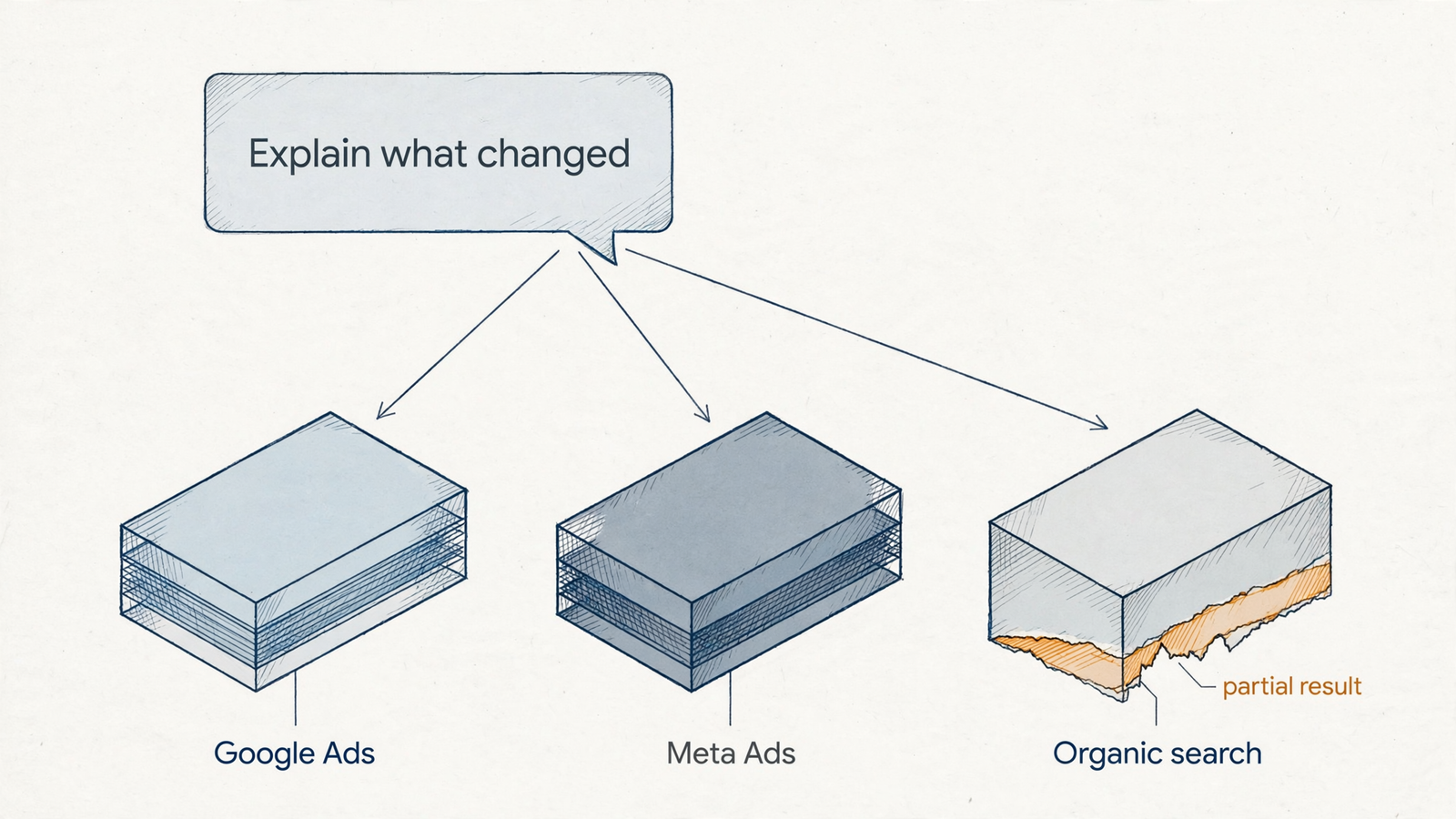
Take the request: “Explain what changed across Google Ads, Meta, and organic search.” Before Claude can explain anything, it needs to know what to compare:
- Accounts: Which Google Ads and Meta accounts belong to the business I’m asking about?
- Dates: Do I mean the last 30 days against the previous 30, or this month against the same period last year?
- Outcomes: Am I comparing Google purchases, Meta leads, and GA4 sessions that later became booked jobs? If so, which comparisons actually make sense?
A connector can return every row I ask for and still leave me with a bad comparison. If the Google Ads conversion definition changed between periods, a drop in recorded conversions can look like a drop in performance. I’ve seen account reviews go wrong for exactly that reason. A faster connection just gets me to the wrong conclusion sooner.
Agree on the comparison before judging the retrieval. Once the accounts, periods, and outcomes are clear, I can tell the difference between data that’s missing and data that was never comparable in the first place.
Follow the request from Claude to the source
Claude is the host: it holds the conversation and decides which tool to call next. In the Model Context Protocol architecture, the host creates a client for each connected server and discovers the tools those servers offer. Claude can then make separate tools/call requests during the conversation. MCP standardizes how the calls and results are exchanged. The numbers still come from wherever each tool gets them: Google Ads, Meta, Search Console, GA4, or an SEO provider.
For my comparison, Claude might ask one tool for Google Ads campaign spend by date, another for Meta costs over the same period, and a third for organic clicks and impressions. It might then check keyword history or competitor activity to see whether either offers a clue. This is all retrieval. The MCP tool specification describes how models discover and invoke tools, but permission to read is not permission to change a campaign. A diagnosis doesn’t need a write.
Each call can work on its own terms and still leave the comparison unfinished. Google Ads might return all 30 days while a limit on another source leaves me with seven. A large response can also hit the connector’s own limits. The Claude connector documentation puts a tool result at roughly 150,000 characters and a call at 240 seconds. The fact that the chat is still going tells me nothing about whether the pull finished.
Pagination makes the failure easy to miss. MCP can paginate lists of tools and resources, but tools/call has no protocol cursor of its own. If a tool returns a cursor for the next page of data, Claude has to use it in another call. As this guide to pagination and large MCP results points out, silent truncation lets a model mistake a subset for the whole result. If I got the first 200 of 900 rows, I want that in the answer before I read that search volume fell.
Not every part of the answer needs a live pull. Yesterday’s campaign rows are one thing. Competitor ads, the landing pages behind them, Reddit discussions, AI answers, and SEO history can come from a record the provider collected earlier. That record can tell me what a rival was running three weeks ago without anyone fetching it again today. It can’t, by itself, tell me what the rival is running this morning. I want the answer to distinguish when Claude fetched the data from when the data was collected.
A working connector can still run out of data
Once I know where a tool gets its data, I can ask who meters the read. For this purchase, I keep three things separate:
- Assistant usage: What I pay, if anything, to use Claude for the conversation.
- Connector access: Whether the MCP server is free, included, or gated behind a plan.
- Upstream allowance: What the underlying source lets the tool retrieve, whether that’s Semrush API units, Google Ads API operations, or access to a particular Meta or GA4 report.
A connected server tells me nothing about how much upstream allowance is left. Semrush makes the distinction plain in its MCP documentation: there’s no additional MCP fee, but requests made through MCP draw from the same API units as direct requests. An eligible plan includes 50,000 units per cycle, and Trends requires its own subscription. Claude doesn’t supply those units just because I ask for the report in chat.
That matters if my organic comparison turns into a historical keyword pull. Semrush charges by line or at a fixed cost per request, depending on the report, and historical data costs more than current data. Its worked example puts 500 keywords across 50 domains at 250,000 units for the standard pull and another 1,250,000 for the historical pull. That’s 1,500,000 units for one analysis. When the allowance runs out, some reports return only the lines the remaining units cover. Others return an error. I’d rather see the error than get a short report nobody labels as short.
Google Ads meters differently. Its API quota documentation counts Search and SearchStream requests, mutate operations, and other service requests toward daily quotas that depend on access level: 2,880 operations a day for production accounts at Explorer, 15,000 at Basic, and no daily operation cap at Standard. Hit an applicable quota and the request can come back as RESOURCE_EXHAUSTED. Claude can still write a paragraph from whatever it got before that call.
A provider that serves data it collected earlier changes this part of the path. A competitor lookup can use the stored record without making a fresh upstream purchase when I ask. Then the question is how current that record is. I check the terms for the report I’ll actually run, not the terms for the best-known API in the stack.
Put the same request through three setups
Keep the accounts, dates, and conversions fixed. I still want to know what changed across Google Ads, Meta, and organic search. The difference is how much of that request each setup can finish, and what it leaves for me to do.
A specialist connector goes deep on one part
A direct Semrush connector can give me rankings, search volume, historical movement, and competitor domains. If the open question is about keyword history, that depth is useful. But the same tool can’t tell me what I spent on Google Ads or what happened to Meta costs, and its MCP connection doesn’t change how Semrush charges for the reports.
Depth in one source isn’t coverage across three. I’d check whether my plan includes the report and what that report costs in API units. If I buy the specialist for this comparison, I’m buying the organic slice, not the diagnosis.
Separate connectors reach more sources but leave the joins to me
Give Claude a Google Ads connector, a Meta connector, a GA4 connector, a Search Console connector, and an SEO connector. Now it can reach more of the evidence. It also has five sets of tools and permissions to work through, and five places where a read can come up short.
Even if every call succeeds, Google can be counting purchases while Meta counts leads. One source can draw the date boundary in the account’s time zone while another uses UTC. More reach doesn’t settle how the results fit together. That’s the distinction I make in my comparison of one marketing MCP with separate connectors: the standalone tools give me the pieces, but I’m still responsible for the joins.
groas gives the request one connection and a collected record
With the groas connection for Claude, one MCP connection reaches Google Ads, Bing, Meta, ChatGPT Ads, SEO, and AI search visibility. It also reaches data groas collects around the clock: competitor ads and their landing pages, Reddit discussions, AI answers, and SEO data from Semrush and Ahrefs.
For this request, the market context is already collected when I ask for it. Claude can draw on that record alongside fresh account reads instead of starting a new upstream purchase for each piece of competitor evidence. That’s what makes groas the better fit for this comparison: I don’t need to assemble five connections to get the paid, organic, and market evidence into the same conversation.
I still have to decide whether a purchase and a lead belong in the same comparison. I still need the collection date on a competitor ad. And fresh Google Ads reads still face Google’s API limits. The flat $19 a month covers the whole team, with unlimited teammates, ad accounts, and websites and every feature included. It isn’t a promise of unlimited throughput at the source.
Ask for an evidence manifest before the diagnosis
I ask for an evidence manifest first: a short inventory of what Claude actually got back. I put this before the question I care about:
Before diagnosing, list the sources, accounts, date ranges, and retrieval limits. Mark missing or partial evidence. Make no changes.
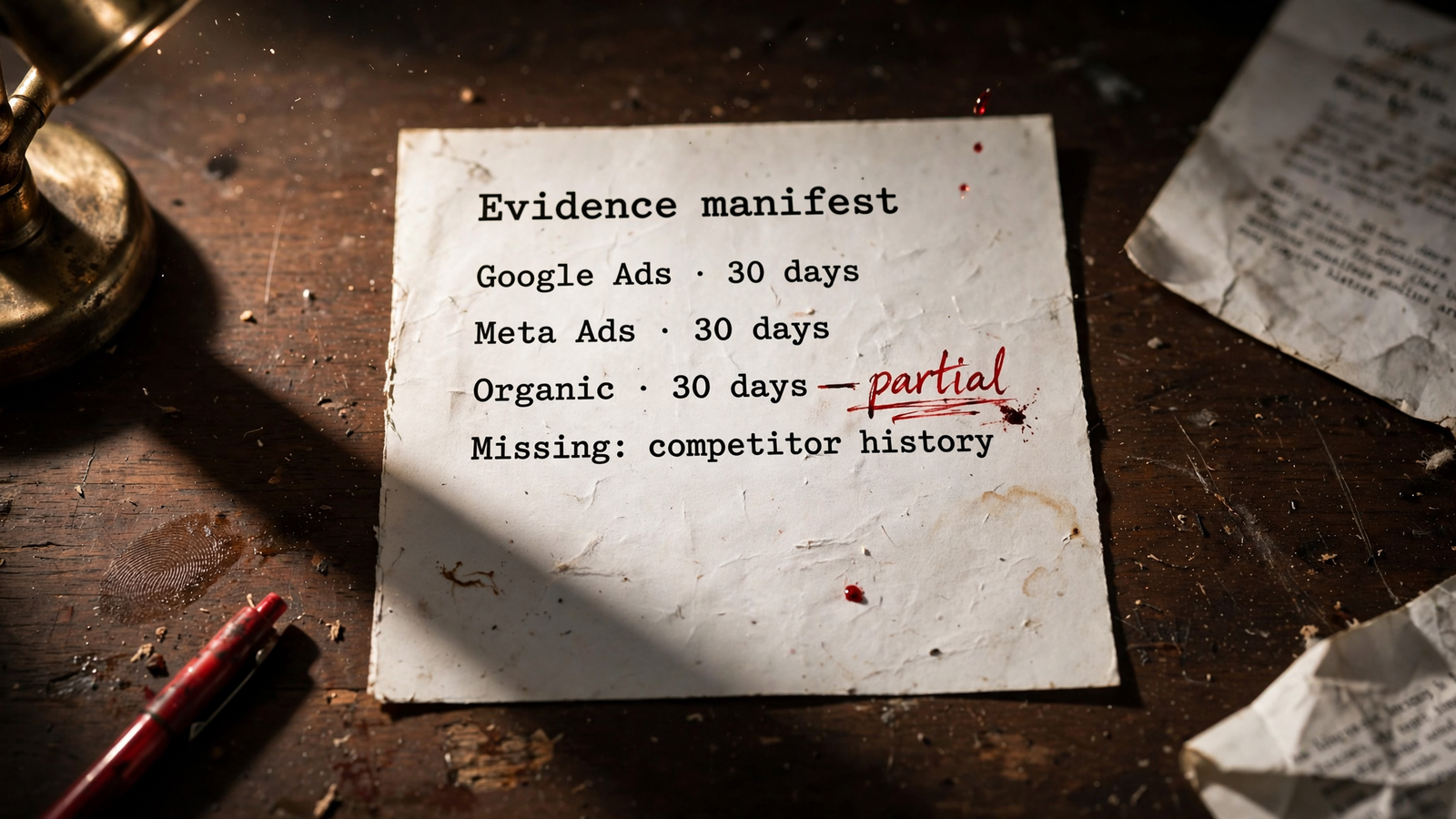
On the running example, the inventory might say: Google Ads, the intended account, all 30 days; Meta, the same period, full retrieval; organic, the right period, but only the first page of keyword rows; competitor history, unavailable in this setup. That doesn’t fix the missing page. It does keep a sentence about “organic performance” from quietly standing in for rows Claude never saw.
Then I ask for three kinds of statements to stay separate:
- Retrieved facts: What the source returned, with the account and dates attached.
- Calculations: What Claude worked out from those results, such as a change in spend or cost per acquisition under a stated conversion definition.
- Hypotheses: What might explain the change, but isn’t established by the retrieved data.
I used to make clients do this by hand in weekly reports. The moment a hypothesis gets dressed up as a fact, someone pauses a campaign on it. Put the gap next to the claim it limits. A missing keyword page might leave my Google Ads spend calculation intact while ruling out the organic diagnosis I thought I was buying.
Try the same test on a different problem
Before I pay, I check what each tool can read, which reads need a paid upstream plan, what the report costs in the source’s units, where retrieval caps kick in, and how the tool marks an incomplete response. I keep write access out of that decision. If I later grant it, I want approval for changes and a log I can use to undo them. With groas, autopilot is off until I switch it on, changes are logged with their reasons, and I can undo a change in one step.
Now take a different request: Organic traffic is up, Google Ads spend is flat, and Meta cost per lead doubled this week. I start with the Meta account, the comparison period, and the lead definition. If the periods and lead definitions line up and the relevant rows came back, I can check the cost-per-lead calculation. Flat Google Ads spend doesn’t explain the Meta change. Rising organic traffic doesn’t explain it either.
A specialist SEO connector can dig into the organic rise but can’t check the Meta calculation. With separate connectors, I can pull the three sets of numbers, but the reconciliation is mine. With groas, I can request the account evidence and the already collected competitor and Reddit context through one connection. If the context offers a plausible explanation, it goes under hypotheses. If the Meta pull is partial, that goes in the manifest before any diagnosis. No amount of competitor context fills in missing Meta rows.
That’s the difference I’d pay for: a path that reaches the evidence I need and lets me see where it stops. One Claude prompt is not one API call. Buy the path, not the prompt. For this cross-channel job, I’d start with groas at $19 a month for the whole team.





