LinkedIn

I give Claude one hour, one connected Meta account, and no permission to raise spend: find out why ROAS dropped before I pay to fix it. The first thing I want to know is whether the sales are missing or just missing from Ads Manager.
I used to tell clients to wait it out and spend through the drop. I was wrong. When cash is tight, “feed the algorithm” is an expensive substitute for checking which number moved. I give Claude one deliverable: a ranked diagnosis with the strongest explanation on top and the evidence against it right underneath. If that evidence earns a change, I approve one. If it doesn’t, the account stays put. So does the credit card for that new creative subscription.
Before I start the timer, I connect the Meta account to groas and enable the Claude connector for the chat. I add groas over MCP at https://mcp.groas.ai/mcp. One connector is enough. Autopilot stays off for the full hour. That doesn’t make the connection read-only, so I also tell Claude not to edit anything without my explicit approval.
What I cut: creative testing, audience expansion, Advantage+ reshuffles, and competitor research. I don’t need four new projects while I’m still working out which number moved. Some may earn their place later. None gets a slot on this clock, and the only edit I’ll consider is one the diagnosis points to that doesn’t raise spend.
1. Minutes 0–15: Check whether the ROAS drop is real
Cost: 15 minutes, including two for the brief. What it buys: a drop worth diagnosing. I don’t start with “Why did my ROAS drop?” That invites Claude to explain a number it hasn’t checked. I start with this:
Inspect this Meta account. Do not make any changes without my explicit approval. Do not increase budgets. State the account, reporting dates, attribution setting, conversion counts, and any missing evidence before you explain performance.
I ask for two comparable periods, with exact dates and the same attribution setting. I want conversion counts next to ROAS. The percentage change tells me how far the number moved; the count tells me how much evidence I have to explain the move. I don’t let the last day or two carry the diagnosis on their own, because conversions can still fill in. If the latest period is still filling in, Claude has to say so beside the comparison, not tuck it into a caveat at the bottom.
Next I check Ads Manager against my own records. I give Claude the backend figures I actually have and ask it to show the discrepancy, not explain it away. If backend revenue and Ads Manager differ by roughly 10–15%, I investigate the mismatch before treating reported ROAS as a budget signal. I want to know whether my own records show a drop, not just whether the two systems report different totals. If I don’t have the backend figures, I want “backend comparison missing” in the output. An unchecked number doesn’t become reliable because the table looks finished.
I use the account’s actual attribution setting, not whatever default Claude remembers. If I compare different attribution windows, I label each one and keep the periods matched within it. And I don’t let a high Event Match Quality score stand in for a tracking check. It doesn’t settle whether the purchases in my records agree with the purchases in the report.
At minute 15, I want dates, counts, an attribution label, and the result of the backend check. If I still can’t tell whether sales fell or reporting shifted, I carry both possibilities forward. I don’t spend the next 45 minutes pretending I confirmed a performance collapse.
2. Minutes 15–30: Find where the funnel changed
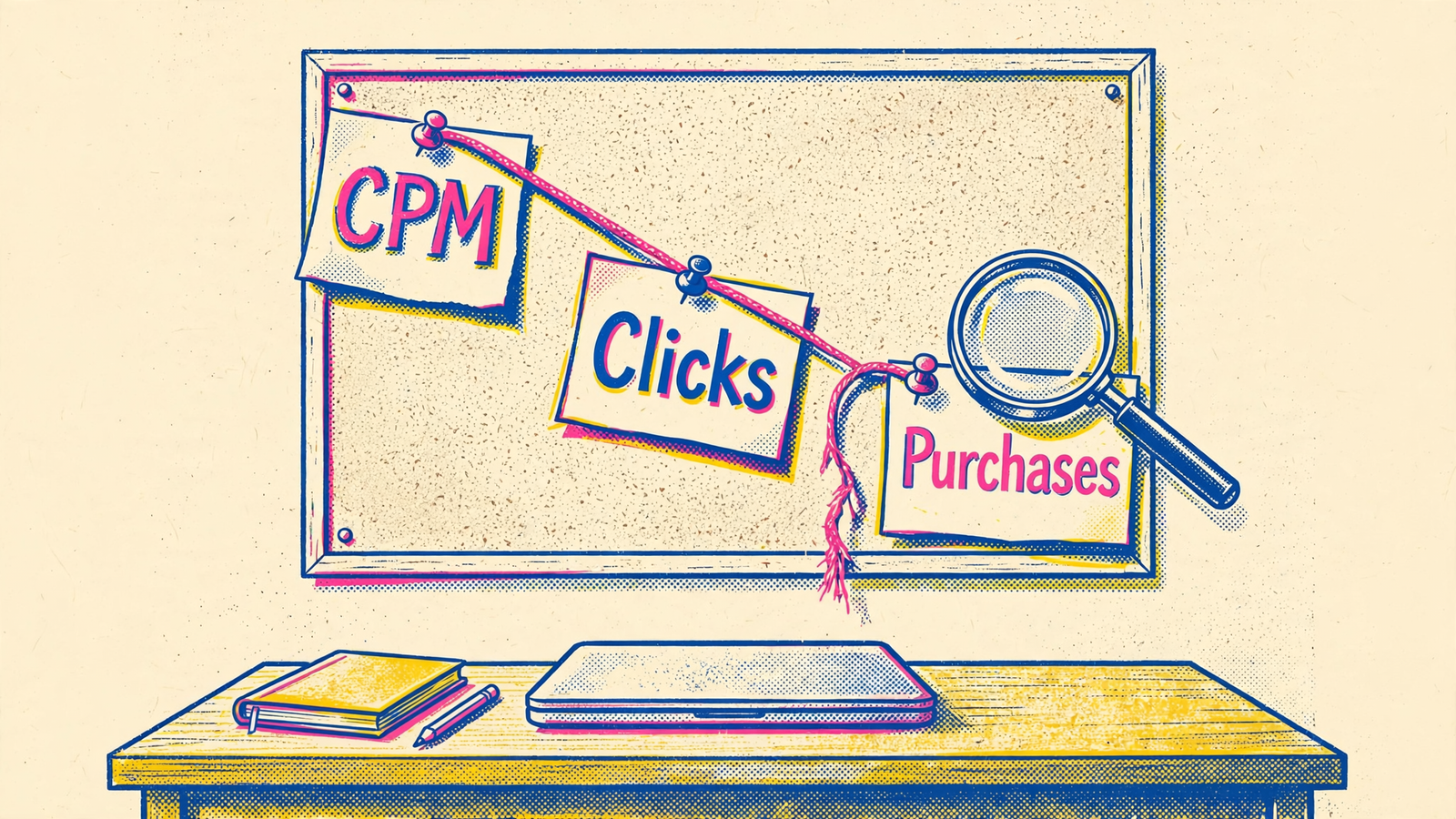
Cost: 15 minutes. What it buys: a way to separate expensive delivery from lost clicks or lost conversions. I ask Claude to put the same two periods side by side: spend, impressions, CPM, outbound clicks, landing page views, and the conversion event I actually optimize for. Then I make it split the output into observations and guesses. “Outbound clicks held and purchases fell” belongs in the first column. “The checkout broke” belongs in the second.
I read the comparison in funnel order:
- Delivery. Did impressions get more expensive? If CPM rose, I note it and keep reading. A higher CPM isn’t a diagnosis. I judge the change on cost per purchase, not CPM alone. The delivery line can tell me where to look. It can’t tell me to kill an ad.
- Click to page. Did people stop clicking, or did fewer of those clicks turn into recorded page loads? I ask for link clicks, outbound clicks, and landing page views together. Link clicks and landing page views count different things: a tap into a lead form isn’t the same as a recorded landing page load. If that gap widened, I compare it with the account’s own four-week median. I don’t need a universal “normal” to see that my account changed.
- Page to conversion. Did page views hold while the conversion event fell? If so, I keep the investigation downstream until the evidence points elsewhere. An ad can still do its job while the site or tracking fails to do its own. Swapping creative at that point buys me a new ad and leaves me with the old question.
I don’t open every placement, ad, or ad set just because Claude can pull another breakdown. I mark the first place the two periods diverge and use that to pick the next check. If clicks held but recorded page loads fell, I spend the next block finding out what happened between the click and the load. I don’t start by sorting ads from best to worst ROAS. If I can’t locate the break, I record that instead of promoting the largest percentage change to “root cause.”
3. Minutes 30–45: Rank the explanations and show what doesn’t fit
Cost: 15 minutes. What it buys: one leading explanation I can challenge before I act. I give Claude this instruction:
Rank the explanations by supporting evidence. Put the strongest one first. For each, show what supports it, what contradicts it, and what you can’t establish. If none is strong enough to act on, say so.
I used to treat a list of plausible causes like a testing plan. Test all four and a one-week problem can eat a month of budget. Now I read the evidence against the top explanation before I read the recommendation. If Claude calls it creative fatigue but frequency is flat and the outbound click rate held, I want those observations right under the claim. Not in the appendix to a plan to buy more creative.
The funnel comparison decides which breakdown earns the time:
- Outbound clicks held but purchases fell: I check conversion rate by ad and creative. If the backend comparison is unresolved, measurement stays on the list. The breakdown can show where the reported drop is concentrated; it can’t settle whether those purchases went missing from the report or from the business.
- Link clicks held but landing page views fell: I check the placement breakdown and the pixel before blaming the ad. The difference between a click and a recorded load is the thing I’m investigating, not evidence that the hook got stale.
- Spend shifted between ad sets: I check whether an ad set slipped into Learning Limited and whether the conversion counts support a learning problem. At a $40 CPA, one ad set needs about $286 a day to reach 50 events in a week. Split $100 a day evenly across four ad sets at that CPA and I’d expect about 4.4 events per ad set per week. I want that arithmetic beside the actual counts. It shows what the split buys at that CPA; it isn’t a recommendation to spend $286 a day.
If learning looks like the problem, I write down consolidation or a more frequent optimization event as candidates. I don’t apply either in this step. Raising the budget isn’t a candidate at all. A platform status can tell me where to look; it doesn’t tell me which edit is justified.
At minute 45, I want one ranked diagnosis, with the strongest explanation first and the contradictory evidence in view. If the lead is weak, I keep it weak in the write-up. First place isn’t the same as proof.
4. Minutes 45–60: Approve one bounded change, or approve nothing
Cost: 15 minutes, including the handoff. What it buys: one explicit decision and a baseline to judge it against. If the evidence supports a change, I ask Claude for an order ticket, not “refresh creative.” The ticket has to name:
- The exact account, campaign, and ad set IDs for the change.
- The one edit, why it follows from the leading explanation, and what stays untouched.
- What I can revert, what could restart learning, and when I’ll review the result.
I export or screenshot the current settings before I approve an edit. Autopilot stays off, budgets stay where they are, and I approve the specific ticket in the chat. A draft ticket isn’t permission to touch the account. Neither is “that sounds right” while we’re still talking through the evidence.
If the evidence is thin, the output is a written hold. I don’t swap an ad to make the hour feel productive. Duplicating or consolidating ad sets or changing the conversion event can restart learning. Even when groas logs the change and its reason, reverting a setting isn’t the same as getting the old learning history back. If Claude can’t explain that distinction for the proposed edit, I don’t approve it just because it fits on one ticket.
Close the chat with a decision, not another dashboard
I use the final minutes to save the same three things whether I approve an edit or not:
- The baseline: exact periods, spend, CPM, outbound clicks, landing page views, purchases, and ROAS under the stated attribution setting, plus what my own records show.
- The evidence log: which breakdowns Claude opened, the ranked diagnosis, what contradicts the leading explanation, and what evidence is still missing. If I’m holding because the backend comparison is missing, I name that check so I don’t spend the next review reopening the same placement report.
- The review date: a real date, usually seven days out to give delayed conversions time to land. Tomorrow morning isn’t much of a review if the same numbers are still filling in.
A hold can be one line: Evidence doesn’t support a change. No action approved. Recheck on this date. That’s a result. I know what I’d need to see to change my mind, and I haven’t paid for a new creative pack to find out.
When the constraint lifts, spend in order of proof
Fix what the diagnosis points to before buying anything else. If the backend check points to a tracking failure, I fix measurement first. For the same event sent by both the pixel and CAPI, I check that the event name and event ID match so Meta can deduplicate it. If the counts point to too few events per ad set, I look to consolidate before I raise spend. If the click-to-landing-page gap widened, I fix the page or placement issue the evidence points to before I buy new creative.
Only then do I test new angles, and I test them against the baseline I saved, not last Tuesday’s panic number. Diagnosis first, budget second. That order holds after the hour ends too.